


Knee osteoarthritis is common enough to change how a normal day feels. The World Health Organization estimates that osteoarthritis affects about 528 million people worldwide, and the knee accounts for roughly 365 million of those cases, according to the WHO osteoarthritis fact sheet. A lot of that pain doesn't show up only on a walk. It shows up when you push out of a chair.
That first step is a different problem from "bad posture." The knee has been bent and quiet. Then it has to straighten and carry your full weight in one move. People often describe the whole pattern as osteoarthritis knee pain when sitting, yet the sharpest moment is usually the stand-up, not the minutes spent in the seat.
You can sort an ordinary stiff start from a pattern that needs a clinician, and you can train the knee to tolerate that stand-up better. Comfort tricks help around the edges. They don't replace the work.
Table of Contents
- Why Knee Pain After Sitting Is So Common
- Ordinary Stiffness or a Sign to Get Checked
- Why Sitting Stiffens an Osteoarthritic Knee
- Break Up Long Sitting and Set Up Your Chair
- Exercises That Build Knee Tolerance Over Weeks
- Heat, Cold and Recovery Wearables Compared
- Build Your Plan and Know When to Call a Clinician
Why Knee Pain After Sitting Is So Common
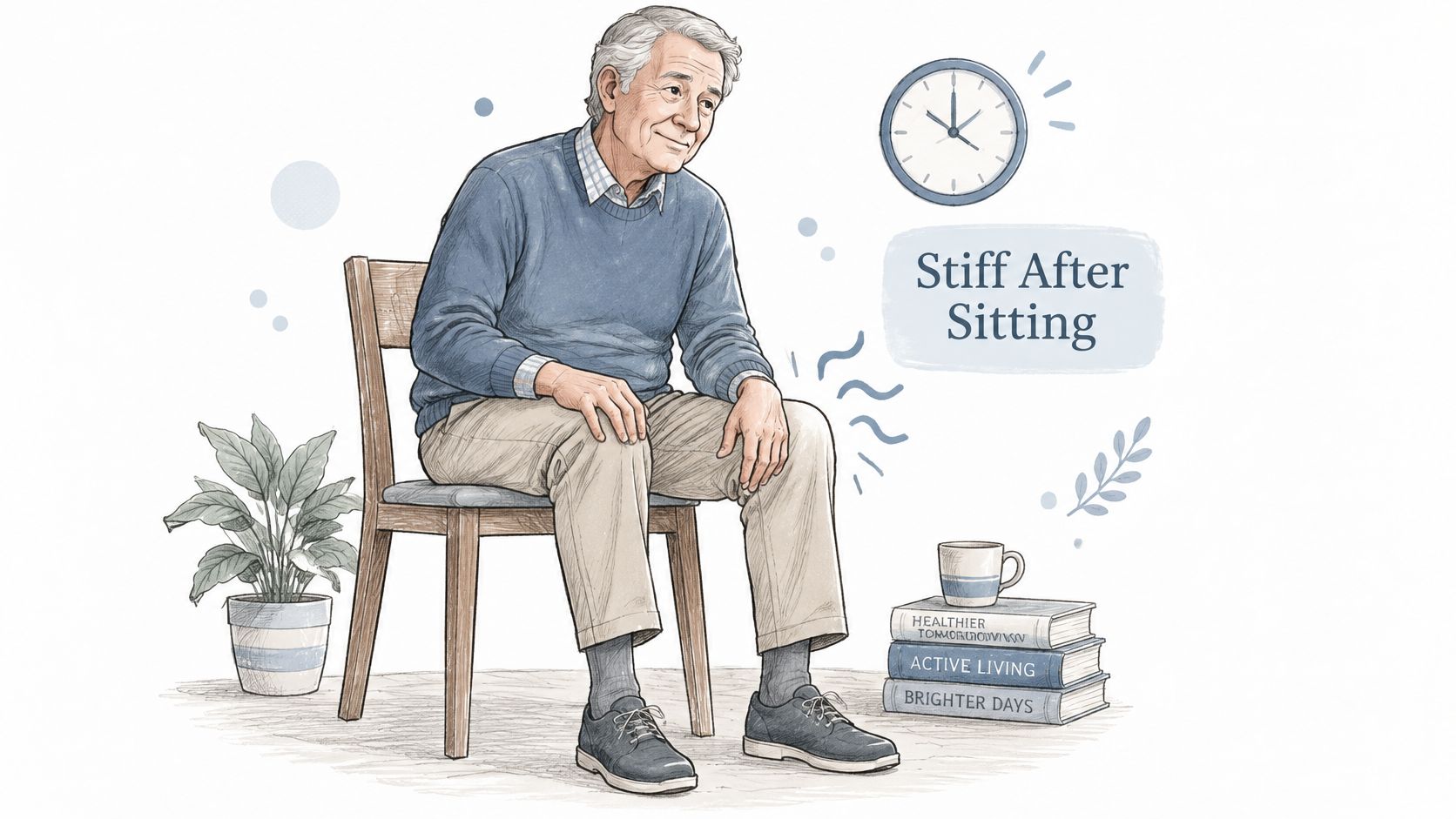
Yes. For many people with knee osteoarthritis, the knee aches or feels stiff after sitting, and that pattern is measurable, not imagined.
In a population-based survey of adults older than 50, 35.0% reported knee stiffness after sitting, lying down, or resting during the day, based on a survey of knee symptoms in older adults. Roughly one in three older adults in that group noticed it. If your knee argues with you after a meeting, a drive, or a film, you are in a large group.
What else that survey found
The same survey used the Western Ontario and McMaster Universities Osteoarthritis Index (WOMAC). Among people assessed with it, 60.8% reported knee pain. Frequency was spread out, not one single story: 16.6% monthly, 13.4% weekly, 20.4% daily, and 10.4% with prolonged pain.
Sex differences were large. Stiffness after daytime sitting or rest affected 40.7% of women and 20.5% of men. Clinicians often hear the same description either way. The knee feels tight after rest, then protests when you rise and restart movement.
The survey shows how common the pattern is. It does not prove that sitting caused osteoarthritis, and it does not prove that a sleeve, a cream, or a chair fixes it.
That limit matters. The design is cross-sectional, so it maps prevalence and associations. It can't tell you what started your knee pain, and it can't rank products. Warmth and support can make the day easier. They don't stand in for a diagnosis, exercise therapy, weight management, or medical care.
Sitting-related discomfort is usually a movement and load problem. The joint stiffens while it is still, then the first steps ask it to work hard. That combination can be managed. A pattern that is new, worsening, or waking you at night deserves a clinician's look rather than another week of waiting it out.
Ordinary Stiffness or a Sign to Get Checked
Start with the row that matches what your knee really does, then follow the action on the right. Ordinary post-rest stiffness is the baseline. The rows below it are the ones that should change your plan.
| Symptom pattern | What it usually means | What to do |
|---|---|---|
| Stiffness that eases within about 30 minutes of first standing from a chair | Ordinary post-rest stiffness | Break up sitting and restart movement gently |
| Ache while seated that eases when you move | Mechanical load and stiffness after rest | Break up sitting and add range-of-motion work |
| Pain at rest or waking you at night, not improving with movement | Possible inflammatory or non-mechanical cause | Arrange a clinician review soon |
| Warmth, redness, marked swelling, or fever with knee pain | Possible infection or inflammatory flare | Seek same-day medical care |
| Knee locks, catches, or gives way | Possible internal damage such as a meniscal tear | Get assessed and do not force movement |
| One calf swollen, painful, or warm after long sitting | Possible deep vein thrombosis, not knee osteoarthritis | Seek urgent medical care |
| Pain or numbness spreading beyond the knee | Possible referred or nerve-related pain | Clinician assessment |
Why rest pain is a different clue
Knee osteoarthritis commonly causes stiffness and pain after prolonged sitting or rest. Pain that is substantially worse at rest, that stays through the night, or that doesn't ease once you move is a different signal. Clinical reviews note that pain worsening at rest should raise suspicion for inflammatory arthritis, tumors, or other non-osteoarthritis causes, even though nighttime pain can also occur in more severe osteoarthritis. A review of when knee pain is not only mechanical is a useful backdrop for that distinction.
Research from the Multicenter Osteoarthritis Study, discussed in that same review, found that pain while sitting or lying was linked with pressure-pain sensitivity at both the knee and the wrist. That points to broader pain sensitization, not only a local load problem. If movement never helps, don't keep treating it as a stiff hinge that just needs a walk.
Locking, swelling, and the calf
Locking, catching, or giving way can mean something inside the joint is getting in the way, such as a meniscal tear. Don't force a deep bend to "work it loose." Get it assessed.
A hot, red, markedly swollen knee, especially with fever, is not a home-exercise day. That pattern needs same-day care because infection and a strong inflammatory flare can look urgent.
A swollen, painful, or warm calf after a long sit is a different body system. It can be a deep vein thrombosis. Knee osteoarthritis advice does not cover that. Urgent care does.
Practical rule: If the pattern is new, changing week to week, or waking you at night, write down when it happens and book a visit.
Pain or numbness that travels past the knee can come from the hip, the back, or a nerve. An exam that only pokes the kneecap can miss that. Bring the travel pattern with you, not only a pain score.
Why Sitting Stiffens an Osteoarthritic Knee
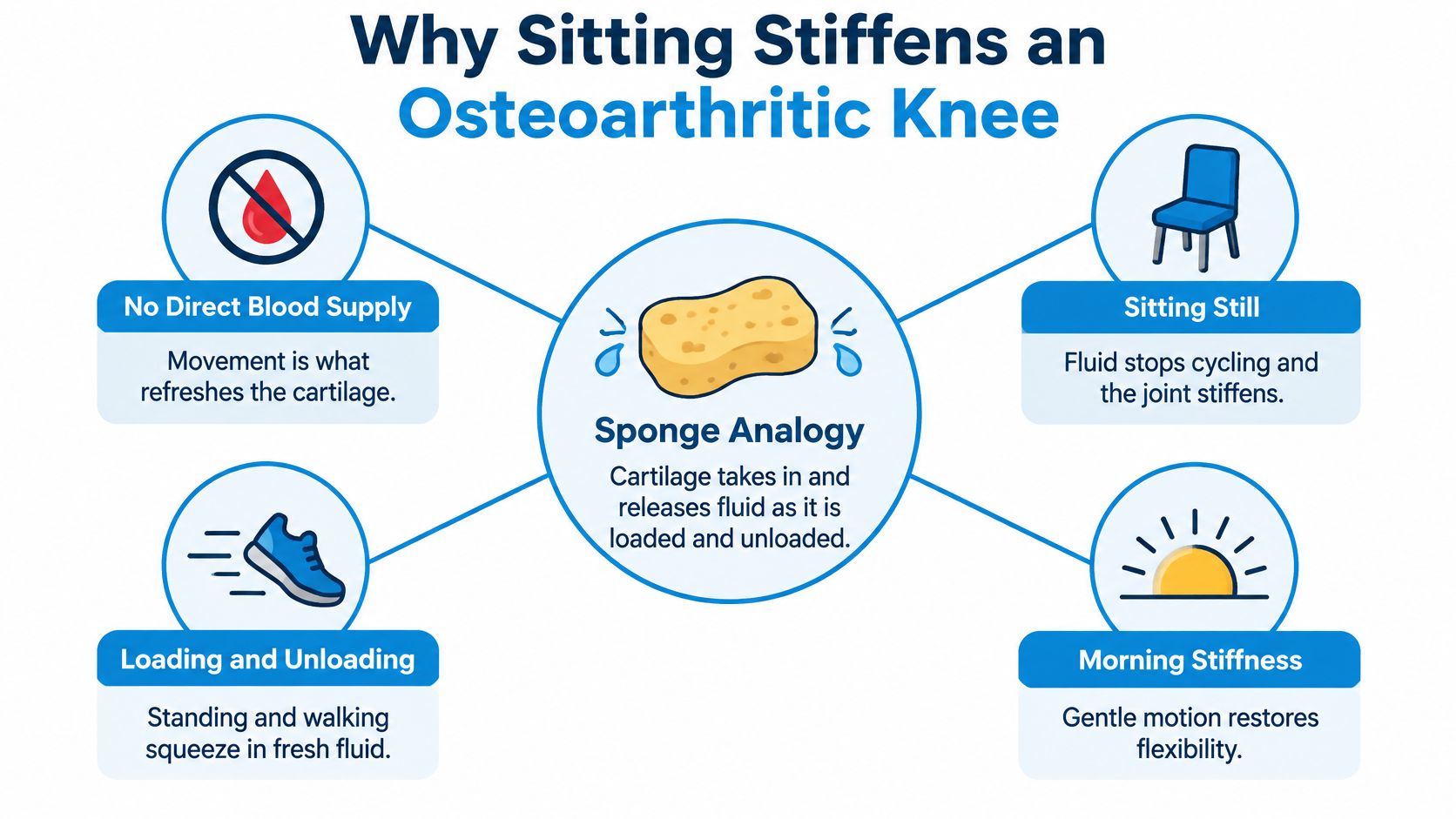
Think of healthy cartilage as a sponge. Load it and fluid squeezes out. Unload it and fluid moves back in. Cartilage has no direct blood supply, so that pump is how the tissue stays nourished. A still, bent knee stops the pump. The joint can feel tight, dry, and irritable even though you haven't "injured" it in the chair.
Three stages that feed each other
Stillness comes first. Long sitting is less about the shape of the chair and more about reduced knee motion. Royal Berkshire NHS guidance on knee osteoarthritis notes that long sitting can cause stiffness and advises getting up, walking, or changing position. The same guidance suggests supported knee bends held for 10 seconds, repeated 10 times, two to three times a day. Inactivity raises stiffness and movement sensitivity. Gentle motion restores range and wakes up the quadriceps before they have to work.
The stand-up is the load spike. You go from a flexed, quiet knee to full body weight in one movement. If the quadriceps and hip muscles are weak, they don't share that demand well. The painful joint and the tissues around it take more of the hit. That's why the first steps after a chair often hurt more than step fifty.
Low-grade inflammation sits underneath. Osteoarthritis isn't only "worn cartilage." The joint lining can be mildly inflamed, so a rested knee feels warm and tender, and the nervous system can turn the volume up on a normal stand-up. The same morning pattern is covered in more detail in this piece on how to handle morning knee stiffness.
A familiar workday
Picture a 66-year-old accountant, an illustrative composite rather than a reported patient. He sits through two-hour meetings. When the meeting ends, he puts a hand on the desk before he trusts the knee. The joint hasn't been damaged by the agenda. It has been parked in flexion, then asked to accept his weight before the muscles are ready.
Changing the chair helps a little. It doesn't rebuild the pump or the muscles. Interrupting stillness, then strengthening the stand-up, lasts longer than hunting for one perfect seat angle. Severe pain, rapid worsening, marked swelling, locking, fever, or an inability to bear weight still needs a clinician, not another adjustment at the desk.
Break Up Long Sitting and Set Up Your Chair
A knee can feel stiff after sitting, then sore when it suddenly has to carry your weight. Break up long stretches in the chair with small movements first, then stand and walk at a comfortable pace. The aim is to make the change from rest to movement gradual.
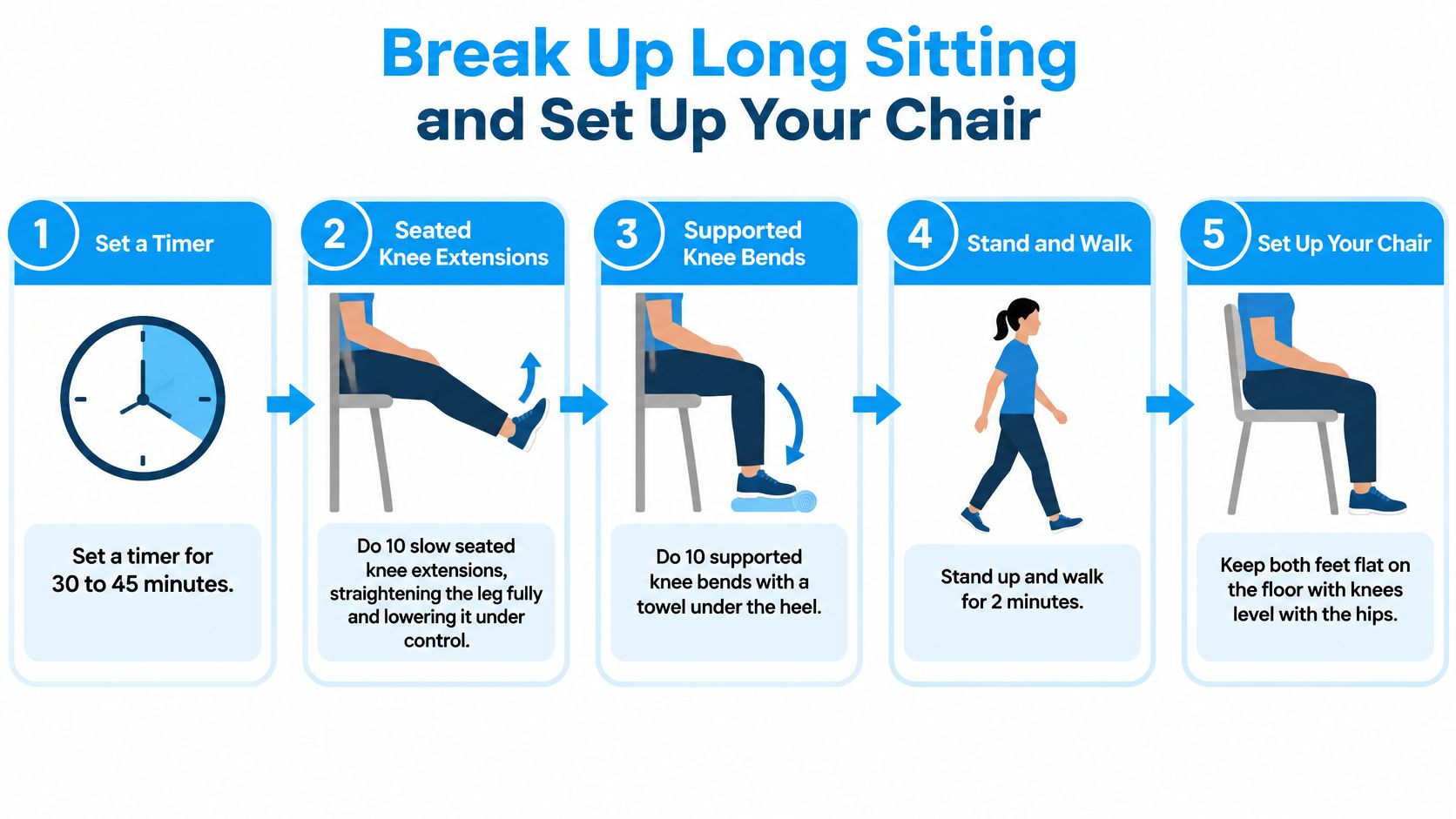
- Set a timer for 30 to 45 minutes. A reminder can prompt you to move before a long seated stretch leaves the knee feeling stiff.
- Do 10 slow seated knee extensions. Straighten one leg, then lower it with control. This brings the thigh muscles into the movement while you are still supported.
- Do 10 supported knee bends. Slide a heel back and hold each bend for 10 seconds. Keep the range comfortable rather than forcing a deep bend.
- Stand with a controlled forward lean. Bring your weight forward and use your hands on your thighs for support if needed. Rise at a pace that feels steady.
- Walk at low intensity for 2 to 5 minutes, then sit again. Keep the pace easy. This is a movement break, not a distance workout.
Seated work is a real start
If standing is painful, seated movement can be a more manageable place to begin. One small randomized trial compared sitting and standing therapeutic exercise over 12 weeks in 54 women aged 50 to 80 with obesity and knee osteoarthritis. The researchers reported lower pain, better knee-function scores, and better physical quality-of-life scores in the sitting group. The standing group had greater mental quality-of-life benefits. These findings describe one study in a specific group, not a result that can be assumed for everyone. Read the trial of sitting versus standing exercise.
The practical point is simple: seated exercise may let you start moving when putting weight through the knee feels uncomfortable. It can be a starting point, with the type and amount of activity adjusted to your symptoms and discussed with a clinician when needed. This single trial does not establish a general recommendation for aerobic exercise.
A short demonstration can help you see the pace of gentle knee movement.
Set the chair so standing is easier
- Feet flat: Place both feet on the floor so you can push evenly.
- Knee angle near 90 degrees: Avoid a very deep bend if it increases discomfort.
- Thighs sloping slightly down: This can help you avoid sitting on a seat that is too low.
- Back support: Lean against the backrest rather than perching and tensing your legs.
- Avoid keeping a pillow under the knee for long periods: It can hold the joint in one position.
- Avoid crossing your legs for long stretches: Change positions regularly.
- Skip a low, soft sofa when you can: It may place the knee in a deeper bend and make rising harder.
A firmer seat with armrests can make standing easier, while a softer seat may feel more comfortable for a brief rest. Choose the firmer option for longer work periods if it helps you rise without straining. For more ideas on adjusting a desk routine, see this guide to managing desk-job pain. A sleeve or brace does not replace regular movement and a comfortable setup.
Exercises That Build Knee Tolerance Over Weeks
The most durable way to ease sitting-related knee pain is to raise the knee's load tolerance with strengthening and aerobic work, not to rest more.
Weak quadriceps and hip muscles give you less control in the sit-to-stand. The joint and the tissues around it then take a bigger share of your weight. The daily seated loop keeps the joint moving. The work below teaches it to accept load again.
| Exercise | Starting dose | Next progression |
|---|---|---|
| Quad sets (tighten the thigh with the knee straight) | 5 to 10 second holds, 10 repetitions | Hold longer, then add straight-leg raises |
| Straight-leg raises | 10 repetitions per leg, lying down | Add a light ankle weight |
| Sit-to-stand practice from a firm chair | 5 to 10 repetitions | Lower more slowly, then use less arm support |
| Heel raises holding a support | 10 repetitions | Progress to single-leg raises |
| Walking on flat ground | 5 to 10 minutes | Add 2 to 5 minutes each week as pain allows |
| Stationary cycling or swimming | 10 to 15 minutes at low resistance | Increase time, then resistance |
Order and the two-hour check
Progress in this order: low-load range of motion, then sit-to-stand practice, then quadriceps strengthening, then tolerated walking or cycling. Jumping to hills or a hard bike gear skips the part your knee is bad at, which is the controlled stand-up.
The American Academy of Orthopaedic Surgeons knee osteoarthritis guideline recommends self-management, strengthening, low-impact aerobic exercise, and neuromuscular education. RACGP guidance strongly recommends land-based exercise regardless of age, structural severity, functional status, or baseline pain. Walking, muscle strengthening, and Tai Chi are named options. Dose should be individual and advanced gradually.
Pain that is more than your usual level, or that feels unusual, and is still there two hours after a session means that session was too much. Reduce or modify the next one.
That 2-hour pain rule is a dose tool, not a reason to quit. A little discomfort during the work can be acceptable. Pain that lingers, swells the knee, or changes how you walk is a signal to scale back. More ideas for the early mobility layer are in these knee mobility exercises.
Signs the plan is working
Over about four to six weeks of steady practice, people often notice they can sit longer before stiffness builds, and they need less hand support to leave a chair. Those are function signs. Chasing a pain-free hour on day three usually leads to a flare and a week off. Keep the stimulus, and let the dose move in small steps.
Heat, Cold and Recovery Wearables Compared
Heat and cold can make movement more comfortable, while topical NSAID gel has a guideline-supported role in knee osteoarthritis pain. These options serve different purposes, so it helps to compare what each one can and cannot do. Heat is often used for 15 to 20 minutes before stretching or walking; cold may soothe pain after a flare or a demanding day.
| Option | What it does | Evidence strength | Best role |
|---|---|---|---|
| Heat pack | Eases muscle tension and stiffness | Short-term symptom relief | Before stretching or walking |
| Cold pack | Numbs pain and may settle swelling after activity | Short-term symptom relief | After a flare or a demanding day |
| Infrared-responsive recovery sleeve (for example Thermo Recovery Wear) | Adds local warmth without compression | Limited independent trials | Comfort during everyday activities |
| Compression sleeve | Provides mild support and may help with swelling | Mixed evidence for osteoarthritis pain | Comfort on long standing days |
| Knee brace | Provides external support for an unstable or painful knee | Benefit is modest and depends on fit; a clinician can match the brace to the knee | Selected cases |
| Topical NSAID gel | Reduces local pain | Recommended in knee osteoarthritis guidelines | Discuss use with a clinician or pharmacist |
How to judge a sleeve
Heat may ease a stiff, guarded feeling before you move. Cold can help settle discomfort after a long day. Neither builds quadriceps endurance, so they do not replace exercise.
An infrared-responsive sleeve is made with material marketed to respond to infrared energy and provide local warmth. These sleeves are generally designed to be worn without compression. Thermo Recovery Wear is one U.S. example. Independent trials are limited, so the evidence does not establish that these sleeves improve osteoarthritis pain. Treat one as a personal comfort choice, not a proven treatment.
Compression sleeves work differently. Some people find the gentle pressure comfortable during long periods of standing; others find tight fabric irritating. A hinged brace is more appropriate to discuss with a clinician if the knee feels unstable. Fit and the reason for using it matter more than a product description.
Topical NSAID gel has a clearer guideline role for knee osteoarthritis pain than a recovery sleeve. Ask a clinician or pharmacist whether it suits you, particularly if you already take anti-inflammatory tablets or have stomach, kidney, or heart conditions.
Before buying a wearable, check the brand's size chart and read its skin-sensitivity guidance if your skin reacts easily. Use the return window to see how it feels during ordinary activities. For more detail on choosing when to use warmth or cooling, read this guide to hot and cold therapy. No wearable replaces a diagnosis or appropriate medical care.
Build Your Plan and Know When to Call a Clinician
- This week, log the pattern and break up sitting. Note whether pain hits when you stand from a chair, while you are still seated, or at night. Run the 30- to 45-minute break-up loop on your longest sitting blocks.
- Over the next four to six weeks, add load. Use the strengthening and walking progression, and apply the 2-hour pain rule after each session. If pain is still up two hours later, make the next session smaller, don't skip the week.
- Book a clinician if the pattern is high-risk or stuck. That includes any high-risk row in the triage table, pain that disturbs sleep, or no meaningful change after about six weeks of consistent exercise.
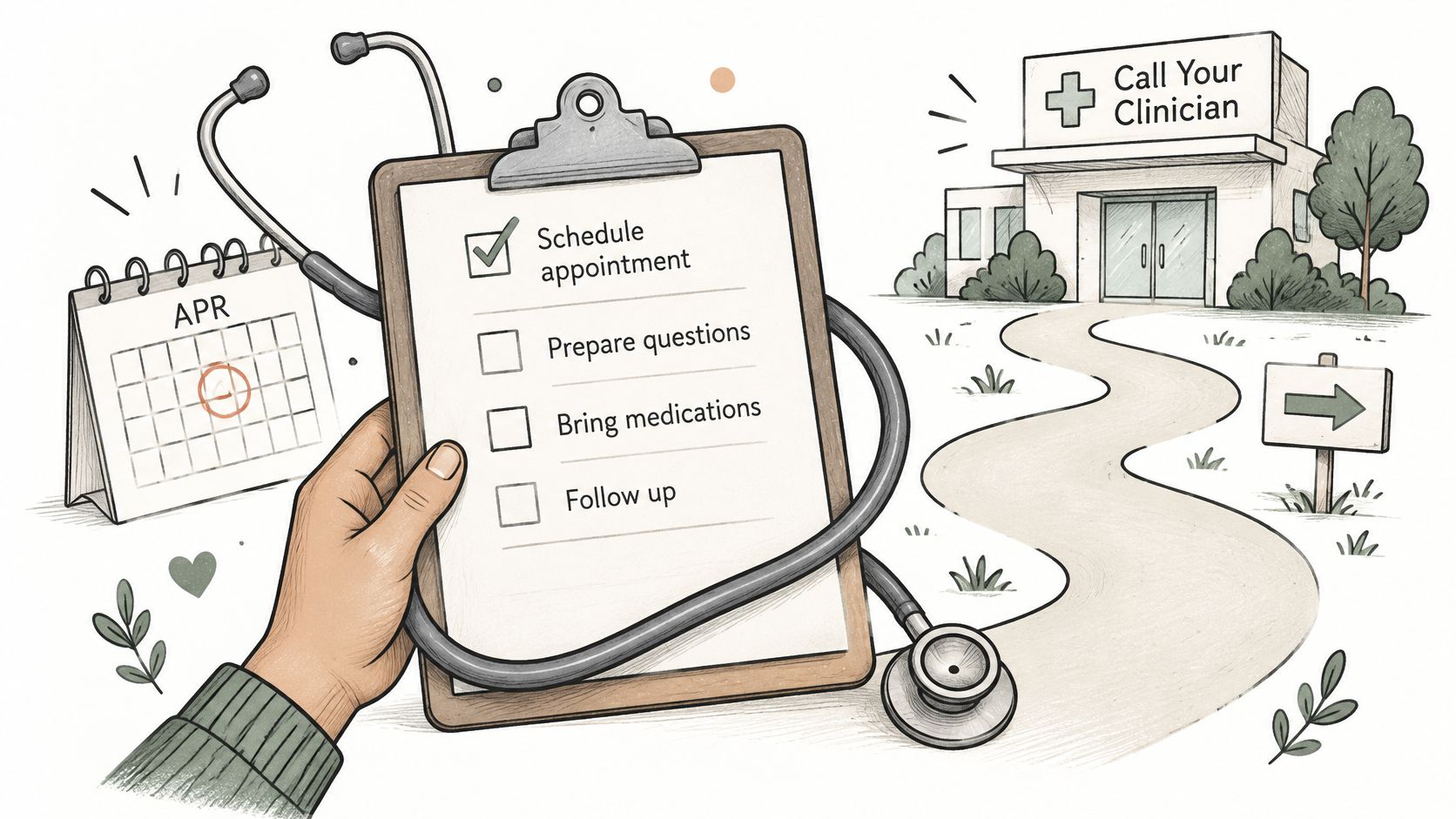
Bring the symptom log, your medicine list, and a sketch of a typical day's sitting and walking. A clinician may talk through exercise referral or physiotherapy, topical or oral pain relief, weight management where it is relevant, and imaging only if the picture would change the plan. A plain overview of those options sits in this guide on how to help osteoarthritis.
Movement and strength come first. A clinical check comes in when the pattern changes, spreads, or refuses to budge.
Thermo Recovery Wear makes non-compression, infrared-responsive knee sleeves meant for gentle warmth during rest and light activity, including long stretches at a desk. They sit beside the exercise plan in this article, not in place of it. If you want to see the knee sleeve and the sizing details, visit Thermo Recovery Wear.


