


You step off a curb, your ankle tips, and suddenly you're testing every step before putting your full weight down. Or you're ready to return to basketball after a sprain, but you don't quite trust your landing. An ankle brace looks like a straightforward solution, until you discover that a soft sleeve, a lace-up support, and a rigid sports brace promise many of the same benefits.
Ankle brace benefits depend on the problem you're trying to solve. Preventing another sprain isn't the same as relieving everyday discomfort, and neither proves that injured tissue will heal faster.
Table of Contents
- Why People Reach for an Ankle Brace
- How an Ankle Brace Actually Supports the Joint
- The Five Core Ankle Brace Benefits Explained
- Compression vs Non-Compressive Ankle Brace Designs
- Matching the Right Brace to Your Situation
- Fitting, Wearing, and Phasing Out an Ankle Brace
- Common Misconceptions About Ankle Bracing
- Putting It All Together and Quick Answers
Why People Reach for an Ankle Brace
An athlete approaching their first practice after an injury and an older walker struggling with morning discomfort may both shop for ankle support. But they're asking different questions. The athlete wants protection during unpredictable movement; the walker wants an easier, more comfortable outing.
Someone with sensitive skin has another concern: whether the support will rub or squeeze. A person whose ankle repeatedly gives way needs to understand the instability, not find a softer fabric.
Start with the problem, not the product
Before choosing a brace, describe what happens without one. Does your ankle hurt during straight-line walking, feel unreliable when you turn, or become uncomfortable only after exercise? Those descriptions are more useful than a product label promising complete support.
For example, someone experiencing ankle pain when running shouldn't assume that the same brace recommended after a basketball sprain addresses their situation. Similar locations of pain don't necessarily mean similar problems.
Your activity also matters. For grapplers, the BJJ injury prevention guide from Locals Jiu Jitsu Alexandria offers activity-specific reading alongside a broader discussion of protection. A wearable support shouldn't be your entire injury-prevention plan.
Start with this question: What do I want the brace to help me do, and what would count as a meaningful improvement?
Separate reassurance from recovery
It's understandable to want something tangible around an uncomfortable joint. Still, feeling supported, moving more comfortably, and being ready for unrestricted activity are different outcomes.
Approach a brace as a tool with a defined job. That makes it easier to judge whether it helps, whether the fit needs changing, or whether you need an assessment instead of another purchase.
How an Ankle Brace Actually Supports the Joint
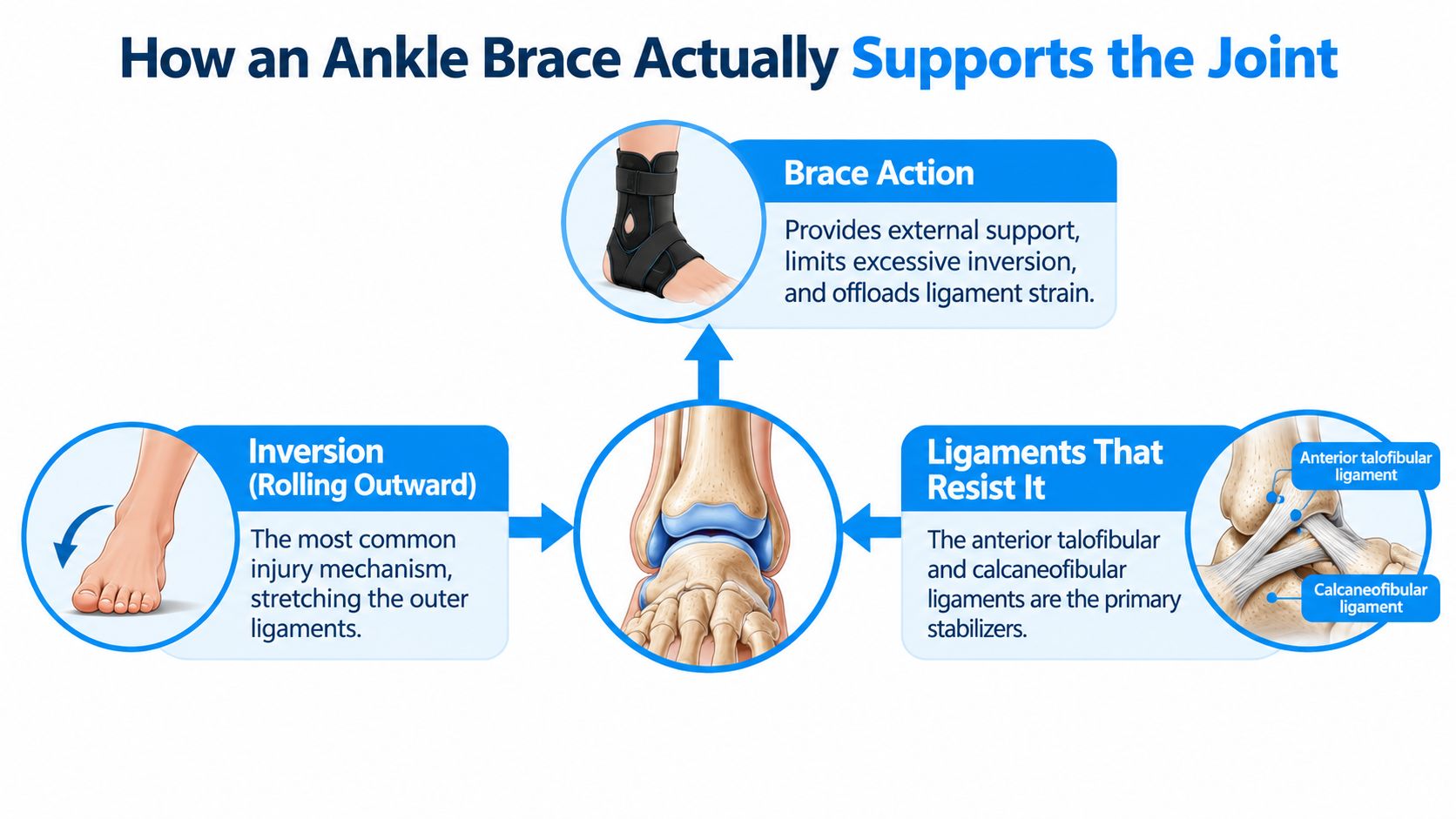
Think of a structured brace as an external restraint rather than a replacement ankle. Its straps or supporting panels are intended to resist unwanted movement while leaving enough usable motion for the intended activity.
Inversion means the sole turns inward. People sometimes describe the resulting accident as rolling onto the outside of the ankle, which explains why everyday descriptions can sound contradictory.
The illustration below offers a simplified mechanical overview, but its “rolling outward” wording shouldn't replace that anatomical definition.
Mechanical support and sensory contact are different
A lace-up or semirigid support is designed to provide mechanical restraint. You can assess that purpose by looking for straps, side supports, and instructions identifying the movements the device is meant to control.
A flexible sleeve may instead emphasize close skin contact or warmth. That contact can make you more conscious of the ankle, but awareness isn't the same as a physical barrier against a forceful roll.
- Mechanical question: What part of the product resists unwanted movement?
- Comfort question: Does the material feel tolerable inside your shoe?
- Evidence question: Was this particular design studied for the outcome being advertised?
Know what tissue you're discussing
Don't use ligament injury, tendon injury, and joint pain as interchangeable labels. A product described as helpful after a sprain doesn't automatically address every source of ankle discomfort.
If you're investigating a tendon diagnosis, the Dream Body Clinic page on damaged tendons in ankle treatment is separate condition-focused reading, not evidence that a brace repairs a tendon. Discuss treatment claims with the clinician who has assessed your ankle.
The practical distinction is simple: what a brace physically does doesn't establish every outcome it might produce. A plausible mechanism is a starting point for evaluating a claim, not proof of faster recovery.
The Five Core Ankle Brace Benefits Explained
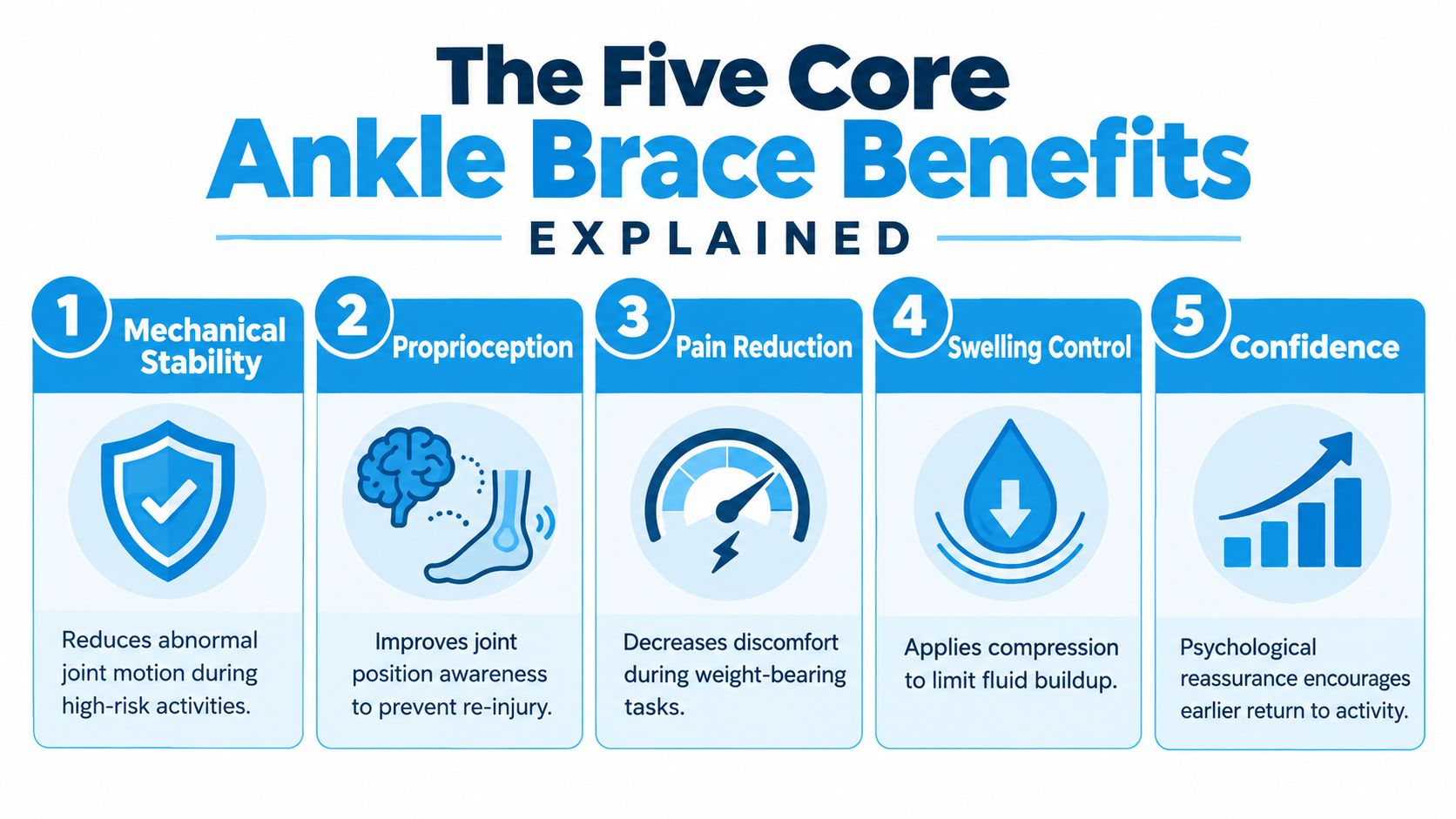
Not every advertised benefit has equally strong evidence. Sports-injury prevention has direct research support; claims about comfort, warmth, or circulation require more careful qualification.
Use the following illustration as a map of common claims, not a guarantee that every brace delivers every outcome.
Mechanical stability during demanding movement
A structured support offers a way to manage unwanted movement during activities involving cuts, landings, or contact. That's a more specific purpose than making an ankle universally stronger or safer.
For a basketball player, the relevant question is whether the prescribed brace suits practice demands and footwear. A comfortable sleeve alone shouldn't be assumed to provide equivalent restraint.
Possible relief from uncomfortable movement
For arthritic or overuse discomfort, treat pain relief as an individual response to assess, not a guaranteed benefit. Ask whether ordinary tasks feel easier without new pressure, rubbing, or changes in how you walk.
The prevention research discussed below doesn't establish effectiveness for osteoarthritis. A successful sports-bracing result can't substantiate a different treatment claim.
Warmth and compression-related comfort
Some designs emphasize insulation or compression. Those features describe how a garment feels or fits, but they don't by themselves prove improved circulation, faster healing, or clinically important swelling reduction.
If circulation is your concern, don't choose a brace solely because its packaging mentions blood flow. Ask what evidence supports that specific product and purpose.
Lower acute sprain risk
The clearest evidence concerns prevention. A pooled analysis involving 3,581 athletes reported a relative risk of 0.36, described as a 64% relative risk reduction, with ankle bracing.
That is a relative comparison from the analysis, not a guarantee of personal protection. The research combined different populations and brace designs, so don't apply its headline result indiscriminately to every ankle garment.
Protection during a planned return to activity
After a sprain, bracing can serve a defined protective role while you rebuild activity tolerance. It shouldn't be treated as permission to skip the steps between comfortable walking and demanding sport.
The accompanying video provides another visual resource for considering ankle support.
Read benefit claims separately. Confidence, comfort, injury incidence, and healing speed are different outcomes, even when marketing places them together.
Compression vs Non-Compressive Ankle Brace Designs
The word brace covers products with very different purposes. Rather than ranking them from weak to strong, compare what each design is intended to do and how much contact you can comfortably tolerate.
The descriptions below are selection categories, not a prescription or proof that every product in a category performs identically.
Ankle Brace Styles at a Glance
| Brace Style | Support Level | Best Fit For | Skin Pressure |
|---|---|---|---|
| Standard compression sleeve | Flexible support without substantial structural restraint | Exploring gentle compression for everyday comfort | Broad pressure from the fabric |
| Lace-up support | Adjustable restraint, depending on straps and construction | A clinician-guided choice when movement control is needed | Adjustable, with possible localized pressure |
| Semirigid hinged brace | More structured control of selected movements | Situations requiring defined external protection | Contact at shells, straps, and edges |
| Non-compressive infrared-responsive design | Flexible garment, not automatically a stabilizing brace | People comparing low-pressure daily-wear options | Intended to minimize squeezing, though fit still matters |
Choose by function rather than appearance
Two black ankle supports may look similar online while serving different jobs. Look past photographs and check whether the manufacturer describes structural restraint, compression, or a fabric-based comfort feature.
The same caution applies to infrared-responsive products. A fabric technology label isn't proof of sprain prevention, and a low-pressure garment shouldn't be substituted for prescribed mechanical support.
For a closer look at sleeve selection, use this ankle compression sleeve selection guide to organize questions about fit and intended use.
Choose the least intrusive design that meets the actual support requirement, not simply the most restrictive option available.
Wear duration belongs in that decision too, but there isn't a universal schedule for each category. Follow the product's instructions and any clinical advice rather than assuming that flexible means unlimited wear or rigid means occasional use only.
Before buying, check the return and sizing information. A device that seems appropriate on paper still needs to work with your foot shape, footwear, skin tolerance, and intended movement.
Matching the Right Brace to Your Situation
Consider how differently these people would define success. One wants to complete basketball drills without an ankle giving way; another wants comfortable shoes during a neighborhood walk.
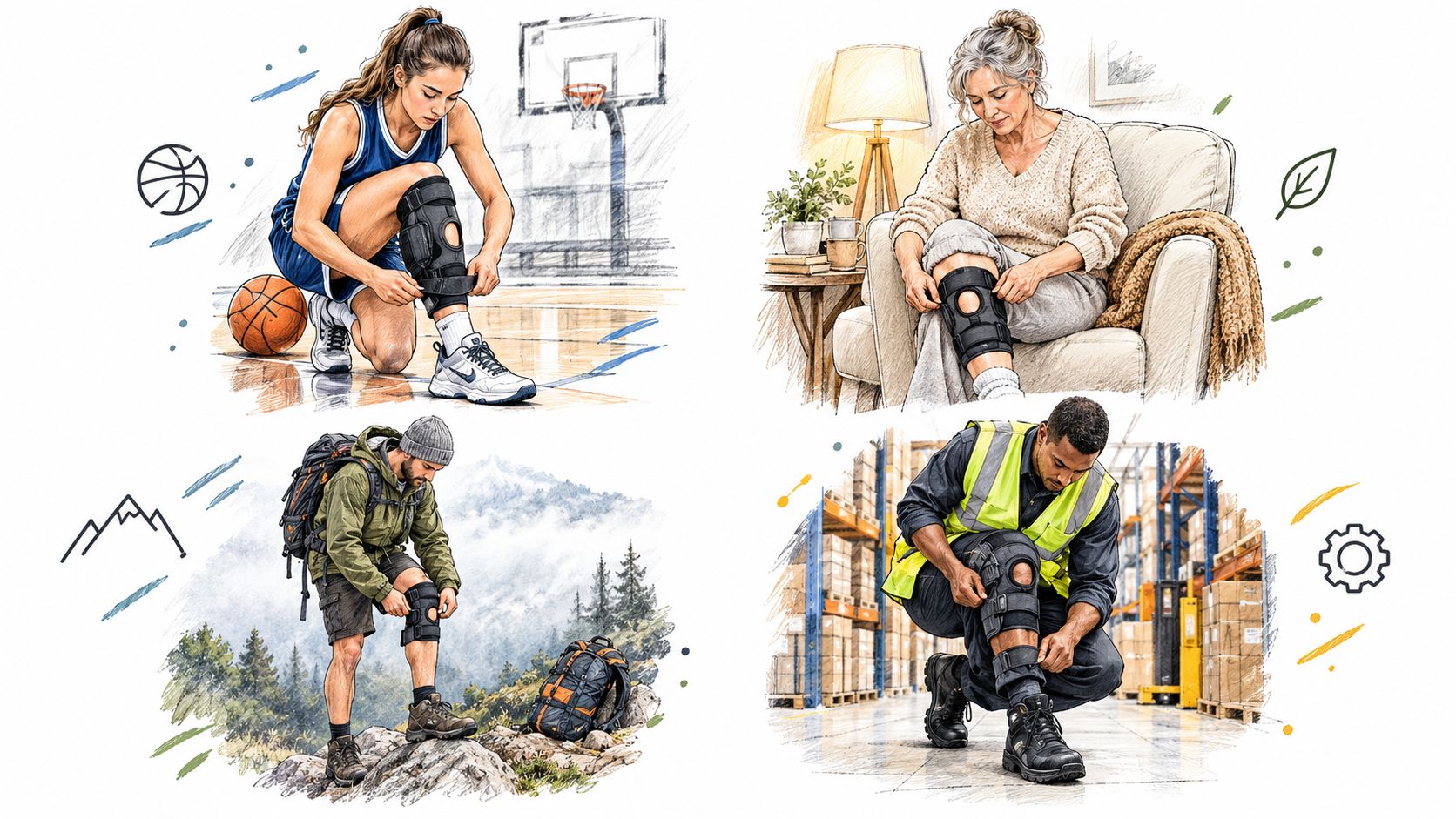
The collage below shows varied support-wear settings, but it depicts knee braces, not ankle fittings. It shouldn't guide ankle-brace positioning or selection.
Returning to basketball after a sprain
A lace-up or semirigid option is worth discussing when your care plan calls for external protection. Bring your basketball shoes to the fitting conversation and ask how the support should work during drills and eventual competition.
Use a sprained ankle healing timeline as background education, not a personal clearance date. The important decision is whether your current function matches the activity you're attempting.
Managing everyday discomfort
For an older adult with diagnosed osteoarthritis, the first question is what the support is meant to accomplish. If the goal is comfort rather than control of instability, a flexible garment may be an option to discuss without defaulting to rigid equipment.
Judge that trial by a concrete task, such as your usual walk. Don't interpret a more comfortable outing as proof that the underlying joint condition has changed.
Avoiding pressure on sensitive skin
Someone who has rejected tight sleeves may prefer to investigate a low-pressure design. Still, non-compressive doesn't mean irritation-proof: seams, edges, and material contact remain relevant.
Check the complete material description and inspect how the garment sits. If every option irritates the same area, seek advice rather than repeatedly changing products.
Walking, desk work, and light activity
For someone seeking general daily comfort, define the time and activity that need support. There little value in building a wear routine around a vague promise of protection.
Try to answer a practical question: does the garment make the intended task more manageable without creating another problem? If the ankle is repeatedly unstable during ordinary walking, prioritize assessment over a higher-support purchase made without guidance.
Fitting, Wearing, and Phasing Out an Ankle Brace
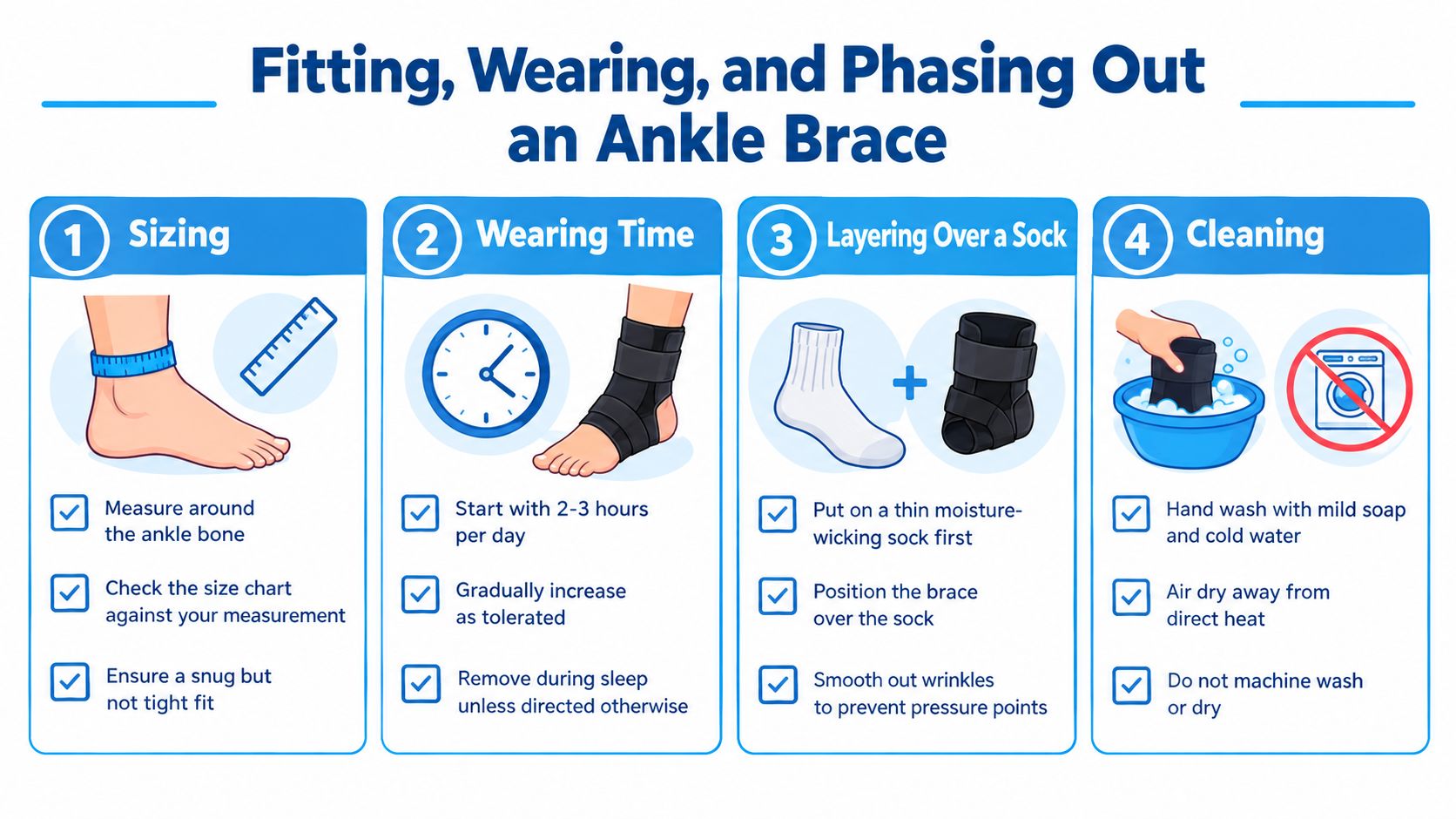
A fitting routine should begin with the instructions for the exact device you own. Don't assume that the measurement location, strap order, or care method is interchangeable across brands.
The checklist below is a visual reminder, not a universal prescription. Its suggested starting wear time and washing instructions may not apply to your brace.
Establish a workable fit
Use the manufacturer's measurement method and size chart rather than choosing by shoe size alone unless instructed. For positioning details, consult this guide on how to put on an ankle brace alongside the device's own directions.
- Check placement: Align the brace as instructed before tightening straps.
- Check layering: If a sock is permitted, smooth out folds beneath the support.
- Check footwear: Test the brace in the shoes you'll use.
- Check comfort: Remove it if it causes pain or discomfort and reassess the fit.
Care instructions matter as much as application. Follow the label for washing and drying rather than assuming that every fabric or rigid component tolerates the same treatment.
Reduce reliance according to function
That distinction allows different decisions for different activities. You may be working toward brace-free lower-demand tasks while continuing protection for more demanding sport.
Recovery checkpoint: Judge progress by balance, coordination, and functional ability, not just time since injury.
Work with your clinician on whether you can walk, balance, and change direction without pain or giving way. Keep strengthening, balance practice, and progressive rehabilitation in the plan during that transition.
For chronic discomfort, arrange a reassessment if your wear time keeps expanding. The question isn't merely whether you can tolerate the garment longer, but whether your underlying needs and treatment plan still match the reason you started wearing it.
Common Misconceptions About Ankle Bracing
“Bracing weakens the ankle” is too broad a conclusion. It confuses using external protection with abandoning physical recovery work.
The clinical guidance discussed earlier treats support and rehabilitation as complementary. It doesn't justify either extreme: avoiding a useful brace out of fear or assuming the brace makes exercise unnecessary.
More pressure isn't evidence of more benefit
A tighter sensation can feel reassuring, but that isn't a reliable measure of protection. Ask whether the fit follows the instructions and supports the intended task without discomfort.
- Reject the squeeze test: Tightness alone doesn't tell you whether a device meets your needs.
- Question unlimited-wear claims: A comfortable product still needs a clear purpose and periodic reassessment.
- Separate outcomes: Prevention evidence doesn't automatically support promises about pain, tissue repair, or circulation.
Preventing another sprain isn't the same as healing one
That's meaningful evidence for recurrent-sprain prevention. It isn't proof that bracing alone restores strength, resolves pain, or makes every subsequent injury milder.
It also doesn't mean rehabilitation has no value because the brace group had fewer recurrences. The study compared specific programs for a particular outcome; a recovery plan must address the functions you need to regain.
Resources on ankle mobility exercises can help you prepare questions for your rehabilitation appointment. Ask which movements suit your stage of recovery and how you'll progress beyond them.
When reading marketing, look for the exact outcome behind the headline. A credible claim names what improved, in whom, and with which intervention, rather than treating every ankle support as interchangeable.
Putting It All Together and Quick Answers
The most useful ankle brace benefits are the ones that match a defined need. Choose protection for a protection problem, evaluate comfort as comfort, and keep unsupported treatment promises out of the decision.
Use this short action plan before committing to a product:
- Choose a purpose: Identify the activity or symptom you want help managing.
- Match the design: Distinguish structural restraint from a flexible comfort garment.
- Confirm the fit: Follow the device's sizing and application instructions.
- Review the result: Track the task you care about, not hours worn.
- Plan the transition: Agree on when to reassess or reduce support.
How tight should an ankle brace feel?
Secure and comfortable, not increasingly painful. Don't use extra tightening to compensate for an uncertain size or a design that doesn't suit your needs.
Can I wear it over a sock?
Follow the manufacturer's instructions. If sock layering is allowed, check for wrinkles and make sure the combined layers don't crowd your shoe.
Is sleeping in a brace safe?
Don't infer nighttime suitability from an all-day comfort claim. Confirm that sleep use is appropriate for your exact device and circumstances with its instructions or your clinician.
When should I seek care instead of self-bracing?
Seek assessment when you can't bear weight, the ankle looks deformed, or pain is severe or worsening. Repeated giving way, persistent discomfort, or symptoms caused by the brace also warrant professional advice rather than another round of self-directed shopping.
Take your usual shoes, your current support, and a description of the movements that trouble you to that appointment. Those details make the discussion more useful.
Thermo Recovery Wear offers compression-lite, infrared-responsive ankle sleeves for people comparing flexible daily-wear options rather than structured sports braces. Visit Thermo Recovery Wear to review its ankle products, sizing guidance, and wear-care instructions, then discuss whether that type of garment fits your comfort goals and recovery plan.


