


You step off a curb, the outside of your foot lands first, and the ankle folds inward before you can catch it. The same roll shows up on a trail root, a wet kitchen floor, or the first sharp cut back to sport. That moment rarely starts with today's stumble. It usually follows an older sprain that never fully settled.
Choosing ankle supports for weak ankles is less about buying the stiffest product and more about naming the job in front of you. Temporary protection after a fresh sprain, a brace that limits a sideways roll, and a light sleeve for rest or easy walking are different tools. Each one belongs with a stage of rehab, and none of them replaces strength, balance, or a check when symptoms don't add up.
Table of Contents
- Why Weak Ankles Keep Giving Way
- When Ankle Weakness Needs a Closer Look
- Comparing Compression Braces and Recovery Sleeves
- How to Fit Ankle Supports for Daily Wear
- Matching Support to Walking Sport and Rehab
- Care Mistakes That Undermine Ankle Support
- Your Next Step for Steadier Ankles
Why Weak Ankles Keep Giving Way
Think of an adult heading back to a casual basketball night. The first sprint feels fine. Then a teammate cuts across, the foot plants, and the ankle rolls the way it did last season. Walking home from the mailbox can do the same thing when the sidewalk drops half an inch. The joint isn't "just sore" in that second. It fails to hold the foot where it should be.
A one-time sore ankle after a long walk often calms with rest, swelling control, and a gradual return to normal steps. Chronic ankle instability is a different pattern. People notice repeated sprains, a sense that the ankle is giving way, pain, or limits on walking and play. A 2019 epidemiological review found that a history of acute ankle sprain carried about 3.5 times the risk of another sprain, and recurrent injuries made up roughly 12% to 47% of reported ankle sprains. In sport, recurrent injuries accounted for 46% of acute ankle sprains in volleyball, 43% in American football, 28% in basketball, and 19% in soccer, according to that review of ankle sprain recurrence.
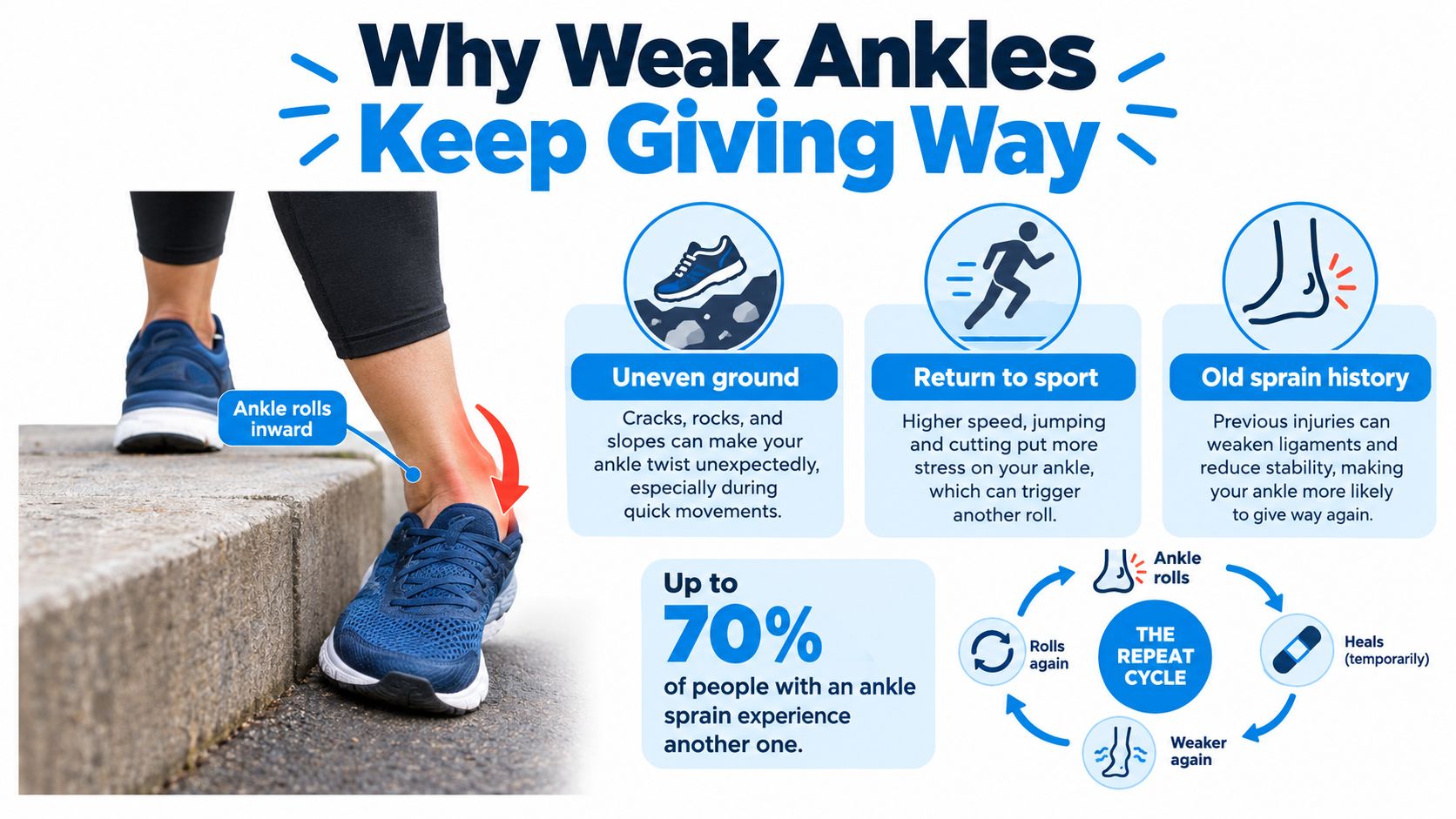
What the repeat roll is telling you
Those figures explain why an ankle brace or stabilizing support is usually a preventive and activity tool, not a comfort accessory. Lower risk is not a guarantee. The same evidence describes risk reduction, and support tends to work best beside balance, strength, and proprioceptive rehab. If you want a plain map of how bad a first sprain was, the ankle sprain grades guide is a useful companion before you pick a device.
A support can make the next curb or cut less likely to fold the ankle. It doesn't finish the job your muscles and balance still have to do.
Later sections separate three practical choices: a soft compression sleeve for comfort and skin feedback, an external brace for mechanical control, and a non-compressive recovery sleeve when tight pressure isn't the goal. The path starts with the pattern of giving way, not with a product ranking.
When Ankle Weakness Needs a Closer Look
A near-roll on a curb can be bad luck. The second near-roll in the same month is a pattern. Run this screen before you spend money: it sorts temporary protection after a fresh sprain, mechanical control for repeat giving way, and calmer recovery wear for rest days from problems that need a clinician first.
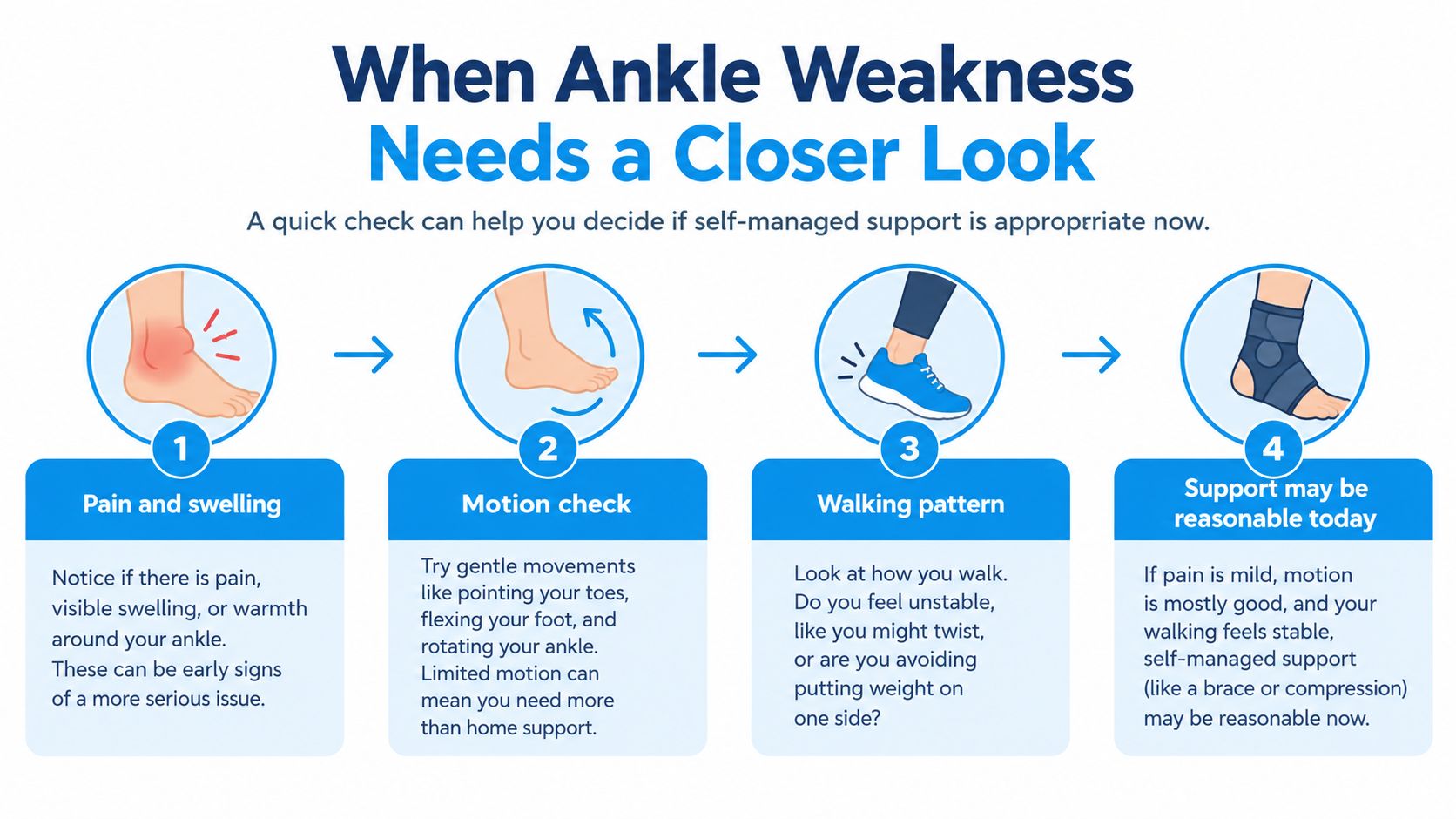
A screen you can do at home
- Pain and swelling: Note where it hurts, how puffy the joint looks, and whether both have been easing or hanging on for days.
- Motion: Gently point and flex the foot. Compare it with the other side. A big loss of upward bend changes how you walk.
- Walking pattern: Take a hallway lap. Limping, a turned-out foot, or a refusal to put full weight down is a different problem from a mild wobble.
- Single-leg balance and giving way: Stand on the sore side near a counter. If you can't hold a short stance, or the ankle has folded more than once this month, treat that as a signal.
After a recent sprain, the first job is usually temporary protection plus early, controlled movement; clinical guidance favors that over long immobilization. A different pattern appears when walking felt fine and rehab stopped early: the ankle can feel weak because strength and balance never caught up.
Red flags that pause the shopping
Get clinical care before choosing a support if you can't bear weight, swelling is marked, the joint locks, sensation changes, or a fracture is possible. Repeat giving way after rehab also earns a closer look, since persistent instability can involve a syndesmotic injury or an osteochondral lesion that may need imaging or referral, as outlined in this clinical overview of ankle sprain. The same source describes common pairing of external support with 8 to 12 weeks of neuromuscular rehab, and sport bracing for up to 12 months after injury to lower recurrence risk; treat those as general patterns rather than a personal prescription.
If running is the trigger, use this guide to an ankle hurting when running to separate training load from joint trouble. A stiff, aching joint is a separate question from an ankle that rolls; the linked arthritis pain relief capsules page belongs to that broader joint-pain path, while the ankle screen above still decides whether support or assessment comes first.
This short video walks through a basic ankle check you can compare with what you felt during the screen.
Use the screen result to choose the next lane: calm findings plus a fresh sprain point to temporary protection and rehab, repeated rolls point to mechanical control for risky movement, and pressure-sensitive rest days point to lighter recovery wear. A red flag sends you to assessment before any product.
Comparing Compression Braces and Recovery Sleeves
Three supports get lumped together in store aisles, and they don't do the same job.
A compression sleeve is soft fabric around the joint. It can feel steady, add warmth, and increase skin feedback. It doesn't have straps or shells that physically block a hard inward roll. On a cut, uneven ground, or the first weeks back from a sprain, that comfortable hug can feel like control without matching a lace-up or semirigid brace.
An external brace, usually lace-up or figure-eight, or a semirigid shell, is built to limit inversion during risky movement. It is the tool for sport, trails, and days when the ankle has already given way. The cost is bulk, warmer feet, and a shoe that may not close if the brace is thick.
A non-compressive recovery sleeve sits in a third lane. It is for people who want light support and warmth without tight pressure. Thermo Recovery Wear makes U.S. recovery sleeves and braces in this category, using infrared-responsive fabric intended to add local warmth and support circulation. The non-compression cut is aimed at rest and light daily activity, with moisture-wicking bamboo charcoal textiles and a sensitive-skin positioning. The company reports up to a 62% improvement in osteoarthritic joint pain. That is a brand claim about joint pain, not proof that every weak ankle will change by that amount.
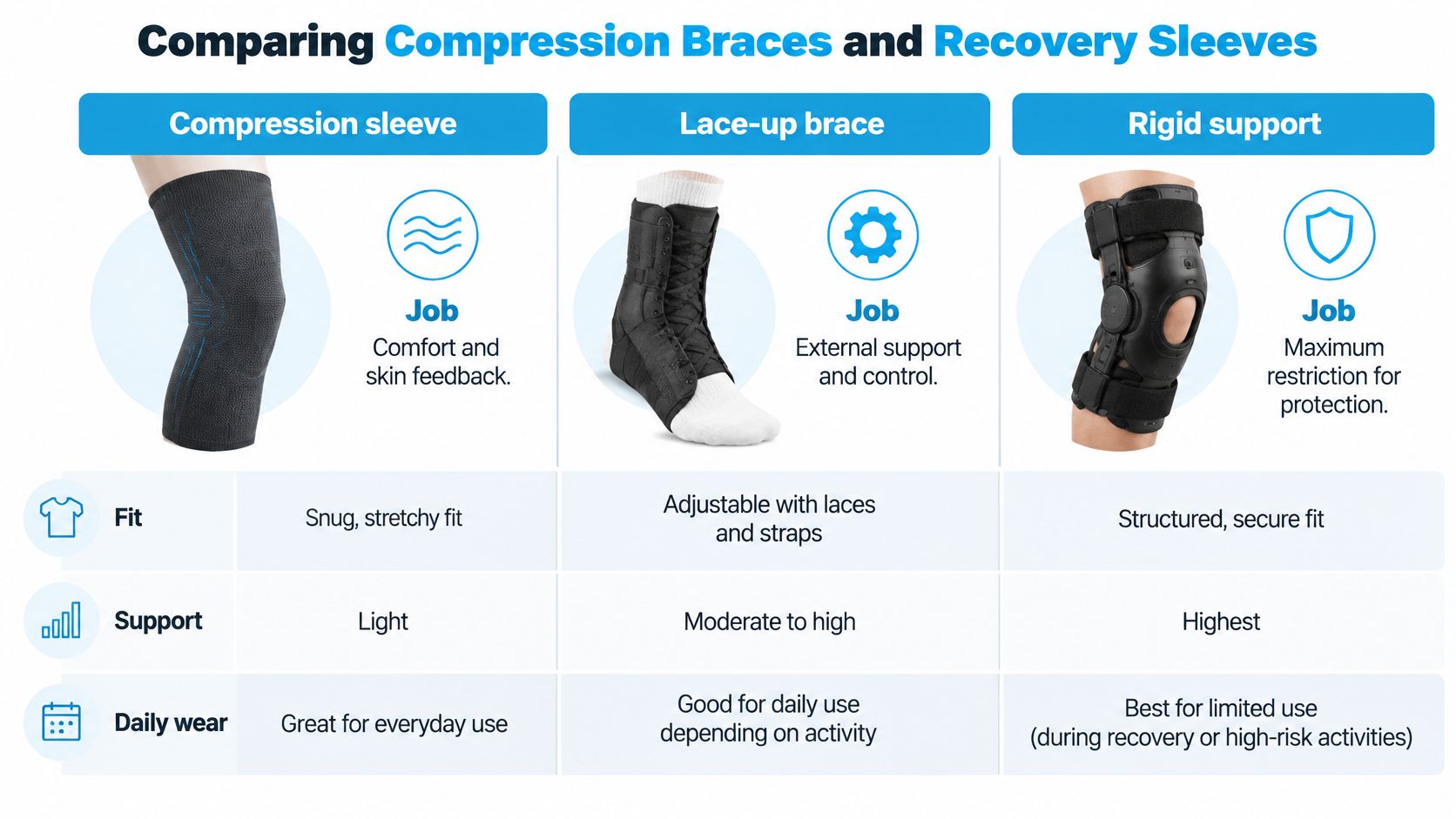
Which ankle support matches the job
| Support type | Best used for | Main limit | Skip it when |
|---|---|---|---|
| Soft compression sleeve | Comfort, mild swelling feel, skin feedback on easy days | Little mechanical stop against a hard roll | You are cutting, jumping, or freshly back from a sprain that still folds |
| Lace-up or semirigid brace | Inversion control in sport, uneven ground, and higher-risk walking | Bulk, heat, and a shoe-fit problem | The task is a balance drill meant to wake up the stabilizers |
| Non-compressive recovery sleeve | Rest, light walking, and people who can't tolerate tight fabric | Not a substitute for straps during high-risk cuts | You need firm sideways restraint right now |
A sleeve that feels nice on the sofa can still be the wrong tool on a side-hill trail.
If the back of the heel is the actual complaint, not the roll, look at Achilles tendon support types before you treat every ache as instability. Match the device to the job, then check the fit on your feet, not in a product photo.
How to Fit Ankle Supports for Daily Wear
A good category still fails if the device sits wrong. Fit is a short routine, not a brand contest.
Start with clean, dry skin. Seat the ankle near neutral, the foot neither cranked inward nor pointed hard down. Straps should cross so they resist a roll, not so they pinch the front of the ankle. Fabric sleeves should lie flat, with the heel opening centered if the design has one.
Pressure, color, and the shoe
- Numbness or hot spots: Loosen or reseat. Tingling toes mean the support is doing too much.
- Color change: Toes should stay their normal color. A pale or dusky foot is a stop, not a break-in period.
- Shoe close: You should lace or strap the shoe without forcing it. If the heel lifts or the tongue bulges, the pair is too thick for that shoe.
- Gait change: Walk a hallway and turn both directions. A brace that makes you limp is too much support for that task, even if it feels "locked in" while you sit.
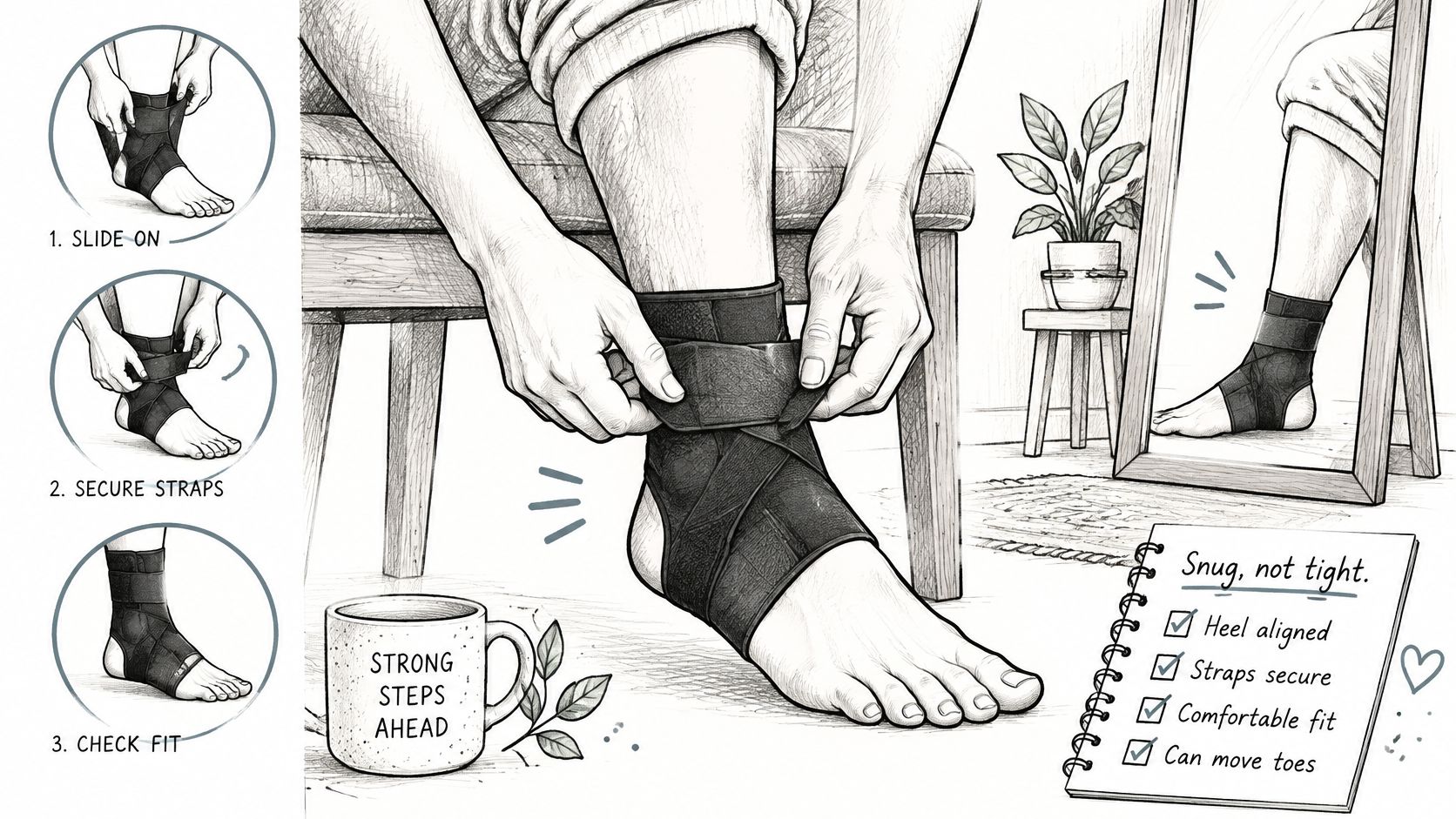
Don't judge the fit in a chair. Stand, walk, and turn, then check again after about ten minutes. Fabric and straps migrate once you move. Older adults and daily walkers often do better with a lower-profile support inside the shoes they already trust, rather than a rigid shell that only fits a bulky trainer.
Benchmarks a try-on can't replace
Home fit doesn't measure recovery. Clinicians sometimes use targets from the Ohio State chronic ankle instability guideline, including dorsiflexion at least 90% of the other side, meaningful improvement on the Foot and Ankle Ability Measure, and no more than one perceived-instability episode during functional activity over two weeks. Ask about those if you are in care. A seated try-on can't stand in for them.
Reassess after real steps. If the support has shifted, the neutral position you set at the couch is already gone.
Matching Support to Walking Sport and Rehab
The same ankle doesn't need the same support for a kitchen lap, a gravel path, and a cutting drill.
For light home tasks and daily walking, many people do well with a sleeve or a light brace they will keep on. Confidence matters here, especially if the goal is steady steps rather than a return to sport. If you are building a walking habit, the benefits of walking 8000 steps from REVETIX put that volume in context, and a support should make those steps feel controllable, not stiff.
Uneven ground raises the roll risk. A lace-up or semirigid brace earns its place on trails, curbs, and work sites where the foot lands off-center. Sport with cutting or jumping is the highest-demand scene. That is where mechanical restraint has the clearest job.
What the protection evidence actually says
An evidence-based guideline in the British Journal of Sports Medicine reported that braces or tape reduced recurrent ankle sprains with a relative risk of 0.30 (95% confidence interval 0.21 to 0.43), about a 70% relative reduction versus no brace or tape in the analyzed evidence. The same guideline reported fewer first-time sprains, with a relative risk of 0.69 (95% confidence interval 0.49 to 0.96), as summarized in this 2018 ankle sprain guideline. Construction, fit, wear time, activity, and whether you keep the device on all change the result. A sleeve and a rigid brace are not interchangeable in those findings.
Feeling stable isn't the same as owning your balance. Bracing or taping may improve joint-position sense through skin feedback in some conditions, while exercise on unstable surfaces, visual-feedback training, and ankle strengthening address the neuromuscular gap, as discussed in this review of ankle proprioception and balance training.
When the support comes off
Use lateral support during higher-risk walking and sport. Take it off for drills meant to recruit the stabilizers. Progress balance from seated to standing to walking, two legs to one, eyes open to eyes closed, and still positions to movement. Pair that ladder with ankle mobility exercises so the joint can bend enough to land well.
Stop and reassess if pain, swelling, or giving way returns. That is the ankle telling you the map needs a rewrite, not a tighter strap.
Care Mistakes That Undermine Ankle Support
A sensible brace can still fail in ordinary use. The usual story isn't a bad product. It's a fit or a habit that undoes the plan.
Over-tightening is the first trap. Extra pressure can irritate skin, change your walk, and push you to leave the support in a drawer. An overly loose support slides and can't control inversion. Snug enough to resist a tip, loose enough that color and feeling stay normal, is the working range.
The second trap is wearing a rigid brace through every strength and balance drill. Protection during a risky walk isn't the same task as restoring active stability. Clinical guidance favors the brace when exposure is high, and progressive unbraced work so the muscles learn the job. A 2014 line of evidence also found that rehab programs improved pain and function and cut recurrent sprains compared with waiting it out, which is why the support has to sit beside exercise rather than replace it.
Hygiene and the checks that matter
Follow the garment's care page. Wash on the cycle it allows, dry it fully, and don't store it damp in a gym bag. Keep the skin dry before you put it on. Replace a support that has stretched, frayed, or lost its shape, because a collapsed strap no longer limits a roll.
Comfort is a weak scorecard. Track a few repeats instead:
- Single-leg stance: Time it near a counter, both sides.
- A simple reach: If you already know a Y-Balance style reach, note the distance, not the vibe.
- Hop tolerance: Only when walking is already solid and a clinician hasn't limited impact.
- Episodes: Count giving-way moments per week, plus whether a hallway walk feels more capable.
One review of postural-control studies found that 9 of 10 orthosis studies reported improvement, across 284 participants. That pool mixed foot orthoses, acute sprains, and chronic instability, so it isn't a success rate for every brace, as the authors of this orthosis and balance review make clear. Use your own repeatable tests.
If marked swelling, inability to bear weight, locking, or a sensory change shows up, the product is no longer the question. Get the ankle assessed.
Your Next Step for Steadier Ankles
Name today's main job before you buy anything else.
If the job is controlling a risky movement, use a lace-up or semirigid brace for cuts, uneven ground, and early return to sport, and keep doing balance and strength work with the brace off during those drills. If a red flag from the earlier screen is present, book a clinical visit instead of adding another strap.
If the job is comfortable feedback on ordinary walks, a soft compression sleeve may be enough, as long as you don't pretend it stops a hard roll. Keep the single-leg practice. A sleeve that only lives in the shoe on game day won't rebuild the stabilizers.
If the job is light activity, sensitive skin, or all-day comfort, and tight compression bothers you, look at a non-compressive ankle recovery sleeve rather than a sport brace. Review Thermo Recovery Wear's ankle recovery sleeve on the brand site, then use the size and care pages before you order. The Lite collection is the current line. U.S. shipping is fast, orders of $49 or more ship free, and returns have a 30-day window.
Whatever you pick, pair it with the stage you're in. A fresh sprain follows a different clock than a year of giving way, which is why a sprained ankle healing timeline is worth reading beside your own symptoms. A support can lower exposure while the ankle gets stronger. It doesn't finish rehab by itself.
Thermo Recovery Wear makes non-compressive, infrared-responsive ankle sleeves for adults who want light support during rest and easy walking without a tight squeeze. If that matches the job you named, visit Thermo Recovery Wear to check the Lite ankle sleeve, sizing, and care notes before you decide.


