


If your hip and lower back hurt together, how do you know which one needs attention, or whether one is making the other worse? Treating them as unrelated problems can miss an important part of the explanation.
Arthritis in the lower back and hips can affect a linked movement system, not just separate joints. Where you feel pain offers useful clues, but it doesn't provide a diagnosis. A symptom map, an examination of both areas, and a realistic care plan can help you move forward without assuming every ache means arthritis or every scan finding needs treatment.
Table of Contents
- How Hip and Lower-Back Arthritis Overlap
- Hip Pain or Back Pain? Matching Symptoms to the Source
- How Clinicians Confirm the Source and When to Seek Urgent Care
- Care Options for Hip and Lower-Back Arthritis
- Exercise Dose That Works When Both Areas Hurt
- Your Next-Step Ladder
How Hip and Lower-Back Arthritis Overlap
Your hip and lumbar spine work like two hinges on the same door frame. When one hinge sticks, you compensate by moving the other differently. The analogy isn't perfect, but it explains why examining only the painful spot can leave part of the problem unresolved.
The hip is a ball-and-socket joint that carries your weight while allowing your leg to rotate. With osteoarthritis, its cartilage becomes thinner, the bone beneath it remodels, and osteophytes, or bony spurs, can form. These changes can make the joint less comfortable under load and harder to move.
In the lower back, degenerative changes can affect the small facet joints behind the vertebrae, the discs between them, and surrounding bone. However, low-back pain isn't automatically arthritis. Muscles, discs, nerves, and other structures can also cause symptoms.
This diagram shows why the hip and spine need to be considered together.
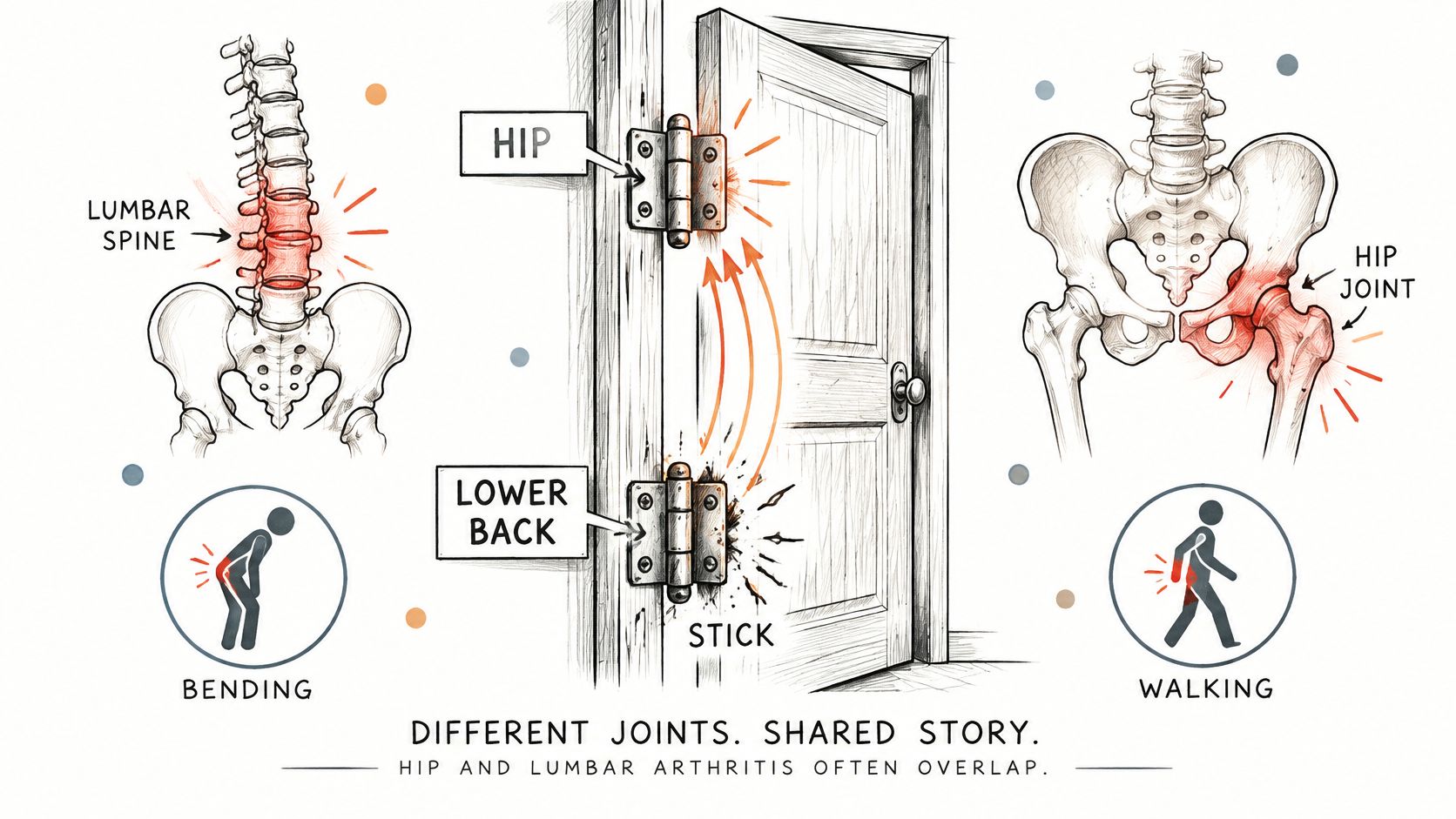
How stiffness changes movement
The relationship works in both directions. When a stiff hip can't extend comfortably during walking, you may compensate through your pelvis and lower back. When your spine is stiff, changes in pelvic position can alter how you load the hip, an interaction described in the AAOS hip osteoarthritis clinical practice guideline.
Think about turning to reach something behind you. Ideally, movement is shared between your feet, hips, pelvis, and spine. If your hip won't rotate, you may twist farther through your back instead. That doesn't prove damage is occurring, but it helps explain why the back can become uncomfortable.
Other nearby structures can complicate the picture. This guide to sacroiliac joint pain causes and treatment explains another possible source of pain around the back of the pelvis.
Common symptoms, different conditions
A 2024 global burden study in BMC Musculoskeletal Disorders estimated that 30–40% of adults aged 45–59 experience some degree of low-back pain. That figure describes back pain, not confirmed spinal arthritis.
Hip osteoarthritis is a narrower diagnosis, but its effect on mobility can be substantial. A 2023 review of the Johnston County Osteoarthritis Project reported that symptomatic hip osteoarthritis affects up to 1 in 4 people by age 85.
A painful area and a scan finding aren't interchangeable. The useful question is whether the examination, symptoms, and imaging tell a consistent story.
If you already have a scan, Dream Body Clinic's resource on understanding your MRI spine report can help you prepare questions about unfamiliar terminology. Note where each ache sits and which movements change it, rather than assuming the longest medical term identifies the cause.
Hip Pain or Back Pain? Matching Symptoms to the Source
| Symptom pattern | Points toward | Why it matters |
|---|---|---|
| Groin, front-of-thigh or inner-thigh pain | Hip | Hip pain is often felt away from the joint |
| Trouble rotating the hip inward or putting on shoes | Hip | Reduced internal rotation is a functional sign of hip osteoarthritis |
| Pain that worsens with standing or walking and eases with rest | Hip or lower back | Both areas carry load, so the pattern alone isn't conclusive |
| Stiffness after prolonged sitting, bending or rising | Lower back | Discs and facet joints respond to spinal position, although hip stiffness can overlap |
| Pain below the buttock or down the leg | Lower back, possible nerve involvement | Radiating pain needs clinical assessment |
| Numbness, tingling, weakness, or bladder or bowel change | Possible nerve involvement, potentially urgent | New bladder or bowel changes and progressive weakness require emergency assessment; other nerve symptoms need prompt review |
| Brief morning stiffness with activity-related pain in an older adult | Possible osteoarthritis at either site | A typical pattern may support clinical diagnosis without routine imaging |
Use this as a conversation aid, not a self-diagnosis tool. The strongest clue is usually a combination of location, movement restriction, and the way symptoms behave. No single row can confirm where pain starts.
Hip joint pain can appear in the groin, thigh, buttock, or knee. Difficulty turning the thigh inward or reaching your foot to put on a shoe may be more informative than pointing to the outside of your hip.
When the hip deserves a closer look
Consider a hypothetical older adult who can still walk briskly but feels a deep groin ache when rising from a chair. They also struggle to turn the affected leg inward while dressing. Being able to walk doesn't rule out a hip problem, because different tasks challenge different movements.
A clinician would want to know whether the groin pain appears during hip rotation, whether there's a limp, and whether the back examination reproduces the same symptoms. The combination matters more than the fact that the person calls it hip pain.
Pain after standing or walking is less specific. Both the hip and spine help support your body, so relief with rest doesn't reliably distinguish them.
When the back deserves a closer look
Now consider someone whose lower-back ache builds during prolonged sitting but whose hip feels comfortable during dressing and rotation. Spinal position may be more relevant to that pattern. It still doesn't establish arthritis, because other back structures can produce similar symptoms.
Pain extending down the leg, particularly with altered sensation, raises a different question: could a nerve be irritated? This explanation of how piriformis-related pain differs from sciatic pain can help clarify terms, but it can't identify the cause without an examination.
Useful distinction: Pain location tells the clinician where to investigate. Movement testing helps determine which structure is contributing.
Before your appointment, record:
- Exact location: Mark the groin, buttock, thigh, lower back, and any pain farther down the leg separately.
- Specific triggers: Note chair rising, reaching your foot, sitting, walking, bending, or turning.
- Stiffness pattern: Describe how long it lasts and whether moving gently helps.
- Functional effect: Explain what you've stopped doing or changed because of symptoms.
Bring observations rather than conclusions. “My groin hurts when I turn my leg to put on a sock” gives a clinician more useful information than “My arthritis is worse.”
How Clinicians Confirm the Source and When to Seek Urgent Care
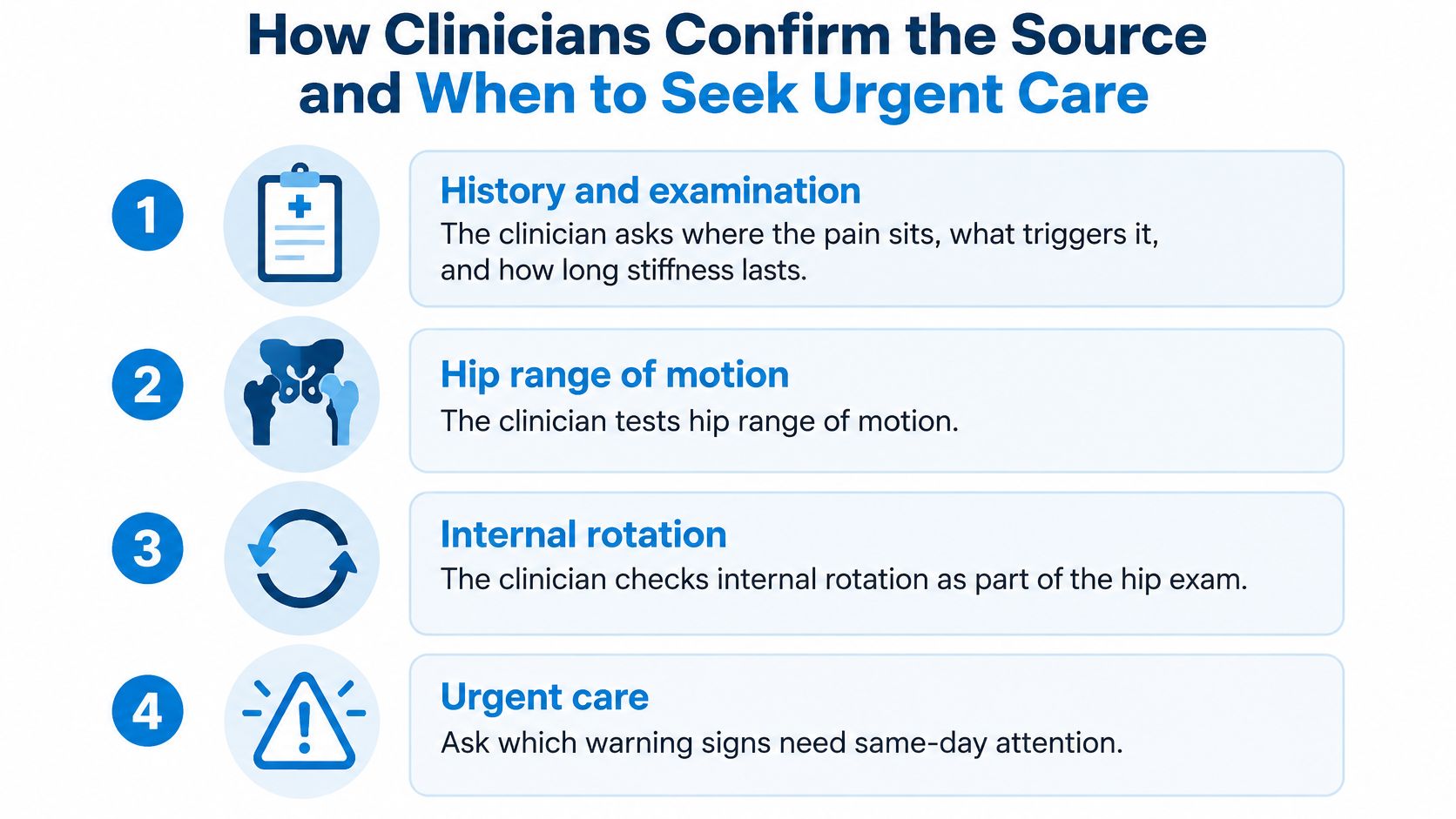
Diagnosis starts with history and examination, not automatically with a scan. A clinician asks where the pain sits, what brings it on, how stiffness behaves, and whether you have symptoms elsewhere. They may also ask about injuries, sleep disruption, general health, and changes in walking.
The examination usually considers both regions. It can include hip range of motion, internal rotation, walking pattern, spinal movement, and checks of leg strength, sensation, and reflexes. The aim is to reproduce and understand your familiar symptoms, not find a movement that feels tight.
The clinical assessment can be understood as a sequence of checks.
When imaging helps
The NICE osteoarthritis guidance supports clinical diagnosis in adults aged 45 or older with activity-related joint pain and little or brief morning stiffness, without routine imaging unless symptoms are atypical or suggest another condition.
That doesn't mean imaging is useless. It means a clinician should have a reason for requesting it, such as investigating an alternative diagnosis or answering a question that could change treatment.
An X-ray can show degenerative changes that don't match the severity of pain. Conversely, a reassuring image doesn't explain away persistent symptoms or rule out every painful structure. Unnecessary scans can add expense and worry without improving the care plan.
The type of arthritis matters too. If you're unsure about the terminology, this comparison of rheumatoid arthritis and osteoarthritis explains why they shouldn't be treated as interchangeable diagnoses.
Warning signs that change the plan
Seek emergency assessment now for new loss of bladder or bowel control, difficulty passing urine with back or leg symptoms, numbness around the groin or saddle area, or rapidly worsening leg weakness.
Other warning signs warrant urgent medical advice rather than waiting for a routine exercise appointment:
- Trauma: Significant pain after a fall or accident, especially if you can't bear weight.
- Fever: Back or hip pain with fever or feeling seriously unwell.
- Unexplained weight loss: Weight loss you haven't been trying to achieve.
- Progressive weakness: A leg becoming weaker, giving way, or functioning less reliably.
- Rest or night pain: Persistent pain at rest or night pain that repeatedly wakes you, particularly when it's new or worsening.
These signs don't prove a dangerous condition, but they change the urgency of assessment. Stable pain that isn't settling belongs in a routine GP or physiotherapy appointment. New or worsening neurological symptoms shouldn't be managed as ordinary joint soreness.
Care Options for Hip and Lower-Back Arthritis
| Option | Best suited for | Evidence and limits |
|---|---|---|
| Physical therapy | Mild-to-moderate symptomatic hip osteoarthritis | Strong evidence for improving pain and function |
| Weight management | Adults carrying extra weight who have weight-bearing joint pain | Reduces cumulative mechanical load; the practical benefit differs between people |
| Short-term pain relievers | Controlling flares while activity builds | Requires clinician or pharmacist review because suitability and risks differ |
| Corticosteroid injection | Selected cases of persistent, clearly identified joint pain | Relief is generally temporary; hip and spinal injections aren't interchangeable |
| Bracing or orthosis | Selected patients with professional fitting | Usefulness is specific to the affected structure and biomechanics |
| Non-compressive recovery wear | Comfort and warmth during light activity | Adjunct only; doesn't reverse cartilage loss or spinal narrowing |
| Hip replacement | Severe hip arthritis with substantial pain and functional loss despite conservative care | Requires a discussion of likely benefits, surgical risks, and recovery |
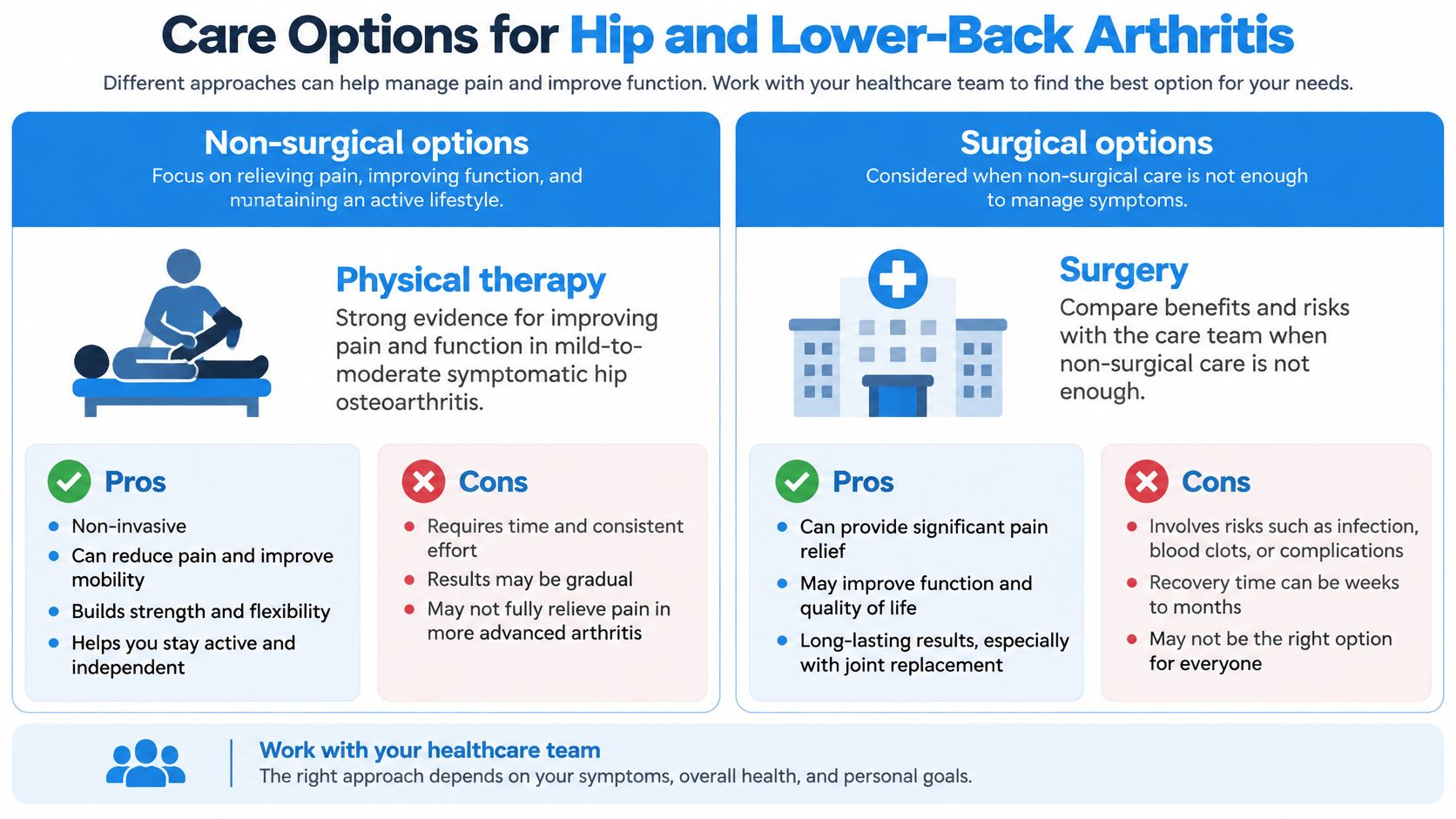
The comparison below separates supportive care from surgery.
Build care around the limiting task
The American Academy of Orthopaedic Surgeons hip osteoarthritis guideline reports strong evidence that physical therapy improves function and reduces pain in mild-to-moderate symptomatic hip osteoarthritis. Programs commonly address hip strength, mobility, walking mechanics, and activity modification.
A useful plan starts with what you need to do. If chair rising is difficult, treatment might include adjusting the chair height and practicing a tolerable sit-to-stand. If walking is the main limitation, the clinician can assess stride, pacing, and whether an aid would help.
Medication choices need an individual safety review. Tell the clinician or pharmacist about your existing medicines and relevant health conditions before adding pain relievers. Injections require a similarly specific discussion about the target, expected duration of benefit, and whether repeat treatment is appropriate.
For more practical self-management ideas, see ways to help osteoarthritis.
This accompanying video can be used to prepare questions for your care team.
Keep comfort measures in their proper role
Say an adult has confirmed hip osteoarthritis alongside back stiffness. Their plan might combine targeted physical therapy, gradual weight management where appropriate, and a comfortable garment during quiet evening activity. Each component has a different purpose.
Warmth and tactile support aren't structural treatment. A wearable doesn't rebuild cartilage, remove a bone spur, or decompress a nerve. Any claim that increased circulation reverses arthritis should be treated cautiously.
If you're considering herbal products, the REVETIX guide to joint inflammation offers background on commonly discussed ingredients. Use it to prepare questions about suitability and interactions, not as a replacement for diagnosis or prescribed treatment.
Hip replacement may become appropriate when hip disease continues to severely limit life despite non-surgical care. It isn't a general treatment for unexplained back pain, so the care team needs to establish what the hip is contributing.
Start with the lowest-risk option that addresses the likely source and your most important functional goal. Escalate because the current plan isn't meeting that goal, not simply because a scan looks abnormal.
Exercise Dose That Works When Both Areas Hurt
| Phase | Example activities | Starting dose | Move on when |
|---|---|---|---|
| Calming and mobility | Gentle walking, pelvic tilts, hip rocking | Brief, comfortable bouts with recovery between them | Symptoms return to baseline by the following day |
| Strength | Sit-to-stand, side-lying hip abduction, bridges | A manageable set with controlled movement and rest before repeating | You can complete the movement without compensating or prolonged aggravation |
| Loading and endurance | Stair practice, cycling, step-ups | Short bouts; increase duration before adding difficulty | Daily walking and household tasks become easier without accumulating symptoms |
| Ongoing maintenance | Walking, swimming, strength circuit | Regular activity matched to recovery and current capacity | Function remains stable and you can adjust activity during flares |
These are progression stages, not deadlines. There isn't a universally established exercise schedule for people whose hip and lumbar symptoms coexist. A physiotherapist can help select movements that challenge the intended muscles without repeatedly aggravating the other area.
A 2025 international exercise research-priority project identified individualized support, long-term adherence, and uncertainty about optimal dosage as important unresolved questions. Exercise can improve average hip osteoarthritis pain and function, but improvements may be modest, and quality-of-life benefits remain uncertain.
Use the following-day response
The 24-hour response is a practical monitoring window, not proof that an exercise is safe or correctly dosed. Mild familiar discomfort that settles back toward your usual level may be acceptable. Pain that keeps escalating, disrupts sleep, or leaves you functioning worse suggests that the load needs adjusting.
Reduce one element at a time: duration, repetitions, range of motion, or resistance. Don't push through sharp pain, new radiating symptoms, weakness, or altered sensation.
A hip-strengthening exercise can temporarily irritate the back if you compensate through the spine. For example, during a bridge, lifting higher isn't necessarily better. A smaller movement that you control comfortably may be a more useful starting point.
Progress by function, not pain elimination
Consider a gardener who can walk comfortably to the end of the street but struggles with a longer outing. They could begin with that manageable route, rest, and repeat it later if symptoms permit. When the same route feels easier and recovery remains predictable, they can extend it slightly.
That's more useful than following a fixed calendar regardless of symptoms. Improvements might include easier chair rising, less reliance on a handrail, or returning to a short gardening task.
- Limited equipment: Use a firm chair for sit-to-stand practice and a kitchen counter for balance support.
- Poor weight-bearing tolerance: Ask about seated exercise, cycling, or water-based activity.
- Restricted mobility: Keep movements small rather than forcing an end position.
- Poor sleep or a flare: Reduce the session rather than treating the usual workload as compulsory.
Gentle movement options such as yoga poses for lower-back discomfort may provide ideas, but skip positions that provoke groin pinching, radiating pain, or difficult twisting. Begin with a tolerable mobility stage this week if no warning signs are present, and ask for help if you can't find a manageable starting point.
Your Next-Step Ladder
- Map the problem before naming it. Mark each painful area separately and identify the task that brings it on. Include activities you avoid, not just the movements you can still complete.
- Check whether the situation is urgent. New bladder or bowel changes, rapidly worsening weakness, or other warning signs need medical attention before self-directed exercise. Don't wait to see whether a garment, stretch, or pain reliever settles them.
- Arrange an assessment for persistent symptoms. Ask the clinician to consider both the hip and lumbar spine. A useful imaging question is, “What would this scan change about my treatment?” rather than assuming that more imaging always provides more certainty.
- Choose a manageable starting activity. Select movements you can perform with control and observe your recovery afterward. Increase the challenge when daily function and symptom recovery support it, not because you feel obliged to meet a timetable.
- Set a review point with your clinician. Agree on a meaningful goal, such as dressing independently, walking to a nearby shop, or sleeping with fewer interruptions. If you're losing function or making no progress despite following the plan, ask whether the diagnosis, exercise selection, or need for specialist input should be reconsidered.
- Bring a useful symptom log. Include pain locations, triggers, stiffness duration, leg symptoms, and how you feel after activity. If you're considering comfort garments, include that question in the appointment so supportive measures fit around the treatment plan.
You don't need to solve the hip-versus-back question before asking for help. Book an assessment this week if pain is persisting, and bring your symptom log so the appointment starts with a clear picture of what's limiting you.
Our recovery sleeves and braces are designed to aid relief for arthritis, back pain, and muscle or joint injuries, rather than enhance athletic performance. If you're considering an adjunct for comfort during recovery or light activity, visit Thermo Recovery Wear to explore our options and discuss their place in your care plan with your clinician.


