


You caught yourself with an outstretched hand, or finished a hard throw, and now the inside of your elbow is sore and swollen. By evening, you're comparing sleeves, straps, and hinged braces, wondering whether more support means a better recovery.
The right elbow brace for sprain recovery isn't necessarily the stiffest one. First, rule out an injury that needs assessment. Then choose enough protection to make appropriate movement manageable, without turning a sore elbow into a stiff one.
Table of Contents
- Which Elbow Brace Matches Your Sprain
- How to Fit an Elbow Brace Safely
- A Short Wear Schedule After an Uncomplicated Sprain
- Tips That Keep the Elbow Moving
- When Home Bracing Should Stop
- Pick a Sleeve You Can Keep Wearing
Which Elbow Brace Matches Your Sprain
A soft sleeve is the default home option only for a mild, stable injury, not for unexplained pain after a hard fall. The buying decision is about what needs protection: comfortable movement, temporary unloading, or a specific direction that an injured ligament can't safely control.
Before shopping, check whether your elbow looks normal, moves reasonably, and feels stable during light use. Don't repeatedly push or twist it to test the ligaments yourself. A reassuring-looking joint can still need examination when the mechanism or symptoms are concerning.
Choose protection by the injury picture
The California elbow-disorders guideline makes diagnosis central to device selection and recommends an X-ray for elbow dislocation to check for an associated fracture. Deformity, inability to move the joint, rapidly increasing swelling, severe traumatic pain, or a cold, numb, or discolored hand means assessment comes before a purchase.
Elbow brace choice by sprain picture
| Injury picture | Brace to consider | Motion allowed | Typical wear window |
|---|---|---|---|
| Mild stable sprain, modest swelling | Soft sleeve or light support | Comfortable bending and straightening | During sore tasks, then reduce as symptoms improve |
| Uncomplicated sprain, still painful with daily reach | Sling or simple splint | Remove as directed for gentle motion | Brief protection followed by gradual reduction |
| Intact ligaments, staged protection prescribed | Adjustable range-of-motion brace | Clinician-set starting angle and progressive motion arc | Remove for prescribed exercise, replace for protection |
| Suspected collateral-ligament instability | Hinged brace with blocked motion | Individualized limits on vulnerable movement | Only as the clinician directs |
| Deformity, suspected fracture or dislocation | No home brace as treatment | Support comfortably without forcing movement | Urgent care and imaging first |
A soft sleeve offers comfort without mechanically blocking movement. That makes it a reasonable consideration for light chores when the elbow is stable, but a poor substitute for prescribed stabilization. Our guide to compression for the elbow explains the comfort-focused role of this type of support.
A sling or simple splint temporarily reduces the demand on a painful arm. The trade-off is that it also makes it easy to stop moving the elbow and shoulder altogether. Choose it for a defined purpose, not because keeping the arm still feels safer indefinitely.
An adjustable range-of-motion brace is different equipment. Its stops control how far the elbow bends or straightens. A clinician should set those limits when protection requires more precision than a fabric sleeve can provide.
Don't confuse snugness with stability
Say lifting a grocery bag makes the inner elbow feel as though it might give way. Tightening a sleeve won't reliably block the sideways stress involved. That symptom needs assessment rather than a heavier fabric or another compression strap.
Buying rule: Choose the device that controls the problem, not the one that feels most substantial in the package.
Our recovery products aren't designed as a preventive measure against injury. Circle the row that matches an assessed injury, and shop only at that level. If you can't confidently choose a row, an examination is more useful than a product comparison.
How to Fit an Elbow Brace Safely
Fit the brace with the arm relaxed and supported. If you tighten it while holding the arm awkwardly in the air, you may compensate for poor positioning by pulling the straps harder.
The American College of Occupational and Environmental Medicine guideline reproduced by California's Division of Workers' Compensation generally limits sling use for sprains to less than 7–10 days, recommends elbow and shoulder movement several times daily, and describes sleep positioning at approximately 45–70 degrees when a splint or brace is indicated. Those recommendations support purposeful protection, not continuous restriction.
Position before tightening
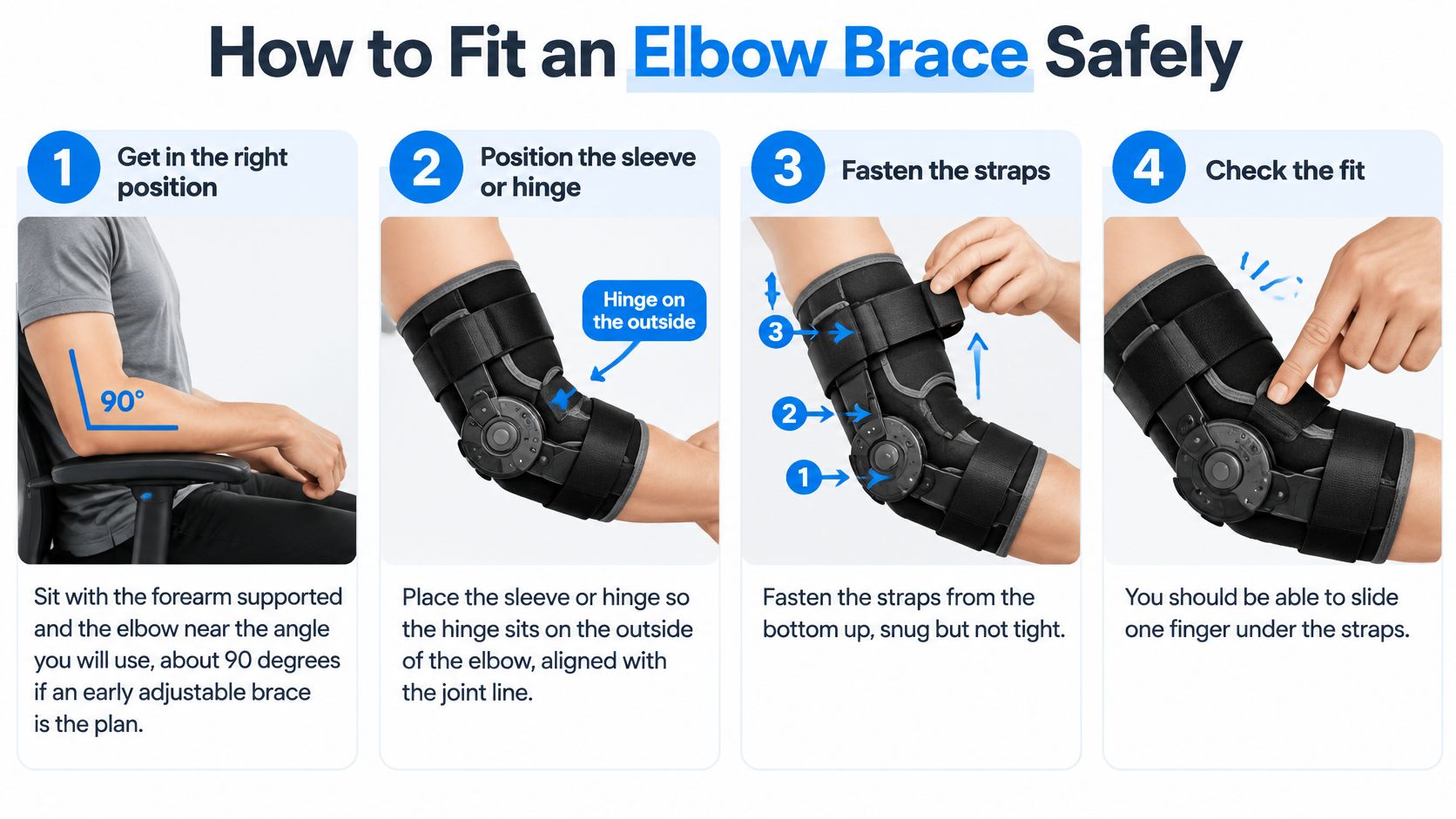
- Support the forearm. Sit beside a table or rest the arm on a pillow. Use the angle prescribed for your brace, rather than forcing the elbow into the shape of the device.
- Align the joint. Center a sleeve over the elbow. For a hinged brace, align its pivot with the elbow's joint line, following the device instructions. A hinge sitting too high or too low can pull against the arm instead of moving with it.
- Fasten without squeezing. Follow the manufacturer's strap sequence and remove slack gradually. The brace should stay in position through the permitted movement without digging in. Tingling, numbness, discoloration, or severe discomfort means loosen or remove it immediately.
- Recheck the hand. Compare its color, warmth, and sensation with the other hand after the brace settles. Check again after moving around, because swelling and strap pressure can change.
Use the illustration for orientation, while following the fitting instructions supplied with your particular device.
Check fit during real use
- Move within the allowed arc. Try gentle bending and straightening if your treatment plan permits it. The brace shouldn't slide, bunch into the crease, or pinch the skin. Don't change hinge stops because you can't reach something.
- Treat nighttime wear as a separate instruction. Don't assume daytime support belongs in bed. Use a brace or splint overnight only when advised, and never tighten it extra to stop it shifting during sleep.
- Build removal into the routine. For an uncomplicated injury, take the support off for the prescribed elbow and shoulder movement. A comfortable sling still needs a plan for reducing use.
Check our sleeve measuring guidance before ordering fabric support. Choosing a smaller size to obtain more support can create pressure without providing the directional control of a hinged brace.
The common mistake is cranking the straps because the elbow still aches. Persistent pain isn't proof that the brace needs tightening. Note the strap positions that passed the movement and circulation checks so you can reproduce that fit after washing, while allowing for changes in swelling.
A Short Wear Schedule After an Uncomplicated Sprain
A wear schedule should combine protection with early controlled movement. It isn't a countdown during which the arm stays locked, and it isn't permission to resume lifting as soon as the date changes.
For an uncomplicated injury with intact ligaments, the review of braces in post-traumatic elbow rehabilitation describes initial positioning near 90° of flexion, protected movement after 1–7 days, and removal for progressive motion after 7–15 days; collateral-ligament injuries may require individualized restrictions for up to six weeks. The table translates that framework into practical decisions, not a self-prescription.
Protection and movement phases
Wear and motion phases for an uncomplicated elbow sprain
| Phase | Timing | Brace use | Movement |
|---|---|---|---|
| Early protection | Immediately after assessment, while pain is high | Prescribed flexed position with forearm mid-rotation, or sling for painful tasks | Gentle elbow and shoulder movement when permitted |
| Protected exercise | Early recovery, once cleared to begin | Brace back on between sessions | Pain-limited bending, straightening, and forearm rotation |
| Wean daytime support | As swelling and pain improve | Off for exercise, on again when protection is needed | Progress toward the prescribed full arc |
| Night support if directed | While the clinician considers it necessary | Prescribed sleep position, never numb or discolored | No extra tightening overnight |
| Collateral-ligament plan | According to the individual rehabilitation prescription | Block the vulnerable direction | Forearm position and extension limits set individually |
| Stop the home plan | Any day motion worsens | Don't continue unsupervised immobilization | Recheck for fracture, instability, or nerve symptoms |
This timeline illustrates the principle of reducing support as function improves. Follow the elbow-specific prescription rather than treating the graphic as instructions for every injury.
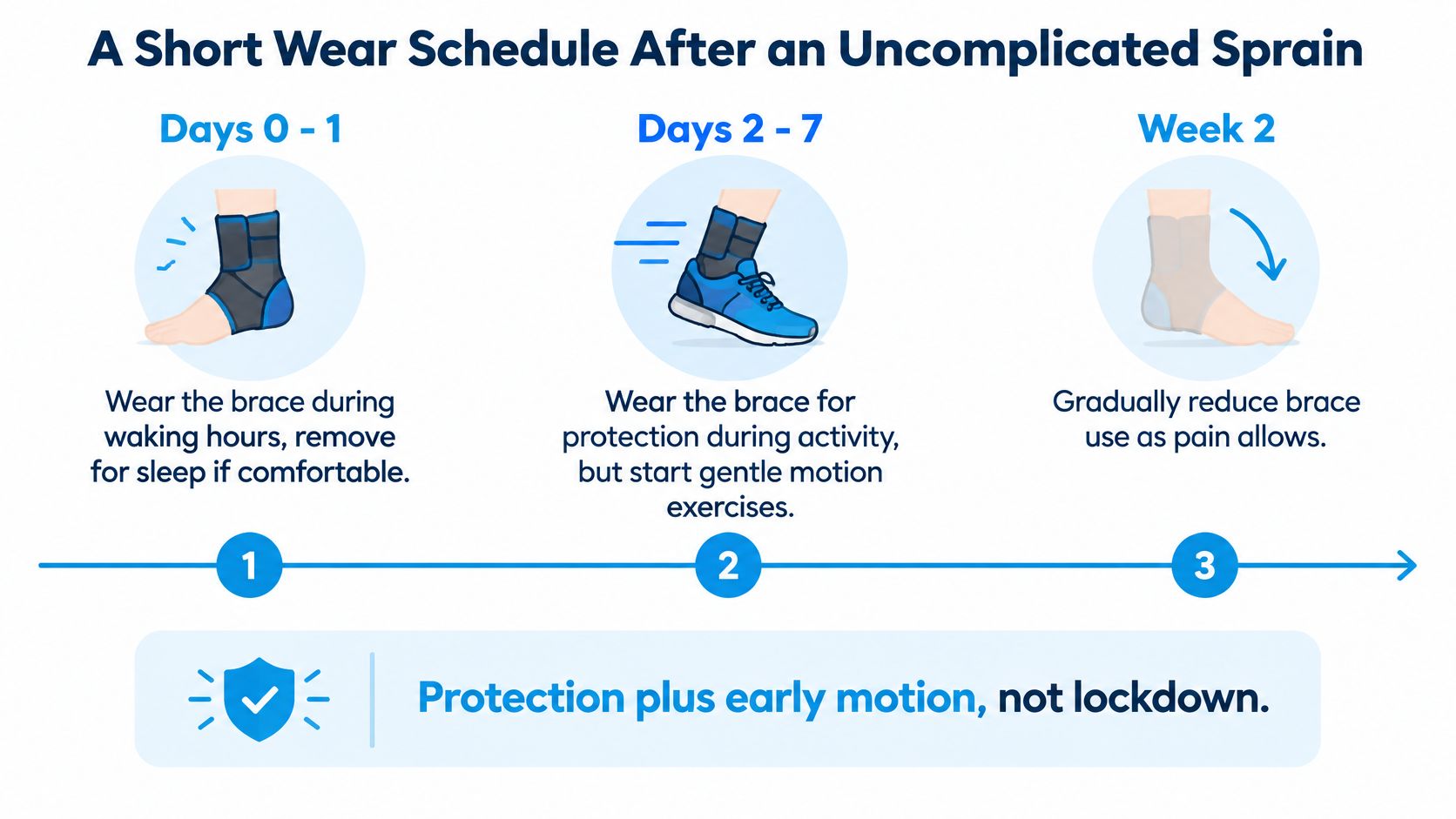
During early exercise, support the arm and move slowly. Flexion and extension mean bending and straightening; pronation and supination mean turning the forearm palm-down and palm-up. Keep those movements within the permitted range rather than stretching to an uncomfortable endpoint.
As the elbow settles, reduce support during easy, controlled tasks before more demanding ones. Taking the brace off for a supported exercise session isn't the same as being ready to carry luggage.
Ligament instability needs its own prescription
Collateral-ligament injuries don't belong on a generic home calendar. A clinician may prescribe a particular forearm position to reduce stress on the injured side and block extension where the joint is vulnerable. Don't copy that positioning from someone else's rehabilitation plan.
Progress when the elbow tolerates the current demand, not because you've reached another square on the calendar.
Keep a daily record of pain, bending and straightening range, and time wearing support. A spike in pain, returning swelling, or a giving-way sensation means don't advance the load; shrinking motion warrants reassessment.
For symptom-management options alongside the movement plan, our hot and cold therapy guide provides additional context. Symptom relief shouldn't be used to push farther than the prescribed range.
Before following any exercise demonstration, confirm that its movements match your clinician's restrictions.
Tips That Keep the Elbow Moving
The easiest mistake is wearing the brace all day and skipping movement because the elbow finally feels quieter. That can make protection feel successful while function gets worse.
The New York Workers' Compensation Board elbow treatment guideline links prolonged immobilization with loss of elbow motion and possible adhesive capsulitis, while recommending gentle protected movement. It also notes a lack of high-quality trials, so there's no dependable universal success rate for a particular brace design.
Make movement easy to repeat
Use comfortable, supported movements rather than an ambitious stretching session. Bend and straighten within your permitted arc, turn the palm as allowed, and move the shoulder so the whole arm doesn't remain pinned to your side.
- Keep sessions gentle. Stop a repetition that causes sharp pain or makes the joint feel unstable. Don't bounce against the stiff endpoint.
- Reduce pulling loads. Split groceries into lighter loads or use the other arm. A bag hanging from the hand can stress the elbow even when it isn't actively bending.
- Change pushing tasks. Don't drive a heavy door open with the injured arm or push yourself up from a chair through that hand.
- Keep the shoulder involved. Comfortable shoulder movement helps avoid guarding the entire upper limb while protecting the elbow.
Our elbow stretches guide can help you understand movement options, but an acute sprain calls for the movements you're cleared to perform, not every stretch you can find.
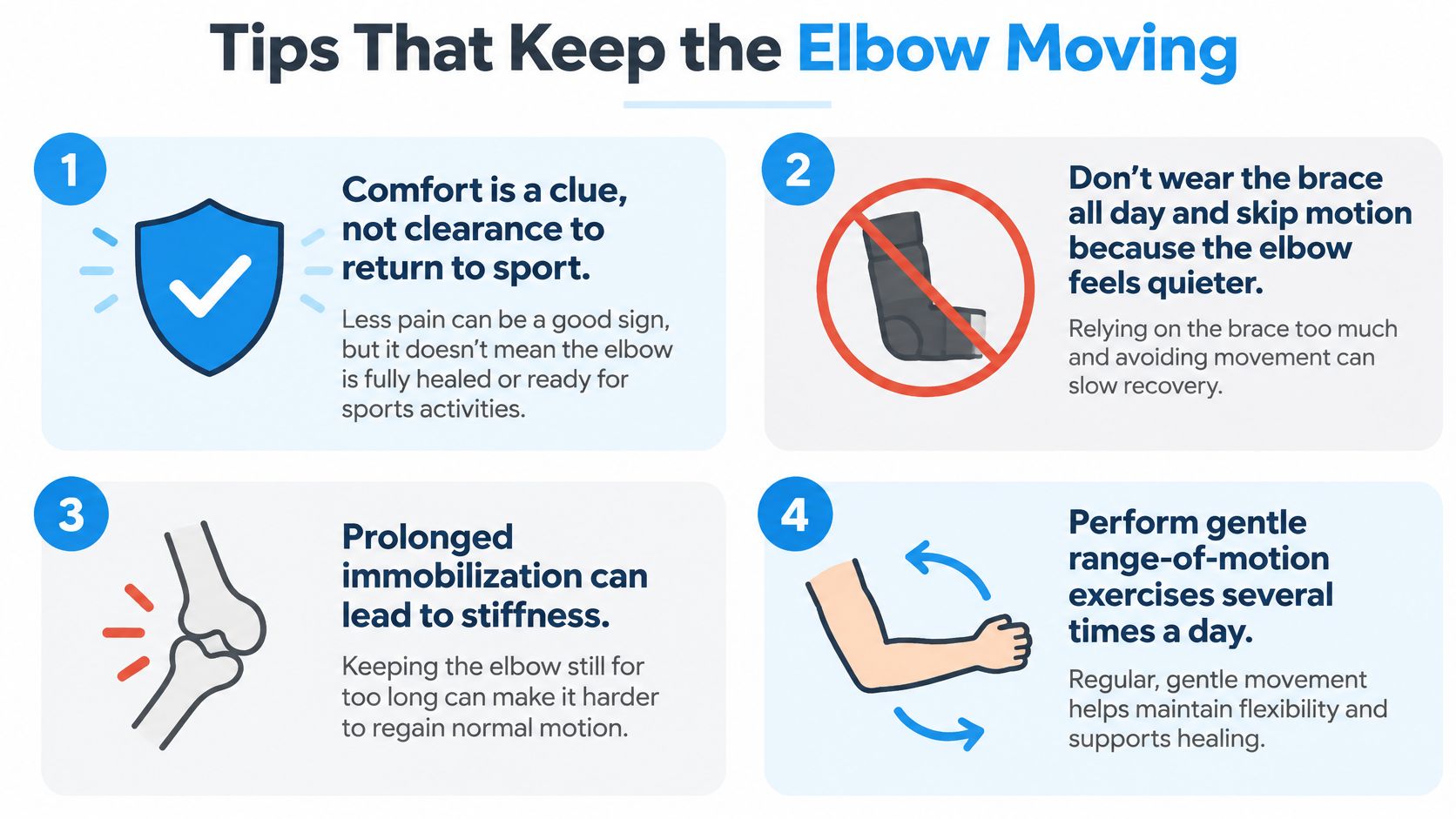
Keep these principles visible where you do your exercises.
Separate comfort from readiness
A sleeve that makes typing easier hasn't established that the ligament can tolerate throwing. Return to demanding activity requires a progression in load and control, not just less pain while supported.
For a broader explanation of increasing rehabilitation demands gradually, Restore Osteopathic Medicine's resource on staged ligament rehab progression offers useful context. Use general rehabilitation education alongside an injury-specific plan, especially when instability is involved.
Measure progress by function: Easier daily movement and an expanding comfortable arc matter more than how secure the fabric feels.
Keep the garment and skin clean. Wash the sleeve according to its label, let the skin dry fully before putting it back on, and check for irritation where fabric folds or straps press.
If warmth under the sleeve becomes a rash, take it off rather than wearing through the irritation. If nighttime tingling appears, reassess fit and whether overnight wear was appropriate. Neither problem is solved by pulling harder on the straps.
When Home Bracing Should Stop
Home bracing stops being appropriate when the symptoms suggest more than a stable, improving sprain. Buying a firmer device won't resolve uncertainty about a fracture, dislocation, unstable ligament, or affected nerve.
Make the decision from the symptoms and the injury mechanism, not from whether a sleeve makes the elbow feel better for a while.
Get urgent assessment for these signs
- Visible deformity or suspected dislocation. Don't try to straighten or relocate the joint yourself. Support the arm comfortably and seek urgent care.
- Inability to move after trauma. A joint that won't bend or straighten needs examination rather than forced stretching.
- Severe pain or rapidly increasing swelling. After a fall or direct blow, these symptoms require assessment for a more substantial injury.
- A cold or discolored hand. Possible circulation problems need emergency evaluation, not a different sleeve size.
- Persistent numbness or substantial weakness. Loosen or remove constricting support immediately. Symptoms that remain need urgent assessment.
A suspected dislocation needs imaging to check for an associated fracture. Keep the arm supported while arranging care, but don't interpret temporary comfort as evidence that the bones and ligaments are properly aligned.
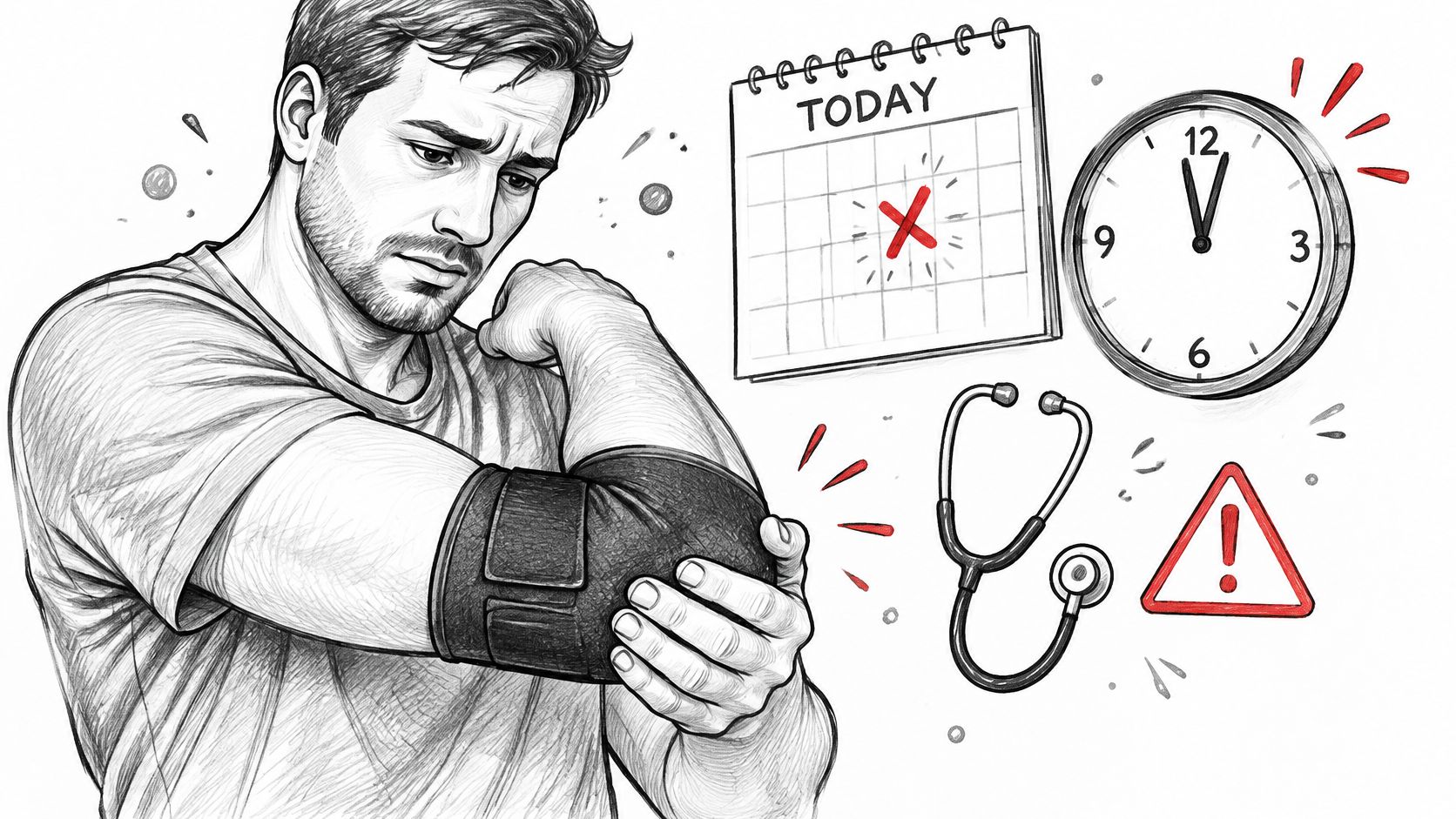
Use this reminder when deciding whether another day at home is reasonable.
Arrange a routine review when improvement stalls
Book an assessment if pain or a giving-way feeling persists despite several days of relative rest. An elbow that bends or straightens less easily over time also needs review, even if the resting ache is manageable.
Bring your symptom-and-motion record and the brace you've been wearing. Describe what provokes the problem: pushing a door, carrying a bag, rotating the forearm, or reaching overhead. Those details are more useful than saying the support isn't strong enough.
Elbow trauma isn't confined to competitive sport. A nationwide South Korean healthcare analysis covering 2011–2020 found that the coded category S53, elbow injury, dislocation, and sprain, increased approximately 32%, even while its age-standardized prevalence declined; treatment costs for the analyzed elbow conditions also rose significantly. That finding describes healthcare burden, not your individual injury severity or likelihood of recovery.
For nonurgent symptom-management questions, our guide on how to help elbow pain can help you organize practical next steps. It doesn't replace examination when traumatic or neurological warning signs are present.
Stable and improving can remain on an appropriate home plan. Unstable, neurologic, or severe post-traumatic symptoms need assessment before another brace is bought.
Pick a Sleeve You Can Keep Wearing
Once a mild, stable sprain has been established, the remaining purchase decision is practical. You need support that's comfortable during light tasks, easy to remove for movement, and sized without squeezing the arm.
I would choose by fit and intended use rather than the strongest-sounding recovery claim. A sleeve that bunches at the crease or encourages you to ignore pain is a poor match, even if it feels reassuring when you first put it on.
A comfort option for the cleared mild case
Our Thermo Lite Recovery Elbow Sleeve, currently $24.99, is a compression-lite, infrared-responsive option intended for comfort and circulation support during recovery. It isn't a hinged immobilizer, doesn't set a protected motion arc, and shouldn't replace prescribed movement or a clinician's bracing plan.
A customer who used the product on a sprained wrist and sprained elbow after a fall reported immediate results and said it wasn't expensive and did the job. That's an individual account of perceived benefit, not evidence that the sleeve diagnoses an injury or guarantees faster ligament healing.
A useful sleeve makes appropriate daily activity more comfortable. It doesn't make inappropriate activity safe.
Buy for the routine you actually have
Before ordering, identify when you expect to wear soft support: preparing food, working at a desk, or doing light household tasks. If the activity requires heavy lifting, forceful pushing, or repeated throwing, changing the activity matters more than choosing a sleeve.
- Check sizing carefully. Measure as directed rather than choosing a smaller size for extra pressure.
- Test ordinary movement. Make sure the garment stays comfortable when you bend the elbow and sit at your desk.
- Use the fit safeguards. Normal hand color, warmth, and sensation matter more than a feeling of tight support.
- Keep recording progress. Continue noting pain, motion, and wear time so comfort doesn't become your only measure.
We offer U.S. shipping, free shipping on orders of $49 or more, and a 30-day return window if the fit isn't right. Those policies make it easier to assess comfort without committing to a garment that presses or slips.
Keep the boundary clear: a soft sleeve isn't injury prevention, and it can't replace imaging when warning signs apply. Choose it for an already-cleared, mild injury that's improving, not to postpone finding out what happened.
Thermo Recovery Wear offers recovery sleeves for comfort during rest and light daily activity, including elbow support for an appropriately assessed mild sprain. Visit Thermo Recovery Wear to review the sizing and support options, then choose a sleeve that fits your recovery plan without replacing movement or necessary medical care.


