


Put on a counterforce strap, lift a full kettle, and the sharp pain on the outside of your elbow can drop within seconds. So why does the same elbow still hurt three months later, the moment the strap comes off?
Because a brace changes where force lands during a task. It doesn't change the tendon. That distinction is the whole game. It decides which elbow pain relief brace you buy, when you wear it, how tight it should be, and when you should stop expecting it to fix anything.
Many shoppers choose an elbow brace by tightness and price. Both are the wrong starting point. What follows is the version a physiotherapist would give you across the treatment table, starting with the four designs you'll find and ending with the point where a brace stops being the answer.
Table of Contents
- Brace Types and What Each One Does
- Match the Brace to Your Elbow Condition
- What Research Says About Elbow Brace Pain Relief
- Trial Steps and Fit Checks
- When Elbow Pain Needs a Clinician
- Confirm Your Diagnosis Before Buying a Brace
Brace Types and What Each One Does
An elbow brace can make a painful task easier without repairing the tendon. For outer elbow pain, clinical reviews describe bracing and anti-inflammatory medication among the nonsurgical options (clinical review of lateral elbow tendinopathy). Orthoses may be less effective than physiotherapy for pain at six weeks, and the evidence has often been low quality. Use a brace to support activity, not as a substitute for rehabilitation.
The honest job description: a brace shifts some force away from an irritated area during a task. It may make the task more tolerable, but comfort is not proof of healing.
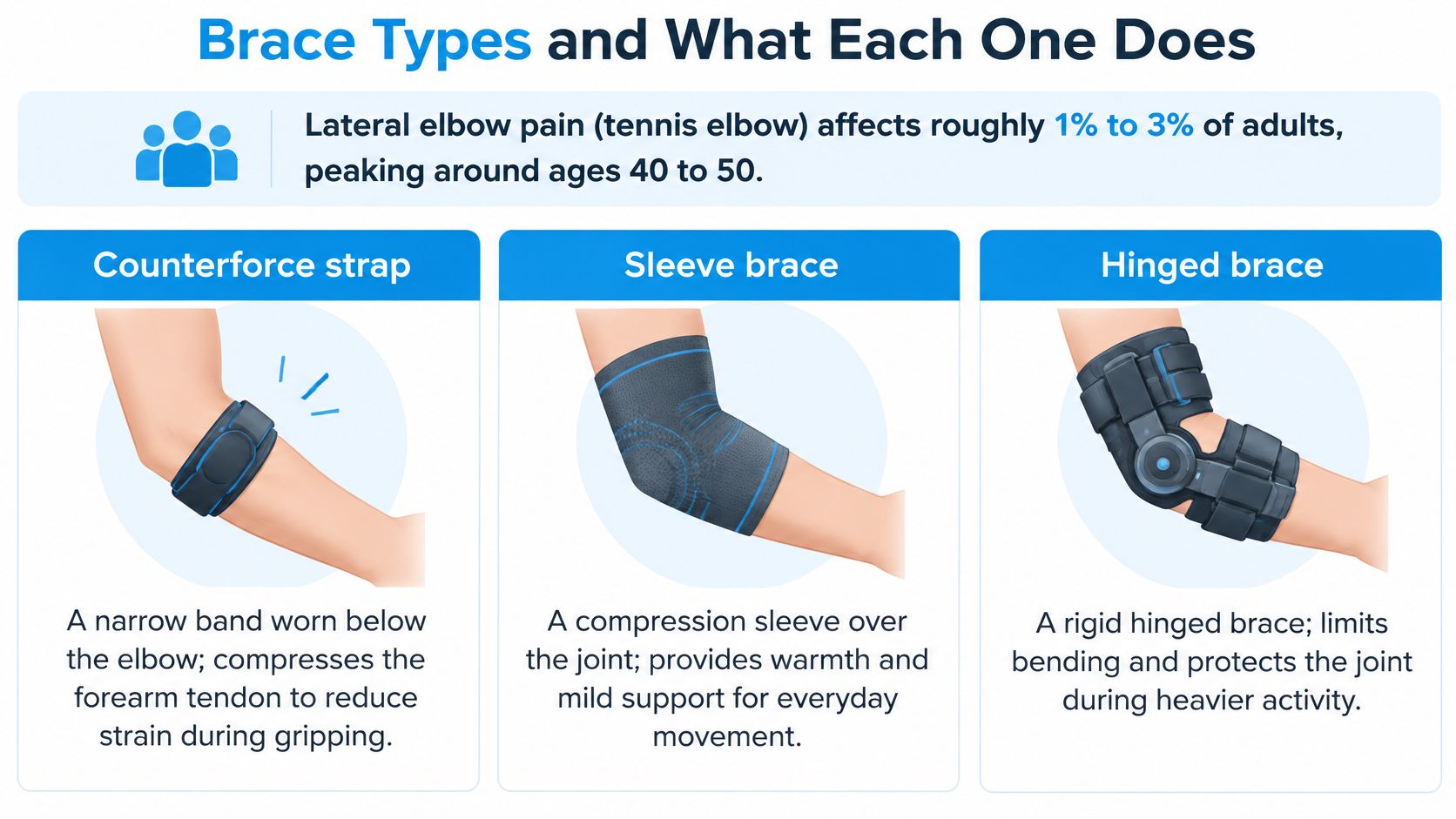
The four forms you'll meet on the shelf
| Brace type | Design | Best for | Trade-off |
|---|---|---|---|
| Counterforce strap | Band worn on the forearm, below the painful outer bony point | Outer elbow pain during gripping, lifting or repetitive wrist movement | Must sit in the correct position; too tight can cause numbness |
| Compression-style sleeve | Elastic sleeve covering the elbow | Diffuse elbow discomfort, warmth and comfort during activity | Pain-free grip gains were comparable to a strap; evidence for superiority is limited |
| Wrist splint | Rigid or semi-rigid support limiting wrist motion | Pain driven mainly by wrist movement | Reduced maximum grip strength compared with elbow supports |
| Night splint | Rigid or semi-rigid elbow or wrist splint | Sleep positioning when a clinician prescribes it | Not for routine overnight use without medical direction |
A strap and a sleeve work differently from a wrist splint: they support the elbow while leaving wrist movement less restricted. In a randomized study of 52 patients, an elbow strap and sleeve both produced greater pain-free grip strength than a placebo orthosis or wrist splint immediately after application (P<0.02). Neither elbow support changed maximum grip strength compared with placebo (JOSPT trial of elbow orthoses). In other words, gripping hurt less, but the arm did not become stronger. The wrist splint also reduced maximum grip strength compared with the elbow supports, which may matter when you need to use your hand during work or sport.
Match the Brace to Your Elbow Condition
Two elbows with the same ache can need different supports. The elbow is a junction for several distinct problems, and each one loads different tissue, so a single "tennis elbow brace" recommendation misses most of them.
Outer elbow pain that spikes on a grip
Lateral epicondylitis hurts at the outer bony point and flares when you grip, lift with your palm down, or turn a doorknob. A counterforce strap or a sleeve worn during those tasks is the usual approach. Clinical guidance reports conflicting evidence for orthoses in lateral elbow tendinopathy and states that an orthosis alone doesn't appear as effective as physical therapy for improving pain and function (JOSPT clinical practice guidance on lateral elbow pain). The same guidance describes a randomized trial in which counterforce bracing beat placebo bracing for short-term pain, particularly across the first 2 to 12 weeks, with functional benefits at 26 weeks. That's a real effect during the irritable phase, not a permanent fix.
Inner elbow pain and the nerve pattern
Medial epicondylitis, golfer's elbow, hurts at the inner bony point and flares with wrist flexion, throwing and heavy gripping. Support it during provoking activity only, and take it off for sleep. Cleveland Clinic advises against overnight wear for golfer's-elbow braces because of circulation concerns.
Ulnar nerve irritation looks different again: tingling or numbness in the ring and little fingers, often with inner-elbow pain after the arm has been bent for long periods. A brace there should only go on if a clinician tells you to, and numbness that persists needs assessment rather than a tighter strap.
When the pattern doesn't fit
Arthritis brings stiffness, morning ache and swelling, and a brace is support alongside medical management. A fall or a knock that leaves sudden pain, bruising or lost movement is an injury to assess before you wrap anything around it. For the tendon-level background behind both tennis and golfer's elbow, our guide to golf elbow and tennis elbow is a useful companion.
| Pain location | Likely condition | Brace approach | Next step |
|---|---|---|---|
| Outer bony point, worse gripping | Lateral epicondylitis (tennis elbow) | Counterforce strap or sleeve during gripping and lifting | Trial for several weeks, then reassess |
| Inner bony point, worse wrist flexion | Medial epicondylitis (golfer's elbow) | Brace only during provoking activity, not overnight | Assessment if pain persists |
| Inner elbow with tingling in ring and little fingers | Ulnar nerve irritation | Brace only if a clinician advises it | Prompt assessment for persistent numbness |
| Stiffness, morning ache, swelling | Arthritis | Support as directed by a clinician | Medical assessment for diagnosis and plan |
| Sudden pain after a fall or knock | Acute injury | Do not self-treat without assessment | Urgent medical review if deformity, weakness or severe swelling |
A pattern that doesn't match this table is a reason to get assessed, not a reason to buy a third brace.
What Research Says About Elbow Brace Pain Relief
Braces help some people in some settings. The evidence is mixed, samples are small, and the strongest studies rarely flatter the product. Knowing what each trial measured keeps you from over-reading your own improvement.
A crossover randomized trial of 63 people whose elbow pain had lasted more than six weeks found statistically significant improvements in pain, pain-free grip strength and function after 12 weeks of brace treatment compared with no treatment, at a significance threshold of P<0.042 for changes over time (review of lateral elbow pain evidence). The review citing it also names the weaknesses: participants weren't blinded, and outcomes appeared in graphs rather than full tables.
What the trials actually measured
Comparison studies are less generous. The same review reports no statistically significant short-term pain benefit for counterforce bracing against other physical-therapy interventions, with a standardized mean difference of 0.02 (95% CI, −0.85 to 0.80), and long-term outcomes favoring other physical therapy, with a standardized mean difference of 1.17 (95% CI, 0.00 to 2.34).
Immediate laboratory gains deserve the same caution. A randomized controlled trial of 34 people with lateral epicondylalgia found pain-free grip strength rose by 17.2 N (95% CI, 7.5 to 26.8 N) and pressure-pain threshold by 42.2 kPa (95% CI, 16.5 to 68.0 kPa) straight after brace interventions, but the control condition produced the same improvements and no brace outperformed it (randomized trial of elbow bracing outcomes). Expectation and general support move early numbers as much as the strap does.
Longer follow-up is kinder to bracing. A prospective randomized trial in that same report found improvements in pain frequency, pain intensity, lifting and twisting difficulty, elbow function and grip-related tenderness with counterforce bracing at 6 months and 3 years.
| Source | Population | Result | Limitation |
|---|---|---|---|
| Crossover randomized trial (cited in a clinical review) | 63 people with elbow pain over six weeks | Significant gains in pain, pain-free grip and function after 12 weeks | No participant blinding; graphical outcome reporting |
| Recent evidence review, short term | Counterforce bracing vs other physical therapy | No significant pain benefit (SMD 0.02, 95% CI −0.85 to 0.80) | Wide confidence interval |
| Same review, long term | Counterforce bracing vs other physical therapy | Other physical therapy favored (SMD 1.17, 95% CI 0.00 to 2.34) | Lower bound reaches zero |
| Randomized controlled trial | 34 people with lateral epicondylalgia | Grip up 17.2 N and pressure-pain threshold up 42.2 kPa immediately after brace use | Control condition showed the same gains |
| Prospective randomized trial | People with lateral elbow pain | Improved pain, function and tenderness at 6 months and 3 years | Brace used as an adjunct, not on its own |
Reading the results sensibly
Put the pieces together and the brace lands in one place: a low-burden complement to exercise, activity change and rest. It's most defensible when comfort and adherence matter, because a strap that lets you finish your loading programme beats a rest period that lets the tendon decondition. It's weakest as a substitute for diagnosis or rehabilitation.
How to hold the evidence: if a brace lets you complete your exercises and your workday with less pain, it's earning its place. If you're relying on it instead of loading the tendon, it's covering for a plan you haven't started.
For the sleeve side of that question, our breakdown of whether compression sleeves help elbow tendonitis covers material, fit and what a sleeve can realistically add.
Trial Steps and Fit Checks
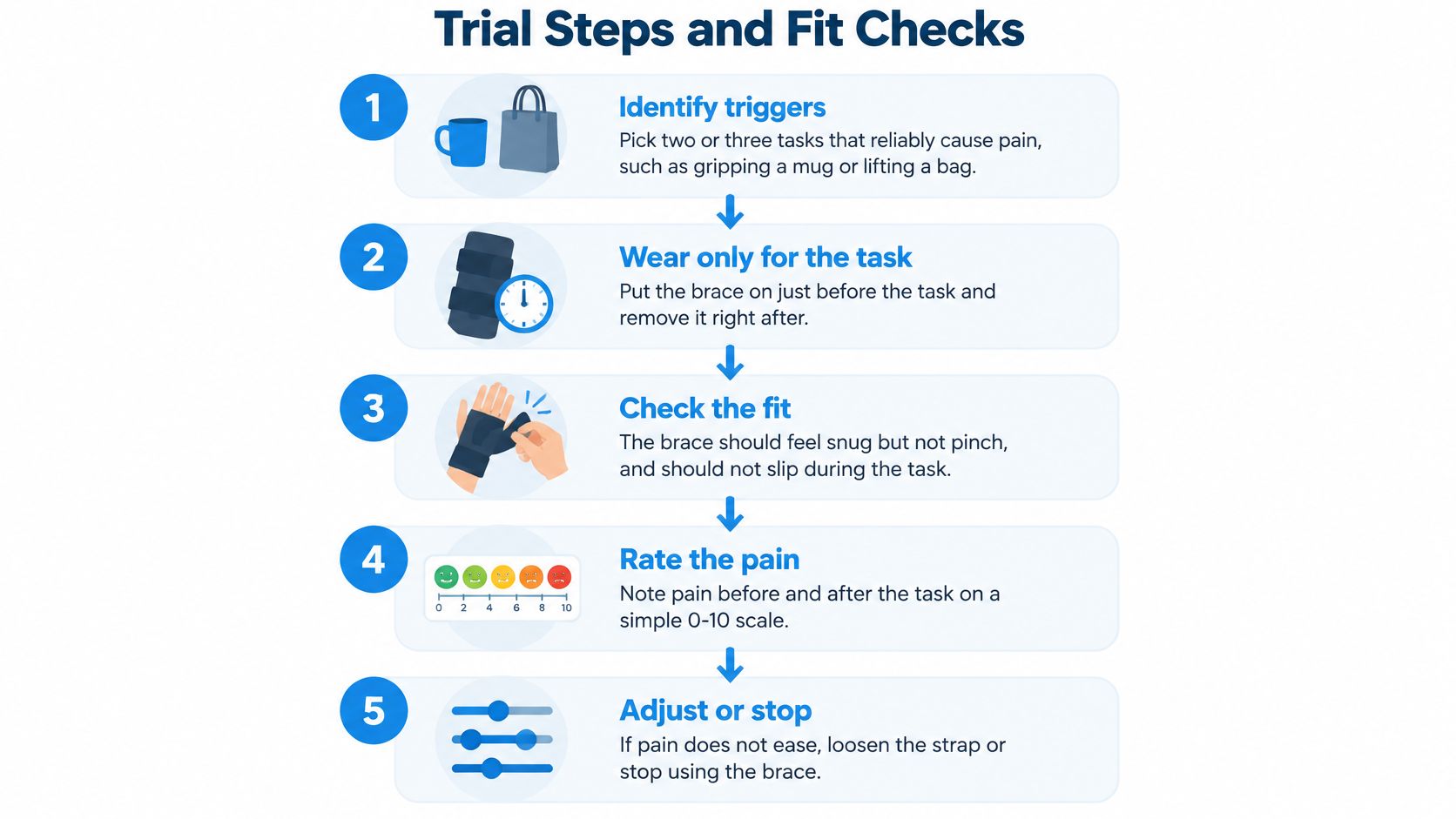
You pick up a coffee mug and the outer elbow bites. That one job is a clearer test than a vague sense that the arm hurts. Run the brace as a timed experiment on two or three tasks that provoke pain, and keep exercise, load changes and rest going beside it. After four to six weeks, ask whether those tasks are more tolerable. The guide on how to wear an elbow brace covers placement and daily use in more detail.
More hours in the brace do not buy more healing, and they can cost circulation. Cleveland Clinic's golfer's-elbow brace guidance advises against wearing a golfer's-elbow brace overnight because it may negatively affect circulation, notes that prolonged use may have negative effects, and says supports should not be worn in bed. The same guidance identifies temporary numbness from nerve compression when a brace is fastened too tightly. It also reviews a British Elbow and Shoulder Society pathway that found no reliable long-term evidence that orthoses outperform placebo or no intervention, despite some short-term findings.
Seeing the strap on a forearm is often clearer than reading the measurements.
Fit rules that prevent most problems
- Name two or three trigger tasks. A mug, a grocery bag, a racquet swing, a screwdriver. "My elbow hurts" cannot be scored. "The second set of tennis" can.
- Put the brace on before the task, not after the pain starts. A counterforce strap only redistributes load while it is on the arm. Starting ahead of the pain means the tendon does not take the full pull of that first hard grip.
- Place a counterforce strap about a finger-width below the painful outer bony point. Sit it on the muscle belly. Keep it off the tender bony bump and off the joint line. It works a bit like fretting a guitar string partway along its length: force still travels, but less of it lands on the sore attachment. Easier grip during the task is comfort, not proof the tendon has healed.
- Set tension snug and supportive, never squeezing. Slide a fingertip under the edge. The strap should not limit wrist motion or dig a groove into the forearm. Extra tightness often feels like more support. It is pressure on skin and nerve, not extra repair.
- Measure before you buy. Measure forearm circumference at its widest point and choose the size printed for that measurement. A sleeve that rolls, slides or leaves gaps needs a different size, not a harder pull.
- Run a two-minute circulation check. Look at skin colour, temperature and swelling, and notice tingling or numbness. Any of those means loosen it or take it off.
- Remove it for rest. Brace on for the provoking task, off for the sofa. Sleeping in a support is out unless a clinician prescribes a night splint.
- Review at four to six weeks. Write down pain during the trigger task, morning stiffness and how long you can grip before fatigue. Numbers on paper beat a memory of "a bit better."
Sleep is a separate decision
Overnight wear belongs to a prescribed night splint for a specific problem, not to a counterforce strap used for daytime tasks. Asleep, you miss the early warning of a strap that is too firm, and forearm circulation is easy to compromise. Routine sleep in a support is not a supported way to speed tendon healing.
During the hard task, the arm can feel calmer within minutes. That is immediate comfort. The change that lasts comes from progressive tendon loading, from changing how you grip, carry or swing, and from enough quiet between sessions for the tendon to adapt.
Practical rule: if you still need the brace to get through the day and trigger-task pain is no better after six weeks, the brace is not doing its job. The trial has not changed the pain. Arrange a clinician review rather than adding more hours in the strap.
When Elbow Pain Needs a Clinician
A brace supports a diagnosis. It can't make one. Some symptoms mean stop adjusting straps and get the elbow looked at.
- Numbness or tingling that lingers after you remove the brace. Nerve compression doesn't settle while the pressure keeps coming back.
- Weakness in the hand, or dropping objects you used to hold. This is a change in function, not a sore tendon.
- Swelling, warmth or redness around the joint. These point toward inflammation or infection rather than a simple tendinopathy.
- A visible deformity, or an arm you can't straighten after a fall or knock. Image and assess before you brace it.
- Night pain that wakes you and doesn't ease with rest. Pain that ignores rest needs a proper look.
- No meaningful improvement after several weeks of a structured trial with exercise and load changes.
- Pain spreading into the forearm, shoulder or neck. The driver may sit somewhere other than the elbow.
A clinician can confirm the diagnosis and decide whether physiotherapy, injection, imaging or a surgical referral is the right next move, and can tell you whether a brace helps at all in your case. Pain that runs from the wrist up the forearm rather than sitting at one bony point is its own pattern; our guide to pain from the wrist to the elbow covers the common nerve and tendon causes.
Where the diagnosis is uncertain, a brace is not a substitute for assessment, and persistent neurological symptoms always need medical advice.
Confirm Your Diagnosis Before Buying a Brace
Before choosing a brace, pin down what is causing the pain. These steps help match support to the problem rather than expecting a sleeve to fix every elbow condition.
- Confirm the condition. Use the location table above to identify where the pain sits. If the pattern is unclear or numbness is present, seek a clinician's assessment before choosing support.
- Match the brace to the trigger. A counterforce strap may suit outer-elbow pain that worsens with gripping. A sleeve may feel more comfortable for diffuse discomfort. Use a wrist or night splint only if a clinician recommends one.
- Check the size chart before ordering. Measure your forearm and compare it with the chart on the product page. A comfortable fit should support the elbow without forcing it tight.
- Set a trial period of four to six weeks. Pair the brace with exercise and ergonomic changes, and track pain, grip tolerance, and any numbness. Reassess on a date you set. A brace may ease discomfort during activity, but that immediate comfort does not show that the tendon has healed.
Swelling over the bony point at the back of the elbow may have a different cause. Read about olecranon bursitis before treating it like tendon pain.
Thermo Recovery Wear's Lite collection includes ankle, elbow, wrist, back, dual shoulder, and knee sleeves. The Thermo Lite Recovery Elbow Sleeve is priced at $24.99. Compare its size chart and sleeve type with the needs identified in your trial plan before ordering.


