


Infrared technology uses electromagnetic radiation with wavelengths between visible red light and microwaves, roughly 700 nanometers to 1 millimeter, and it's used to sense heat and, in some therapies, to deliver light.
But if a thermal camera, a treatment laser and a recovery sleeve all use infrared, are they doing the same thing? They aren't. Understanding the difference starts with separating what detects radiation, what delivers light and what responds to body heat.
Table of Contents
- What Infrared Technology Is and Where It Sits on the Spectrum
- Infrared Bands From Near to Far
- How Infrared Light Affects Tissue and Circulation
- Infrared-Responsive Fabrics in Everyday Recovery Wear
- What Clinical Evidence Shows for Joint Pain and Circulation
- Safety Limits and Evidence Gaps to Check
- Deciding Whether Infrared Wear Fits Your Routine
What Infrared Technology Is and Where It Sits on the Spectrum
Think of sunlight passing through a prism. The familiar rainbow appears, with red at one end, but the radiation doesn't stop where the visible colors end. Beyond red lies a region your eyes can't detect.
In 1800, William Herschel placed a thermometer beyond the red portion of prism-separated sunlight and measured a higher temperature than in the visible colors, revealing invisible radiation carrying heat, as described in NASA's introduction to the electromagnetic spectrum. That experiment established an important idea: a detector can reveal something your eyes miss.
The spectrum diagram places that invisible region beside its visible neighbor.
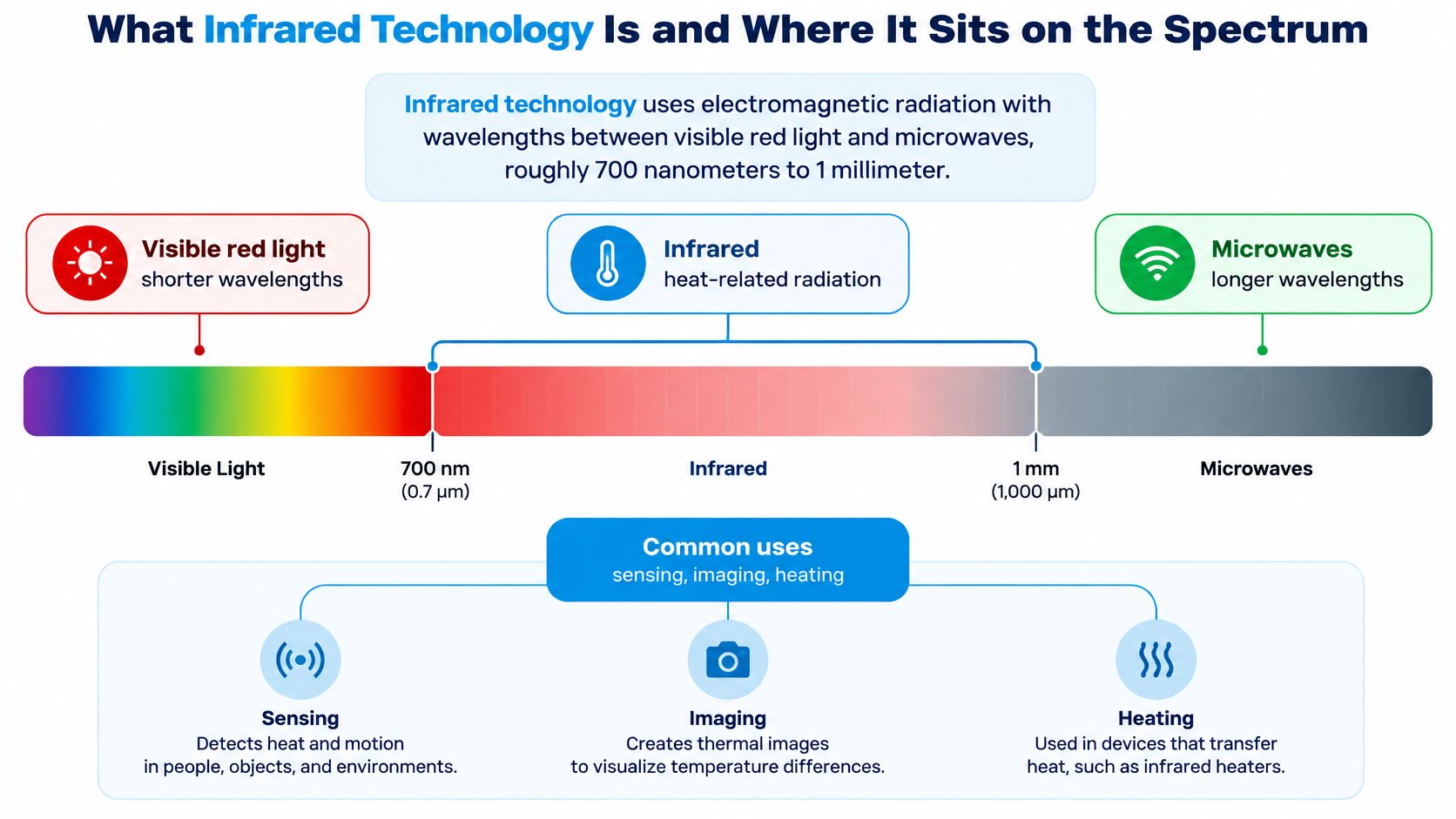
From invisible radiation to useful measurements
Objects emit radiation according to their temperature. A person, a radiator and even a cold night sky emit infrared, although their emissions differ. A thermal detector measures those differences and software converts them into information people can interpret.
Say you're checking a drafty house. A thermal camera doesn't photograph heat in the same way a phone photographs a doorway. It detects infrared arriving from surfaces and displays a color-coded representation that can help identify areas needing closer inspection.
The same broad principle supports several applications:
- Building inspection: Thermal images help locate unusual surface-temperature patterns associated with heat loss.
- Industrial maintenance: Inspectors look for temperature differences that warrant investigation.
- Earth observation: Instruments examine radiation from the surface and atmosphere.
- Astronomy: Infrared instruments reveal cool objects and material that visible-light observations can miss.
- Material analysis: Infrared signatures help distinguish how substances absorb, reflect or emit energy.
Not every infrared device measures heat
A TV remote sends coded infrared pulses to a receiver. An infrared heater supplies radiant energy. A thermal camera detects radiation rather than supplying a therapeutic exposure.
These examples explain why infrared names a region of the spectrum, not a single operating method. The source, detector, and intended task determine what the technology does.
Mental model: Visible light is the window your eyes can see through. Infrared is the neighboring region that requires a different instrument, not a universal synonym for treatment.
So, when asking “what is infrared technology?”, the useful follow-up is: does this device send, detect or interact with infrared?
Infrared Bands From Near to Far
Wavelength changes how infrared interacts with a target and which detector can measure it. The engineering bands below use the approximate wavelength boundaries described in NIST's infrared detector reference.
| Band | Wavelength | Typical use |
|---|---|---|
| Near-infrared (NIR) | 0.7–1.1 µm | Reflected-light sensing and spectroscopy |
| Short-wave infrared (SWIR) | 1.1–2.5 µm | Imaging through haze and material inspection |
| Mid-wave infrared (MWIR) | 2.5–7 µm | Imaging hot objects and gas detection |
| Long-wave infrared (LWIR) | 7–15 µm | Thermal cameras that read emitted heat |
| Far infrared | Above 15 µm | Thermal sensing and heat-emission research |
The symbol µm means micrometer, a unit used to describe these small wavelengths. The boundaries are classification conventions, not sharp physical walls where radiation suddenly changes character.
How to read the bands in practice
Near-infrared instruments often work with light reflected from a target. Short-wave infrared also supports reflected-light imaging and material inspection, where differences between substances can become easier to distinguish than in an ordinary photograph.
Mid-wave instruments serve applications involving thermal emission and molecular absorption. Long-wave thermal cameras primarily examine emitted radiation from objects, while longer-wave systems support specialized thermal measurements.
Health publications may instead use IR-A, IR-B and IR-C terminology. Those categories don't line up neatly with every engineering classification, so compare the actual wavelength specification rather than assuming similarly named bands are identical.
Questions that make a claim checkable
An infrared label alone tells you too little. A credible product description should identify its operating band and distinguish emission, reflection and heat retention.
- Which band? Request the actual wavelength range, not just an infrared logo.
- How much energy reaches the target? Output at the source isn't necessarily exposure at the skin or inspected surface.
- How was it measured? Look for the instrument, distance, geometry and test conditions.
A sleeve that retains warmth and a lamp that delivers measured optical energy might both feel comfortable. That doesn't make their mechanisms interchangeable.
How Infrared Light Affects Tissue and Circulation
Photobiomodulation, often shortened to PBM, uses light to influence biological activity rather than heating tissue. It commonly involves non-thermal red or near-infrared light, with a reported range of 600–1,100 nanometers in the systematic review of photobiomodulation and chronic pain.
Red light belongs to the visible spectrum, so PBM isn't exclusively infrared. Nor does every infrared treatment qualify as PBM: a heat-producing device may act mainly through temperature.
The proposed biological pathway
The proposed pathway involves several connected responses, not a guaranteed sequence that happens whenever skin encounters infrared:
- Light absorption: Photons may be absorbed by mitochondrial cytochrome-c oxidase. Mitochondria are often compared with cellular power stations; this enzyme is part of their energy-processing machinery, not a literal solar panel.
- Electron-transport activity can change, affecting ATP production. ATP functions like a spendable energy currency within cells.
- Chemical signaling shifts: Reactive oxygen species and nitric-oxide signaling may be modulated. Think of changes to internal messages rather than adding more energy.
- Blood vessels may dilate, potentially changing local blood flow and tissue oxygenation. The analogy is widening a delivery route, although the biological response depends on exposure conditions.
- Inflammatory mediators may change. These are signals involved in coordinating tissue responses, not an on-off switch for inflammation.
The diagram offers a simplified view of these proposed interactions, not proof that every infrared product improves circulation.
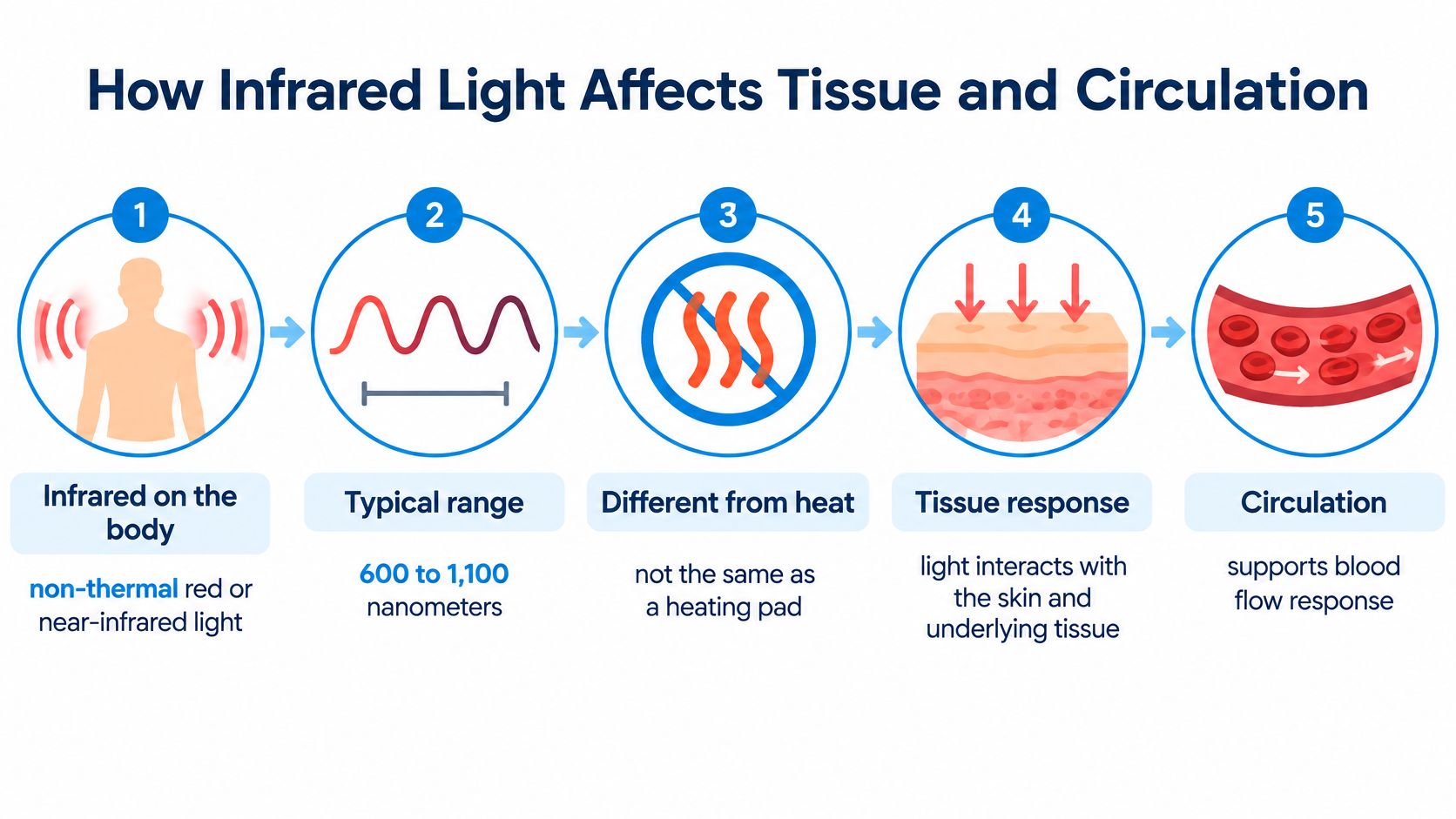
Mechanism isn't the same as treatment success
A plausible cellular pathway doesn't establish that a particular product relieves pain. Researchers still need to show that the intended exposure reaches tissue and produces a meaningful clinical result.
For an example of how a clinic describes active-light treatment, Aspen Falls Wellness explains laser therapy for chronic back pain. Use that resource to understand the treatment format, not as evidence that a passive garment supplies an equivalent exposure.
Likewise, hot and cold therapy involves temperature-based approaches that shouldn't be confused with non-thermal optical treatment.
Useful PBM reporting includes spectral output at the skin, irradiance, energy density, exposure time, tissue temperature and a controlled clinical endpoint. Irradiance describes the rate of energy delivery over an area; energy density describes the delivered amount over that area.
Feeling warmth doesn't tell you the optical dose. A biological explanation is a starting point for testing, not a substitute for it.
Infrared-Responsive Fabrics in Everyday Recovery Wear
An infrared-responsive textile is a material-based approach rather than a powered treatment lamp. The intended mechanism is that the fabric interacts with body heat and emits some energy toward the skin.
This illustration shows the general concept, but a diagram can't establish how much energy a particular garment delivers.
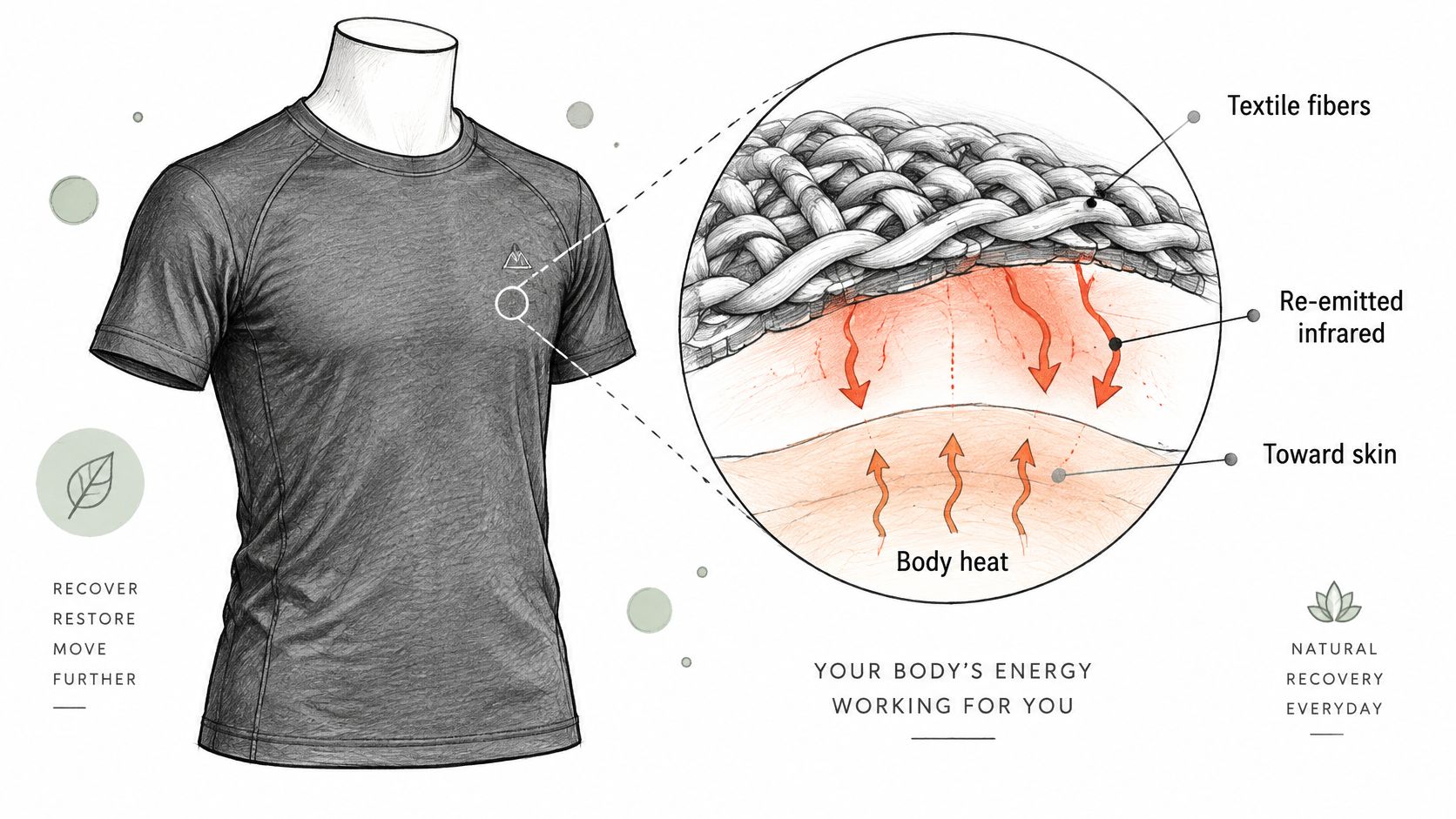
At Thermo Recovery Wear, our bamboo charcoal fabric emits far infrared radiation, and our products aren't categorized as compression apparel. Those are separate characteristics: material emission describes an energy interaction; non-compression describes how a garment applies pressure.
Compare the job, not just the shape
A knee sleeve, wrist sleeve, elbow sleeve or back support may resemble another product while working differently.
| Option | Main action | What to evaluate |
|---|---|---|
| Heating pad | Adds external heat | Temperature control and application instructions |
| Compression sleeve | Applies pressure | Fit, pressure and whether compression is appropriate |
| Infrared-responsive garment | Interacts with body heat through its materials | Measured emission and evidence for the intended use |
A passive textile doesn't create a new external energy supply. Any claim that its material response produces a therapeutic effect needs testing beyond a demonstration that the fabric emits infrared.
Bamboo-charcoal emission claims should therefore be separated from claims about pain relief or circulation. Without published output measurements and relevant clinical testing, you can't determine effectiveness from the ingredient name alone.
Other fabric properties need separate checks
Moisture management concerns how a textile handles perspiration. Antimicrobial performance concerns microorganisms or odor control, while sensitive-skin suitability concerns tolerability.
None of those properties establishes an infrared treatment effect. Equally, a material's infrared response doesn't prove that every wearer will find it comfortable against the skin.
Material names can also obscure these distinctions. The explanation of germanium in recovery fabrics provides context for another ingredient readers may encounter, but ingredient descriptions still need to be distinguished from finished-garment testing.
For a visual introduction to recovery-wear concepts, the video below provides additional context.
Choose the garment by its intended role and documented performance. Don't infer that a soft sleeve supplies the same intervention as a clinical light source just because both descriptions mention infrared.
What Clinical Evidence Shows for Joint Pain and Circulation
The evidence supports investigating specific infrared interventions, not treating infrared as a universally proven remedy. A review of far-infrared biological effects and medical applications discusses potential benefits involving pain, inflammation and healing, while emphasizing that outcomes depend on delivery conditions.
For someone with osteoarthritis or persistent joint discomfort, that distinction matters. Evidence for an intervention must match the condition, treatment method and outcome being claimed.
What stronger evidence looks like
A controlled clinical trial can compare an active-light treatment with a sham treatment or another appropriate comparator. Its practical value depends on whether the researchers describe the intervention well enough to reproduce it and measure outcomes that matter to patients.
A systematic review can bring trials together, but pooling doesn't erase differences between devices, treatment schedules or participants. If the underlying protocols differ substantially, a broad positive conclusion may not tell you which consumer product to choose.
Circulation findings require another distinction. A measured change in blood flow or oxygenation is a physiological outcome. It isn't automatically evidence of less pain, better walking or lasting improvement in joint function.
| Evidence offered | What it can help establish | What it doesn't establish alone |
|---|---|---|
| Controlled clinical outcome | Whether a defined intervention helped participants | That another product performs equally |
| Laboratory circulation measurement | A physiological response under test conditions | Durable symptom relief |
| Textile emission test | That a material emits radiation under stated conditions | Treatment of osteoarthritis |
| Customer testimonial | An individual's reported experience | Cause, average benefit or safety |
The gap between a trial and a garment
A trial using a defined optical exposure cannot validate a garment just because both involve infrared. A garment needs its own relevant measurements and clinical comparison.
Questions about far infrared and cellular health can help frame the discussion, but an explanation of cellular activity isn't a patient-outcome study.
Infrared thermography belongs in a different category again. It records radiation to help assess temperature patterns; it doesn't deliver treatment. A thermal image also doesn't establish the cause of pain by itself.
Judge an infrared claim by the intervention actually tested, not by the shared word infrared.
The balanced conclusion is potential for symptom relief with defined interventions, with less certainty when a garment's exposure and clinical performance aren't documented. Any advertised percentage improvement should lead to a published trial whose participants, comparator and outcome match the claim.
Safety Limits and Evidence Gaps to Check
Stop using a product if your skin becomes excessively hot or irritated. Don't apply heat-producing treatments over damaged or numb skin without clinical advice, and don't interpret increasing warmth as evidence that a treatment is working better.
Those precautions address tissue exposure, not whether infrared sounds natural. A dermatology review of infrared effects on skin links adverse effects, including burns and photoaging, primarily to heating while discussing potential applications of controlled low-irradiance exposure.
Match precautions to the actual product
A passive garment and an electrically powered lamp need different safety assessments. Consider the material against your skin, any pressure it applies, the heat it produces and the equipment instructions.
- Reduced sensation: If you have neuropathy or can't reliably feel temperature, ask a clinician before using a warming product.
- Diabetes or circulation concerns: Get individualized advice rather than relying on a general safe-for-everyone statement.
- Implanted electronic devices: Check compatibility for powered treatment equipment. Don't assume the same concern applies identically to an unpowered textile.
- Persistent joint symptoms: Older adults managing osteoarthritis alongside other treatment should discuss how an additional intervention fits their care.
A product being designed for extended wear doesn't remove the need to inspect your skin and reassess comfort. Remove it if it causes irritation, unusual pressure or worsening symptoms.
Ask for evidence that answers the safety question
Consumer textile testing doesn't always provide standardized exposure measurements, wear conditions or representative skin-tone information. Missing information doesn't prove harm, but it limits confidence in broad safety claims.
Request spectral output, irradiance, energy density, tested wear duration and skin-temperature readings. Also ask whether measurements were taken from the finished garment during realistic use rather than from an isolated material sample.
For more context on practical precautions, review infrared therapy side effects.
Safety and effectiveness are separate questions. A tolerable product may not relieve symptoms, and a potentially useful intervention may still be inappropriate for someone with impaired sensation or vulnerable skin.
Deciding Whether Infrared Wear Fits Your Routine
Infrared-responsive wear is best considered as a possible comfort-focused addition to care, not a replacement for diagnosis, prescribed treatment or rehabilitation. The right decision depends on your symptoms, skin health and expectations.
If you have mild, stable stiffness and want an option without compression, a carefully monitored trial may be reasonable after checking suitability. If you're recovering from an acute injury, have numbness or diabetes, or are considering powered equipment with an implanted device, get clinical guidance first.
Choose according to your actual goal
Someone hoping to feel more comfortable during a walk has a different goal from someone seeking treatment for a new swollen joint. New or worsening symptoms deserve assessment rather than repeated product changes.
Similarly, expecting a garment to cure osteoarthritis creates a test no comfort product should be assumed to pass. Keep exercise, physiotherapy and medical management central to the plan your clinician recommends.
A comparison of types of recovery wear for joint and muscle support can help you distinguish garment categories before choosing one.
Make a trial useful rather than vague
- Describe the problem. Write down the affected joint, what the discomfort feels like and which activities make it better or worse. Use a practical task, such as walking your usual route or getting up from a chair, as a reference.
- Ask your clinician whether the proposed product is appropriate, especially if you have altered sensation, skin damage or unexplained swelling.
- Examine the documentation. Check whether the product's claimed mechanism and supporting tests concern the finished garment and your intended use.
- Set a review date before starting. For example, you might choose a month-long personal comfort trial, provided that duration fits clinical advice and the product instructions. This is a planning choice, not a proven treatment schedule.
Judge the result by a meaningful change in comfort or function, not warmth alone. Record irritation or worsening symptoms too, and don't continue an unhelpful product because its scientific explanation sounds convincing.
For practical purchasing questions, we offer a hassle-free 30-day return policy, and you can text us at 855-640-8844. A return option helps manage a purchase decision; it doesn't replace clinical evidence or establish a therapeutic benefit.
Thermo Recovery Wear offers infrared-responsive sleeves and braces for people exploring a non-compression addition to their recovery routine. Visit Thermo Recovery Wear to compare options for your knee, wrist, elbow or back, and choose according to fit, documented features and your clinician's advice.


