


The most common advice about infrared therapy side effects is also the least useful: “There are none.” Infrared therapy is generally well tolerated when the dose, distance, heat, and device are appropriate, but “infrared therapy” covers very different technologies. A concentrated clinical emitter can create a meaningful burn or eye hazard. A passive recovery textile uses your body's own heat and presents a different, usually more localized set of concerns.
That distinction matters if you're deciding whether a light panel, therapeutic machine, sleeve, or brace belongs in your recovery routine. The safest choice depends less on the word infrared and more on how energy reaches your tissues, how much heat builds up, and whether you can feel a problem developing.
If you're comparing infrared approaches with other pain technologies, the Pain and Sleep Therapy Center's overview of cold laser therapy side effects offers useful context about why treatment method and exposure conditions matter. For a plain-language introduction to the topic, you can also review this beginner's guide to infrared therapy for pain recovery.
Table of Contents
- The Reality of Infrared Therapy Side Effects
- Documented Risks of High-Powered Clinical Devices
- Mild Reactions and Wearable Textile Considerations
- Who Should Avoid Infrared Therapy
- Comparing Active Emitters and Passive Recovery Wear
- Best Practices for Safe Daily Use
- When to Stop Use and Seek Medical Advice
The Reality of Infrared Therapy Side Effects
“Risk-free” is too broad a promise. Controlled research generally describes infrared therapy as low risk, but reviews and device surveillance still identify burns, skin irritation, eye injury, dehydration, low blood pressure, and impaired blood flow as safety concerns. A 2022 review of musculoskeletal applications also identified pain, burn injury, and infection as concerns raised by earlier research, even though the studies reviewed did not document those adverse effects (2022 musculoskeletal review).
The first question should be: What kind of infrared treatment are you using?
An active device produces infrared energy with electricity. Depending on its design, it may use a concentrated light source, a heated emitter, a panel, or another powered system. The output can be directed at a specific body area, and the user may need to manage treatment time, distance, positioning, and eye protection. When those controls fail, the tissue receives more energy than intended.
A passive infrared-responsive garment works differently. Semiconductor materials in the fabric are intended to respond to body heat and return warmth locally. The garment doesn't function like a high-powered lamp shining a concentrated beam at your skin. Its practical risks are more likely to involve heat retention, friction, pressure, moisture, sensitive skin, or delayed recognition of irritation.
The practical distinction: A powered emitter can deliver excessive energy from outside the body. A passive textile mainly modifies the heat already produced by your body.
That doesn't make a garment automatically appropriate for everyone. If you have reduced heat sensation, poor superficial circulation, dermatitis, eczema, fever, an active infection, or cancer-related skin damage, heat and infrared exposure may be unsuitable without clinical advice. The delivery method changes the risk profile, but it doesn't erase the need for screening.
Documented Risks of High-Powered Clinical Devices
Infrared therapy side effects are not equally likely across every product. The clearest documented danger comes from thermal injury linked to powered devices that deliver concentrated or excessive heat. A CMS decision memo reviewing infrared therapy devices reported FDA MAUDE surveillance records involving 46 to 51 burn cases, including 12 burns from the Model 120 home unit and 33 burns from the Model 480 professional unit (CMS decision memo on infrared therapy devices). These reports do not mean that every infrared device has the same risk. They show that burns can occur when treatment intensity, distance, or duration is poorly controlled.
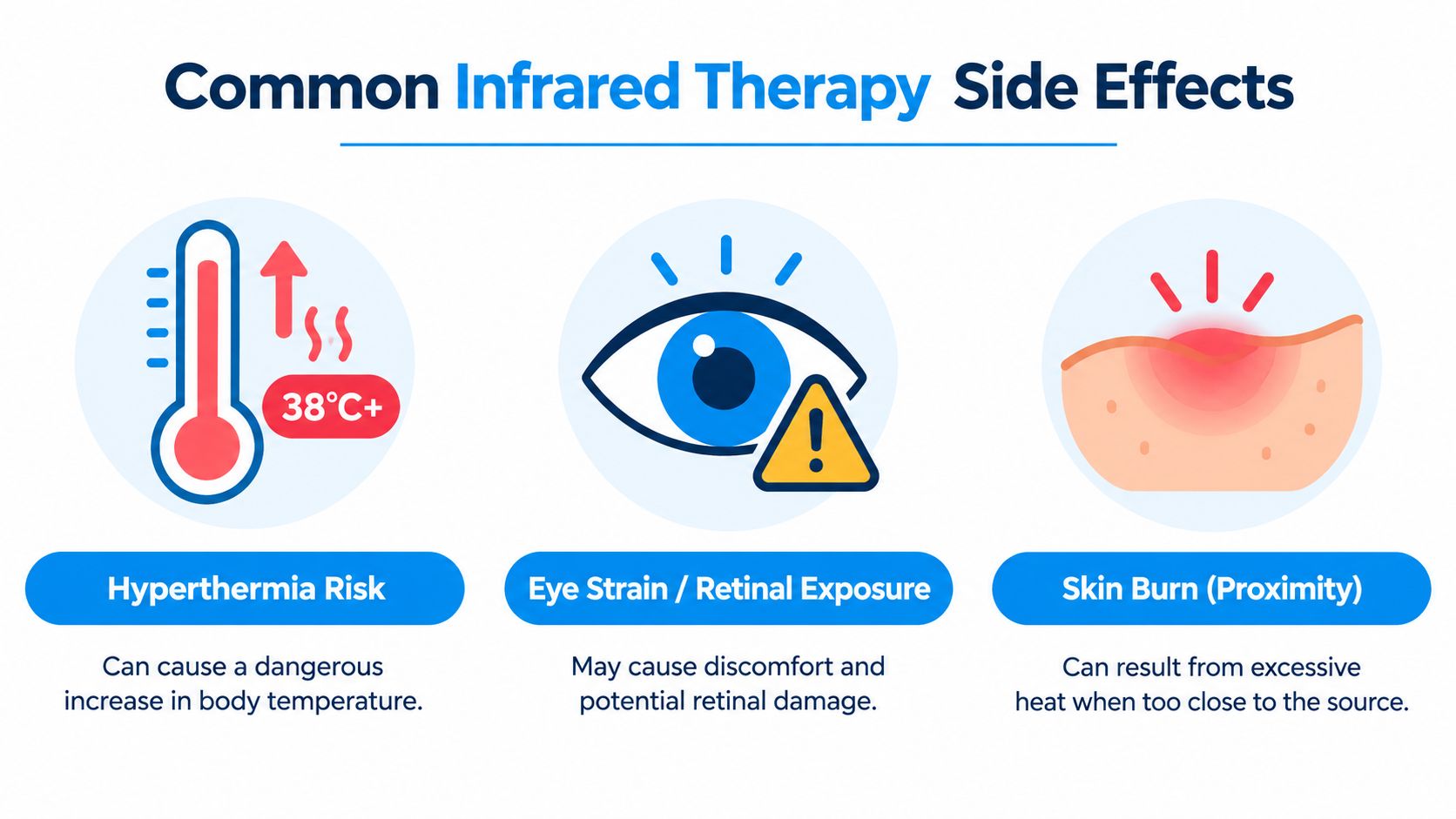
Skin can overheat when the source is too close, a session runs too long, or the user cannot feel discomfort reliably. Reduced sensation removes the body's usual warning signal, much like a faulty temperature alarm that stays silent while a surface keeps heating. Distance and exposure-time instructions therefore function as safety controls, not optional details.
Why the eyes need special protection
The eyes require separate caution because infrared energy may reach ocular structures without the immediate warning produced by visible light. Safety reviews describe possible injury to the retina, lens, and cornea, including retinal thermal burns and visual disturbances after excessive exposure or inadequate protection (ocular infrared exposure review).
Risk increases with high-power sources, close distance, and longer exposure. A panel directed at a knee creates a different situation from a source used near the face, yet comfortable skin temperature does not prove that direct viewing is safe. Follow the device's eye-protection instructions, prevent direct exposure, and stop treatment if you develop visual changes, eye pain, unusual light sensitivity, or persistent eye strain.
The CMS evidence summary also found that controlled studies did not support infrared therapy for treating wounds, ulcers, or peripheral sensory neuropathy, while reported harms were generally burns. The practical boundary is clear: a device should not be used to self-treat a medical condition only because warmth feels soothing.
For people considering infrared devices for back discomfort, this guide to infrared light therapy for back pain provides helpful context. Follow the device instructions and seek individualized medical advice when a condition, medication, or sensory problem could change your risk.
Mild Reactions and Wearable Textile Considerations
Passive infrared-responsive clothing creates a gentler use case, but “gentler” doesn't mean “ignore your skin.” The fabric is designed to interact with heat from your body, returning localized warmth rather than projecting a concentrated external beam. That may feel comfortable around a knee, wrist, ankle, shoulder, or back, yet the same warmth can become irritating if the garment traps heat, rubs repeatedly, or stays against damp skin.
The usual early reactions are temporary redness, warmth, dryness, or mild soreness. Redness that fades after removing the garment may reflect a short-lived local response. Redness that keeps spreading, feels hot or painful, or comes with stinging is different. Treat it as a reason to stop and inspect the skin.
Read the skin response, not just the sensation
Use a simple three-part check before and after wearing recovery textiles:
- Before application, look for cracks, rash, broken skin, unusual swelling, or an area that already feels hot.
- During wear, pay attention to persistent stinging, increasing pressure, numbness, tingling, or discomfort that keeps intensifying.
- After removal, check whether warmth and redness settle or remain noticeable.
A newer review adds a longer-term consideration that consumer summaries often omit. Repeated or excessive infrared exposure may contribute to photoaging through oxidative stress and matrix metalloproteinase activation, while skin-surface temperatures above 42 °C increase burn risk (review of infrared exposure and skin effects). That evidence is especially relevant to people who wear heat-retaining products for prolonged periods or who have sensitive, inflamed, or fragile skin.
Warmth should remain comfortable. If you need to tolerate the sensation because you expect the garment to work, remove it instead.
Fabric choice also affects comfort. Moisture, seams, friction, and tightness can produce symptoms that users mistakenly blame on infrared exposure. If your skin reacts easily, compare construction and fiber options in this resource on the best fabric for sensitive skin, and introduce any new garment gradually rather than wearing it continuously from the first use.
Who Should Avoid Infrared Therapy
Infrared therapy is not automatically appropriate for every person or product. The safest decision depends on three questions: Can you feel heat accurately? Can the area regulate temperature and heal normally? Does the device create concentrated energy or only localized warmth? A clinical review of musculoskeletal infrared therapy identifies several situations requiring caution, including impaired skin heat sensation, superficial circulation defects, dermatitis or eczema, cancer-related skin damage, fever, and active infections (clinical review of musculoskeletal infrared therapy).
Use this screening process before trying a new device or garment.
Start with your ability to monitor the area
If neuropathy or another condition reduces heat sensation, the usual warning signal may arrive late or not at all. Circulation problems can also make tissue responses less predictable. In either case, ask a clinician whether infrared use is suitable, and avoid testing a product on an area where you cannot judge warmth, pain, pressure, or skin color reliably.
Check the skin and your current health
Postpone use over irritated, broken, or infected skin unless a qualified clinician gives specific instructions. Heat, moisture, and friction may worsen the area or obscure a change that needs assessment. Fever also calls for caution because adding warmth can increase discomfort, dizziness, or fluid loss.
A device-specific review matters because a powered clinical emitter can create a more concentrated exposure than a passive recovery textile. The infographic below raises further questions about implanted electronic devices, pregnancy-related abdominal exposure, thermoregulation disorders, severe skin conditions, and unsupervised use by children. Treat these as prompts for individual medical advice, not as universal rules for every infrared lamp, device, or textile.
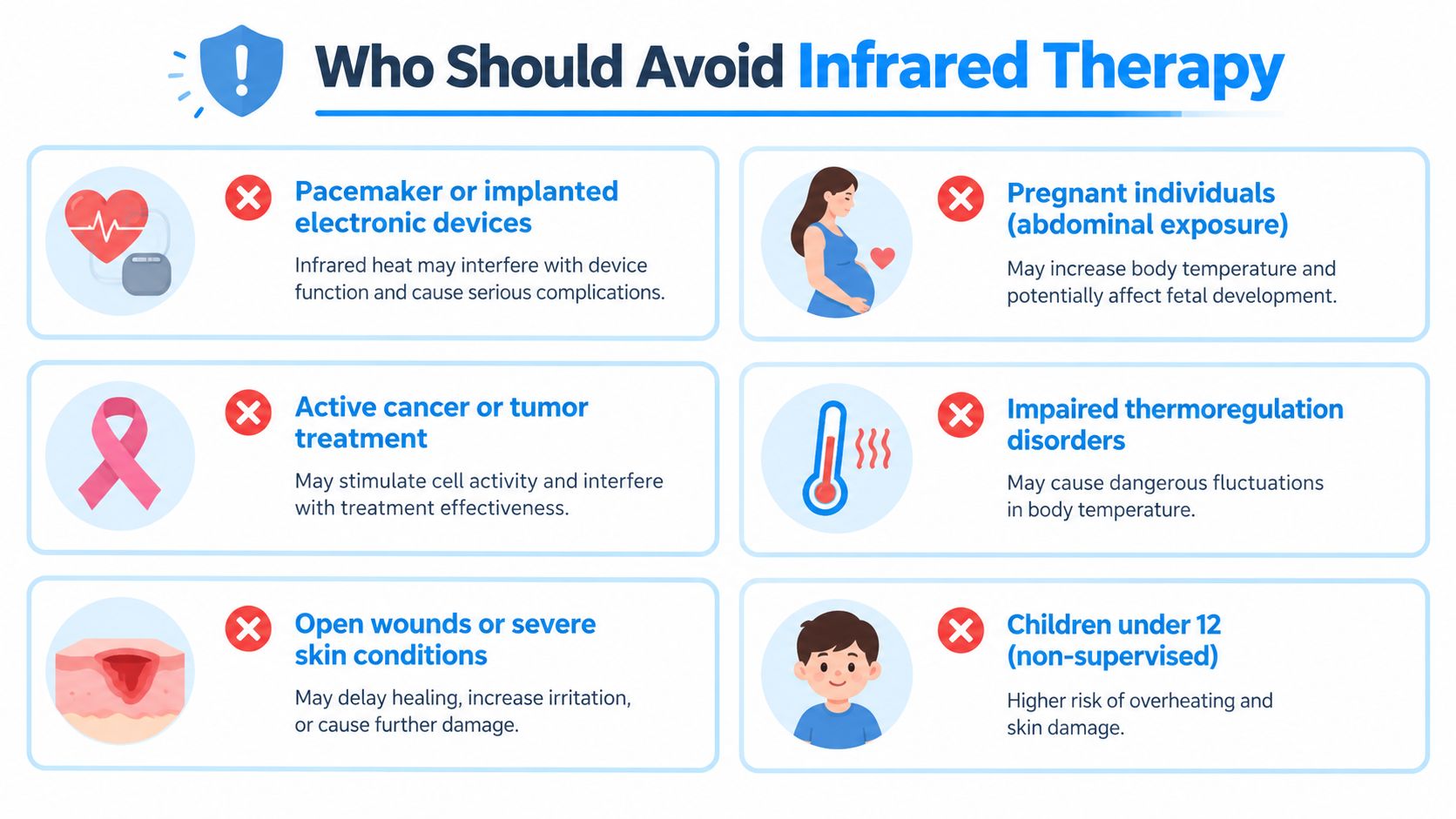
If you are pregnant, managing chronic illness, recovering from surgery, taking photosensitizing medication, or using an implanted electronic device, consult your clinician and read the exact product instructions. A physical therapist can help decide whether warmth supports movement or risks masking symptoms that need evaluation. Stop if you cannot monitor the area confidently.
Comparing Active Emitters and Passive Recovery Wear
The useful question is how infrared energy reaches your tissues: through an external emitter or through a textile that responds to your body heat. The two approaches may share the word “infrared,” but their safety demands differ because the energy delivery is different.
Active devices, including panels and lasers, can create a more concentrated treatment. That control comes with responsibilities. Users may need to set distance, position the device correctly, limit exposure time, monitor skin temperature, and use eye protection. Intense infrared close to the face can injure the eyes. Retinal thermal burns and visual disturbances have been reported with excessive exposure or without suitable protection, as discussed in this review of ocular infrared hazards.
Passive textiles provide localized warmth through semiconductor-integrated fabric. They use the wearer's body heat rather than directing a powered beam at the treatment area. Their practical concerns are usually closer to those of other skin-contact recovery products: heat buildup, sensitive skin, moisture, friction, and delayed awareness of irritation when sensation is reduced.
| Feature | Active IR Devices, Lasers and Panels | Passive IR Textiles, Sleeves and Braces |
|---|---|---|
| Energy source | Powered external emitter | User's body heat |
| Main safety controls | Distance, timing, positioning, eye protection | Fit, skin checks, ventilation, breaks |
| Primary severe concern | Burns and ocular exposure | Localized irritation or excessive warmth |
| Typical use pattern | Defined treatment sessions | Wear during rest or light activity, according to product directions |
| Best suited to | Users able to follow technical instructions | Users seeking localized support without a powered emitter |
| Clinical oversight | Important when treating illness, injury, or sensitive areas | Important when sensation, circulation, or skin integrity is impaired |
A powered device may be unsuitable for someone who cannot follow eye and distance precautions. A passive sleeve can also be unsuitable when numbness, dermatitis, or circulation problems make skin changes difficult to detect. Mild warmth does not remove the need for judgment.
For a related comparison between non-compressive support and tighter garments, see this explanation of thermal compression wear. Choose based on symptoms, sensation, skin condition, mobility, and your ability to monitor the area, rather than on the expectation that longer wear is automatically better.
Best Practices for Safe Daily Use
Safe use starts with treating infrared recovery wear as a skin-contact product, not as a harmless accessory. Before putting it on, wash and dry the skin, remove lotions or oils that could increase friction, and check for redness, broken skin, swelling, or an existing rash. Make sure the garment fits without creating painful pressure or deep marks.
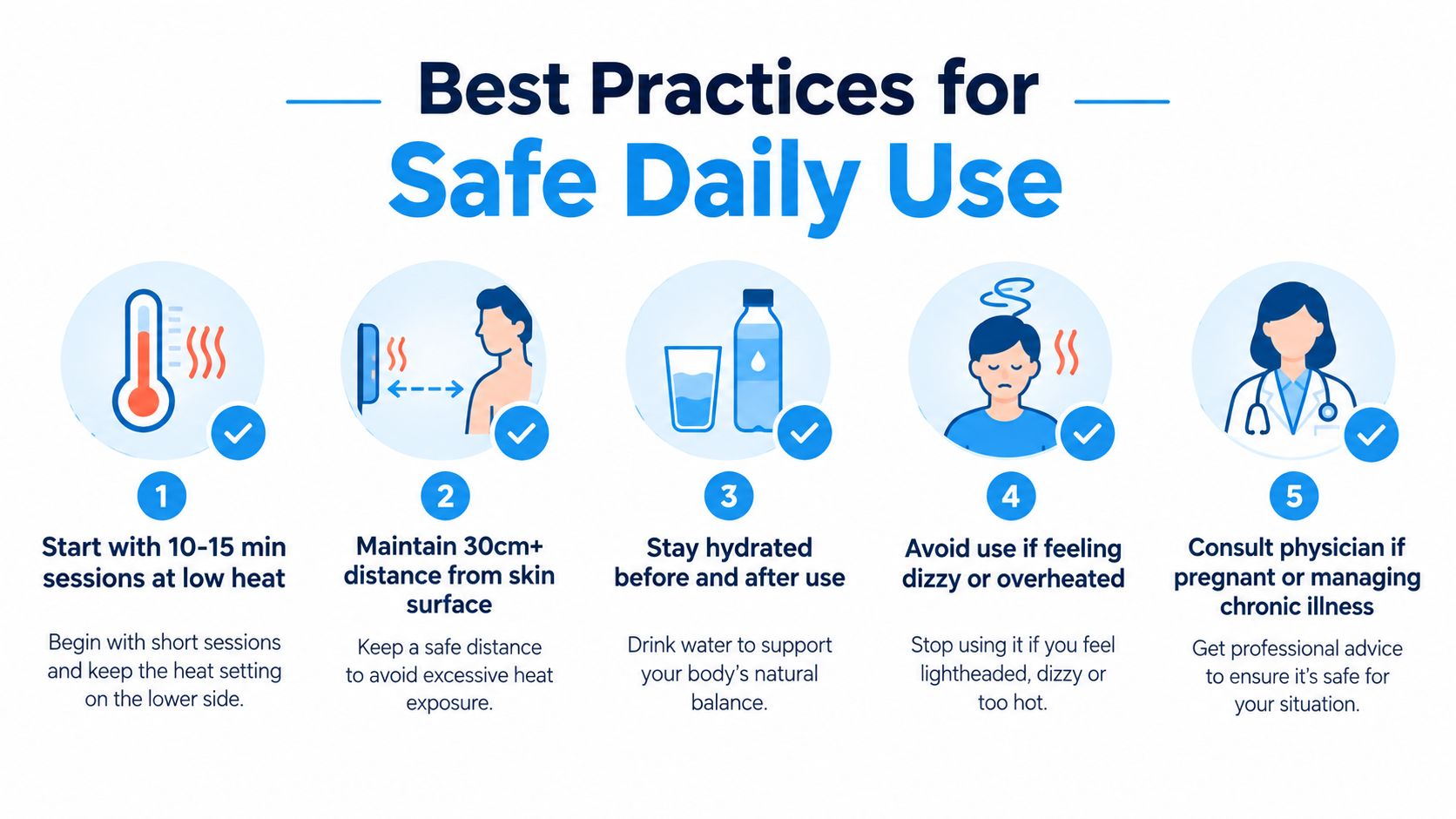
Start conservatively. Wear the product for a limited period, then remove it and inspect the area. Don't sleep in a new garment until you know how your skin responds, and don't continue wearing it through numbness, tingling, stinging, or unusual warmth.
A practical daily routine
- Prepare the area: Clean, dry skin reduces moisture-related irritation and makes changes easier to notice.
- Check circulation and sensation: Compare the treated area with the opposite side before and after use. Report unusual discoloration, persistent swelling, or reduced sensation.
- Control heat: Take breaks so the skin can cool and breathe. Stop if you feel dizzy, overheated, weak, or unusually thirsty.
- Protect the fabric: Follow the garment's washing and drying instructions. Harsh care can affect fit, texture, and the material's intended properties.
- Record patterns: Note when warmth feels helpful and when symptoms appear. A short log can help a physical therapist distinguish a useful response from irritation.
Hydration is sensible when you're using any warming intervention, especially if you're active or in a hot environment. It won't make an unsafe device safe, and it doesn't compensate for excessive exposure.
For general heat-treatment habits, this step-by-step heat pack guide provides a useful comparison. Heat packs and infrared-responsive textiles aren't identical, but both require attention to skin checks, duration, and comfort. You can also compare how people use hot and cold therapy when deciding which recovery strategy fits a particular flare-up.
When to Stop Use and Seek Medical Advice
Temporary warmth or mild redness that settles after removal may be a tolerable response. Persistent redness, stinging, worsening pain, unusual swelling, blistering, numbness, tingling, or discoloration signals that you should stop using the product and assess the area. Don't cover a blister or painful patch with the same garment to see whether the discomfort disappears.
Seek medical advice promptly if symptoms continue, worsen, or involve vision. Eye pain, visual disturbance, or unusual light sensitivity after using an active infrared source requires particular attention because ocular injury may be more serious than the surface sensation suggests.
A practical example is a knee sleeve that feels comfortable during a walk but leaves a hot, painful area afterward. Remove it, inspect the skin, and avoid further use until a clinician or physical therapist can help identify whether the issue came from heat, friction, fit, circulation, or an unrelated condition. If the pain itself keeps increasing despite treatment, don't let temporary warmth hide a problem that needs diagnosis.
Bring the product name, instructions, wear time, body location, and symptom timeline to your appointment. That information helps your clinician decide whether to adjust the dose, change the garment, stop infrared exposure, or address another cause of your symptoms.
Infrared therapy can be a reasonable adjunct for some people, but the risk-to-reward balance depends on dose, delivery method, skin health, sensation, and monitoring. The safest approach replaces absolute promises with careful observation.
Thermo Recovery Wear offers compression-lite sleeves and braces made with infrared-responsive, semiconductor-integrated textiles for localized warmth during rest or light activity. If you're considering passive recovery wear and want to compare fit, materials, and care guidance, visit Thermo Recovery Wear and review the product instructions before choosing a garment.


