


You step off a curb, your foot turns inward, and a sharp sting shoots along the outside of your ankle. You hop home, tell yourself it's minor, then wake up to swelling and a nagging question: what will stop this from happening again? The right ankle support brace to stop rolling can protect the joint during vulnerable activities, but it works best as one part of a plan that restores strength, balance, and confidence.
Table of Contents
- That First Roll and Why It Keeps Happening
- How an Ankle Actually Rolls and What a Brace Does About It
- The Main Brace Types and When Each One Wins
- Sizing, Fit, and How Long to Wear a Brace
- Choosing Between Everyday Wear and Sport Use
- Rebuilding Ankle Strength So a Brace Becomes Optional
- Common Brace Mistakes That Make Rolling Worse
- Your Next Steps and a Simple Action Checklist
That First Roll and Why It Keeps Happening
The first roll often happens during an ordinary moment, such as stepping off a curb or walking across uneven pavement. The ankle turns inward, the outer ligaments take the strain, and swelling may appear later. Many people are surprised when the problem returns, especially because stretched lateral ligaments can heal longer and looser than expected.
After a sprain, your ankle may also lose some position awareness. That can make your muscles react a little late when you step on uneven ground, land in basketball shoes, or walk after a long day on tired feet. Repeated sprains can develop into chronic ankle instability, so a brace deserves more thought than choosing the tightest product.
If your ankle hurts while running, review this guide to ankle pain when running alongside an evaluation of your walking and running mechanics. A brace can interrupt the cycle by limiting risky motion during activity, but it can't retrain the muscles and balance system that help you control each step.
How an Ankle Actually Rolls and What a Brace Does About It
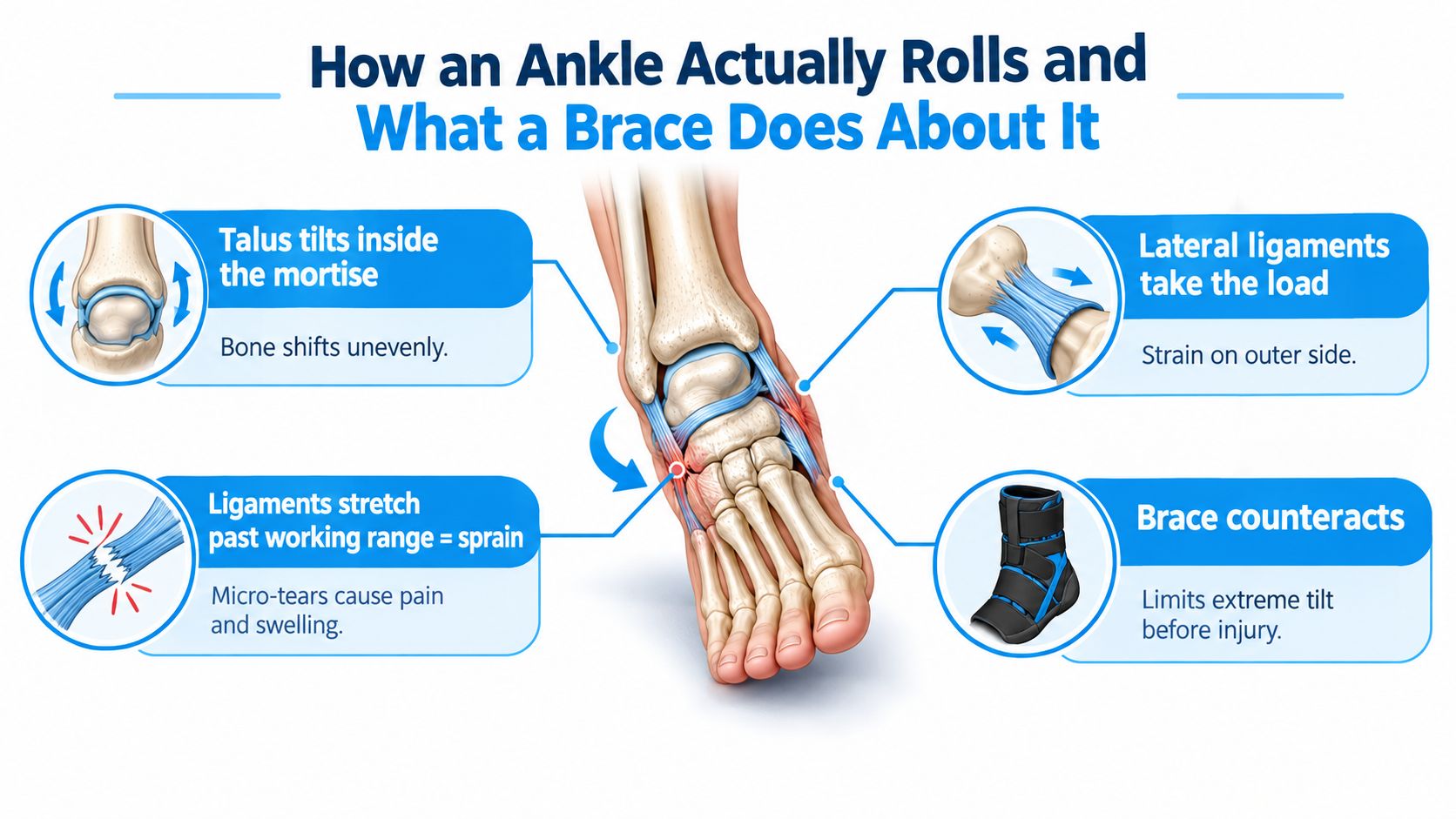
An inward roll is called inversion. Think of your ankle as a small teeter-totter: the talus shifts unevenly inside the ankle socket, the outer ligaments absorb the load, and the foot flips beneath the leg when the movement exceeds what those tissues can handle.
The anterior talofibular ligament usually faces the first strain, followed by the calcaneofibular ligament as the roll continues. The risk rises when the foot is pointed downward, because that position gives the ankle less protection against a sudden inward tilt.
Mechanical control and sensory feedback
A brace can help in two different ways. A stirrup or hinged design creates sidewalls that resist excessive inversion, while a lace-up brace uses adjustable tension to support the ankle from several directions. A soft sleeve usually offers less physical blocking and more compression, warmth, and skin feedback that may help you notice the joint position sooner.
Biomechanical testing found that all tested braces reduced dynamic and passive inversion compared with no brace, with hinged designs providing the strongest restriction. The same study found that braces increased opposing resistance torque and could delay inversion onset by positioning the ankle more anatomically during a sudden load. See this overview of musculoskeletal pain support if recurring ankle pain is part of a broader recovery problem.
For a plain-language look at support garments and their intended uses, explore types of joint support apparel. The key distinction is simple: a sleeve reminds and supports, while a structured brace more directly resists the movement that causes a hard roll.
The Main Brace Types and When Each One Wins
No single brace wins every situation. The useful question is, what kind of rolling are you trying to control, and what can your shoe comfortably accommodate?
A lace-up brace is often a practical choice for basketball or tennis. You can adjust medial and lateral support, and many designs fit inside an athletic shoe. It may disappoint when swelling changes throughout the day, because the fit can become inconsistent or the laces may need repeated adjustment.
A stirrup brace uses rigid side shells to limit side-to-side motion. It can be valuable after an acute sprain when swelling and tenderness make extra protection useful, but the same shell can feel awkward under narrow footwear or cleats. A semi-rigid hinged brace offers stronger control during cutting sports while preserving controlled forward-and-back movement. Its cost is bulk and a greater chance of changing how your shoe fits.
A knit sleeve suits daily walking, long shifts on hard floors, mild symptoms, and runners who want warmth and position feedback without much bulk. It won't provide the same mechanical stop during a forceful basketball landing or a fast cut.
| Brace Type | Best Scenario | Worst Scenario | Key Trade-off |
|---|---|---|---|
| Lace-up | Court sports and adjustable support inside a shoe | Swelling that changes the ankle shape | Control and adjustability versus pressure and fit changes |
| Stirrup | Acute protection when side-to-side motion feels unsafe | Tight cleats or narrow casual shoes | Strong restriction versus bulk |
| Semi-rigid hinged | Repeated instability during cutting and landing | Minimal shoes or unrestricted movement needs | High protection versus comfort and shoe compatibility |
| Knit sleeve | Daily wear, mild symptoms, and low-profile support | Hard landings and true inversion events | Comfort and feedback versus limited mechanical control |
For another perspective on lower-profile support, compare features in this ankle compression sleeve selection guide. The right choice balances protection, shoe fit, and wearability, not one feature in isolation.
Sizing, Fit, and How Long to Wear a Brace
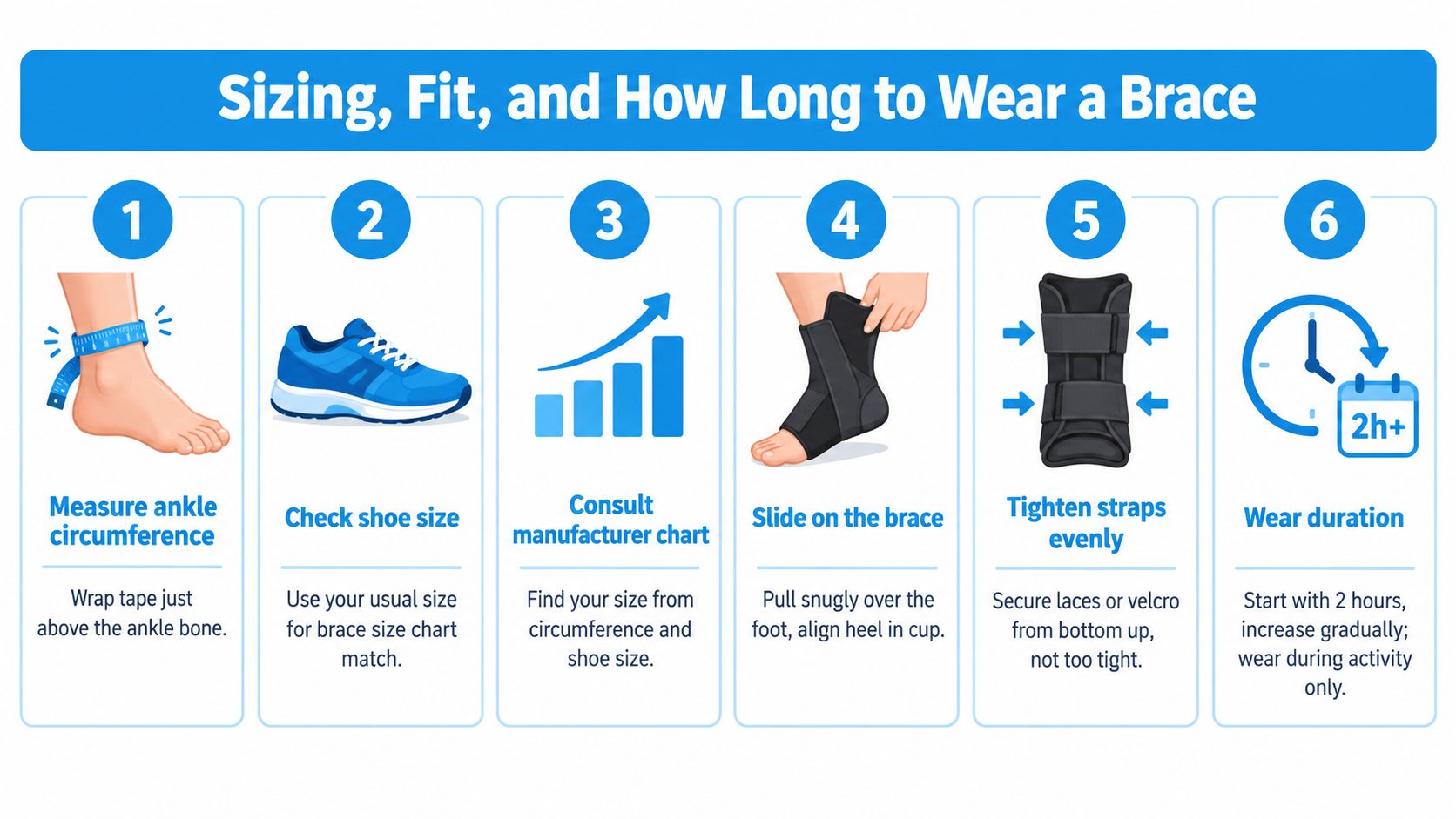
Start with the manufacturer's chart. Measure ankle circumference where the instructions specify, note your shoe size, and use both measurements when the chart requests them. A brace that matches only your shoe size may still slip or press in the wrong place.
A first-fitting check
Place the heel fully into its pocket before tightening anything. Secure laces or straps evenly from the bottom upward, then walk on a flat surface and check whether the brace stays aligned inside your shoe.
Choose a thin, moisture-wicking sock without bunching around the heel. Cotton can hold moisture, while folds create pressure points that may feel like joint pain. If you use a sleeve, consult the manufacturer's care and size guidance, such as this sizing chart resource, while remembering that ankle measurements still need to match the ankle product's own chart.
Wear time depends on the problem and the advice of your clinician. During acute recovery, a brace may be used for much of the day for a limited period under professional guidance. For sport prevention, wear it during the activity rather than automatically during rest. With chronic instability, intermittent, symptom-driven use often makes more sense than treating the brace as permanent armor.
Fit warning: Numbness, color change, new pain, or repeated slippage means the brace is too tight, poorly shaped, or the wrong model.
Choosing Between Everyday Wear and Sport Use
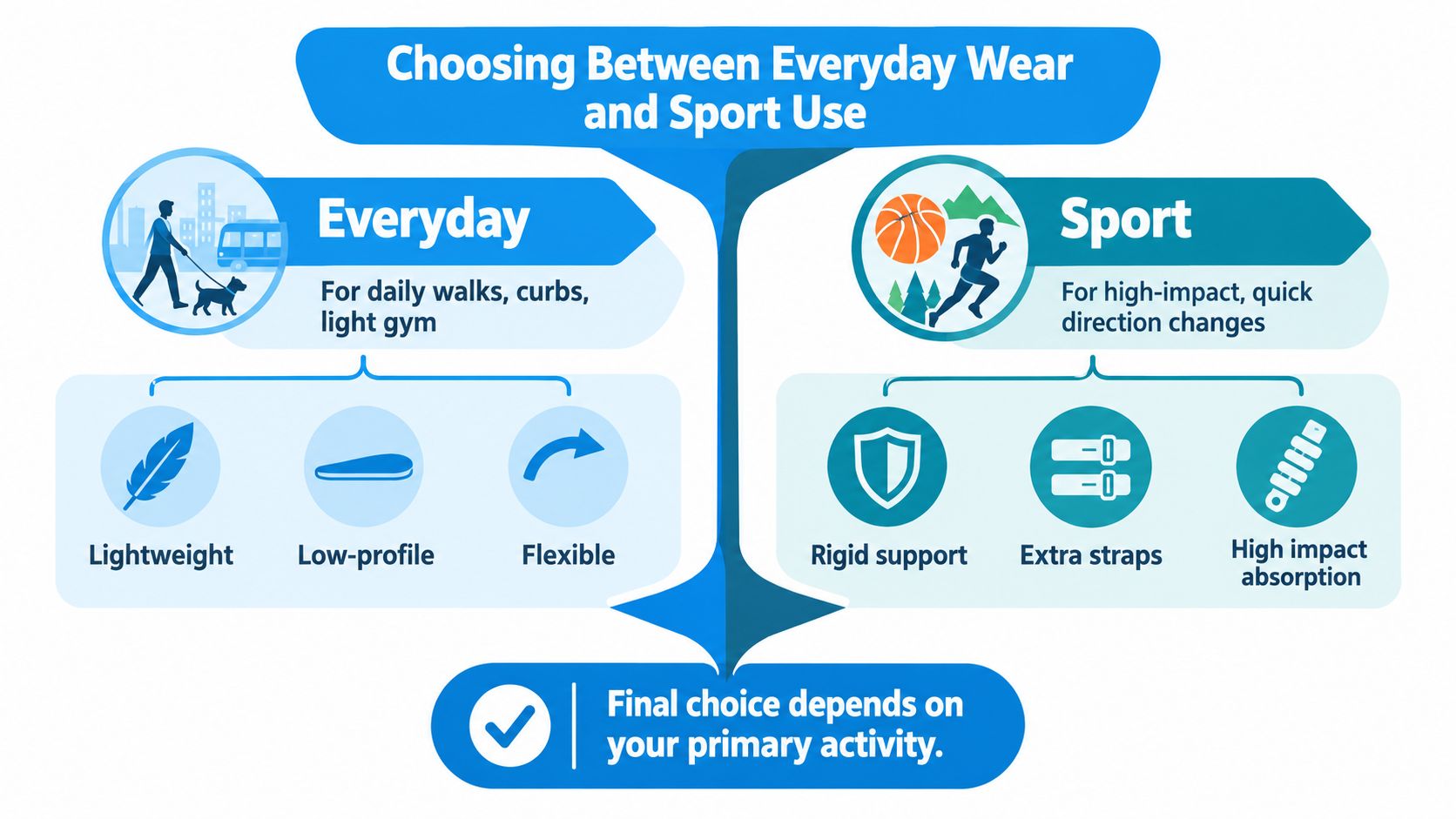
Start with the event that makes you distrust your ankle. A lateral curb misstep during a dog walk doesn't create the same demand as a basketball landing or a trail run with rapid direction changes.
A practical selection flow
- Daily walking and commuting: Choose a low-profile sleeve for mild symptoms, or a lace-up design when the ankle gives way during ordinary steps.
- Basketball, tennis, and court movement: Consider lace-up support for adjustable side-to-side control. If repeated landings still feel unstable, a semi-rigid hinged model may offer a stronger safety margin.
- Trail running and uneven hiking: Lace-up or semi-rigid support can be more suitable than a sleeve when uneven surfaces trigger near-rolls.
- Light gym work: Match the brace to the exercise. A sleeve may be enough for controlled strength work, while jumping and cutting call for more structure.
Rigid braces can feel bulky in casual shoes and may restrict some ankle motion. Sleeves fit more easily but may barely slow a true inversion event. Taping can be useful for some athletes, but the choice between tape and a brace should account for comfort, skill, and whether support remains secure throughout activity.
The broader recovery picture may include sleep, training modification, and other clinician-directed tools. For context on how hyperbaric chambers aid recovery, separate general recovery strategies from the brace's specific job, which is controlling risky ankle motion.
For basketball-specific considerations, see this guide to braces and sleeves for basketball players. Your shoe, swelling pattern, and landing demands should determine the category.
Rebuilding Ankle Strength So a Brace Becomes Optional
After rolling the same ankle twice, a brace can provide immediate confidence. It is only part of recovery, though. The brace limits risky motion from the outside, while rehabilitation retrains the peroneal muscles and balance system to react before the foot turns inward.
Four stages of rebuilding control
- Restore motion. Start with pain-free ankle circles, alphabet tracing, and gentle calf stretching. Stop short of sharp pain or movements that increase swelling.
- Add control. Balance on one leg on a stable surface. Progress when you can hold the position without frequent foot corrections.
- Build strength. Use resistance-band eversion and dorsiflexion, then add heel raises and controlled landing drills. The outward-moving muscles help oppose inversion, the motion that rolls the sole inward.
- Return to the trigger activity. Wear the brace during sport-specific drills first. Add cutting, hopping, or uneven-ground work after walking and basic balance are controlled.
A brace cannot replace neuromuscular training. External support can help prevent another roll, while balance work improves the ankle's ability to detect and correct a misstep. Pair the brace with progressive exercise rather than treating it as the entire solution.
If ordinary cardio is difficult during recovery, review cardio while injured with BionicGym. Check with a clinician before exercising after a significant injury. Let symptoms and movement control guide progression, not a calendar alone.
Common Brace Mistakes That Make Rolling Worse
The first mistake is expecting one brace to handle every situation. A soft sleeve may feel comfortable on a commute, but it can't replicate the side-to-side mechanical control of a stirrup or structured hinged brace during a forceful landing. If the ankle still shifts during the activity that caused the original problem, the category may be wrong.
The second mistake is wearing support continuously without a rehabilitation plan. Major reviews describe functional braces as preferable to immobilizing braces for acute sprains and report that functional bracing can reduce recurrent sprains by about 50% to 70% in people with previous sprains, while also noting that guidance on exact wear duration remains unclear (American Family Physician review). Use a brace for the task that exposes the ankle, then keep restoring motion, strength, and balance.
Tightness isn't the same as stability
A lace-up brace should feel secure, not numb. If your toes tingle, change color, or the brace shifts your foot into an awkward position, loosen it and reassess the size or design.
Better habit: Check the fit after walking, not just while sitting. Movement reveals pressure, slippage, and shoe interference that a stationary fitting can hide.
The third mistake is confusing symptom relief with restored capacity. A brace can reduce unwanted motion, but it won't correct weak eversion, poor landing control, unsuitable footwear, or an untreated injury that needs examination.
Your Next Steps and a Simple Action Checklist
Use the next week to turn uncertainty into a small test.
- Measure and match. Record ankle circumference and shoe size, then compare the chart for a lace-up, stirrup, or hinged model. Write down the activity that triggered your last roll and choose the brace category for that activity, not for every possible use.
- Start three exercises. Use pain-free ankle range of motion, single-leg balance, and banded eversion as a simple starting routine. Perform them consistently during the week, and stop or seek guidance if pain, swelling, or instability worsens.
- Test before trusting. Wear the brace with the intended sock and shoe on a flat surface. Check heel position, circulation, strap pressure, and slippage before moving onto curbs, courts, trails, or uneven ground.
- Use protection strategically. Wear stronger support during the activity that creates risk, and treat the brace as an aid while rehabilitation rebuilds control.
An inward roll happens when the foot tilts beyond the ankle's controlled range. Brace choice should match the force and setting, while fit determines whether that support works in practice. A well-chosen ankle support brace to stop rolling, paired with consistent rehabilitation, can turn repeated near-misses into controlled movement.
Thermo Recovery Wear offers compression-lite ankle recovery sleeves designed to provide comfortable support during movement and recovery routines, including walking and light activity. Visit Thermo Recovery Wear to review the ankle support option and its sizing guidance before choosing your next layer of daily support.


