


Knee supports can help some people with knee osteoarthritis, but the average benefit is modest: a randomized study of 91 participants found a six-month pain difference of only -0.2 points. The stronger case is a properly fitted unloading brace worn with exercise, not a sleeve sold as a cure.
Why do shop pages still treat every elastic tube and every hinged frame as the same product? Because the word "support" hides the only question that changes the result. Which part of the knee is worn, and will you keep the device on?
If you are asking whether are knee supports good for arthritis, the useful answer is not a blanket yes. It is a match between brace design, the compartment that hurts, and the hours you can tolerate the fit.
Table of Contents
- Do Knee Supports Help Arthritis Pain? The Short Answer
- What Large Studies Show About Pain and Function
- Warmth, Feel and Load
- Matching a Brace to Your Arthritis Pattern
- How to Fit and Wear a Knee Support Every Day
- Warning Signs That Need a Doctor, Not a Brace
- Decide Whether a Knee Support Belongs in Your Plan
Do Knee Supports Help Arthritis Pain? The Short Answer
Do they help, or only feel as if they might? For selected people, yes. The help is modest, and its size tracks the brace, the compartment that hurts, and whether the device stays on during real walking.
The 2019 American College of Rheumatology and Arthritis Foundation guideline strongly recommends tibiofemoral knee braces when osteoarthritis substantially affects walking, joint stability, or pain, and when the person can tolerate the inconvenience. Patellofemoral braces get only a conditional recommendation, because trial results vary and some people find them burdensome. Fitting should follow the affected compartment and the functional problem, not a generic pain score.
| Support type | What it does | Evidence for osteoarthritis | Best fit |
|---|---|---|---|
| Soft compression or warming sleeve | Light compression, warmth, and proprioceptive feedback | Weak; mainly comfort and short-term symptom relief | Mild, spread-out pain and people who want all-day wear |
| Patellofemoral brace | Supports kneecap tracking | Conditional recommendation; trial results vary | Pain at the front of the knee linked to the kneecap |
| Hinged or stabilizing brace | Limits sideways or buckling motion | Limited evidence; used mainly for instability | Knee that gives way or feels unstable when walking |
| Unloading brace (tibiofemoral) | Shifts load away from one damaged compartment | Strongest recommendation when arthritis substantially limits walking, stability, or pain | Arthritis confined to the inner or outer compartment with load-related pain |
A knee support changes how the joint is loaded or felt. It does not rebuild cartilage.
That guideline frames bracing as an adjunct to exercise, weight management where it applies, medication, and other non-surgical care. The mechanical job is assistance with instability, painful loading, or trouble walking. Comfort, skin, and the ability to wear the device through a normal day are clinical limits, not afterthoughts.
A sleeve abandoned by noon has already lost the only advantage the table gives it. An unloader that matches an inner or outer compartment belongs in the plan only if the hinge and straps stay tolerable on the days walking hurts most. Other comfort products, including CBD oils for stiff knees, sit outside that match. They do not choose the brace or replace a strengthening plan.
What Large Studies Show About Pain and Function
Average results are smaller than most product pages imply, and several careful trials cannot separate the brace from everything else the person was already doing.
A Cochrane review of braces and orthoses for knee osteoarthritis found low-quality and inconclusive evidence for improvements in pain, stiffness, function, and quality of life. In one randomized study of 91 participants, six-month visual-analogue pain scores showed no statistically significant difference. The mean difference was -0.2 points (95% confidence interval -1.15 to 0.75). WOMAC function was likewise not significant, with a mean difference of 0.1 (95% CI -7.26 to 7.46). Both groups improved. That pattern fits a wider treatment program, or ordinary fluctuation, rather than the brace alone. The same review found no clear advantage of valgus bracing over laterally wedged insoles.
Why one unloading trial looks different
Pooled averages mix sleeves, hinges, and unloaders. A design that shifts load off a damaged inner compartment can move pain scores in a way a mixed review will wash out. That is why a six-week medial unloading trial sits so far from the six-month null result above. It also means nobody should be promised a fixed percentage of relief.
| Study or review | Outcome | Reported result | What it means |
|---|---|---|---|
| Cochrane review of braces and orthoses | Pain, stiffness, function, quality of life | Low-quality and inconclusive evidence | Average benefit is uncertain |
| Randomized study, 91 participants | Pain on visual-analogue scale at six months | Mean difference -0.2 points (95% CI -1.15 to 0.75) | No significant difference; both groups improved |
| Randomized study, 91 participants | Function on WOMAC at six months | Mean difference 0.1 (95% CI -7.26 to 7.46) | No significant difference |
| Unloading brace trial, 67 patients with medial osteoarthritis | 24-hour pain change over six weeks | -41.35 with brace plus usual care versus -15.37 with usual care alone | Larger pain reduction for properly designed unloading braces |
| 2024 scoping review | Breadth of evidence | 31 randomized controlled trials covering 47 bracing interventions | Results vary with brace design and study quality |
A 2024 scoping review covered 31 randomized controlled trials and 47 bracing interventions. With that spread of designs, a single star rating for "knee supports" is a marketing shortcut. Selection, sizing, adherence, and pairing the device with exercise still decide whether a trial result shows up in your week. Short, regular knee mobility exercises belong in that pairing, because a brace that only substitutes for movement leaves the muscles that steady the joint untrained.
Warmth, Feel and Load
Three different jobs get bundled into one product photo. Only one of them has a clear mechanical target during walking.
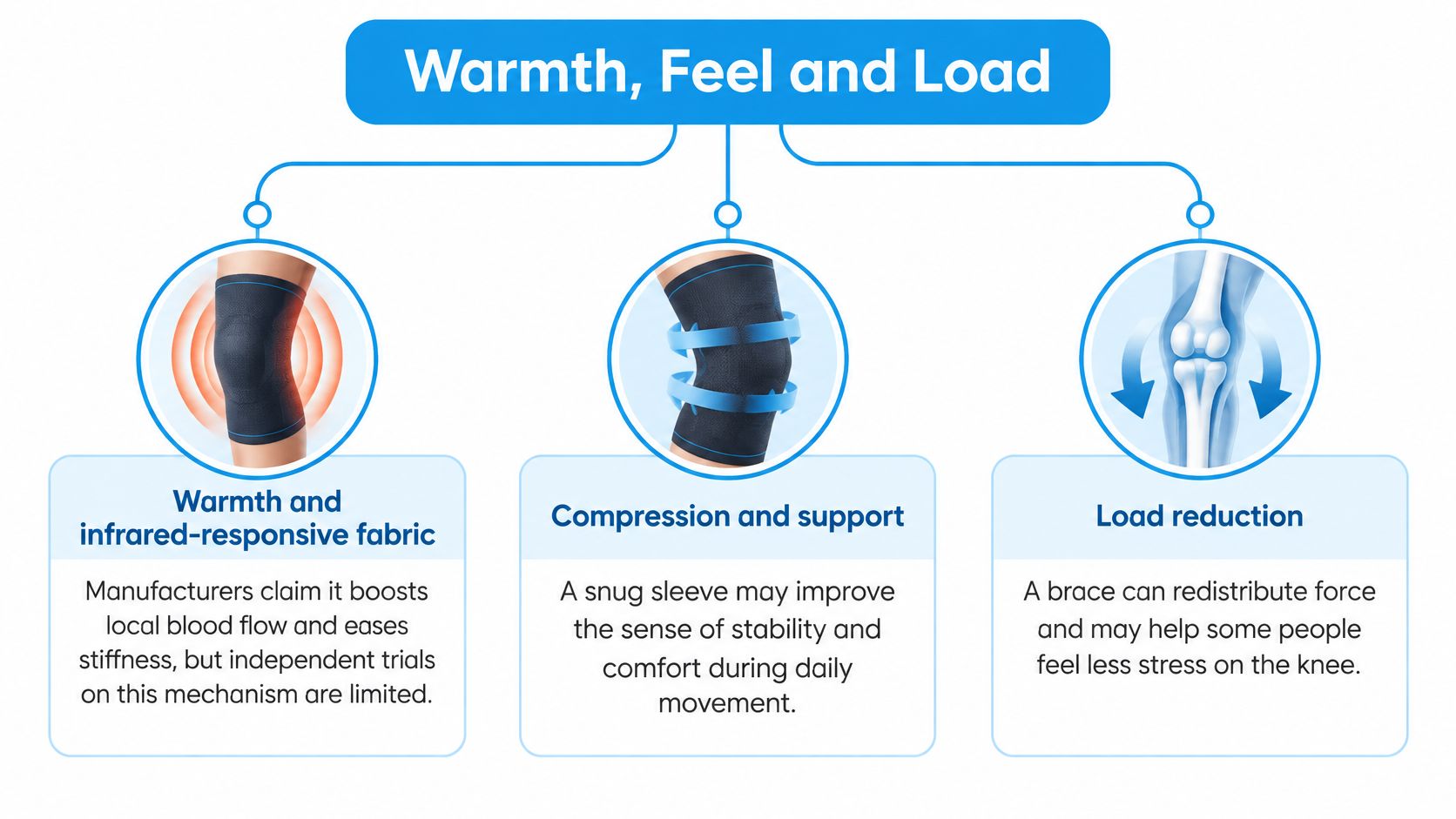
Warmth and infrared-responsive fabric. Makers say embedded fabrics raise local blood flow and ease stiffness. Independent trials of that mechanism are thin, so treat warmth as comfort. Heat before a walk and cold after a flare are separate tools, and a plain hot and cold therapy routine often does that job without a brace at all.
Compression and proprioception. A snug sleeve gives light pressure and extra feedback about where the knee is in space. Many people walk with more confidence because the joint feels located, not because the cartilage surface changed. That sensory effect is real enough to notice on a grocery trip and small enough to vanish once the sleeve comes off.
Mechanical unloading. A fitted unloader applies an external force so less load passes through the damaged inner or outer compartment while you walk. That is a different category from warmth. It is also why soft sleeves should not be sold with the same promise.
Handrail or bracket
Think of a sleeve as a handrail. It steadies you. An unloader is closer to a bracket under a sagging shelf. It moves weight. Some of the relief people notice arrives because they walk more once the knee feels safer, so the device and the extra steps are hard to split. None of the three restores the cartilage that has already thinned.
Matching a Brace to Your Arthritis Pattern
Do knee supports suit every arthritis pattern? No. The useful choice depends on where the knee hurts, what triggers the pain, and whether the support can address that problem comfortably. A sleeve and a brace are not interchangeable: the difference between a knee brace and a knee sleeve is functional, not just a matter of style.
Start with the location of the pain. Inner-knee pain is the pattern most studied in unloading-brace trials. An unloader applies an external valgus or varus moment to shift load away from the more affected side of the tibiofemoral joint, most often the medial side during walking. Outer-knee pain involves a different alignment pattern. Pain around the kneecap points toward a patellofemoral brace rather than a tibiofemoral unloader.
Next, consider what the knee does. Repeated giving way or a feeling of looseness may favor a hinged stabilizer, once a clinician has assessed the ligaments and surrounding strength. True locking needs clinical assessment first. A brace is not a substitute for finding its cause.
Timing also helps narrow the choice. Pain with walking or stairs is the situation in which an unloader may have a mechanical role. Aching after sitting or stiffness in cold conditions gives less reason to choose a rigid frame, and may make a light sleeve a more practical option. Skin condition and movement matter too: rigid shells and straps require skin that can tolerate contact and enough knee bend for everyday tasks. A sore shin or a knee that will not straighten can make a tight unloader a poor first choice.
Consider the activities the support needs to fit. Neighborhood walks, a standing shift, and comfort at rest place different demands on a brace. A low-profile sleeve may be easier to wear during a quiet day, while a corrective brace needs to change the activity that brings on pain to justify its added bulk.
For example, a person with inner-knee pain on stairs and a bowed-in stance may fit the pattern an unloader is intended to address. If that same person instead has kneecap pain during squats, a patellofemoral brace is a better match to consider. The symptoms and alignment pattern, not the person's worst pain day alone, should guide the choice.
Evidence supports a cautious, pattern-specific decision. In a randomized trial of 67 patients with symptomatic medial knee osteoarthritis, the brace-plus-usual-care group improved by -41.35 points on 24-hour pain over six weeks, compared with -15.37 points with usual care alone. The between-group difference was about -25.98 points (95% CI -41.64 to -10.33, P<0.0001). Pain on movement and Lequesne scores also improved more with the brace, according to the Scientific Reports trial. At follow-up, the fitted brace reduced knee adduction impulse by about 36% and the second peak knee-adduction moment by about 26%. These findings concern an unloading brace, not a generic sleeve.
Guidance is less definitive. The Royal Australian College of General Practitioners knee and hip osteoarthritis guideline cannot recommend for or against varus unloading braces for lateral-compartment disease and suggests not offering valgus unloading braces for medial disease because evidence is insufficient. One positive trial does not establish a universal benefit, and a guideline's uncertainty does not show that a well-fitted brace never helps.
Ask a clinician or orthotist to confirm the affected compartment before choosing an unloading design. A brace that applies force in the wrong direction is less likely to help and may irritate the skin.
How to Fit and Wear a Knee Support Every Day
A brace that wins a clinic visit can still fail in a coat, on a bus, or under work trousers. Wearability is part of the effect, not a footnote.
The 2025 PROP OA randomized trial, covered by Manchester Metropolitan University, used physiotherapist assessment, individual selection, fitting instruction, follow-up, and reminders. Even then, only 66% met the adherence bar, wearing the brace at least one hour on two or more days per week at three and six months. At six months, 24% said the brace did not fit under clothing. Comfort, profile, heat, slippage, and donning difficulty can matter as much as the hinge.
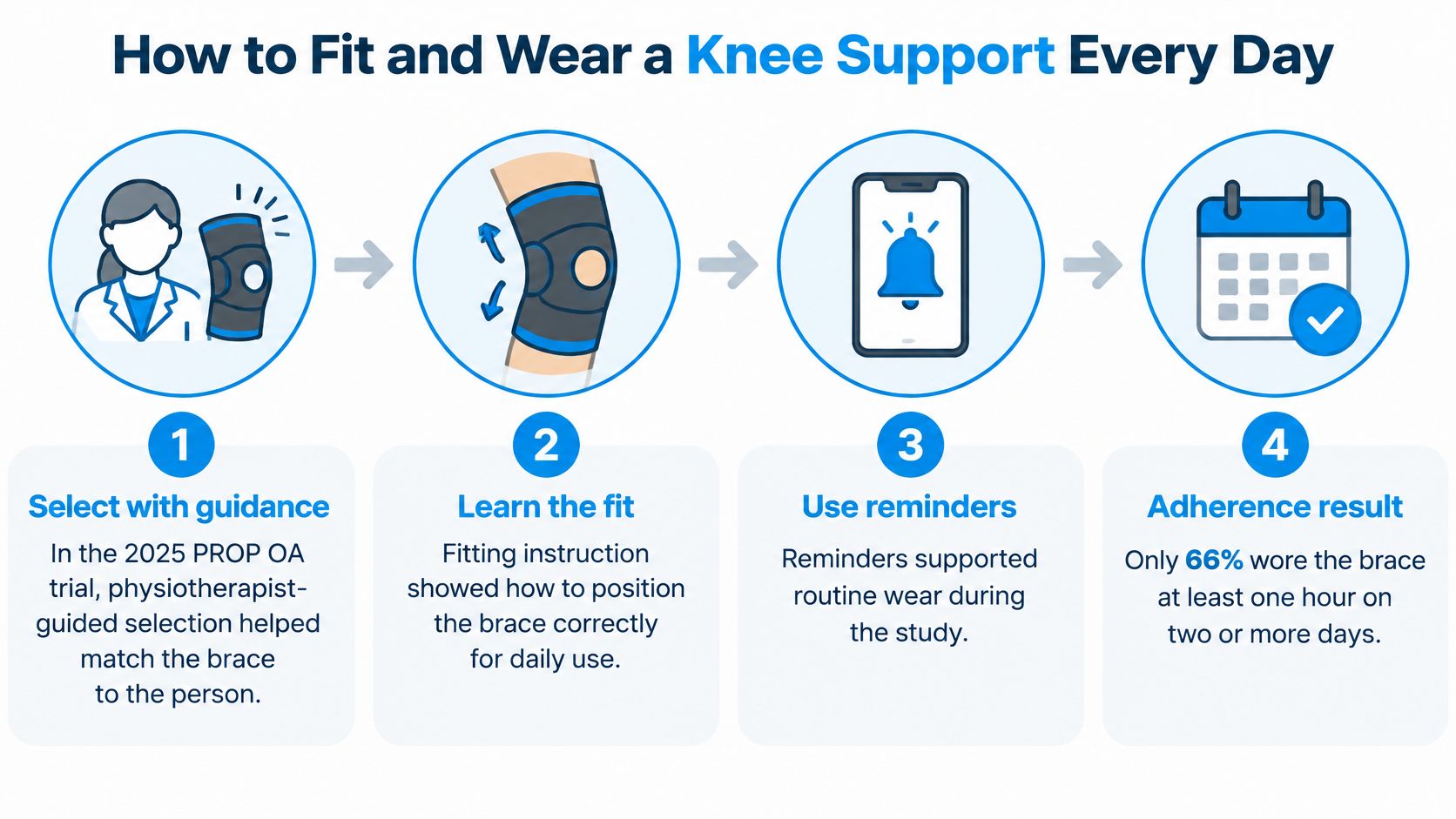
A week-one wear test
- Measure before you order. To find your knee sleeve size, measure the circumference of your leg about two inches above your knee and match it to the size chart. A guess from a clothing size is how straps end up in the wrong place.
- Dress for the day you live. Put the support on in the morning and check it under the trousers you wear to work, not under shorts in a fitting room.
- Start at one hour. Wear it for one hour on day one, then add time across the week. Jumping to a full shift is how heat and pressure get misread as "it doesn't work."
- Look at the skin every evening. Redness that fades is one thing. Lasting pressure marks, broken skin, or a change in color is another.
- Reset straps when it walks down the leg. Slippage means the corrective force, if there is one, is no longer where it was fitted.
Mild snugness is expected. Numbness, tingling, a cold foot, increasing swelling, or discoloration means take it off and get advice. Test walking first. Sleep and a full workday are separate experiments, and a device that only feels fine while you sit has not passed. Our notes on how to wear a knee brace walk through position and skin checks in more detail. If circulation symptoms persist, stop and let a clinician look, rather than tightening the next strap.
Warning Signs That Need a Doctor, Not a Brace
The symptom people most often brace through, and shouldn't, is a knee that locks or catches. That can be loose or displaced cartilage, or another mechanical block. A sleeve will not put a fragment back where it belongs.
A support is a supplement to an exam. It is not the exam. Use the pattern below before you decide the next purchase is "a stronger brace."
| Symptom | What it may signal | What to do |
|---|---|---|
| Knee locks or catches | Loose or displaced cartilage or other mechanical problem | See a clinician promptly; do not rely on a brace alone |
| Knee gives way or buckles | Instability or weak supporting muscles | Get assessed; a stabilizing or hinged brace may be considered after review |
| Hot, red, or swollen knee | Possible infection or inflammation | Seek same-day medical care |
| Numbness, tingling, or cold foot | Brace too tight or circulation concern | Remove the support and seek advice |
| Pain that wakes you at night or worsens quickly | Pattern that needs investigation | Arrange a clinical review |
| No improvement after several weeks of consistent use | Brace type or pattern may be wrong | Review the choice with a clinician |
What "several weeks" is for
If you have worn the device as fitted, kept your walks, and the pain is unchanged, the mismatch is information. The compartment may be wrong, the straps may have been slipping, or the pain may not be osteoarthritis at all. A review can reopen exercise dosing, weight management where it applies, medication, or imaging. The brace can remain one piece of that plan. It should not be the whole plan, and it should not delay a hot, red knee or a foot that goes numb.
Decide Whether a Knee Support Belongs in Your Plan
Sort the decision by what the knee does on a normal day, then give the device a time limit.
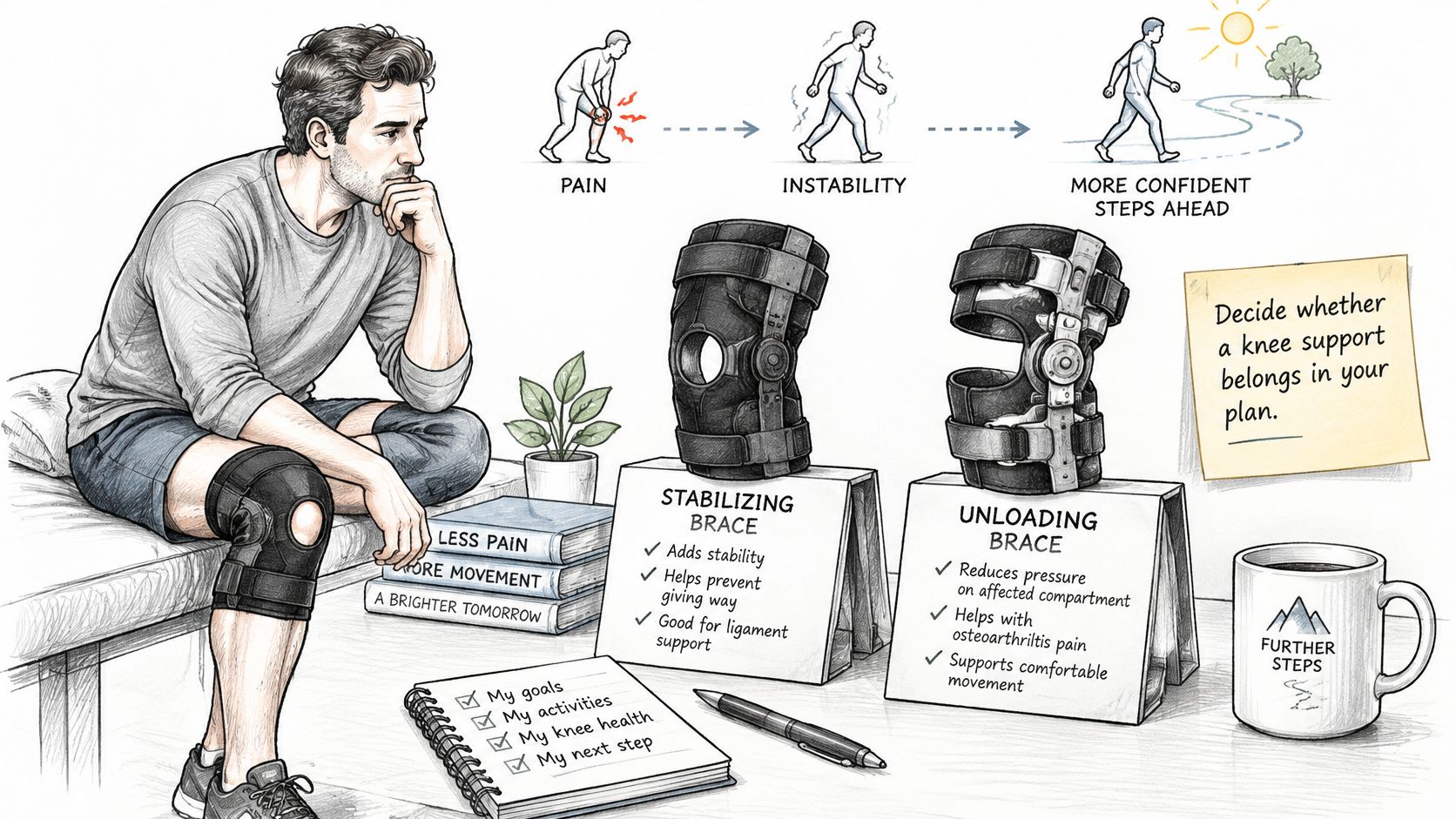
Unstable, load-painful, and limiting your walk. Ask a clinician to help choose a fitted device, usually an unloader or a stabilizer, rather than starting with the softest option on a retail page.
Mild and spread out. A sleeve can add warmth and a sense of position. Do not expect it to correct joint loading. Our Thermo Lite Knee Sleeve is marketed for arthritis and everyday joint pain. The products have received medical endorsement for significantly enhancing comfort and functionality in cases of grade 1 and 2 osteoarthritis, and the fabric is semiconductor-embedded and relieves chronic osteoarthritic joint pain by up to 62%. Those are manufacturer claims, not independent trial results. Set them next to the uncertain averages and the medial-unloader findings before you buy.
Run a six-week log. Note pain, walking distance, and skin each week, then review it with a clinician. The American Academy of Orthopaedic Surgeons osteoarthritis of the knee review says brace treatment could improve pain, function, and quality of life, while also finding insufficient evidence to recommend for or against a valgus-directing brace in some contexts. Many studies lasted less than six months, so long-term control and sustained wear stay uncertain.
Keep the rest of the plan. Exercise, strengthening, and any prescribed medication stay in place for the whole trial. A useful overview of options for osteoarthritis of the knee puts bracing in that wider list.
Before you pay, ask four plain questions. Does the knee give way? Where exactly is the pain? Will this device fit under the clothes you wear? What is the return window if it slips or marks the skin?
This short video shows how clinicians talk through non-surgical choices, including support, when arthritis is already limiting daily walking.
Thermo Recovery Wear makes compression-lite, infrared-responsive knee sleeves for people who want warmth and light support during rest and everyday movement with osteoarthritis stiffness. If a soft sleeve matches your pattern, and a clinician has ruled out the red flags above, browse current knee options and sizing on Thermo Recovery Wear.


