


Most advice on the difference between knee brace and knee sleeve is too simplistic. It treats them like two versions of the same product, then asks which one is better. That's the wrong question.
A knee brace and a knee sleeve usually solve different problems. One is for mechanical control. The other is for comfort, compression, warmth, and body awareness. If you also add a non-compressive thermal sleeve into the mix, the old brace-versus-sleeve debate gets even less useful.
Buy based on the job. Not the category name.
Table of Contents
- Why the Knee Brace vs Sleeve Question Is Usually Framed Wrong
- What a Knee Brace and a Knee Sleeve Actually Are
- Core Differences Between Knee Brace and Knee Sleeve
- Clinical Indications and What the Evidence Shows
- Wearability, Comfort, and Long-Term Adherence
- Pros and Cons of Each Option
- Which Option to Choose for Your Situation
- Common Questions on Knee Braces and Sleeves
Why the Knee Brace vs Sleeve Question Is Usually Framed Wrong
Most shoppers are told to think like this: sleeves are light support, braces are strong support, pick the stronger one if your knee hurts more. That advice sounds tidy. It's also how people end up wearing the wrong thing.
The choice starts with one question: what problem are you trying to solve? Pain is not one problem. Swelling after a long walk, ACL instability, arthritic stiffness in the morning, and kneecap irritation during stairs are not interchangeable. They shouldn't be matched to the same device.
A major review and guideline distinction is blunt about this. Braces are more often used when mechanical support or unloading is needed, while sleeves are mainly used for compression, warmth, and proprioceptive feedback. In knee osteoarthritis guidance, sleeves were described as having unproven effectiveness for disability, while valgus knee bracing was reported to decrease pain and disability in medial knee osteoarthritis and was described as more effective than knee sleeves, though the evidence base itself was modest and the recommendation level low in that guideline (knee osteoarthritis guidance on brace versus sleeve roles).
That matters because it kills the lazy shopping rule that a brace is just a “more serious sleeve.”
Practical rule: If your knee needs to be controlled, aligned, or offloaded, think brace. If it mainly needs to feel better, move more comfortably, or tolerate daily activity, think sleeve.
There's another problem with the usual framing. It ignores adherence. A brace that lives in your closet helps nobody. A sleeve that you'll wear all day may be the better choice for real life, even if it offers less structural support.
That's where non-compressive thermal sleeves deserve a place in the conversation. Some people don't need compression at all. They need warmth, comfort, and something they can tolerate for hours without skin irritation or squeeze.
What a Knee Brace and a Knee Sleeve Actually Are
A lot of confusion comes from lumping every knee support product into one bucket. That's a mistake. These are different tools.
What counts as a knee brace
A knee brace is a structured support device. It usually includes some combination of hinges, stays, straps, rigid side supports, or a frame built to limit or guide motion. The point isn't just to cover the knee. The point is to control the knee.
Common brace categories include:
- Functional braces for ligament instability, such as ACL or PCL issues
- Hinged braces for side-to-side support and movement control
- Unloader braces for compartment-specific osteoarthritis
- Post-op braces for protecting the knee after surgery with controlled range of motion
These aren't fashion differences. They change what the product can physically do.
A rigid or hinged brace can resist twisting, reduce side-to-side wobble, or shift load away from a painful part of the joint. A plain sleeve can't do that.
What counts as a knee sleeve
A knee sleeve is a pull-on fabric support. It's usually made from knit elastic, neoprene, or another stretch material. It applies uniform contact around the joint without rigid hardware.
Its main jobs are simpler:
- Compression
- Warmth
- Proprioceptive feedback
- Mild support for swelling or soreness
That's why many people like sleeves for workouts, long days on their feet, or low-grade arthritis discomfort. They're easier to wear and easier to forget you're wearing.
If you want a clearer breakdown of compression-oriented support categories, Thermo Recovery Wear has a useful explainer on compression knee support.
Where thermal sleeves fit
There's a third category that gets overlooked. A thermal sleeve may look like a knee sleeve, but it isn't necessarily a compression product. Some are designed mainly for warmth and therapeutic fabric response rather than squeeze.
That distinction matters if you hate tight neoprene, deal with sensitive skin, or want something you can wear for long stretches while sitting, walking lightly, or sleeping. A thermal sleeve may help with comfort and stiffness, but it does not replace a brace when joint control is needed.
A tight sleeve can make an unstable knee feel more secure without actually stopping the motion that causes trouble.
That's why “feels supportive” and “provides structural support” are not the same thing.
Core Differences Between Knee Brace and Knee Sleeve
The difference between knee brace and knee sleeve becomes obvious once you stop comparing labels and start comparing functions.
Knee Brace vs Knee Sleeve vs Thermal Sleeve Compared
| Feature | Rigid Knee Brace | Compression Sleeve | Thermal (Non-Compressive) Sleeve |
|---|---|---|---|
| Mechanical support | High. Designed to control or limit motion | Low. Does not provide structural joint control | None. Not a stabilization device |
| Compression level | Usually low to moderate, depends on design | Moderate to high, depends on fabric and fit | Minimal or absent by design |
| Warmth effect | Variable. Often limited in ventilated braces | Often noticeable, especially neoprene | Main feature in this category |
| Bulk under clothing | Highest | Low to moderate | Usually low |
| Best use case | Instability, post-op protection, unloading | Mild swelling, soreness, activity comfort | Stiffness, comfort, compression intolerance |
| Typical wear pattern | Task-specific or clinician-directed | Exercise or daytime daily wear | Extended comfort wear |
If you want a broader look at the support spectrum, see this guide to types of joint support apparel.
Support is not the same as compression
People often use the word support when they really mean one of three different things:
- Mechanical support means the device changes motion or load.
- Sensory support means it improves awareness of the joint.
- Comfort support means it reduces stiffness or irritation enough that you move better.
A rigid brace is built for the first job. A compression sleeve is usually built for the second and third. A thermal non-compressive sleeve is almost entirely in the third category.
That's why a sleeve can help and still not be a brace.
Sleeves can still change what the knee experiences
Saying a sleeve doesn't provide structural support doesn't mean it does nothing. In knee osteoarthritis, an elastic knee sleeve changed gait biomechanics in measurable ways. Knee adduction angle at ground contact fell by 1.9±2.1°, peak knee adduction by 1.5±1.6°, first peak knee adduction moment dropped 10.1%, and positive knee adduction impulse dropped 12.9% versus no sleeve (elastic knee sleeve biomechanics study in knee osteoarthritis).
That doesn't magically turn a sleeve into an unloader brace. It does show that a sleeve can influence joint loading without rigid hardware.
The practical spectrum
Here's the blunt version:
- Choose a rigid brace when the knee is unstable, vulnerable, or needs offloading.
- Choose a compression sleeve when the knee is basically stable but irritated.
- Choose a thermal non-compressive sleeve when comfort, warmth, and wear tolerance matter more than squeeze.
The biggest shopping mistake is buying for the word “support” instead of the actual function you need.
Clinical Indications and What the Evidence Shows
The right device depends on the condition. Not on marketing copy.
Clinical Indication Matchup Brace vs Sleeve vs Thermal Sleeve
| Condition | Best-Fit Device | Evidence Strength | Key Mechanism |
|---|---|---|---|
| Medial knee osteoarthritis needing unloading | Unloader or valgus brace | Guideline-level support, but modest evidence base | Offloads the affected compartment |
| Mild osteoarthritis stiffness or swelling | Compression sleeve or thermal sleeve | Sleeve evidence is mixed for disability outcomes; comfort use is practical | Compression, warmth, sensory feedback |
| ACL reconstruction recovery | Brace or sleeve depending stage and prescription | Randomized trial evidence showed similar longer-term outcomes between brace and sleeve | Protection early on vs comfort and function later |
| Patellofemoral pain | Exercise first, orthosis choice secondary | Very low-quality review evidence for orthoses overall | Symptom modulation rather than structural correction |
| Clear instability or giving-way episodes | Brace | Mechanism strongly fits problem | Motion control and stability |
| Compression intolerance with chronic stiffness | Thermal sleeve | Best viewed as comfort-oriented rather than structural | Warmth and wearability |
If you're specifically comparing options after ligament surgery, this article on a lightweight knee brace for ACL recovery is worth reading alongside your clinician's advice.
Osteoarthritis
For medial knee osteoarthritis, brace and sleeve are not interchangeable. The guideline cited earlier found valgus bracing reduced pain and disability and was more effective than sleeves in that setting, though the evidence quality was not strong enough to oversell it.
My recommendation is simple. If your problem is compartment loading and alignment, a brace makes sense. If your problem is more about stiffness, mild swelling, and wanting a low-profile option, a sleeve is a reasonable first move.
A thermal sleeve fits when the person won't tolerate compression or wants all-day warmth more than firm hold.
ACL recovery and ligament issues
A lot of shoppers assume “more rigid must be better.” Not necessarily.
In a randomized controlled trial after ACL reconstruction, 62 patients wore a functional knee brace and 65 wore a neoprene sleeve, with no significant differences at 1- and 2-year follow-up on any measured outcome. Reported adjusted mean differences at 2 years crossed zero across outcomes, including ACL-QOL, KT-1000 side-to-side difference, hop limb symmetry index, and Tegner activity scale (randomized ACL brace versus neoprene sleeve trial).
That does not mean braces are useless after ACL surgery. It means you shouldn't assume rigid hardware automatically improves long-term function. Braces may still matter at specific phases for protection or surgeon preference. They just don't get an automatic win.
If you have true instability, buy control. If you're farther along and chasing comfort and confidence, don't overpay for hardware you may not need.
Patellofemoral pain
For patellofemoral pain syndrome, the evidence is underwhelming for orthoses as a category. A Cochrane review found very low-quality evidence that braces, sleeves, and straps did not produce an important short-term difference in pain or function when used alongside exercise, and none of the three included studies found an important difference between brace and sleeve (Cochrane review on braces, sleeves, and straps for patellofemoral pain).
That's why I'd put exercise and load management first, not a shopping cart full of supports.
Meniscus, post-op, and unstable knees
When the knee locks, gives way, or has a fresh structural injury, the device is an adjunct. It is not the treatment. Bracing often has a role there because the problem is mechanical.
A sleeve may still have a place later for swelling and comfort. It just shouldn't be asked to do a brace's job.
Wearability, Comfort, and Long-Term Adherence
A support you won't wear is a bad support. This gets skipped in almost every brace-versus-sleeve article, and it shouldn't.
Why people abandon knee supports
Rigid braces can be awkward under pants, annoying in the car, and frustrating on stairs. Neoprene sleeves can feel swampy, pinch behind the knee, and irritate skin if worn too long. Even a good product fails if it slides, overheats, or takes too much effort to put on.
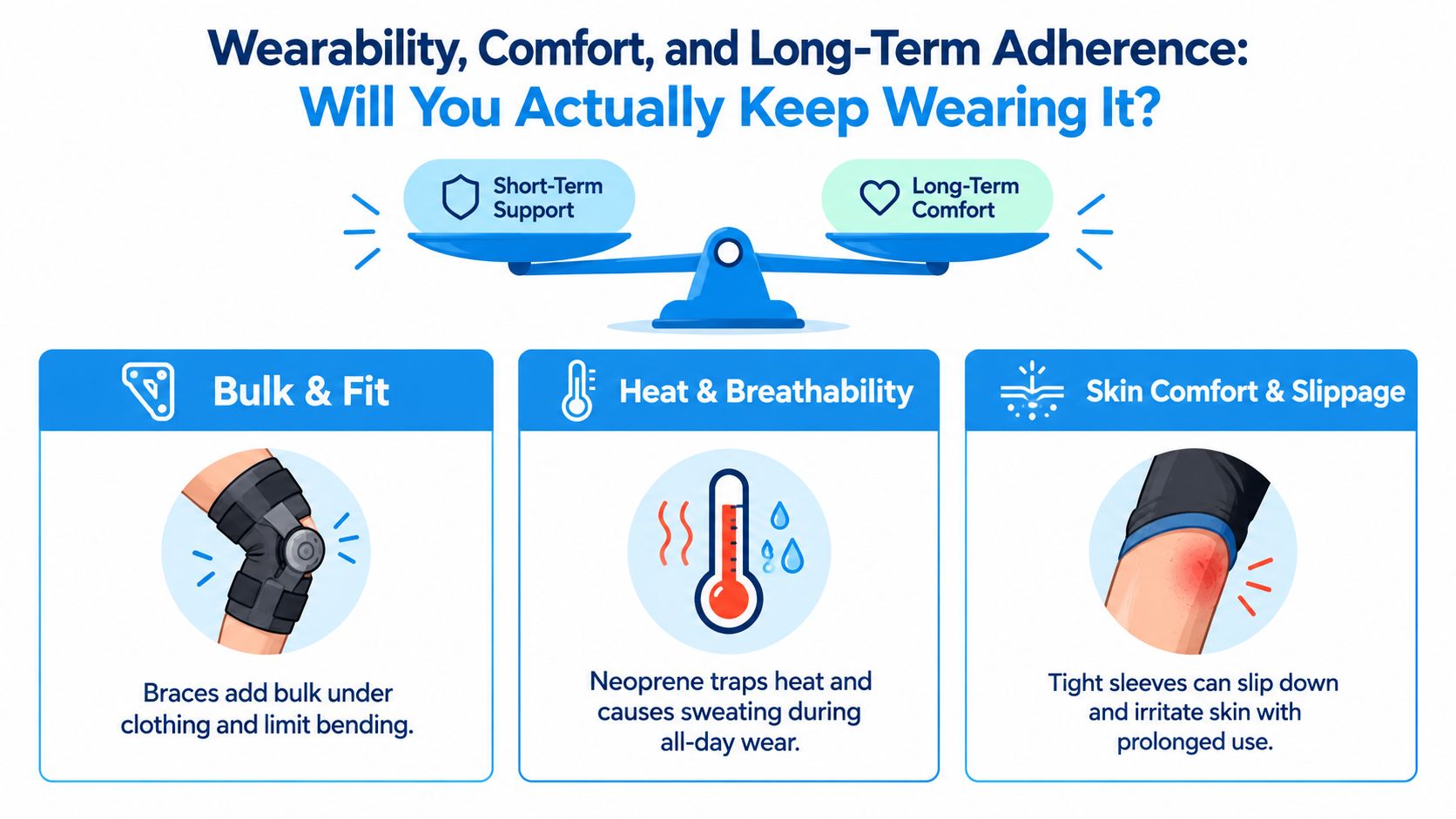
Reviews have noted that wearability, low-profile design, reduced slippage, and comfort strongly influence whether people keep using a support. The same review discussion also points out a long-standing reality: brace adherence over time has often been low, while some sleeve designs may win because users tolerate them better (review discussion of knee orthosis design and comfort factors).
Adherence is a clinical variable
This part matters more than people think. If a brace offers stronger mechanical help but sits in a drawer, its real-world effect is zero.
A small cohort report on a bioactive knee sleeve showed high early wear times, averaging 19.3 hours per day at 2 weeks, 19.0 hours at 6 weeks, and 13.8 hours at 3 months (bioactive knee sleeve wear-time report). I wouldn't use one small cohort to make sweeping claims, but it reinforces the obvious point: people often wear simple, tolerable products longer.
If your knee support keeps slipping, check sizing before you blame the category. This knee sleeve sizing chart can help you think through fit.
Who should care most about comfort
These groups usually need to prioritize wearability:
- Older adults with daily stiffness who want something on for long stretches
- People with sensitive skin who react badly to tight neoprene
- Desk workers and travelers who need low-bulk comfort
- People with chronic pain who value consistency more than max support
- Anyone with compression intolerance who wants warmth without squeeze
For these users, a non-compressive thermal sleeve can make more sense than either a hinged brace or a standard compression sleeve.
Pros and Cons of Each Option
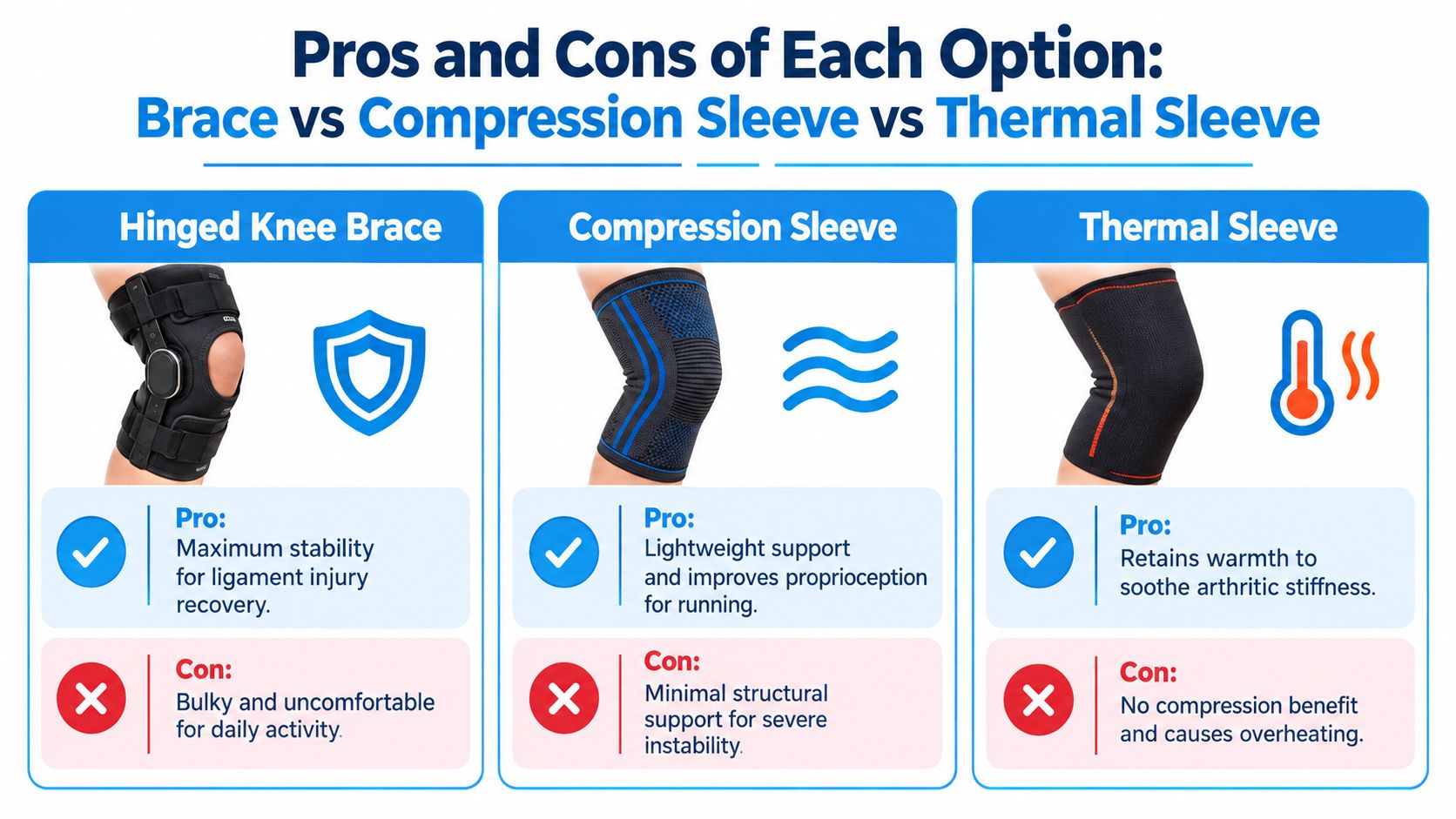
No category wins outright. Each one wins in specific situations and loses in others.
Here's the quick visual before the blunt breakdown.
Hinged or rigid knee brace
Best when the knee is unreliable. If you're descending hills, returning to cutting sports, or protecting a healing ligament, a brace earns its bulk.
Pros:
- Strongest mechanical control when instability is the issue
- Useful for compartment offloading in the right osteoarthritis case
- Better match for post-op or clinician-directed use
Cons:
- Bulky under clothing
- Harder to wear for long sedentary stretches
- Can feel excessive for mild pain or swelling
- Fit is fussier, especially across brands and leg shapes
Compression sleeve
Best when the knee is stable but cranky. This is the practical middle ground for workouts, walking, and day-to-day soreness.
Pros:
- Easy to wear
- Lower profile
- Good for warmth, compression, and joint awareness
- More realistic for regular use
Cons:
- Doesn't stabilize true instability
- Can trap heat, especially in neoprene
- Can roll, slip, or irritate skin if too tight or poorly sized
This short video gives a useful visual comparison of support styles in the world.
Thermal non-compressive sleeve
Best when wear tolerance is the priority. If compression bothers you, but your knee likes warmth, this category deserves more attention than it gets.
Pros:
- More comfortable for long wear
- Less squeeze for sensitive skin or swelling fluctuations
- Good fit for stiffness-focused users
Cons:
- No meaningful structural support
- Not a substitute for a brace
- May feel too minimal if you expect a locked-in sensation
No sleeve, brace, or thermal garment replaces strength work, rehab, or an actual diagnosis when the knee is unstable.
Which Option to Choose for Your Situation
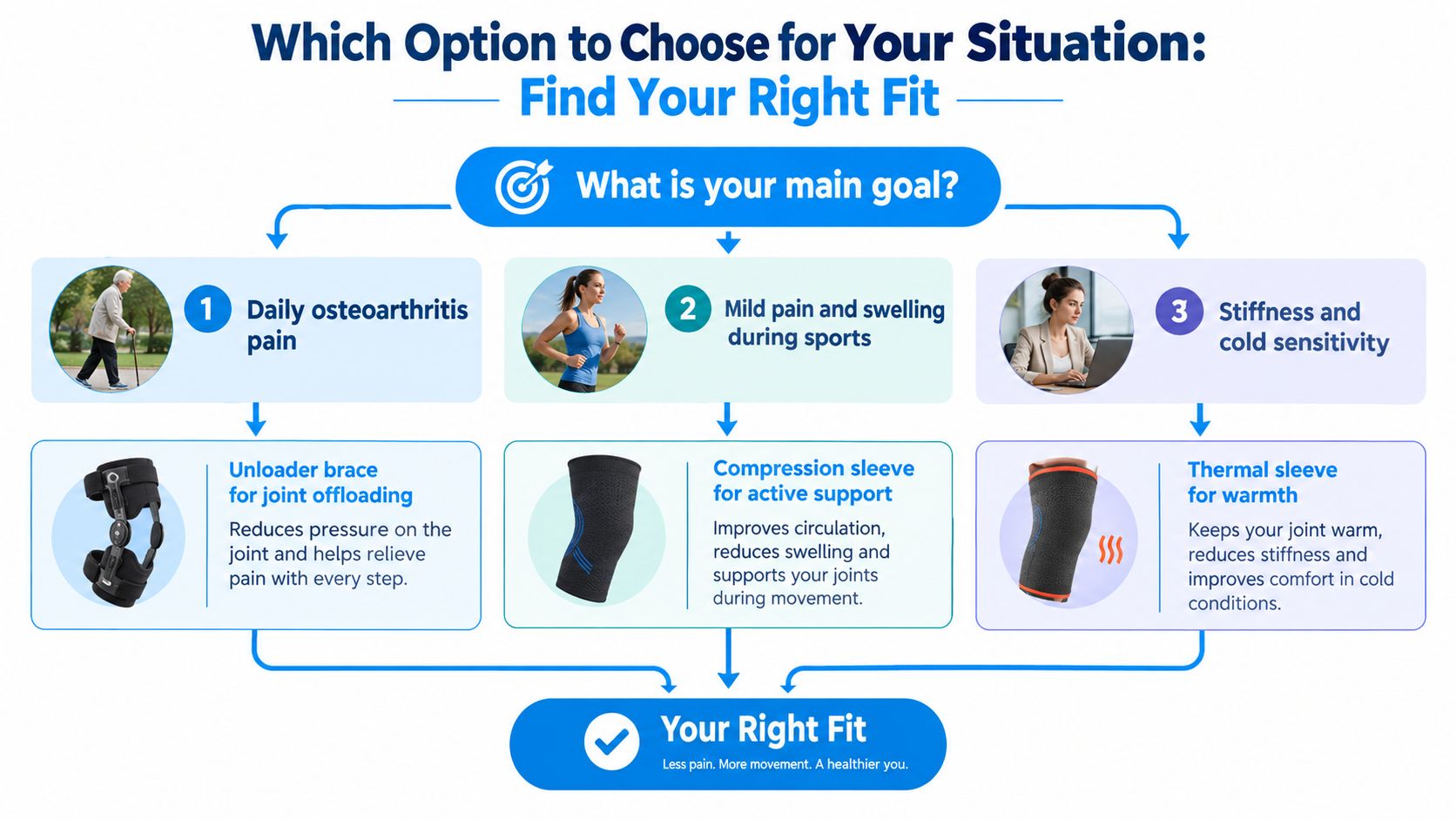
You don't need a winner. You need a match.
Start with your main problem
-
Your knee gives out, shifts, or feels unstable
Choose a brace, especially a hinged or clinically directed design. Mechanical problems need mechanical help.
-
Your knee is sore, mildly swollen, or tired during activity but stays stable
Choose a compression sleeve. That's the cleanest answer for most active adults with manageable symptoms.
-
Your main complaint is stiffness, cold sensitivity, or poor tolerance for tight compression
Choose a thermal non-compressive sleeve. That's where comfort can beat compression.
Fast recommendations by user profile
If you have one-sided osteoarthritis and the goal is offloading, look at an unloader-style brace. If you have post-ACL recovery needs, follow your surgeon or physical therapist on brace use, then step down when appropriate instead of clinging to hardware forever.
If you have patellofemoral pain, don't expect miracles from any support. Prioritize rehab, and use a sleeve only if it helps you tolerate activity. If you have low-grade chronic pain and hate compression, a product like Thermo Recovery Wear's infrared-responsive knee sleeve fits the comfort-and-warmth lane rather than the stabilization lane.
For shoppers who want something less bulky than a traditional brace, this guide on a lightweight knee brace can help narrow the field.
The short triage rule
Use this:
- Instability = brace
- Swelling, mild soreness, proprioception = compression sleeve
- Warmth, stiffness, compression intolerance = thermal sleeve
Get evaluated if the knee locks, repeatedly gives way, swells dramatically, or follows acute trauma.
Common Questions on Knee Braces and Sleeves
How tight should a knee sleeve feel
Snug, not punishing. It should stay in place and feel supportive without numbness, tingling, skin digging, or a throbbing band above or below the joint. If swelling changes through the day, you may need a more forgiving fit rather than the tightest size you can squeeze into.
Should you size up or down
If you're between sizes and your knee swells easily, sizing up is often the smarter move for comfort. If your main complaint is slippage, reassess measurements and fabric type before assuming you need more compression.
Can you wear them all day
A sleeve often works better for all-day use than a rigid brace. A thermal non-compressive sleeve can be even easier for long wear if you dislike pressure. Rigid braces are usually better used with a purpose, such as activity, recovery stage, or a clinician's instruction.
When should you stop guessing and see a clinician
Get assessed if you have:
- Locking
- Repeated giving way
- Persistent swelling
- Inability to bear weight normally
- Recent trauma
- Numbness or neurological symptoms
Those aren't shopping problems. They're evaluation problems.
Thermo Recovery Wear offers compression-lite, infrared-responsive knee sleeves and braces for people who want warmth and recovery support without the squeeze of a standard compression sleeve. If your knee is stable but stiff, sensitive, or hard to keep comfortable all day, visit Thermo Recovery Wear and look at the non-compressive recovery-wear approach before defaulting to a bulky brace.


