


The strongest-looking knee brace isn't automatically the one that will help you most. A rigid frame can be a sensible choice for pain tied to a specific, overloaded side of the knee, yet the wrong fit or an unrelated pain pattern can make that brace bulky, uncomfortable, and hard to wear. Meanwhile, a softer sleeve may feel better for stiffness around the kneecap or general aching, even though it doesn't shift joint load like an unloader brace.
A useful arthritis knee brace review should ask more than which product feels supportive in a shop or tops an online ranking. It should match brace mechanics to the location of your pain, your alignment, and the amount of support you can tolerate in daily life.
Table of Contents
- Why the Wrong Brace Worsens the Right Problem
- The Four Brace Families and What Each Actually Does
- Comparing Braces on Fit, Comfort, Evidence, and Wear Time
- Matching the Brace to Your Pain Pattern
- Scoring Braces and a Short Decision Flowchart
- What to Expect in the First 30, 90, and 180 Days
- Brace Questions Buyers Ask After the Comparison
Why the Wrong Brace Worsens the Right Problem
A brace can be well made and still aggravate the problem you want to manage. Its effect depends on whether its support matches your pain pattern and whether you can wear it comfortably.
Evidence for knee braces varies by outcome. A Cochrane review of braces and orthoses for knee osteoarthritis found mixed results across clinical studies. Some short-term comparisons favored a brace or neoprene sleeve for pain or function, while other outcomes showed no clear benefit. The review also noted uncertainty about long-term use and whether people keep wearing braces.
Customer reviews need the same context. One wearer may feel steadier or walk more comfortably; another may get little relief and stop using the brace because it's hot, bulky, or hard to fasten. A positive review describes one person's experience, not a reliable prediction for every knee.
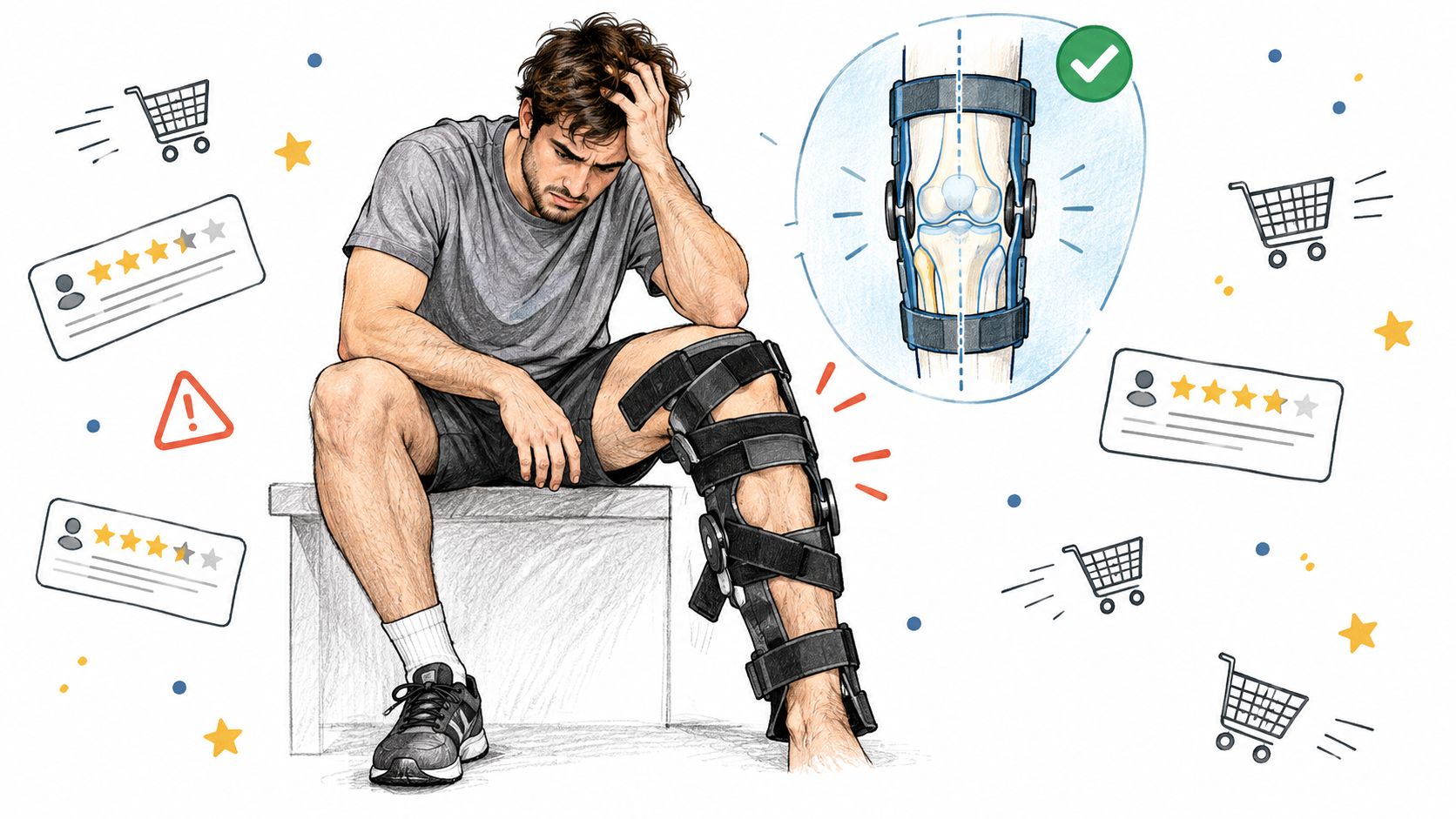
Four ways a brace can fail in practice
- It targets the wrong area. A brace that shifts load away from one side may not help pain under the kneecap or aching across the knee.
- You stop wearing it. Bulk, heat, awkward fastening, or discomfort can make a potentially useful brace impractical.
- It irritates your skin. Pressure or rubbing at contact points can limit wear time.
- It slips during movement. A brace that migrates may no longer sit where it needs to.
The American College of Rheumatology/Arthritis Foundation guideline for osteoarthritis management conditionally recommends tibiofemoral bracing when osteoarthritis affects walking, stability, or pain and the person can tolerate the inconvenience. That is a selective recommendation, not a reason for every person with arthritis to buy a brace.
Compare braces with other care options using options for osteoarthritis of the knee, and browse osteoarthritis treatment approaches for a broader overview.
The Four Brace Families and What Each Actually Does
A product page may use terms such as support, stability, compression, or thermal recovery as if they mean the same thing. They don't. These four families work differently, so start by identifying the mechanism rather than judging a brace by its appearance.
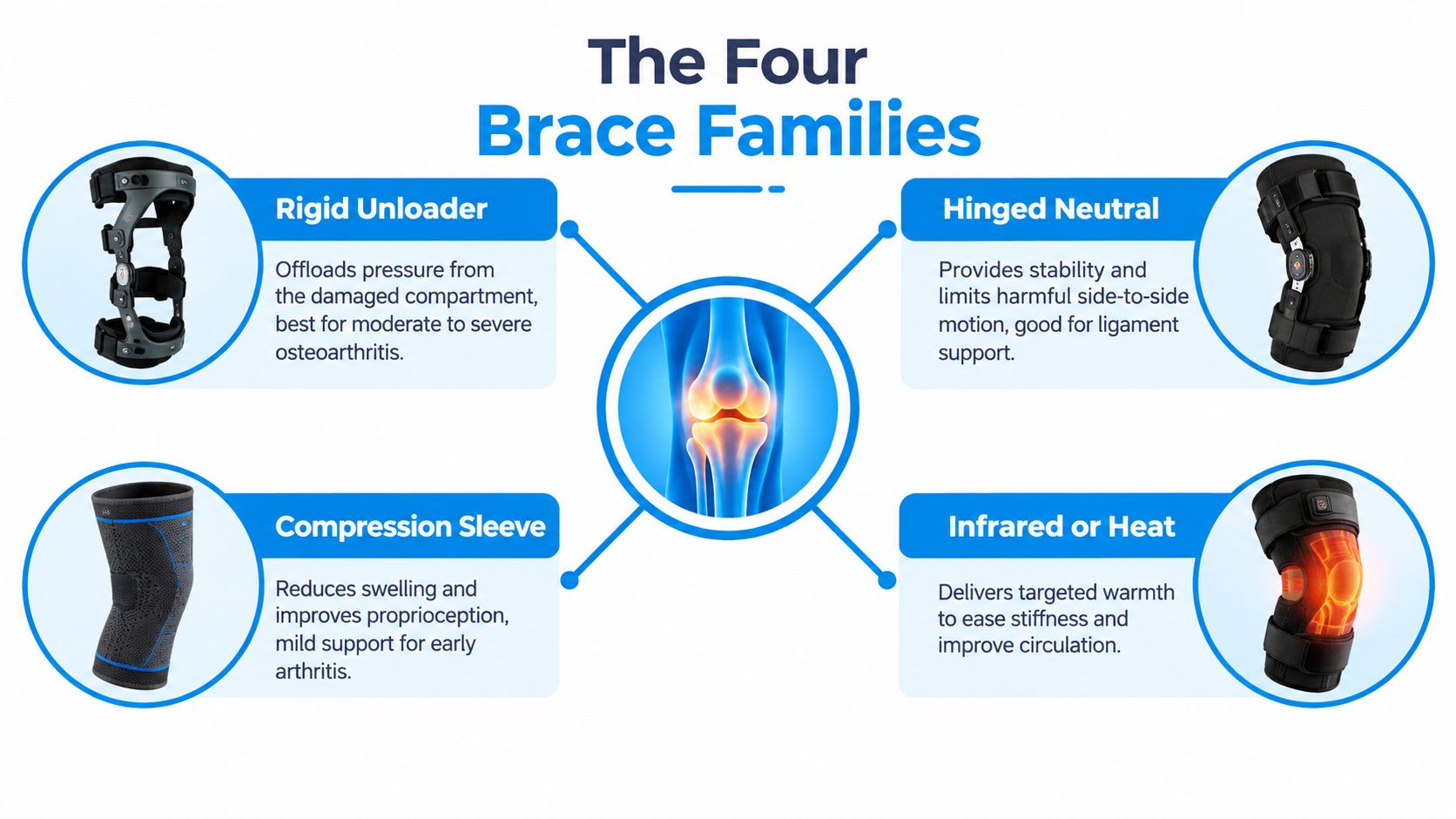
Rigid unloader braces
An unloader uses a frame and adjustable forces to try to redirect pressure away from a more affected knee compartment. That makes it most mechanically relevant when arthritis is concentrated on one side and alignment contributes to the loading pattern. A systematic review of valgus unloader braces found reduced knee adduction moment in studies of people with medial-compartment osteoarthritis. That measure is a biomechanical indicator of loading, not a promise that every wearer will feel less pain.
The trade-off is practical: frames can be bulky, and fit and adjustment matter. Choose this category for a specific offloading goal, not because it looks more substantial.
Hinged neutral braces
A hinged neutral brace is meant to provide support around the joint without the same compartment-specific force shift as an unloader. It may suit someone who needs a more structured feel than a sleeve, but it shouldn't be described as equivalent to an unloading brace.
Compression sleeves
A sleeve applies fabric pressure around the knee. Some wearers find the warmth and close fit reassuring, and a sleeve may offer a convenient option for mild symptoms. But it doesn't provide the same mechanical load shift as a rigid unloader.
Infrared or thermal recovery sleeves
These products are designed to provide warmth or a thermal sensation, often with a softer, less structured fit. They may appeal to people who dislike tight compression, but warmth doesn't establish that a brace is unloading the joint or treating the source of pain. For a plain-language comparison of garment styles, see the guide to the difference between a knee brace and a knee sleeve.
Which description sounds closest to your problem: targeted pressure relief, a steadier feel, light compression, or a softer warmth-focused layer? That answer helps narrow the field before you compare products.
Here's a visual overview of how different brace styles are used:
Comparing Braces on Fit, Comfort, Evidence, and Wear Time
A brace earns its place by matching the problem and staying comfortable enough to wear. More structure does not automatically mean more relief.
| Brace Family | How It Works | Evidence and Limits | Comfort and Wear | Often Suits |
|---|---|---|---|---|
| Rigid unloader | Applies force intended to reduce load on a targeted compartment | The mechanical rationale is clear, but symptom relief varies between users | Structured and sometimes bulky; fit and adjustment affect comfort | Diagnosed compartment-specific arthritis when a clinician confirms the brace is appropriate |
| Hinged neutral | Adds support around the knee without targeting one compartment for unloading | Benefits depend on the design and the reason for wearing it | More substantial than a sleeve; hinges need to sit correctly as the knee bends | People seeking a steadier feel without compartment-specific offloading |
| Compression sleeve | Applies fabric pressure around the knee | Research findings vary by sleeve and study; it does not unload one compartment | Flexible, though heat, tightness, or skin irritation can limit wear | People with mild symptoms who prefer a close fit |
| Infrared or thermal recovery sleeve | Provides a softer, warmth-focused layer without an unloader's force shift | Warmth claims do not establish arthritis pain relief or joint unloading | May suit people who dislike rigid or tight braces; check skin comfort | People seeking everyday comfort with less structure |
Studies of knee braces for osteoarthritis test different designs and outcomes, so their findings do not support blanket claims that every brace works or that sleeves never help. Judge the fit, comfort, and mechanism together.
A rigid unloader makes sense when its targeted force shift matches a diagnosed pattern and you can tolerate the bulk and adjustments. For diffuse aching or pain beneath the kneecap, a softer sleeve may be easier to wear, even though it does not shift joint load. Keep supplement choices separate from brace performance. To find joint supplement research, review that evidence on its own.
The practical test: A brace you cannot wear comfortably is unlikely to help in daily use, however plausible its design sounds.
Fit matters. Follow the manufacturer's measuring instructions and place the sleeve as directed. A knee sleeve sizing chart can help you choose a size; significant instability or a need for an unloader calls for professional fitting advice.
Matching the Brace to Your Pain Pattern
Start with where and when the knee hurts, then ask whether the pain points to a specific compartment, instability, or a more general comfort need. These examples are decision prompts, not diagnoses.
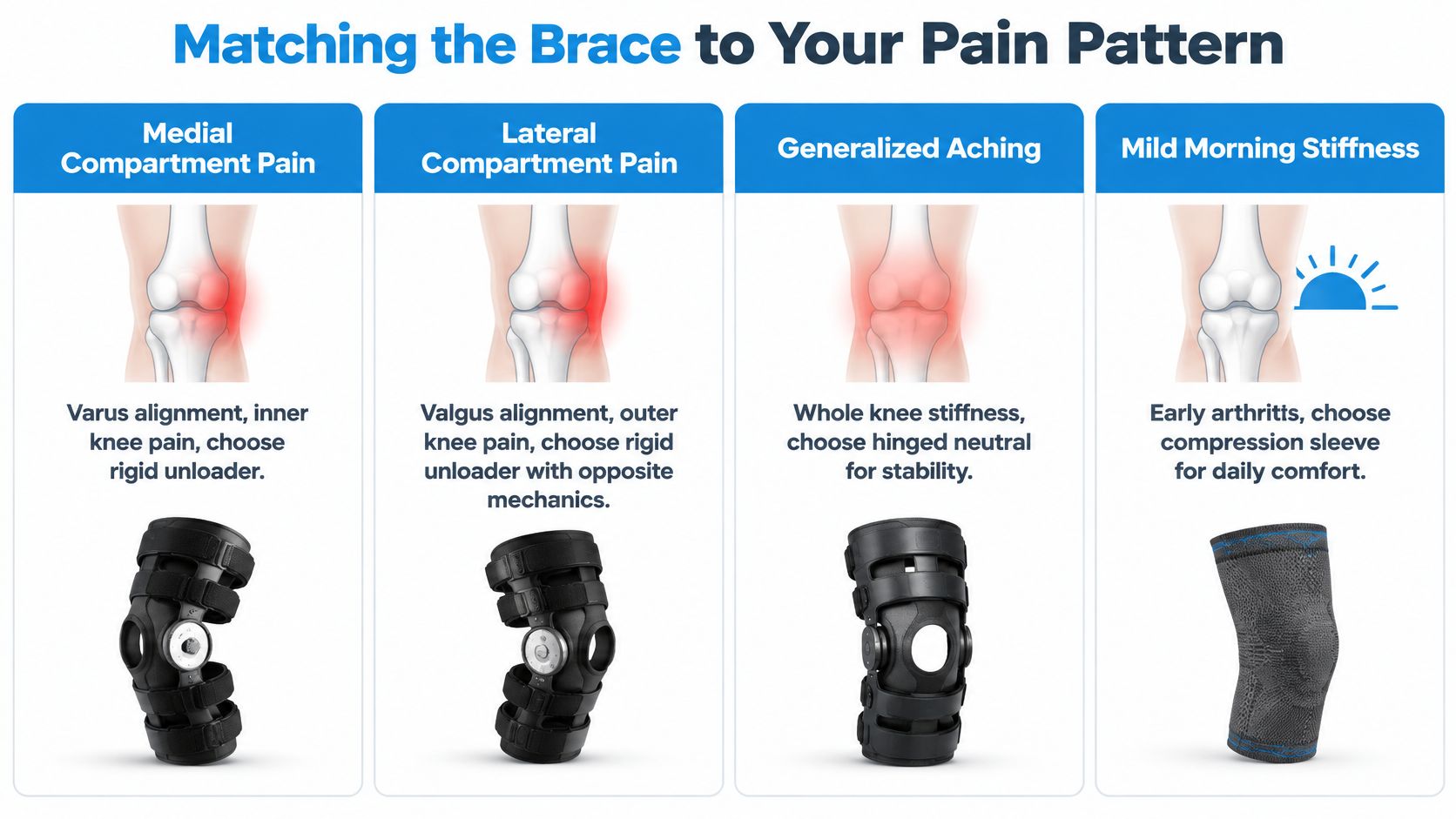
Inner-knee pain with varus alignment
If pain is concentrated on the inner side and a clinician has identified medial-compartment arthritis with varus alignment, ask whether a valgus unloader fits your case. Compartment-specific unloading has a mechanical rationale here. Don't choose one by appearance alone: have a clinician or physical therapist confirm the pattern and help assess fit.
Pain beneath the kneecap
Pain under the kneecap, particularly around stair use or after sitting, shouldn't automatically send you toward a rigid unloader. A softer sleeve or thermal layer may be more comfortable for general support, but it won't correct the cause of patellofemoral pain or shift force the way an unloader is designed to.
Clinical recommendations can differ by arthritis pattern. A recent review of the guidance described recommendations against using valgus unloaders for medial-compartment osteoarthritis and realigning braces for patellofemoral osteoarthritis. That's another reason to get the pain source and alignment assessed instead of treating every brace marketed for arthritis as interchangeable.
Sensitive skin or low tolerance for compression
If snug garments irritate your skin or feel unpleasant, don't force a tight sleeve just because it's a common first purchase. Consider a less compressive option for comfort, while staying clear about what it can and can't do: warmth may feel pleasant, but it isn't structural support or compartment unloading. Stop if the garment causes irritation, numbness, or worsening discomfort.
Walking most of the day
For longer daily wear, comfort, stable positioning, and ease of application matter as much as brace design. A flexible sleeve may suit someone seeking light support; a hinged brace may be a better question for someone whose main concern is instability. A rigid unloader may still be appropriate when the clinical pattern fits, but only if you can wear and adjust it reliably.
The central point is simple: match the brace to the pain pattern and the job you need it to do. A technically advanced frame isn't automatically the best choice for generalized aching, and a soft sleeve shouldn't be mistaken for targeted unloading.
Scoring Braces and a Short Decision Flowchart
A simple scoring system can turn a vague shopping decision into a more useful comparison. Rate each brace you're considering from 1 to 5 on five factors, with a low score meaning a poor match and a high score meaning a strong one.
- Pain match: Does its mechanism fit the location and likely source of your symptoms?
- Fit tolerance: Can you position it comfortably without rubbing, excessive pressure, or slipping?
- Wear time: Can you realistically use it for the activities that trigger your symptoms?
- Evidence: Is there relevant clinical evidence for this brace type and your situation?
- Value: Does the expected benefit justify the cost to you?
Give the factors different importance if your situation calls for it. For example, a person seeking targeted relief for diagnosed medial-compartment arthritis might give pain match more weight, while someone with sensitive skin could prioritize fit tolerance and likely wear time. Keep the weighting personal; this is a shopping aid, not a validated medical score.
A short decision flowchart
Is the pain clearly on the inner or outer side? If yes, ask a clinician whether alignment and compartment-specific unloading are relevant. If not, don't assume an unloader is the right starting point.
Can you tolerate a structured frame? If no, consider a softer option for comfort. If yes, a hinged or unloader design may be worth discussing if its mechanism matches the problem.
Do you have skin sensitivity or circulation concerns? Prioritize careful fit and a fabric you tolerate. Don't accept numbness or irritation as the price of support.
Do you need it for extended daily activity? Choose for realistic comfort, movement, and ease of putting it on, not a promise of continuous wear.
As an example, someone with general stiffness who dislikes tight garments might score a soft sleeve well for fit and wear time, but poorly for evidence of targeted unloading. That result doesn't prove the sleeve will relieve arthritis pain. It shows the shopper values comfort and should avoid paying for a rigid mechanism they don't need or can't tolerate. If symptoms suggest instability or compartment-specific arthritis, ask a clinician before relying on a self-score.
What to Expect in the First 30, 90, and 180 Days
Treat bracing as a trial you evaluate, not a permanent purchase you assume will work. The useful question is whether the brace fits, whether you wear it during relevant activities, and whether your day-to-day function changes.
First 30 days
Check fit during the activities that usually bother your knee. Note when you wear the brace, whether it slips, and whether you notice rubbing, warmth, or skin irritation. Record pain and practical changes such as whether walking or standing feels easier; memory alone makes it hard to judge a gradual difference.
Make small fit adjustments according to the product instructions. Don't tighten a brace to compensate for migration without checking placement, and don't keep wearing it through numbness or worsening symptoms.
Days 31–90
Review your notes. A modest change that helps you complete ordinary activities may matter more than a dramatic claim on a product page. If you rarely wear the brace because it's cumbersome or uncomfortable, that's evidence the choice doesn't fit your routine, even if the design looks appropriate.
If pain or walking tolerance hasn't changed, revisit the pain pattern and brace category rather than automatically buying a stronger model. A physical therapist can help you assess movement and discuss how a brace fits alongside activity. You can also review guidance on knee mobility exercises.
Days 91–180
If a targeted brace seems useful but is difficult to fit, ask whether professional adjustment or a custom option is appropriate. If the pain has shifted, or the brace now feels wrong, reassess rather than assuming you need more support.
Get clinical advice for locking, significant new swelling, visible deformity, or instability. Those signs call for assessment, not a different online ranking.
Brace Questions Buyers Ask After the Comparison
How should a knee brace fit?
A brace should feel secure without pinching, causing numbness, or making swelling worse. Check that it sits in the intended position around the kneecap, doesn't dig into the crease behind your knee, and stays aligned along the calf when you walk.
If a rigid brace has hinges, confirm they remain where the instructions indicate as your knee bends and straightens. For wear and positioning guidance, see how to wear a knee brace. A poor fit can make even a suitable brace frustrating.
What should I expect to pay?
Prices vary by construction, brand, and how the brace is fitted. A simple sleeve and a rigid unloader aren't direct substitutes, so comparing them by price alone can mislead: one offers a softer fit, while the other is designed to shift loading. Check what the product does, what adjustments it allows, and whether you can return it if fit is unsuitable.
Will insurance or HSA/FSA funds cover it?
Coverage depends on the plan and the brace. A prescribed, medically indicated brace may be handled differently from an over-the-counter sleeve, so check with your insurer and benefits administrator before buying. Ask whether you need a clinician's prescription, a specific supplier, or documentation.
When should I stop wearing it?
Remove the brace if you develop skin breakdown, numbness, new instability, or pain that worsens while wearing it. Don't respond by tightening it or wearing it longer. If symptoms continue after you take it off, or your knee locks, swells significantly, or feels unstable, contact a clinician.
The best brace is the one whose mechanism fits your problem and whose fit lets you use it without creating a new one. Choose for the pain pattern, not for the most impressive-looking frame.
Explore Thermo Recovery Wear if you're comparing softer, compression-lite infrared recovery sleeves for everyday comfort. Review the sizing and wear guidance, then choose a support style that matches your symptoms and what you can comfortably wear.


