


The most popular advice about the best back brace for arthritis is to buy as much support as you can tolerate and wear it whenever your back aches. That advice flips the evidence. A stiffer brace doesn't produce better outcomes, and a brace worn from morning to night can work against the muscles meant to protect your spine. What separates a brace that helps from one that becomes a crutch is narrower than a product category: whether it matches the structure causing your pain, whether it suits the task that provokes it, and whether your walking, sitting and daily tasks measurably improve after a few weeks.
This guide treats a brace as a tool with a job description. It reports what trials measured, where the evidence thins out, and which claims on a product page you can verify yourself in a hallway with a stopwatch and a mirror. For some readers the honest answer will be no brace at all, or a brace used only while rehabilitation does the essential work.
Table of Contents
- Why a Back Brace Is Not a Stand-Alone Arthritis Treatment
- Quick Picks for Your Pain Pattern and Daily Routine
- Confirm the Pain Source Before You Buy a Brace
- Compression and Non-Compressive Braces Compared Side by Side
- Fit, Sizing and Skin Checks That Decide Results
- Judging Results and Staying Safe as an Older Adult
- Choose Your Brace and Confirm the Next Step
Why a Back Brace Is Not a Stand-Alone Arthritis Treatment
Arthritis care has no product that replaces movement, strength and a correct diagnosis. A brace sits in the same category as a walking stick or a knee sleeve. It changes the load on a painful region for the hours you wear it, then stops working when you take it off. The clinical literature says so in numbers that are easy to misread.
What the pooled data actually shows
The review of bracing outcomes in chronic low back pain reports a statistically significant pain reduction with lumbar support, a standardized mean difference of 1.33 (95% confidence interval, -2.09 to -0.57, p = 0.0006). Then read the heterogeneity figure printed beside it: I² = 97 percent. Nearly all of the variation between studies came from differences in patients, devices and treatment duration, not from one consistent treatment effect.
That caveat explains how a review can report a strong average benefit and still decline to crown a superior product. The same body of work describes a randomized comparison in which adding a back brace to education and exercise produced no different pain-disability outcome than education and exercise alone. It also flags the concern that prolonged lumbosacral orthosis use may contribute to trunk-muscle weakness or atrophy.
The practical rule: judge a brace by what changes during the task and after you take it off, not by how rigid it feels in the shop.
The configuration the evidence supports
A comfortable, removable brace worn selectively during aggravating activities such as walking, lifting or prolonged standing fits the evidence better than an all-day garment. So does keeping core conditioning, mobility work and clinician-directed treatment running in parallel. If you want the active half of that plan spelled out, these arthritis pain relief strategies cover the movement and load-management routines a brace is meant to supplement rather than replace.
That gives the decision frame for everything below. Choose by pain pattern, by the task that provokes it and by fit on your body. Then judge the purchase by whether your pain score, walking tolerance and daily tasks improve over several weeks. The support level printed on the box tells you almost nothing about that.
Quick Picks for Your Pain Pattern and Daily Routine
Timing narrows the field faster than any label. When your back hurts points to a brace design, and the trade-off column tells you what you give up by choosing it.
| Pain pattern | Starting brace type | Main trade-off |
|---|---|---|
| Pain worst during standing or walking | Adjustable lumbosacral support | Can limit breathing and sitting if fastened too tightly |
| Stiffness after sitting or rising | Light elastic lumbar support, worn during that activity | Gives less stabilization for heavy lifting |
| Pain with lifting or bending at work | Semi-rigid lumbosacral orthosis, used for those tasks only | Reduces trunk movement; can encourage reliance if worn all day |
| Constant mild ache with sensitive skin | Non-compressive thermal sleeve | Warmth claims have weaker evidence than measured pain and function change |
| Radiating leg pain, weakness, or bowel or bladder change | No self-selected brace; medical assessment first | A brace can mask a condition that needs treatment |
Standing and walking intolerance is the most common reason people start shopping. An adjustable lumbosacral support is the reasonable first try: fasten it only as firmly as the walk demands, and confirm you can take a full breath and sit down without the front edge digging into your hip crease.
Stiffness that settles in after a long sit behaves differently again. A light elastic lumbar support worn for the first hour of movement after the sitting helps some people get going. It won't stabilize a spine under load, so don't wear it to move furniture.
Lifting and bending at work justify the semi-rigid orthosis, which reduces trunk movement enough to make a lift feel controlled. The trade-off is real: leave it in the locker and put it on for the task.
Seating and the stiffness pattern
If your worst hour is the one after you stand up from a desk, the seat is part of the problem. Chair features that deliver lasting relief from Tyner Furniture are worth reviewing alongside any brace, because an hour of support can't cancel out eight hours of poor seating.
A rule that saves money: one brace, one task, three weeks of notes before you judge it.
How to test one pick at a time
Start with a single type for two to three weeks. Change the brace only if the pain pattern changes or the task changes, not because a different model advertises more support. Sensitive skin is its own constraint: a non-compressive sleeve lets you test daily wear without pressure marks, but warmth alone won't tell you whether the brace is working, so log function as well as comfort.
The table is a starting point, not a verdict. Your body and your workday will overrule it more often than any specification sheet will.
Confirm the Pain Source Before You Buy a Brace
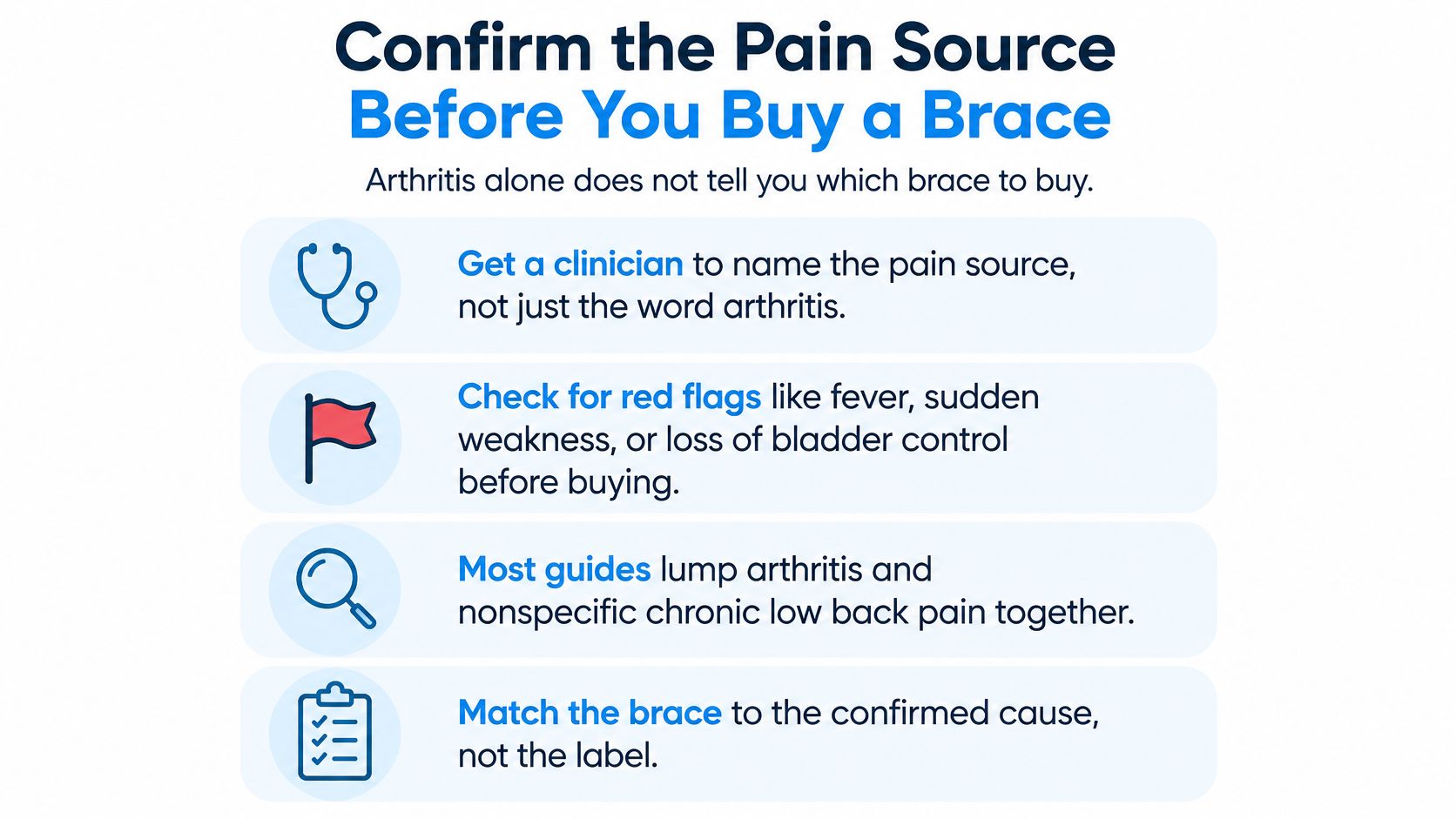
Arthritis alone does not tell you which brace to buy, because it isn't one condition and the trials didn't study it as one. A 2025 systematic review of 16 randomized trials found a statistically significant pain benefit from lumbar supports, but results were highly inconsistent across studies, and the devices, populations and comparators varied substantially. Much of that evidence base studied chronic low back pain generally rather than confirmed spinal osteoarthritis.
The lookalikes that need different care
Six problems get grouped under "back arthritis" and each responds to different support:
- Facet-joint arthritis: pain that worsens with extension and standing, often eased by sitting.
- Spinal stenosis: leg symptoms and reduced walking distance, which a compressive brace can aggravate.
- Degenerative disc disease: pain with flexion and prolonged sitting.
- Sacroiliac pain: located near the dimples rather than the lumbar spine, and poorly served by a lumbar belt.
- Osteoporosis-related pain: where compression and rigidity raise their own risks.
- Nonspecific low back pain: the category most bracing trials enrolled.
A brace cannot be selected reliably from the word arthritis, and Cochrane concluded that evidence is insufficient to support routine lumbar-support use for chronic low back pain. Lumbar supports used alone may produce little or no improvement in pain or disability, while adding one to medication may give only a small short-term pain reduction, with the evidence rated very uncertain.
The red flags that come before any purchase
Stop shopping and get assessed if you have new leg weakness or numbness, bowel or bladder changes, fever, significant trauma or a suspected fracture, or unexplained weight loss. Those findings point to something a brace can mask rather than manage.
Ask for a cause, not a product. "Which structure is generating this pain, and which movements load it?" is the question a clinician can answer and a sizing chart cannot.
For readers whose pain has a confirmed cause, walking tolerance and leg symptoms are often the deciding details. This overview of relief for spinal stenosis explains why leaning forward changes symptoms and how that shapes support choices. If night pain and morning stiffness dominate instead, the surface you sleep on matters as much as anything you strap on, and this Grants Pass guide to back pain mattresses from Gates Home Furnishings is a useful companion read.
The contrarian conclusion is uncomfortable for anyone selling braces. For some readers the most evidence-based choice is none, particularly when a brace replaces the rehabilitation that would change the pain. Bring the pain pattern and your list of aggravating tasks to a clinician before you buy, not after.
Compression and Non-Compressive Braces Compared Side by Side
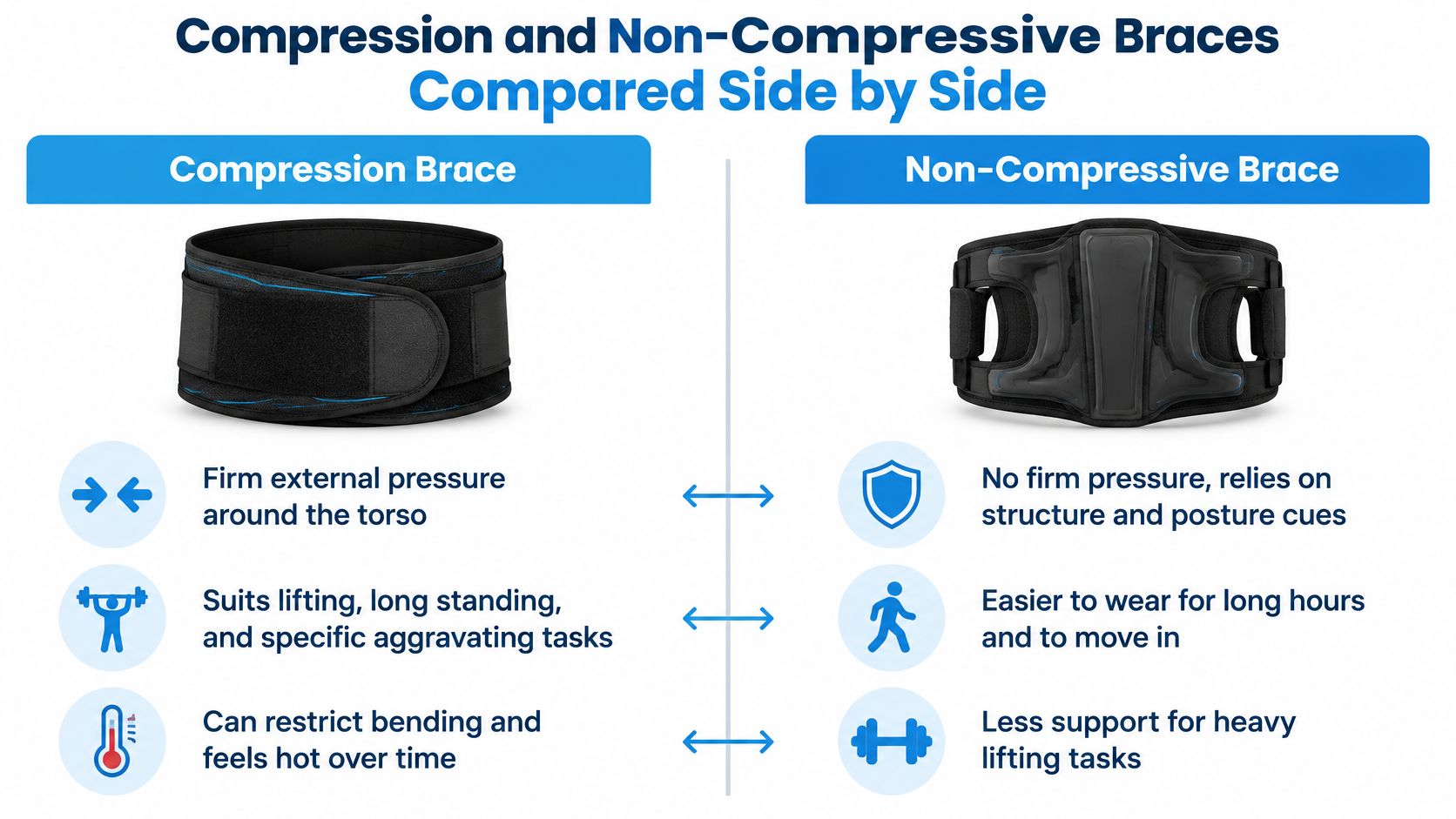
Two families of product dominate the market, and they work by different mechanisms rather than by different strengths. Compression braces wrap the torso in firm pressure and often include rigid or semi-rigid stays. Non-compressive designs rely on structure, fit and fabric rather than squeeze.
Where compression earns its place
Compression does a specific job well. It applies external pressure that makes lifting, long standing and repeated bending feel more controlled, and semi-rigid stays reduce the range of trunk movement that provokes pain. The cost shows up in the same hours: firm wrapping can restrict bending, breathing and hip motion, and it holds heat. Anyone who has worn a tightly fastened lumbar belt through an afternoon meeting knows the trade-off isn't theoretical.
The supporting evidence is mixed and skewed short-term. Reported pain and disability benefits concentrate over brief intervention periods, which is consistent with a device that changes load while it's on and says nothing about what happens once you take it off.
What a non-compressive sleeve can and cannot claim
Non-compressive sleeves remove the squeeze and are built for light movement across long days, which suits sensitive skin, older wearers and people who react badly to tight garments. Thermo Recovery Wear's Premier Non-Compression Recovery Wear, for instance, is designed for everyday joint pain without the squeeze of compression. That is the honest ceiling for the category: coverage and comfort during daily tasks.
The marketing leans on warmth and circulation. Fabric in this category is often described as infrared-responsive, and that property belongs in the comfort file until your own records show a functional gain, because warmth is easier to feel than to measure.
Thermo Recovery Wear reports that its semiconductor-embedded fabric relieves chronic osteoarthritic joint pain by up to 62 percent, and states that the products have received medical endorsement for significantly enhancing comfort and functionality in grade 1 and 2 osteoarthritis. Treat both as company statements rather than independent measurements, and put them in the comfort column until your own log shows a change in walking or tasks.
| Criterion | Compression brace | Non-compressive sleeve |
|---|---|---|
| Mechanism | Firm external pressure and rigid or semi-rigid support | Light support and warmth without squeeze |
| Movement freedom | Can restrict bending, breathing and hip motion | Designed for light movement and daily wear |
| Skin and fit risk | Higher risk of pressure marks and rolling | Lower pressure; sensitive-skin claims need checking |
| Best fit | Lifting, long standing or specific aggravating tasks | Daily comfort, sensitive skin, low tolerance for squeeze |
| Support evidence | Mixed; pain and disability benefit mainly over short periods | Infrared and warmth claims remain company-reported |
| Manufacturer claims | Support level and adjustability | Up to 62 percent pain relief (company-reported) |
The mechanism difference decides more purchases than the marketing does. If you can't tolerate pressure across the abdomen, no amount of adjustability will make a compression orthosis wearable, and the reverse holds for anyone who needs restraint during heavy lifting. This comparison of non-compression versus compression sleeves walks through how the two constructions behave on the body over a full day.
For a clinician's view of how support level should be matched to a task, this short walkthrough is a useful sanity check before ordering.
The rule the table implies is simple. Judge the claim by function after several weeks, never by the marketing number on the page. A 62 percent figure you can't reproduce in your own hallway is worth less than a note that says you walked twelve minutes further on Tuesday.
Fit, Sizing and Skin Checks That Decide Results
Fit decides whether any of the evidence applies to you. A systematic review of 13 randomized controlled trials found that orthotic support significantly reduced low back pain (p < 0.00001) and disability (p = 0.004), while noting that the evidence base mixes different brace designs, populations and treatment durations. That's why it doesn't establish one universally superior product, and why the same review stresses reassessing fit during movement: excessive abdominal pressure, edge rolling, skin irritation or numbness all reduce adherence and undermine real-world effectiveness.
The fit test, in order
- Put it on seated, then stand. The lower edge should clear your hip crease when you're upright.
- Take a full breath. If the brace shortens your inhale or presses under the ribs, it's too tight.
- Sit, bend and rise from a chair. The front shouldn't dig in and the back shouldn't ride up.
- Walk for about ten minutes. The brace should stay where you placed it without hitching.
- Inspect the skin at every point where an edge or seam touched you.
Sizing starts at the waist, measured at the navel with a soft tape, then checked against where the lower edge lands relative to the hip. Charts vary by brand, so the checklist outranks the number. Adjustability usually matters more than maximum rigidity, because your circumference changes across a day and a brace that can't follow it will either bite or slip.
Skin, seams and the claims worth verifying
Our back sleeve is hypoallergenic and gentle on sensitive skin, and the Thermo Lite Recovery Back Sleeve is latex-free. Those are still claims to verify on your own skin over the first week, because reactions depend on your skin rather than on a specification.
| Check | Good fit | Red flag |
|---|---|---|
| Breathing | Full, comfortable breath while seated and standing | Shallow breath or pressure under the ribs |
| Sitting and hip motion | Sits, bends and rises without the edge digging in | Brace rolls up or limits hip bend |
| Walking | Stays in place through a 10-minute walk | Shifts, slips or rolls during walking |
| Skin at contact points | Mild warmth only, fades quickly after removal | Redness that persists, blisters, or skin breakdown |
| Sensation | Normal feeling in the legs and abdomen | Numbness, tingling or colour change |
| Adjustment | Closes securely without cinching tight | Cannot adjust, or must be tightened to stay on |
Stop rule: any red flag in that table means take the brace off, not tighten it.
If a row fails, change the size or the type rather than your tolerance. These back support belt wearing tips cover placement and strap tension for readers who want a second reference while testing fit at home.
Judging Results and Staying Safe as an Older Adult
Comfort is a poor referee. A brace can feel reassuring and change nothing about your function, so measure what the trials measure rather than what the mirror suggests.
The five numbers worth logging
Keep the log short enough that you'll fill it in. A pain rating tied to one specific aggravating task, a disability questionnaire, walking tolerance, a count of daily tasks managed unaided and a skin check will tell you more in three weeks than any product description can. Record the same task at the same time of day, or the numbers stop meaning anything.
| Measure | How to record it | When to check |
|---|---|---|
| Pain score | 0 to 10 rating before and after the aggravating task | Daily log, reviewed weekly |
| Oswestry Disability Index or Quebec Back Pain Disability Scale | Standard questionnaire | Baseline, then after several weeks |
| Walking tolerance | Minutes or steps before pain rises | Weekly |
| Daily tasks | Count of tasks done unaided (dressing, stairs, carrying shopping) | Weekly |
| Skin condition | Inspect contact points after removal | Daily for fragile or sensitive skin |
Read the rows together rather than separately. If walking tolerance falls while your pain score improves, the brace is buying comfort at the cost of capacity. A flat pain score alongside a rising task count is still a win. That's the pattern a single number would hide.
What the trials did not report
The Cochrane review of lumbar supports and other devices found that included trials did not adequately report adverse events, falls, medication reduction, social participation or broader functional outcomes. An absence of reported harm is therefore not proof of safety, and it says nothing about a wearer with fragile skin, diabetes, reduced sensation, balance problems or osteoporosis.
Those conditions change how you run the trial at home. Reduced sensation means pressure damage can build without warning, which is why the daily skin check in the table matters more than the pain score. Balance problems make a brace that shifts during walking a fall risk rather than a fit annoyance. Numbness, colour change, worsening pain, breathing discomfort or skin breakdown are all reasons to stop, and wear during short, chosen tasks with a gradual build-up gives you cleaner data than putting the brace on for a full day at once. Pair wear with walking or prescribed exercise rather than immobilization.
No universal schedule exists. One older review described studies using roughly 6 to 8 hours daily, but that figure came from heterogeneous low back pain research, not definitive arthritis trials.
Newer work points toward orthoses integrated with physiotherapy, with brace plus physiotherapy offering limited additional benefit over physiotherapy alone. That ordering matters: the therapy is the treatment, the brace is the accessory.
If your skin reacts to everything you wear, fabric choice narrows the field before fit does. This guide to the best fabric for sensitive skin explains which weaves and finishes cause fewer reactions over long wear.
Choose Your Brace and Confirm the Next Step
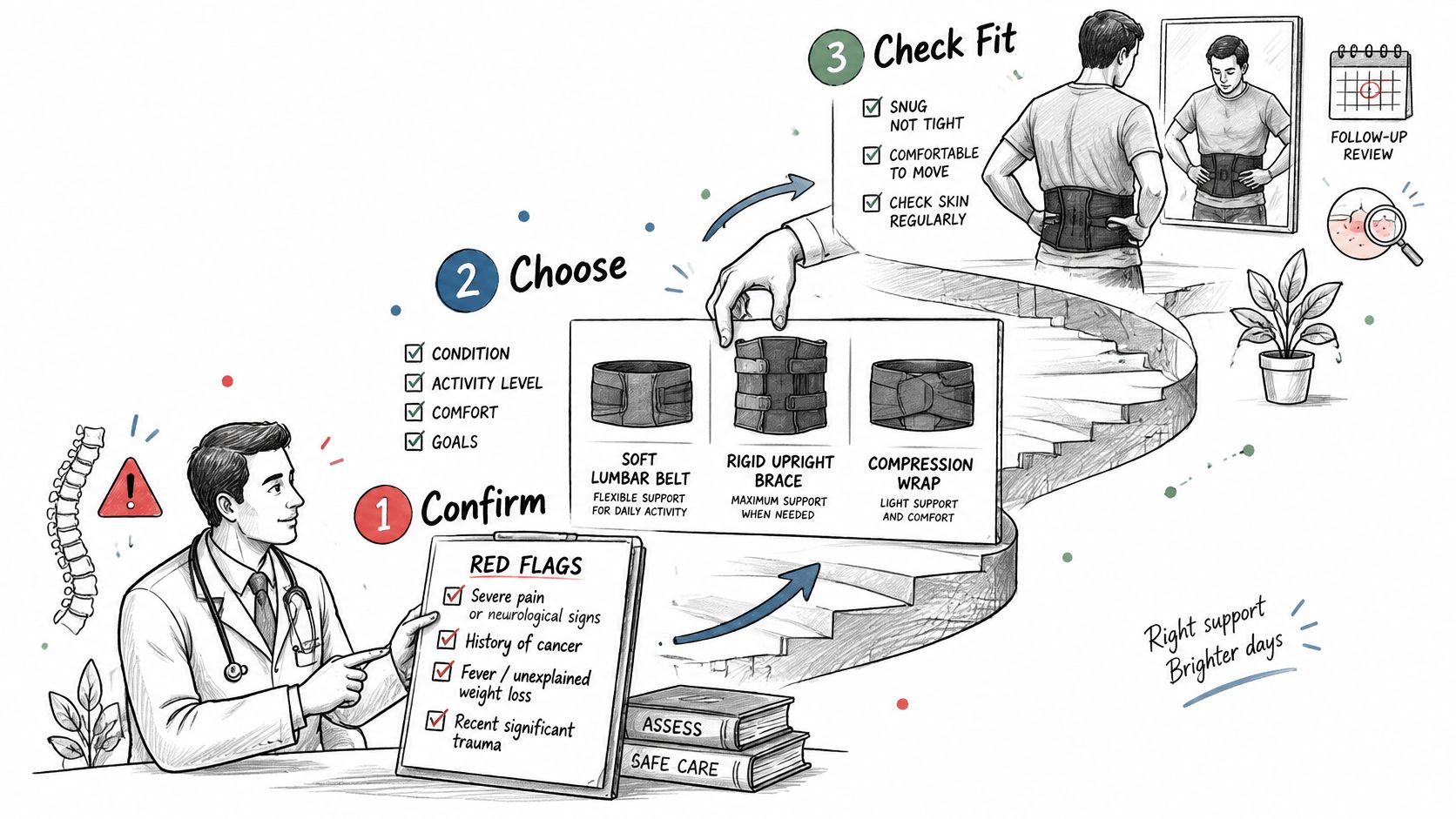
The decision collapses into seven steps, in this order.
- Confirm the cause. If any red flag applies, see a clinician before you spend money.
- Pick one starting type from the pain-pattern table, not three.
- Run the fit test during a short walk before the return window closes.
- Buy where the size chart is published and the return policy is readable.
- Wear it for the aggravating task only in the first weeks.
- Log pain, walking and daily tasks so the review is evidence, not memory.
- Review after several weeks and stop if function drops.
Buying details that change the math
Prices and promotions move, so compare across sellers before ordering and confirm whether a bundle discount applies to the size and type you need. Our multi-item pricing is straightforward: buying 2 products saves 15%, buying 3 saves 20%, and buying 4 or more saves 25%. Read the return window as carefully as the discount, because a brace that fails the fit test needs to go back.
The Thermo Lite Recovery Back Sleeve is currently priced at $54.99, and it's designed to be worn directly against the skin for 24/7 wear. That construction suits readers who want light, non-compressive coverage across a long day; it doesn't override the wear-schedule rule for a rigid orthosis, and it doesn't replace the log.
Judge any product, ours included, against the criteria in this guide rather than against its marketing claims. The criteria are boring and portable: does it match the confirmed pain source, does it survive the fit test, and does your function improve over several weeks?
Your next action is small and specific. Write down the pain pattern and the three tasks that provoke it, take that list to a clinician if any red flag applies, and run the fit test on the first brace you try before you decide anything.
Thermo Recovery Wear builds non-compressive, infrared-responsive sleeves and braces for people who want support without the squeeze of a rigid belt, including a back sleeve designed for long daily wear against the skin. If the approach in this guide matches how you want to test a brace, start with the Lite Recovery Back Sleeve and log your pain, walking and daily tasks for three weeks before you judge it. Visit Thermo Recovery Wear to compare sizes, fabrics and current pricing.


