


Why buy the tightest men's tights shorts if your main goal is comfortable walking or sitting without a waistband digging into your stomach? A close fit, useful muscle support and medical compression aren't interchangeable, yet shoppers often encounter them under the same label.
Start with the job you need the garment to do. Running, lifting, resting at home and managing a medical condition call for different choices. Fabric, construction and fit matter more than a performance slogan, especially if you have sensitive skin or chronic joint pain.
Table of Contents
- Men's Tights Shorts Types by Use
- How Compression Changes What Your Legs Do
- Fabrics and Construction Worth Checking
- Separating Proven Benefits From Marketing Claims
- Sizing and Wear-Testing Men's Tights Shorts
- Fixing Fit, Skin and Care Problems
- Choose the Right Pair for Your Activity
Men's Tights Shorts Types by Use
| Use | Garment type | Compression level | Best fit |
|---|---|---|---|
| Running or cycling training | Compression tights shorts | Moderate to firm | Long sessions where muscle vibration and chafing matter |
| Lifting or gym sessions | Basic training tights shorts | Light | Warmth and friction control under loose shorts |
| Walking, errands, home recovery | Non-compression recovery tights shorts | None or very light | All-day wear at home and light outdoor activity |
| Rest-time comfort after training | Compression-lite recovery shorts | Light | Comfort during rest, not treatment |
| Swelling or medical support | Medical compression shorts | Graded and prescribed | Only under clinical guidance |
Match the activity first, then consider pressure. The compression column is a buying category, not a standardized pressure prescription. A manufacturer's moderate label doesn't tell you exactly how much pressure a garment applies.
Read the terms before choosing
Tights describes a close-fitting garment, whether it ends along the thigh or extends down the leg. Compression describes applied pressure, which may be uniform, targeted or graduated. Graduated compression specifically means that pressure changes along the garment, so not every tight stretch short qualifies.
Recovery describes an intended use, not proof of treatment. Recovery shorts may prioritize softness, warmth and easy movement without applying meaningful compression.
For a runner preparing for a long session, compression tights shorts can provide a held-in feel without loose fabric rubbing between the thighs. A cyclist should also consider saddle contact and padding: ordinary running tights shorts aren't automatically a substitute for purpose-built cycling shorts.
A lifter wearing tights under loose gym shorts usually needs less pressure. The priorities are coverage through a squat, comfortable warmth between sets and a crotch panel that doesn't pull when the hips bend.
Choose coverage that serves the task
For a desk worker who walks at lunch, non-compression recovery shorts are a sensible starting point. Check seated comfort and freedom of movement rather than looking for the strongest support claim.
Compression-lite shorts occupy a narrower middle ground. They suit someone who prefers gentle containment while resting after training, provided that sensation remains comfortable. They aren't a reason to tolerate pressure you dislike.
Medical compression belongs in a separate category. If swelling or a diagnosed condition drives the purchase, let a clinician determine whether shorts are appropriate and what pressure profile you need.
Shorts also won't support every area of the leg. If your concern is lower-leg coverage rather than thigh coverage, the guide to men's compression leg sleeves explains a different garment format.
Buying rule: Restricted stride, persistent pressure marks or numbness aren't signs of an effective workout garment. Stop and reassess the fit, pressure level or garment type.
How Compression Changes What Your Legs Do
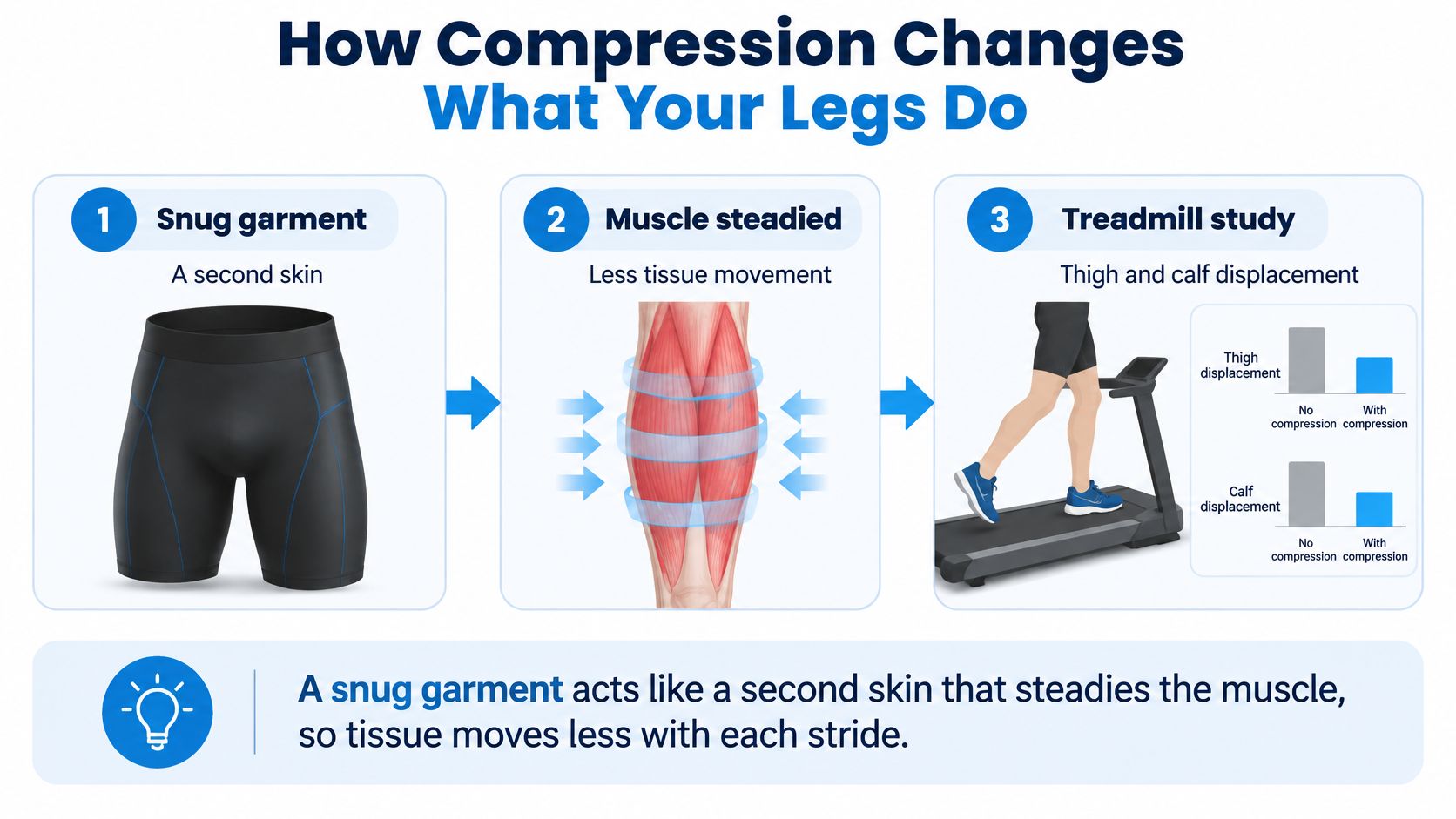
A snug garment acts like a second skin around soft tissue. When your foot lands, the muscle and surrounding tissue can move within that external support, but the fabric limits how far they shift.
In a controlled treadmill study of recreationally active men, lower-limb compression garments reduced thigh and calf displacement and soft-tissue vibration across the tested running speeds, while muscle activation was lower during submaximal running. That finding describes a mechanical effect, not a guarantee that every wearer will run better.
The diagram illustrates the proposed relationship between garment fit and tissue movement.
Stabilization isn't the same as extra power
Think about the difference between a loose shoe and a securely fitted shoe. In the loose shoe, your foot slides before the upper contains it. A snug upper limits that unwanted movement.
Compression garments perform a broadly similar containment job for soft tissue, although the analogy doesn't make the effects identical. Limiting oscillation may alter how muscles respond to repeated impact and how much mechanical energy moves through the tissue.
The study used lower-limb garments, so don't assume that short tights produce the same calf effects. A garment can only directly contain the area it covers. This matters when a product description borrows findings from full-length tights to sell thigh-length shorts.
Check the engineering rather than the slogan
The practical buying priorities are visible in the garment:
- Waistband stability: The band should anchor the shorts without requiring constant tightening. If it shifts, the supporting panels won't stay where the designer intended.
- Purposeful support: Look for an explanation of targeted or graduated construction. Decorative panels and extra-thick fabric don't establish a meaningful pressure profile.
- Seam positioning: Examine the inner thigh and the underside of the seat. Raised intersections near the adductors or gluteal fold can create a pressure point during repetitive hip movement.
More tension isn't necessarily better engineering. A short that holds the thigh securely but pulls across the front of the hip can interfere with the movement you bought it for.
Likewise, a garment that feels supportive while standing may become slack or restrictive when you run. Fabric stretch, panel shape and body proportions all affect that balance.
Judge compression by stable containment without movement restriction. Don't translate less tissue movement directly into faster race times, and don't pay extra merely because a package describes its fabric as powerful. The useful design is the one that remains correctly positioned through your activity.
Fabrics and Construction Worth Checking
| Feature | What to look for | Why it matters | How to check |
|---|---|---|---|
| Liner moisture transport | Fast wetting and one-way transport | Moves sweat away from groin and thigh | Test data citing AATCC TM195 results |
| Fabric blend | Elastane with a stated fiber mix | Balances stretch recovery and dryness | Fiber content on the care label |
| Waistband | Wide, flat, stable band | Stops rolling and slipping | Squat and hip-flexion test in the garment |
| Seam placement | Flat seams away from adductor and gluteal contact | Reduces chafing | Inspect inside seams under stretch |
| Inseam length | Mid-thigh to above-knee options | Balances thigh coverage against heat | Compare with the shorts length you already wear |
| Antimicrobial or odor treatment | Stated treatment with wash durability | Odor control over repeated wear | Check for wash-test evidence behind the claim |
Demand more than a moisture-wicking label
Moisture-wicking is incomplete information. A fabric can absorb perspiration yet leave the skin-facing surface damp, or spread liquid without drying quickly enough for your activity.
Centexbel's explanation of AATCC TM195 testing describes measurements including wetting time, absorption rate, spreading speed, wetted radius and one-way liquid transport on both fabric surfaces. Those results distinguish how a fabric handles liquid from how soft it feels in your hand.
The liner has a specific job: move perspiration away from the groin and upper-thigh contact area. The outer face then needs to spread that moisture so it can evaporate. Absorption, transport and drying aren't interchangeable properties.
Elastane supplies stretch and recovery, but its presence doesn't establish moisture performance. Cotton can feel pleasant against skin yet retain water, making a cotton-rich pair a different proposition for quiet home use than for a sweaty training session.
Inspect the assembled shorts
Turn the shorts inside out. Feel the crotch panel, seam junctions and waistband attachment, then stretch them gently to see whether rough edges become exposed.
A smooth fabric sample can't tell you everything about the finished garment. Seams interrupt liquid pathways, overlapping panels add thickness, and stretching changes the spaces through which moisture travels.
Inseam choice brings another trade-off. Longer coverage can separate rubbing skin surfaces, but it also covers more of the thigh. Shorter legs expose more skin, yet the hem must remain below your personal friction zone rather than creeping into it.
Bamboo charcoal and antimicrobial descriptions deserve the same scrutiny as other performance claims. For terminology, the guide to what antimicrobial fabric means is useful, but an odor-control treatment doesn't prove effective sweat transport.
Before paying a premium, ask for:
- Surface results: What are the inner- and outer-face wetting times?
- Transport results: What is the one-way liquid transport result?
- Drying evidence: How quickly does the material dry under body-temperature conditions?
A brand may not publish these details. Treat that as missing evidence, not automatic proof of poor fabric, and make sure the return conditions allow a meaningful fit assessment.
Separating Proven Benefits From Marketing Claims
Men's tights shorts are often sold as performance gear, but the evidence is weaker than the marketing. Useful clothing benefits don't require a promise of faster running, injury prevention or accelerated healing.
The distinction matters when a package combines several very different claims.
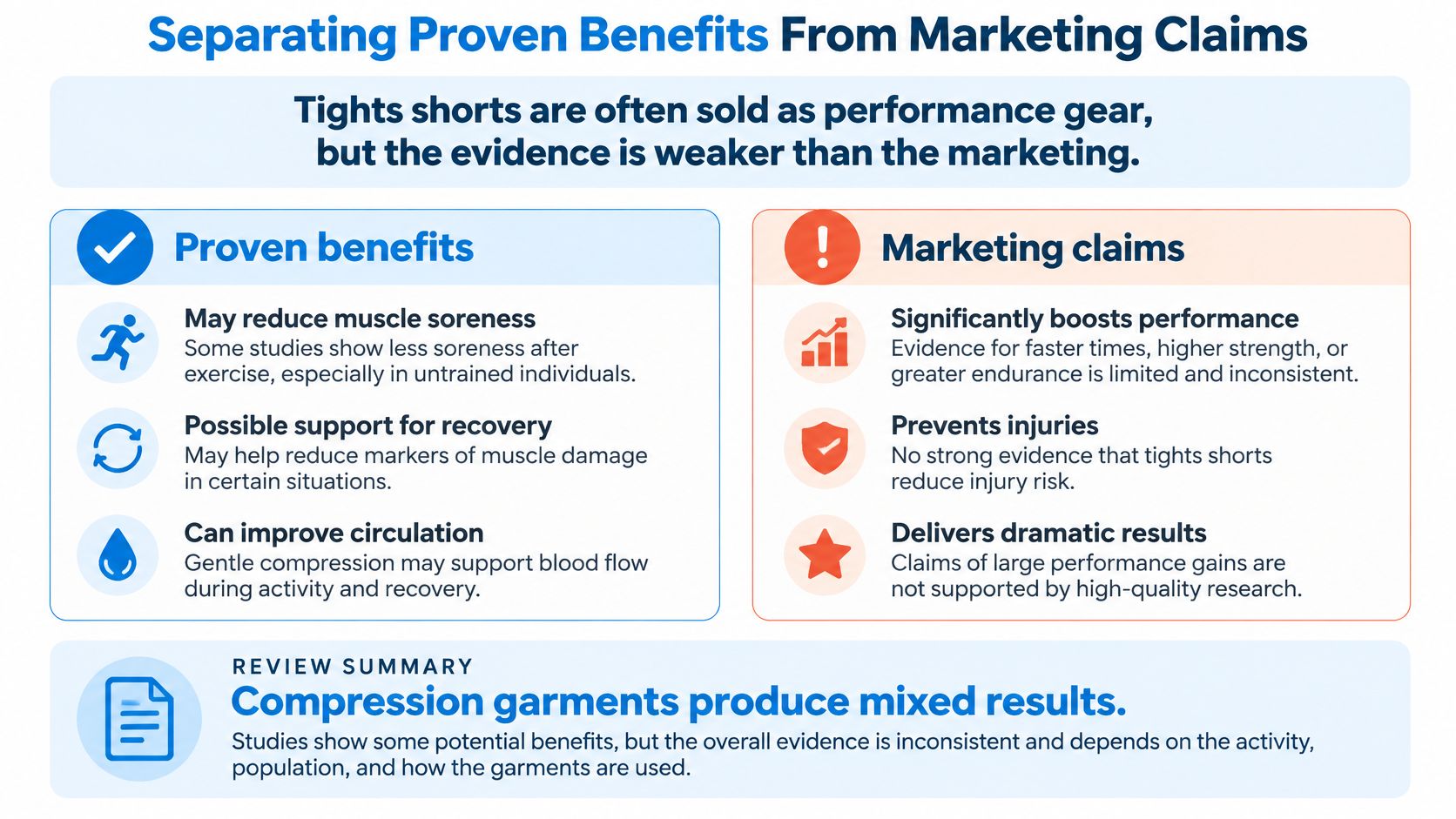
A systematic review in Sports Medicine found equivocal performance results overall, with many measures of perceived exertion, movement output and cardiorespiratory function likely unchanged. Broad claims that compression makes everyone perform better aren't a sound basis for purchase.
Put each benefit in the right category
- Practical clothing benefits: Coverage, warmth, reduced skin-on-skin contact and a comfortable supported sensation are reasonable buying goals. Whether you get them depends on the garment and your body.
- Uncertain recovery advantages: Promises about less soreness or improved later performance deserve qualification. They aren't reliable outcomes for every activity, wearer or product.
- Unsupported guarantees: Injury prevention, faster race times and therapeutic circulation improvements shouldn't be treated as established benefits of ordinary retail tights shorts.
Absence of convincing evidence isn't proof that nobody benefits. It means the seller shouldn't turn a possible effect into a dependable promise, particularly for someone buying because of pain.
A garment that separates rubbing thighs can be worth buying even if it doesn't improve athletic performance. Conversely, a product with impressive technical language is poor value if its waistband distracts you throughout a walk.
Keep warmth and treatment separate
Thermal clothing and compression clothing also solve different problems. The guide to thermal compression wear provides context for comparing those categories, but warmth alone doesn't establish a therapeutic effect.
Comfort is a valid result. You don't need to rename it injury prevention to justify a purchase.
Excessive pressure can cause discomfort and numbness, and severe constriction isn't something to train yourself to tolerate. Don't size down to make an ordinary pair feel more technical.
For an additional explanation of compression garments, the following video offers another format.
Keep your decision grounded in an observable outcome: fewer rubbing points, adequate coverage or comfortable rest. Judge the garment by the job you need it to do, not the most ambitious claim printed on its label.
Sizing and Wear-Testing Men's Tights Shorts
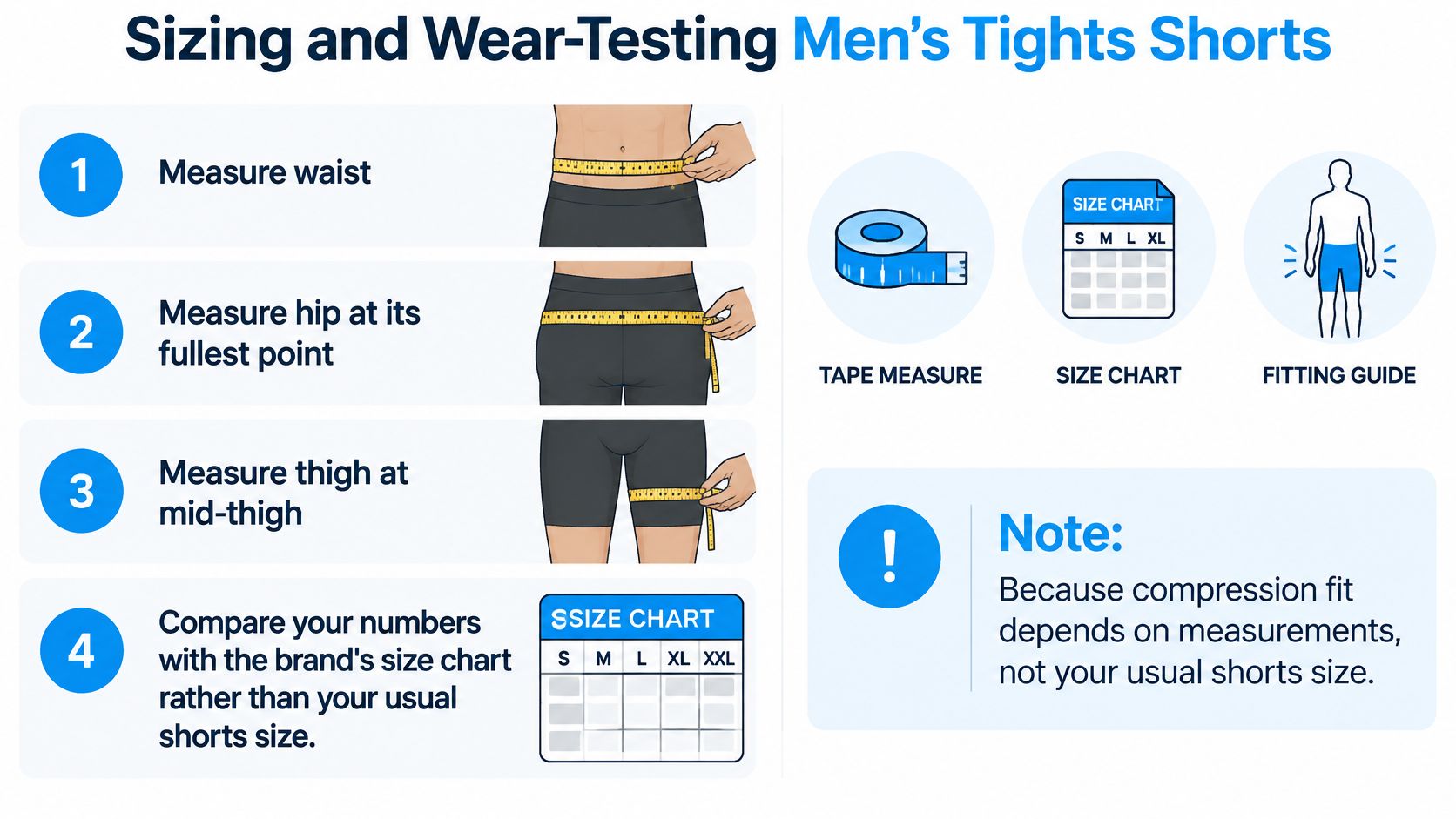
Measure your waist, hips at their fullest point and thigh at mid-thigh with a flexible tape. Keep the tape level and against the skin without pulling it tight enough to indent it.
Compare those measurements with the specific brand's chart, including its instructions for where to measure the waist. Don't substitute your usual loose-shorts size, and don't borrow a size from another brand.
For help keeping measurement technique consistent, the ClothME clothing measurement guide is a useful reference. The following illustration summarizes the main measurement points.
Test positions, not just appearance
Follow the retailer's hygiene and return requirements when trying shorts on. Start with a dry garment, since damp skin makes it harder to distinguish a difficult fit from fabric sticking.
- Move through your normal range. Squat, lunge and raise each knee. Check whether the crotch pulls downward, the hems climb or the fabric blocks hip movement.
- Pause while standing. Notice any tingling, numbness or unusual coldness. Remove the garment if these appear rather than waiting for your body to adjust.
- Sit in your usual chair. Lean forward as you would at a desk. The waistband shouldn't fold into a narrow cord or press painfully into your abdomen.
- Inspect your skin after removal. Look around the groin, thigh hems and waistband for redness, abrasion or persistent indentations. Note the exact location so you can identify the offending seam or band.
- Try gentle walking. Once the initial fit is comfortable, assess heat, dampness and whether the shorts stay positioned without adjustment.
Account for pain and ease of dressing
For older men or anyone with limited hand strength, putting the garment on is part of the fit test. If you need to yank hard at the waistband or struggle to pull the legs into position, consider a less restrictive design.
A review of compression garments and physiological effects indicates that compression shorts don't necessarily increase muscle blood flow, even though some studies report reduced delayed-onset muscle soreness or improved subsequent performance. Don't use a circulation promise to override an uncomfortable fit.
Longer thigh coverage may help when a short inseam rides into a skin fold. For chronic pain, also check whether dressing requires awkward bending or whether a panel edge presses on a sensitive area.
If you're measuring a separate support garment, use its own anatomical landmarks. The guide to how sleeves are measured explains why a shorts measurement cannot replace a sleeve measurement.
Stop wearing the garment and speak to a clinician if pain worsens, skin breaks down or swelling increases. Seek advice before trying firm compression if you have circulation concerns, impaired sensation or damaged skin. A good fit supports your intended activity without restricting movement or leaving lasting marks.
Fixing Fit, Skin and Care Problems
| Symptom | Likely cause | Fix |
|---|---|---|
| Numbness or tingling in the legs | Compression level too high | Remove the garment, then reassess a larger size or lower compression level |
| Persistent pressure marks | Waistband or thigh band too tight | Loosen the fit and recheck the size chart |
| Overheating and sweat pooling | Liner without effective moisture transport | Choose a garment with documented wicking results |
| Rolling or slipping waistband | Waist too large or narrow band | Choose a wider, flatter band in the correct size |
| Inner thigh chafing | Seams in the friction zone | Choose flat seams or a compatible smooth liner |
| Skin irritation or redness | Fabric or detergent sensitivity | Wash with mild detergent and skip fabric softener |
Diagnose before buying another pair
A rolling waistband doesn't always mean you need a smaller size. It can also indicate a band that's too narrow, a rise that doesn't suit your torso or excessive tension pulling from the hips.
Check the rest of the garment before changing size. If the thighs and seat already feel tight, sizing down to fix a loose waist is likely to create another problem. Choose a different cut instead.
For recurring irritation, compare the rash location with the garment's seams and elastic edges. The guide to the best fabric for sensitive skin can help you evaluate alternatives, but persistent irritation deserves medical assessment rather than repeated fabric experiments.
Protect the stretch and surface finish
Use the care label as the starting point, then keep the routine gentle:
- Wash inside out. Choose cold or lukewarm water and a gentle cycle where machine washing is permitted. Keep hook-and-loop fasteners away from the knit.
- Use mild detergent. Skip fabric softener, which can leave deposits that interfere with moisture handling. Rinse thoroughly if detergent residue irritates your skin.
- Avoid high dryer heat. Heat is hard on stretch fabrics and can shorten their useful life.
- Air dry flat in shade. Reshape the garment without pulling the waistband or hanging the wet shorts by a narrow elastic edge.
- Rotate between pairs. Let each garment dry fully rather than wearing damp shorts again.
Don't assume persistent odor proves that an antimicrobial treatment has worn off. Residue, incomplete drying and retained soil can also contribute. Clean according to the label before deciding that a finish has failed.
Replacement check: Gently stretch the fabric and release it. If it stays baggy, or the waistband no longer holds its original shape, a different washing routine won't restore the fit.
A size or cut change can solve pinching, slipping and misplaced hems. A fabric change can improve how the garment feels against your skin. Neither will repair worn elastic, damaged seams or a permanently distorted waistband.
Choose the Right Pair for Your Activity
Running or lifting: Choose between compression tights shorts and basic training tights according to how much containment you want. Prioritize documented moisture transport, unobtrusive seams and a waistband that stays positioned. For lifting, freedom through the hips matters more than a firm standing fit.
Walking, errands or home recovery: Start with a non-compression pair if you don't need pressure. At Thermo Recovery Wear, our products aren't categorized as compression apparel: our Thermo Lite Collection is non-compression recovery wear designed for home use, with products also suitable for walking and running errands. The collection includes recovery sleeves rather than an established range of men's tights shorts, so choose the garment format that matches the area you want covered.
Pain, swelling or sensitive skin: Don't use firm compression as the default solution. Choose comfort first and get clinical guidance when symptoms, circulation concerns or a medical condition are driving the purchase.
Compare value within the right category
A premium running tight and a soft home-recovery garment aren't direct substitutes. You're comparing different construction priorities, not just different prices.
For context, Nike's men's running-shorts catalog listed men's half-length running tights at USD 75.00 and USD 85.00 in 2026. That provides a retail benchmark, not evidence that a higher price delivers a better fit or stronger health benefits.
Before ordering, write down:
- Activity: The actual task and position you'll spend most time in.
- Compression: The least pressure that serves that task comfortably.
- Size: The chart-based choice supported by your body measurements.
Buy for those requirements, then keep the pair only if its fit holds up during real movement.
At Thermo Recovery Wear, we offer non-compression recovery sleeves for home use and light everyday activity, an alternative when firm athletic compression isn't what you need. Visit Thermo Recovery Wear to explore the Thermo Lite Collection and compare the relevant garment's materials and size guidance before choosing your support.


