


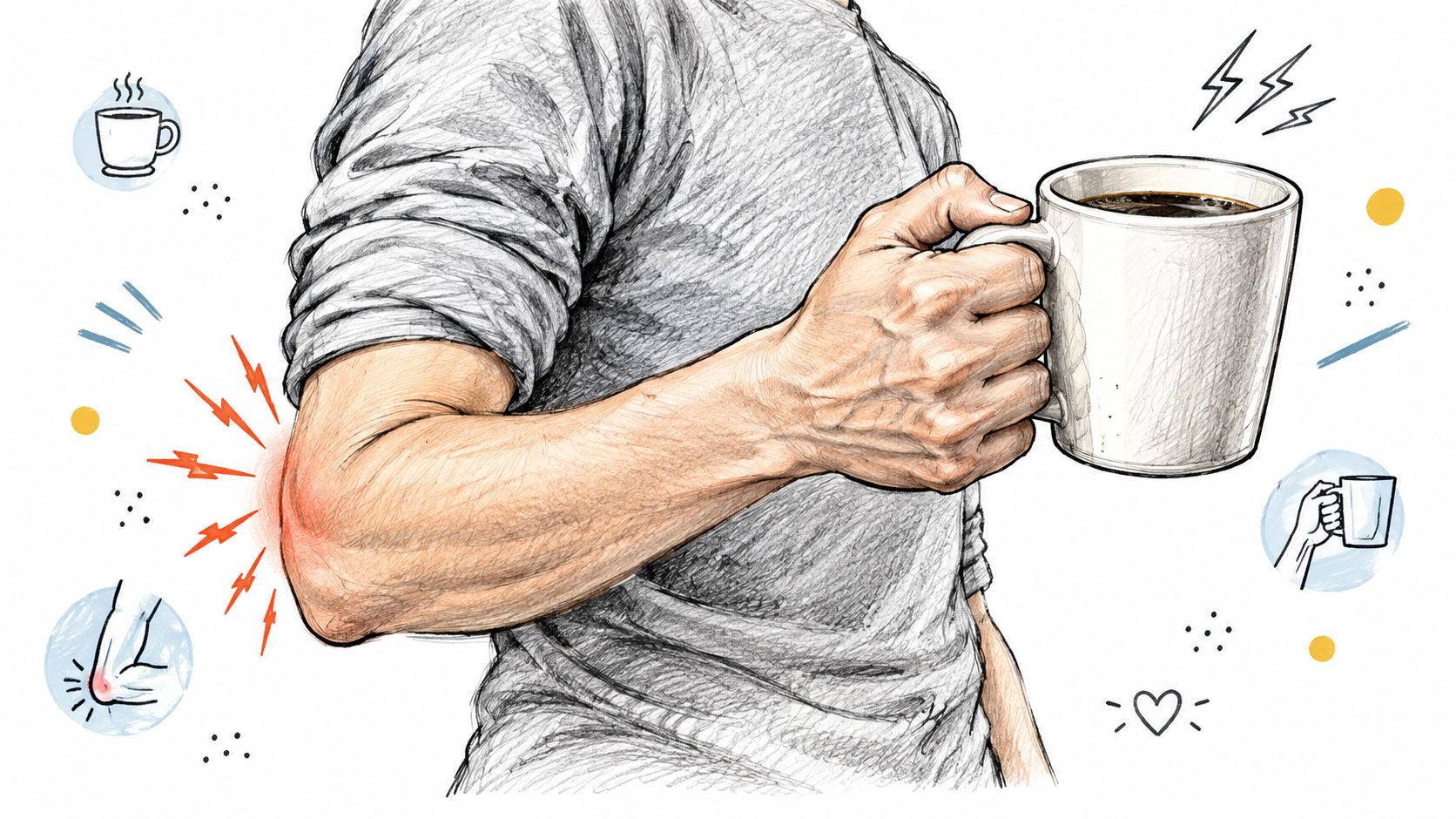
You lift a coffee mug and feel a sharp tug on the outside of your elbow. Typing, turning a door handle, carrying a shopping bag, or gripping a racket can trigger the same familiar pain. A compression sleeve seems like an appealing answer because it's simple, discreet, and easy to wear.
So, do compression sleeves help tennis elbow? They can provide short-term comfort and support for some people, especially during gripping activities, but they aren't a stand-alone cure. The useful question isn't whether a sleeve magically heals the tendon. It's when gentle support helps most, who may respond better, how long to wear it, and when another approach makes more sense.
The answer depends on the type of support, the activity causing symptoms, your tolerance for pressure, and the treatment horizon. Research supports immediate or short-term symptom relief more clearly than lasting healing. This guide separates those outcomes so you can decide whether to try a sleeve, consider a counterforce band, use a non-compressive option, or seek a more complete rehabilitation plan. If your discomfort extends from the wrist toward the elbow, this guide to pain from the wrist to the elbow may also help you think through the pattern.
Table of Contents
- When Elbow Pain Makes Every Grip Hurt
- Understanding Tennis Elbow and Why It Lingers
- How Compression Sleeves Work for Tennis Elbow
- What Clinical Studies Show About Relief
- Compression Sleeves Compared With Infrared Recovery Sleeves
- How to Choose Wear and Use a Sleeve Effectively
- Deciding If a Sleeve Is Right for You
When Elbow Pain Makes Every Grip Hurt
Tennis elbow usually announces itself through ordinary movements rather than dramatic injuries. You reach for a mug, lift it from the table, and notice pain along the outer elbow. Later, you try to open a jar, carry groceries, use a mouse, or shake someone's hand. Each task asks the forearm muscles to stabilize the wrist, and the irritated tendon may respond with a sharp ache or pulling sensation.
That experience can make a sleeve feel like an obvious experiment. A soft layer around the elbow promises warmth and a sense of security without the bulk of a rigid brace. For someone who still needs to work, cook, train, or care for family, even a modest reduction in discomfort can make an important daily task feel manageable.
The practical answer: A sleeve may reduce symptoms while you use your arm, but pain relief doesn't prove that the tendon has healed.
A 2013 clinical study involving people with lateral epicondylalgia found that both a counterforce elbow band and a counterforce elbow sleeve reduced pain immediately, and both performed better than a wrist splint for pain relief. The study found the difference between the elbow supports and the wrist splint was statistically significant, while the band and sleeve didn't differ significantly from each other in the reported comparison. That supports a cautious conclusion: an elbow sleeve can help some people feel better quickly, but the finding doesn't establish long-term tissue repair.
The rest of the answer requires more nuance. We need to distinguish a full sleeve from a targeted counterforce band, understand why tendon pain can persist, and weigh immediate comfort against longer-term rehabilitation. We also need to account for age, activity, skin sensitivity, and wear time, because the same garment won't feel or function the same way for every person.
Understanding Tennis Elbow and Why It Lingers
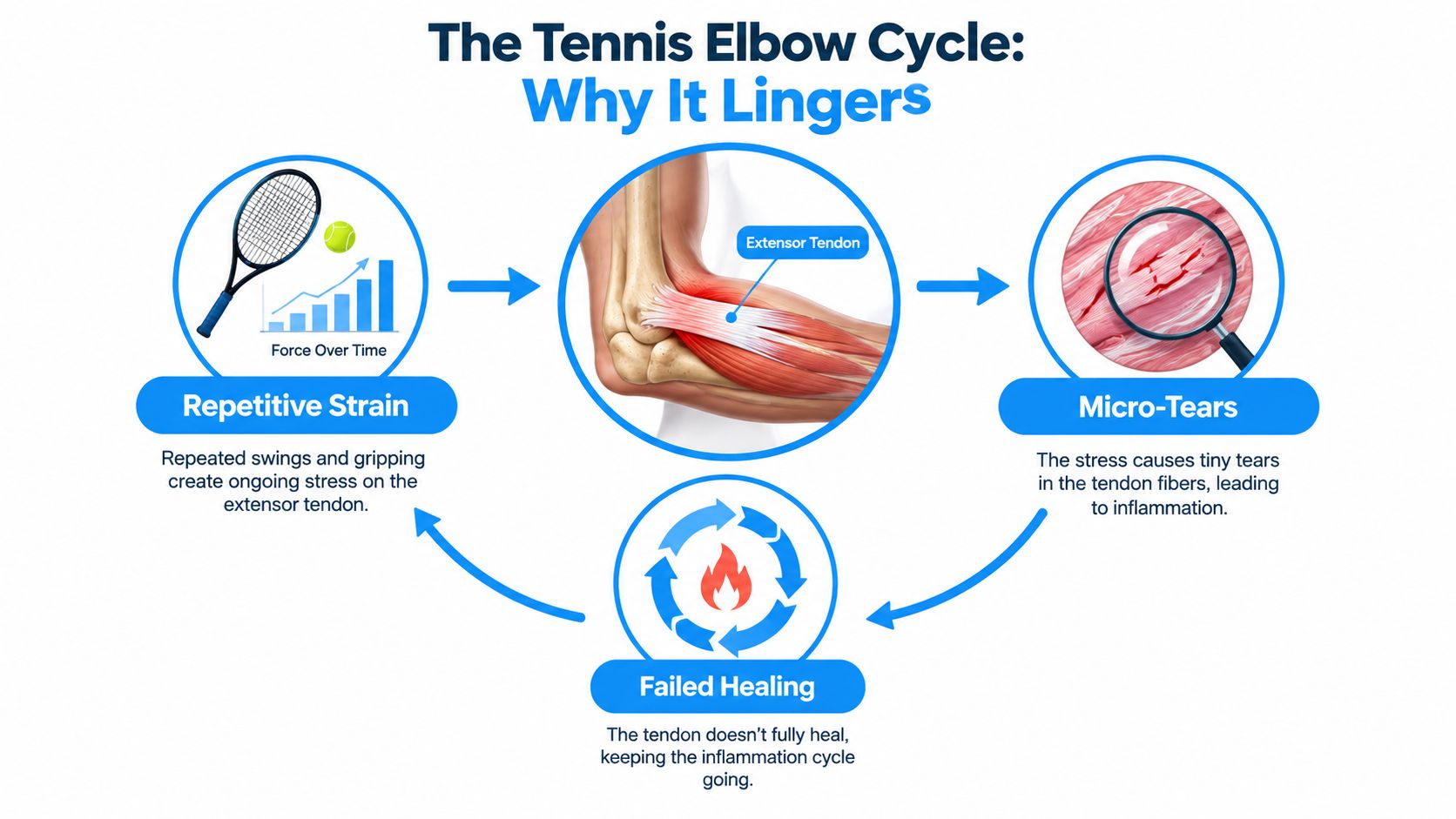
Tennis elbow is the common name for lateral epicondylalgia, pain associated with the tendons that attach forearm extensor muscles near the outside of the elbow. Those muscles help extend and stabilize the wrist and fingers. They work when you grip a racket, hold a tool, type for long periods, or lift an object with the wrist extended.
A simple analogy is a rope tied to a wall. If you pull the rope occasionally, it usually tolerates the load. If you pull it repeatedly before it has recovered, the fibers can become irritated and less capable of handling the same force. The forearm tendon is not like a frayed rope, but the analogy captures why repeated gripping and twisting can keep symptoms active.
Why rest doesn't always settle the problem
Stopping one painful activity may calm symptoms, but daily life often continues to load the same area. A keyboard, screwdriver, saucepan, racket, or child can all require the wrist and forearm to stabilize under force. If the tendon repeatedly meets more load than it can currently tolerate, the irritation can return as soon as normal activity resumes.
Tennis elbow is also common beyond recreational tennis. A review estimated that it affects 1–3% of adults each year, with prevalence rising to 19% among people aged 40–50 in the cited review. Those figures help explain why short-term symptom control matters, but they don't change the central treatment principle. A sleeve can make movement more comfortable while you address the loads and strength deficits that keep provoking the tendon.
Some people also explore options such as nonsurgical elbow joint repair when persistent pain raises questions about regenerative or procedural care. That kind of decision belongs in a conversation with a qualified clinician who can assess the diagnosis, duration, examination findings, and alternatives. A compression sleeve remains a support tool, not proof that the underlying tendon problem has been corrected.
How Compression Sleeves Work for Tennis Elbow
A compression sleeve creates gentle pressure around a broader area of the arm. That pressure may help in several ways, although the experience varies according to fit, fabric, activity, and the type of elbow support.
First, the sleeve can provide a physical sense of containment. It doesn't necessarily redirect force as precisely as a counterforce band, but it may reduce the feeling that the forearm is moving without support. Second, contact with the skin gives your nervous system extra information about the position and movement of the elbow. That sensory feedback can improve movement awareness and make a painful task feel less threatening.
Support is not the same as offloading
Warmth is another possible benefit. A fabric layer can retain some of your body's heat, which may reduce stiffness and make movement more comfortable. That effect is different from healing a tendon. Feeling warmer doesn't demonstrate that the tissue has regained its normal capacity.
The design matters too:
- A full elbow sleeve covers a wider region and offers broad pressure, warmth, and sensory feedback.
- A counterforce band applies more targeted pressure around the upper forearm. Its purpose is to alter how load reaches the tendon attachment during gripping and twisting.
- A wrist splint limits wrist movement and changes the task demands farther from the painful elbow. It may help some conditions, but it isn't the same intervention as an elbow sleeve.
A counterforce support works somewhat like moving the tie point on a rope. Instead of asking the irritated attachment to absorb every pull directly, the support changes the distribution of force through the forearm. The randomized prospective study summarized in the clinical evidence shows why this distinction matters. A counterforce brace produced short-term improvements in pain frequency and severity and maintained an advantage in overall elbow function at the later assessment, while both brace groups improved in grip strength and tenderness in the reported trial.
That result still shouldn't be stretched into a promise of healing. A sleeve may help you complete a controlled task with less pain, but it won't automatically strengthen the tendon or correct an excessive workload. For practical discussion of how elbow compression is used, see this overview of compression for the elbow. The main expectation should be symptom support during selected activities, followed by a plan that gradually rebuilds tolerance.
What Clinical Studies Show About Relief
The answer depends on timing, age, and the task you need to perform. Research supports immediate and short-term symptom relief more consistently than lasting superiority over rehabilitation. In a 2013 study, both a counterforce elbow band and a counterforce sleeve reduced pain immediately, and both provided greater relief than a wrist splint. The difference between either elbow support and the wrist splint was significant, with P < 0.01. The band and sleeve did not differ significantly, with P = 0.23 in the study report.
A P value describes the likelihood of seeing a difference under the study's statistical assumptions. It does not predict how much one person will improve. A significant group result therefore cannot guarantee that a particular sleeve will feel comfortable or useful throughout a workday.
What happens as time passes
Another randomized prospective study reported statistically significant benefits from counterforce bracing compared with a placebo brace at 2, 6, and 12 weeks. Pain frequency and severity decreased, and the brace group retained an advantage in overall elbow function at 26 weeks. Both groups improved in grip strength and tenderness according to the published study.
That pattern supports using a brace as an adjunct when movement is painful, rather than treating it as a stand-alone cure. Wear time should match the activity that provokes symptoms. A sleeve may be most useful during gripping, lifting, or sport, then removed if pressure irritates the skin or becomes uncomfortable.
The longer-term findings are less decisive. An analysis summarized by the American Academy of Family Physicians found that brace-only care improved daily activities in the short term, but at 26 and 51 weeks it showed no significant difference from physical therapy or combined treatment as summarized in the broader analysis. A later review also concluded that counterforce braces may reduce short-term pain in younger adults under 45, while physiotherapy produced better long-term effects.
| Time Point | Finding for Sleeve or Band | Comparison Group |
|---|---|---|
| Immediately | A counterforce band and sleeve reduced pain | Both outperformed a wrist splint for pain relief |
| 2, 6, and 12 weeks | Counterforce bracing reduced pain frequency and severity | Statistically better than a placebo brace |
| 26 weeks | Overall elbow function retained an advantage in the bracing study | Placebo brace comparison |
| 26 and 51 weeks | Brace-only care had no significant long-term difference | Physical therapy and combined care |
Guidance remains cautious about who benefits and for how long. A California industrial relations guideline update recommends tennis elbow bands, straps, and braces across acute, subacute, and chronic presentations, while acknowledging that uncertainty guideline information. For product comparison, review top-rated elbow compression sleeves, then judge each option by fit, pressure tolerance, and whether it helps you perform a task with less pain.
Compression Sleeves Compared With Infrared Recovery Sleeves
If gripping a racquet, lifting a pan, or turning a tool makes the elbow ache, the better sleeve depends on what kind of support your arm tolerates. Compression and infrared-responsive garments create different sensations, so the useful question is not whether one “cures” tennis elbow. It is when short-term pressure helps, and when low-pressure warmth may feel more practical.
The comfort trade-off
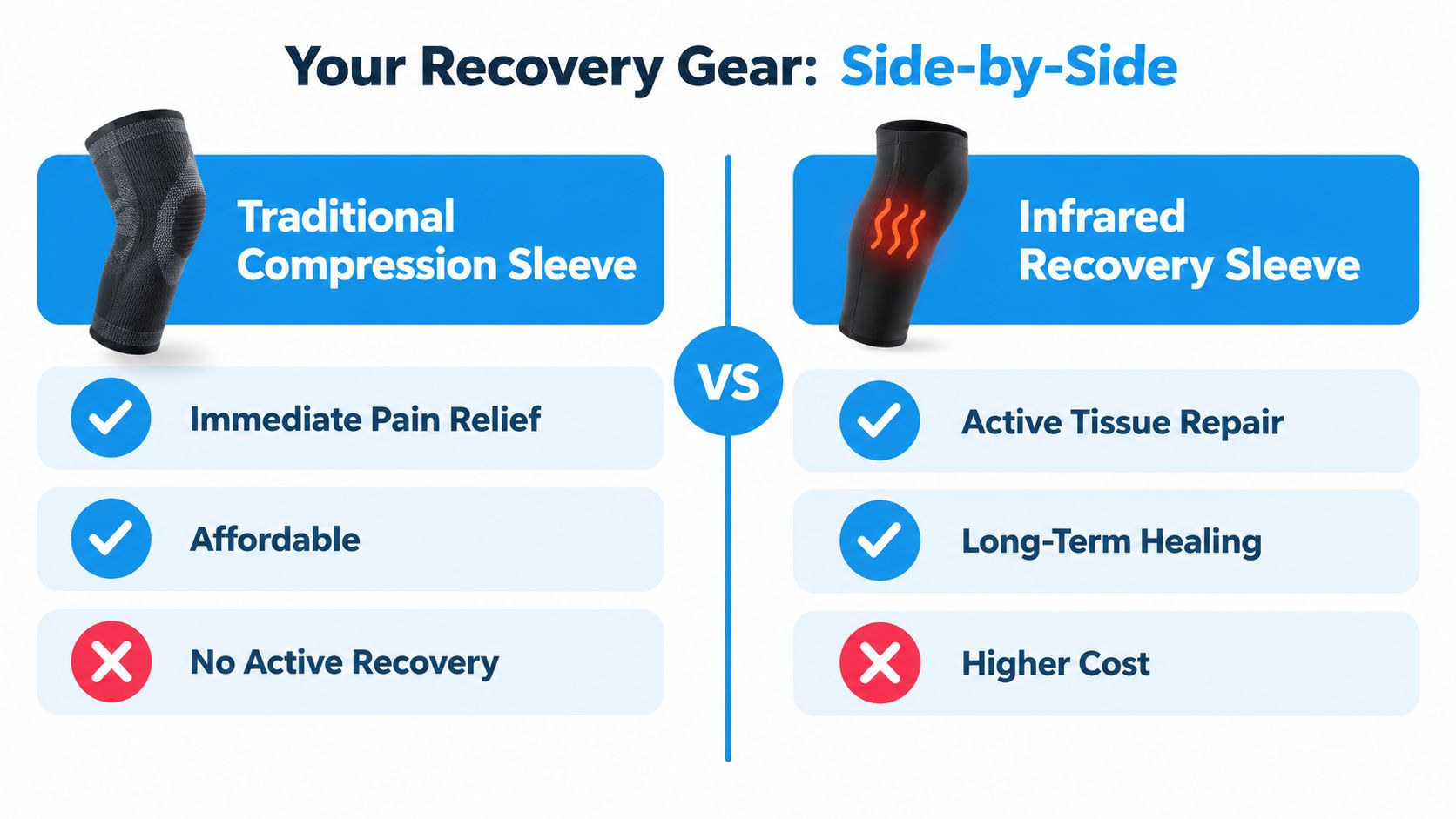
A traditional compression sleeve applies circumferential pressure. During gripping, lifting, or sport, that close contact may improve movement awareness and make the arm feel more supported. It can function like a gentle reminder of the elbow's position, rather than acting as a repair for the tendon.
Pressure is not comfortable for everyone. Tight fabric, seams, or prolonged contact may irritate sensitive skin or make movement feel restricted. Older adults, people with fragile skin, and anyone who notices discomfort from snug garments may prefer a less compressive approach.
A non-compressive infrared recovery sleeve is designed to rest against the skin without depending on a tight squeeze. Thermo Recovery Wear's Thermo Lite Recovery Elbow Sleeve is one example positioned around compression-lite or non-compressive daily support. Its design includes bamboo and charcoal textiles, moisture-wicking construction described by the brand, and infrared-responsive fabric intended to support local warmth and circulation. These are product features, not evidence that the sleeve repairs a tennis elbow tendon.
| Feature | Traditional compression sleeve | Infrared-responsive recovery sleeve |
|---|---|---|
| Main physical input | Circumferential pressure | Contact, warmth retention, and fabric response without relying on tight pressure |
| During gripping | May provide broad support and sensory feedback | May provide warmth and a low-pressure layer |
| Sensitive-skin consideration | Pressure and seams may be bothersome | A non-compressive design may feel easier for some users |
| Wear preference | Often chosen for activity-specific support | Often considered for rest, light movement, or discreet daily wear |
| Evidence question | Short-term bracing evidence is stronger than long-term cure evidence | Product-specific healing claims require careful interpretation |
For context on the proposed technology and realistic expectations, read this beginner's guide to infrared therapy for pain recovery. Warmth may improve comfort, while compression may provide task-specific support. Neither replaces progressive loading, activity changes, or professional assessment when symptoms continue.
The available sleeve-specific study used a daily 30-minute protocol rather than all-day wear study protocol. More hours are therefore not automatically better. Select the least restrictive option that helps a defined activity, then judge it by pain and function.
How to Choose Wear and Use a Sleeve Effectively
Begin with the size chart, not with the idea that tighter support works better. A sleeve should feel secure while allowing normal elbow and wrist movement. Remove it and reassess the fit if you notice numbness, tingling, color change, coldness, throbbing, worsening pain, or pressure marks that remain after removal.
Match the garment to the task
Wear the sleeve during the activity that first brings on symptoms. That could be typing, gardening, lifting a pan, using a hand tool, or playing tennis. If it eases discomfort without masking sharp pain or encouraging you to push harder, it may provide short-term support while you change the aggravating movement.
Use one repeatable task to judge whether it helps:
- Choose one task, such as lifting a light mug or turning a handle.
- Check your baseline without the sleeve. Notice pain, grip tolerance, and ease of movement.
- Repeat the same task with the sleeve fitted correctly.
- Stop if symptoms worsen. Less pain does not mean the tendon is ready for a sudden increase in load.
The available sleeve-specific research examined a daily 30-minute protocol rather than all-day wear. As noted earlier, that makes real-world wear time uncertain. Start with a defined activity or brief trial, then assess comfort and function instead of assuming longer wear will bring greater benefit.
Protect the skin and the tendon
Keep the fabric clean and dry, particularly after sport or manual work. Check your skin after use for rubbing, rash, pressure points, or redness that does not settle. If you have circulation problems, reduced sensation, unexplained swelling, or previous reactions to support garments, ask a clinician before using compression.
A sleeve has a limited role within a broader recovery plan. Reduce the grip or task that provokes pain, then gradually rebuild strength with an appropriate exercise program. This tennis arm sleeve guide covers product-related considerations, but it cannot replace an examination when the diagnosis is uncertain.
Seek professional input when pain is severe or steadily worsening, follows a fall or collision, or comes with weakness, numbness, or difficulty using the arm normally. These features may indicate a problem beyond uncomplicated tennis elbow.
Deciding If a Sleeve Is Right for You
A sleeve makes sense when your goal is short-term comfort during a specific gripping or twisting task. Judge it by function: can you complete the activity with less discomfort while keeping the load reasonable? Current evidence supports immediate and short-term relief more clearly than lasting tendon healing.
Your age and symptom timeline can shape the choice. Earlier findings suggest counterforce braces may reduce short-term pain more in younger adults under 45, while physiotherapy may produce stronger long-term effects. A sleeve can support a task, but it does not rebuild the tendon's ability to tolerate load.
Skin sensitivity changes the decision. If tight pressure causes irritation or distracts you during the day, choose lower-pressure wear or non-compressive infrared warmth for rest and light activity. These options aim to provide comfort without squeezing the arm.
Use this guide:
- Choose targeted support when gripping or twisting clearly triggers symptoms.
- Choose comfort-first wear when pressure irritates your skin or you need light support for daily movement.
- Add rehabilitation when symptoms return, since a garment alone will not restore load tolerance.
- Seek evaluation when pain, weakness, numbness, swelling, or reduced function suggests more than routine overuse.
A sleeve has a modest, specific role. It may make movement easier while you reduce provoking loads and gradually rebuild strength.
Thermo Recovery Wear offers compression-lite and infrared-responsive elbow sleeves for warmth, circulation support, and light daily activity, including options for people who do not tolerate tight gear. Visit Thermo Recovery Wear to review elbow sleeves, sizing guidance, and recovery-wear options.


