


You've just finished a tennis match, lifted something awkwardly, or spent hours at a desk, and your elbow is throbbing. You reach for an ice pack, then pause over the elastic bandage because you're not sure whether wrapping it will help or make the problem worse.
That hesitation is sensible. An elastic bandage for elbow support isn't a universal fix. It can provide short-term support for a mild strain or help hold a cold pack in place, but it won't correct tendon overload, and it may aggravate a swollen bursa or compromise circulation if applied too tightly. The right choice depends on the tissue involved, the reason for wrapping, and how long you intend to wear it.
Table of Contents
- When an Elastic Bandage for Elbow Support Makes Sense
- Matching the Wrap to the Elbow Condition You Actually Have
- Wrapping the Elbow the Right Way Without Cutting Off Circulation
- How Tight Is Too Tight and How Long Should You Wear It
- Compression-Free Alternatives for Sensitive Skin and Long Wear
- Warning Signs That Mean Remove the Wrap and Call a Clinician
- Your Pre-Wrap Checklist and Next Steps for Lasting Recovery
When an Elastic Bandage for Elbow Support Makes Sense
You finish a lift, a match, or a physical task with a mildly swollen elbow. A wrap can help for a short period, but only if the problem suits compression and the bandage has a clear job.
An elastic bandage for elbow support fits a recent, mild strain or impact-related swelling. Gentle pressure can limit movements that trigger pain and hold a cold pack in place during an acute flare. First-aid guidance recommends checking circulation and fit while wrapping. St John Ambulance's elbow and knee bandage guidance covers those safety basics.
Use it for temporary support, not all-day protection. Light compression during an aggravating task may make mild soreness more manageable. Persistent pain at the outer or inner tendon attachment, especially pain that worsens with gripping or lifting, usually needs a more targeted approach than pressure around the whole joint.
Practical rule: Compression supports a short-term plan. It does not replace diagnosis, activity changes, or rehabilitation.
Skip the wrap if the elbow looks misshapen, a fracture is possible, or swelling is increasing quickly. Broad compression is also a poor default for chronic tendon pain. Epicondylitis usually responds better to adjusted loading, gradual strengthening, and, in some cases, a counterforce strap. For practical guidance on helping elbow pain, review the likely cause before choosing support.
Ask three questions before applying it:
- What happened? A fall, twist, sudden load, and repetitive activity suggest different injuries.
- Where is the pain? Pain at the back point, outer elbow, or inner elbow changes the support decision.
- What's the goal? Swelling control, task support, and comfort during computer use require different strategies.
If compression irritates your skin or you need support for longer wear, a non-compression infrared sleeve may be a better option. For temporary wrapping, you can browse Healtsy bandages, then adjust the fit for support rather than maximum tightness.
Matching the Wrap to the Elbow Condition You Actually Have
The diagnosis matters more than the bandage. Lateral epicondylitis, commonly called tennis elbow, affects about 1% to 3% of adults each year, with the greatest relevance for working-age adults, particularly around ages 45 to 64, according to this overview of medial and lateral epicondylitis. Elbow pain is common in occupational settings too. One population-based study recorded elbow pain in the previous week among 636 of 6,038 respondents, or 11%, while separate healthcare data showed lateral epicondylitis prevalence rising from about 969 per 100,000 people in 2011 to 1,248 per 100,000 in 2020. Those figures help explain why people keep searching for elbow supports, but they don't mean every painful elbow needs a wrap. The occupational study and prevalence analysis are available through Rheumatology.
Read the pattern before choosing the support
A mild sprain often follows a twist, fall, or forceful movement. Pain may sit along one side of the joint, and gentle figure-eight support can reduce uncomfortable motion if it doesn't increase symptoms.
Epicondylitis usually develops with repeated gripping, wrist extension, racquet sports, tools, or lifting. Outer elbow pain suggests lateral involvement, while inner elbow pain suggests medial involvement. A counterforce strap below the elbow generally makes more sense than squeezing the entire joint. This discussion of elbow tendonitis compression sleeves explains why localized support can be more appropriate.
Olecranon bursitis causes swelling over the pointed back of the elbow. Don't aggressively compress that lump. Evidence-based elbow guidance notes that compression wrapping for an effused elbow may lack support and could increase pressure inside the joint. A padded, non-constrictive cover is usually safer while the cause is assessed.
| Condition | Typical Symptoms | Wrap Recommendation |
|---|---|---|
| Mild sprain or strain | Pain after a twist, fall, or sudden load | Gentle short-term support may help |
| Lateral or medial epicondylitis | Outer or inner elbow pain with gripping and lifting | Prefer a counterforce strap or targeted brace |
| Olecranon bursitis | Soft or firm swelling over the back point of the elbow | Avoid tight compression over the bursa |
| General post-activity swelling | Broad puffiness after exertion without deformity | Light, even compression may be reasonable |
Don't confuse elbow support with unrelated skin concerns. If you're researching an appearance-focused issue, use an appropriate resource such as this evidence-based routine for dark elbows, not a tighter bandage.
Wrapping the Elbow the Right Way Without Cutting Off Circulation
Start with the arm relaxed and slightly bent, around 30 degrees, with the elbow crease visible. The skin should be clean and dry, and you should inspect it for cuts, blisters, rash, or fragile areas before covering it.
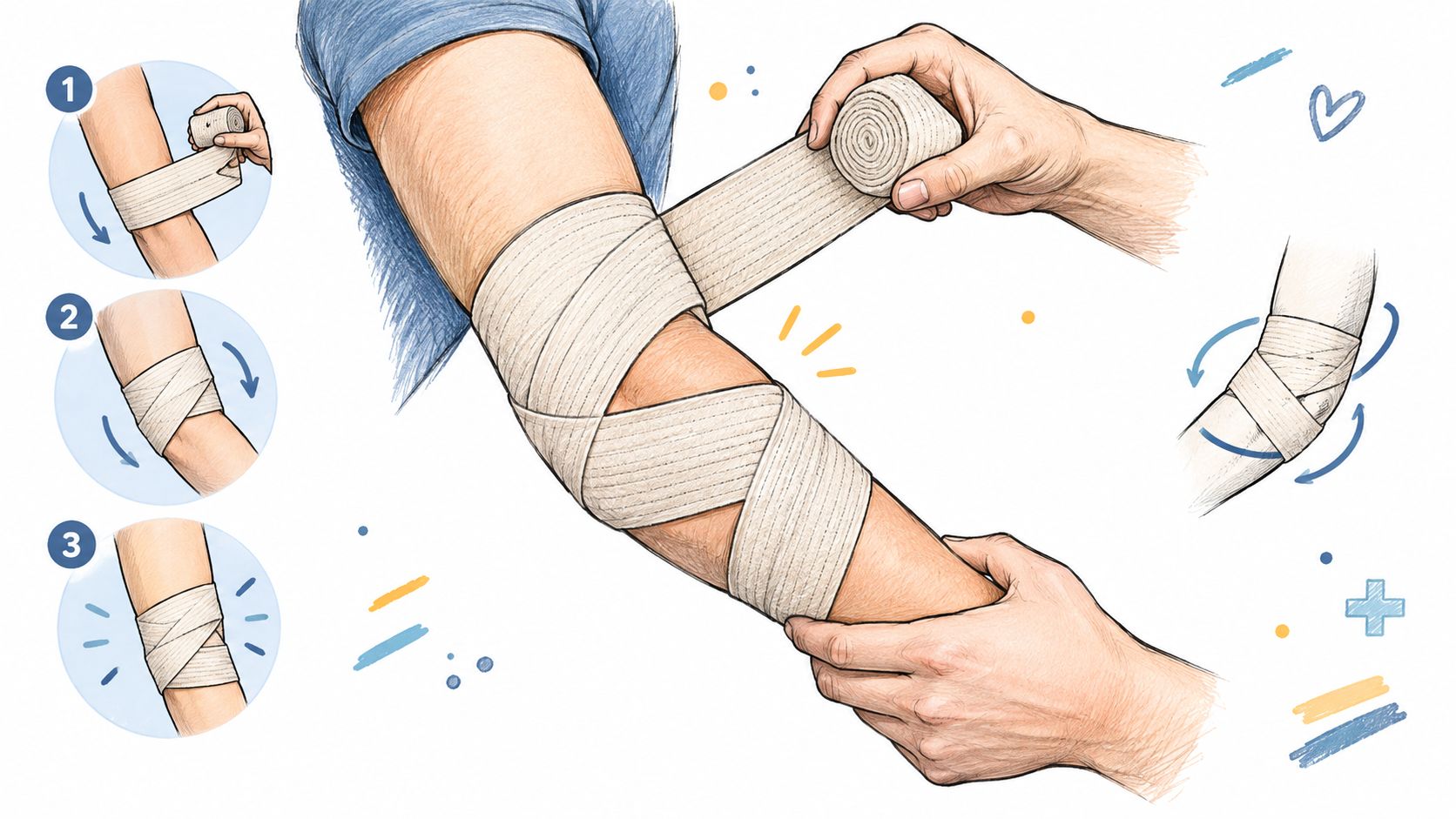
Hold the rolled end against the upper forearm, roughly two inches below the elbow crease. Wrap with light, even tension, keeping the bandage flat and overlapping each pass by about half its width. Work in a smooth spiral toward and around the joint rather than pulling sharply at each turn.
As the bandage crosses the elbow crease, use a loose figure-eight pattern. Let the fabric cross the front of the joint diagonally so the elbow can bend without the material bunching into the crease. You want firm contact, not a deep squeeze. A finger should slide under the bandage without force at any point.
After two or three layers, secure the end with the clips or self-grip. Check the hand immediately. Press a fingernail on a finger beyond the wrap and watch for color to return within about two seconds. If the fingers tingle, turn pale, feel cold, or look dusky, remove the bandage and reapply it with less tension.
A good wrap moves with the elbow. It shouldn't pinch behind the joint when you bend it.
Bend and straighten the elbow gently several times. If the bandage rolls, cuts into the crease, or causes new pain, take it off and start again. A visual demonstration can help, but don't copy tension blindly because arm shape, swelling, and skin tolerance vary. For brace positioning during activity, see this guide to wearing an elbow brace.
Use the following video as a technique reference, while still checking your own circulation and comfort:
How Tight Is Too Tight and How Long Should You Wear It
A wrap that feels like a tourniquet is too tight. Excessive pressure can reduce circulation, irritate the skin, increase pressure below the elbow, and make it harder to judge whether the injury is improving.
For a recent strain or impact, aim for firm, even support that limits swelling without changing the hand's normal color, warmth, or sensation. Check the hand immediately after application, again after movement, and regularly while the bandage remains on. If the fingers tingle, become pale or cold, or look dusky, remove the wrap and reapply it more loosely.
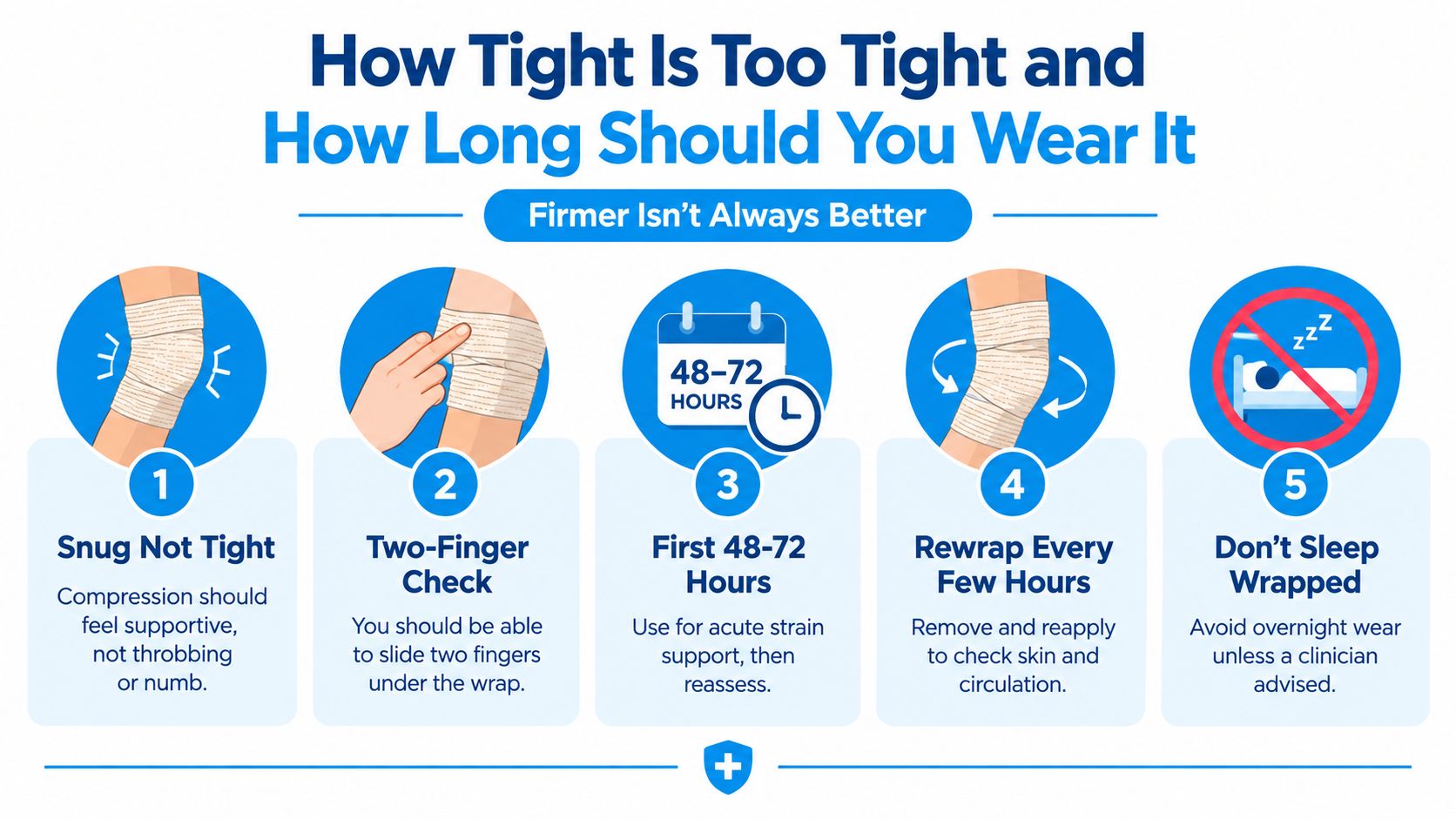
Use a practical fit test. You should slide two fingers beneath the bandage without forcing them. The fabric should lie flat, without ridges, folded sections, or a tight edge. Reapply the wrap if swelling changes, the material shifts, or the hand feels different.
Routine compression for an acute elbow injury generally belongs in the first two to three days, not as an indefinite daily habit. Short-term swelling control and comfortable all-day wear require different choices.
For tendon irritation, wear the bandage only during activities that provoke symptoms, then remove it. Do not sleep in an elastic wrap unless a clinician specifically directs you to. Pressure during rest can hide worsening symptoms and prevent the skin from drying and recovering.
For more guidance on fit, pressure, and intended use, read this resource on compression for the elbow.
Compression-Free Alternatives for Sensitive Skin and Long Wear
Traditional elastic bandages are adjustable and inexpensive, but they're demanding. You need to apply them evenly, monitor the hand, remove them for skin checks, and adjust them when swelling or activity changes. They can also trap sweat, rub against the elbow crease, and trigger irritation in people with eczema, dermatitis, or a history of contact reactions.
A compression-lite infrared sleeve takes a different approach. Instead of relying on a tightly pulled bandage, a fitted knit sleeve provides mild support through fabric tension. It may sit more neatly under clothing and can be more practical for desk work, walking, golf, tennis, or light household activity.
That doesn't make a sleeve suitable for every injury. A sleeve isn't a substitute for evaluation after a fall, and it won't provide the same adjustable compression as a wrap during acute swelling. It's more appropriate when the problem is ongoing discomfort, mild stiffness, or activity-related irritation and you need a comfortable layer rather than firm pressure.
| Feature | Elastic Bandage | Infrared Compression-Lite Sleeve |
|---|---|---|
| Fit | Adjustable by hand, but technique-dependent | Consistent fitted design |
| Skin tolerance | Can trap moisture and create pressure points | Fabric-based support may feel less restrictive |
| Swelling control | More suitable for short-term, adjustable compression | Not intended as firm swelling control |
| Daily activity | May shift or require rechecking | Designed for discreet light movement |
| Best use | Acute strain support or cold-pack retention | Ongoing comfort when tight wraps aren't tolerated |
Thermo Recovery Wear offers a Thermo Lite Recovery Elbow Sleeve, a non-compression option intended for elbow support during rest or light activity. If fabric sensitivity is your main concern, review this guide to the best fabric for sensitive skin before choosing any sleeve.
My recommendation is straightforward. Use an elastic wrap for short-term swelling support when circulation is normal. Choose a compression-lite sleeve for longer, gentler wear when skin pressure and repeated rewrapping are the problem.
Warning Signs That Mean Remove the Wrap and Call a Clinician
A patient once slept in an elbow wrap and woke with numb fingers and a dusky hand. The problem wasn't that support was wrong. The problem was leaving a pressure-sensitive device in place without checking the hand or skin.
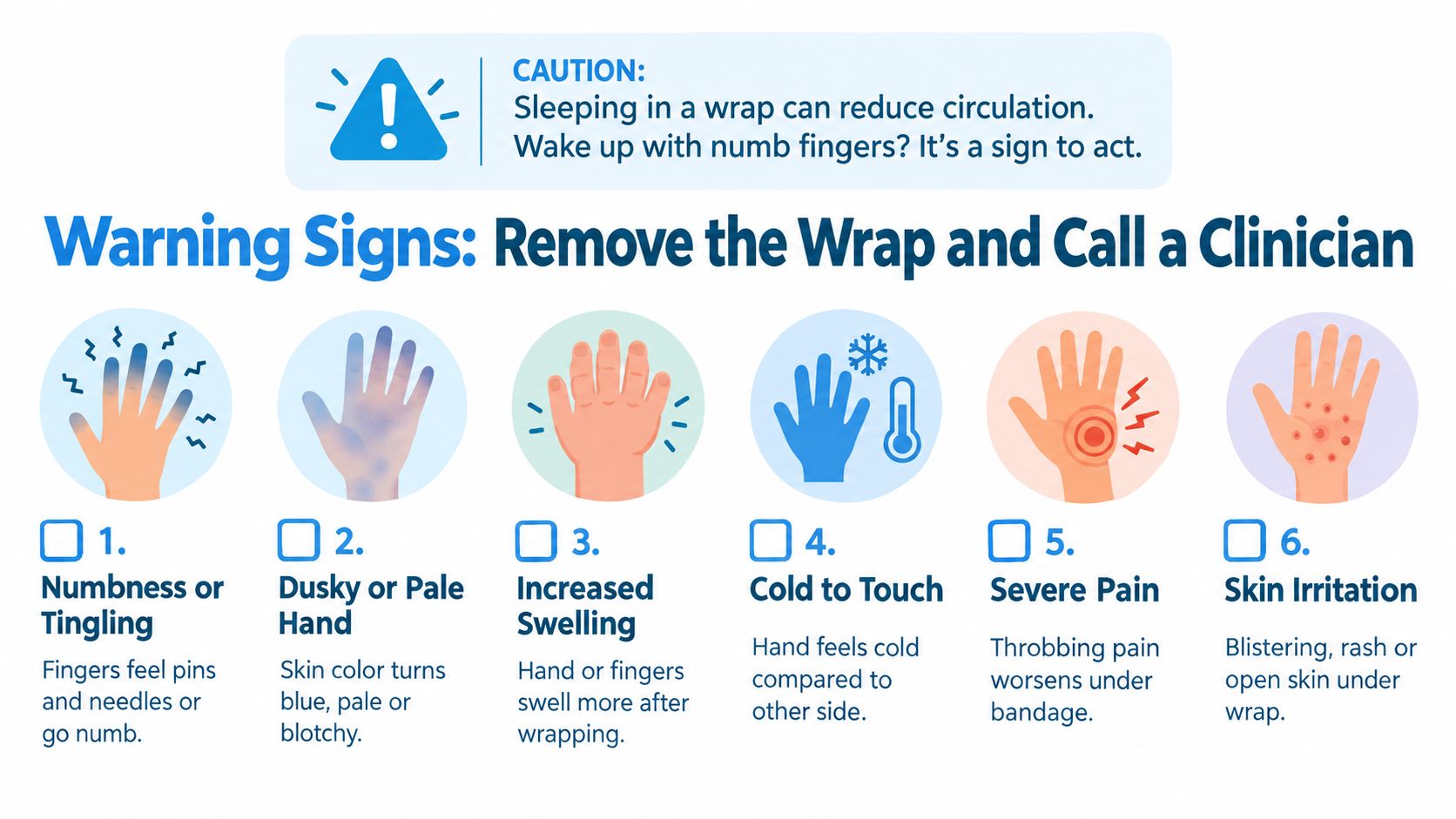
Remove the wrap immediately if you notice:
- Numbness or tingling: Pins and needles that don't settle quickly after loosening are not normal.
- Color change: Blue, white, gray, or blotchy fingers suggest a circulation problem.
- Increasing swelling: Swelling in the hand or fingers below the bandage means the fit may be obstructing fluid movement.
- Cold skin: One hand feeling colder than the other needs prompt attention.
- Worsening pain: Throbbing or escalating pain under the bandage is a reason to stop, not tighten.
- Skin damage: Rash, blistering, burning, open skin, or sharp pressure marks require removal.
When the hand changes, the wrap comes off. Don't wait to see whether it settles overnight.
Some symptoms call for urgent evaluation rather than another attempt at wrapping. Seek medical help for a suspected fracture, obvious deformity, severe loss of movement, or a hand that remains pale, blue, cold, numb, or weak after the bandage is removed.
Arrange a clinical assessment if elbow pain persists beyond a week, if you can't fully bend or straighten the joint, or if fever, spreading redness, or unusual warmth accompanies swelling. Those signs may point to an injury or infection that compression can't treat.
Don't try to push through worsening symptoms because the bandage feels supportive. Take it off, compare both hands, and contact a clinician when the change doesn't resolve promptly.
Your Pre-Wrap Checklist and Next Steps for Lasting Recovery
Use this quick decision guide before you wrap:
- Acute sprain: Gentle support and cold-pack retention may help temporarily, then reassess as swelling settles.
- Epicondylitis: Choose targeted support during aggravating activity and pair it with progressive rehabilitation.
- Bursitis: Avoid tight pressure over a swollen olecranon bursa until the cause is assessed.
- Sensitive skin or long wear: A non-compression sleeve is often more practical than repeated elastic wrapping.
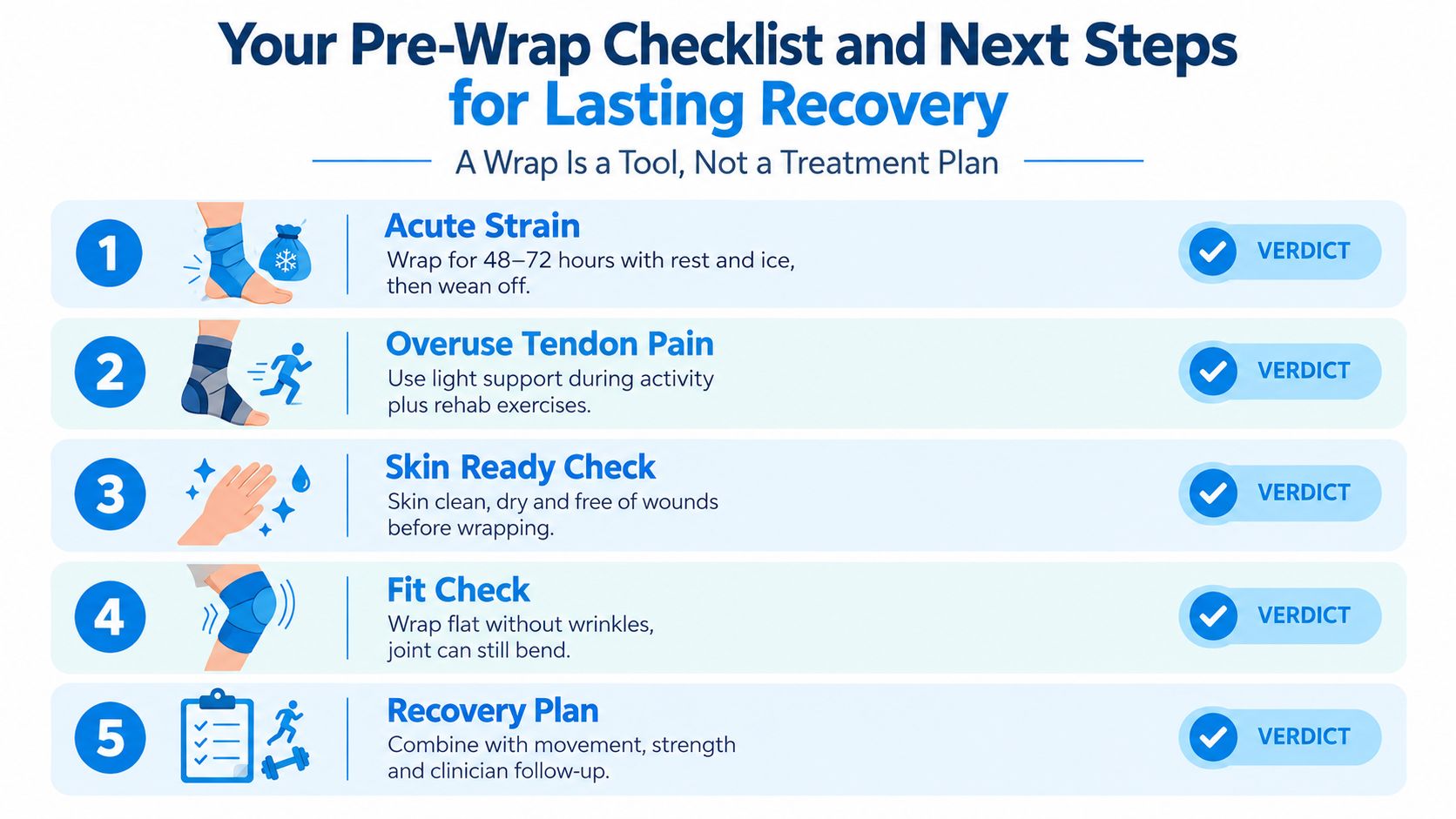
Before applying an elastic bandage for elbow support, inspect the skin and confirm that there are no wounds, blisters, or active rashes. Check the hand's color, warmth, and sensation first, decide when you'll remove the wrap, and keep the bandage flat so wrinkles don't create pressure points.
An acute flare may respond to rest, cold, and gentle support. Ongoing tendon pain needs a gradual return to load, including clinician-guided strengthening rather than indefinite protection. Heat can feel useful for stiffness before movement, while cold is often more comfortable after an activity-related flare, but neither addresses a persistent mechanical problem on its own.
A wrap is a tool, not a treatment plan.
Stop self-care and arrange an evaluation if pain keeps returning, movement remains limited, swelling is unexplained, or the injury followed substantial force. Imaging may be appropriate when a fracture, major ligament injury, or another structural problem is suspected. If tight compression has irritated your skin or caused circulation concerns, a compression-lite infrared sleeve can offer a less restrictive option for light activity, but it still shouldn't delay an assessment for red flags.
Address the cause, not just the elbow.
Thermo Recovery Wear offers compression-lite infrared elbow sleeves and braces designed for comfortable support during rest or light daily movement without a tightly wrapped bandage. Visit Thermo Recovery Wear to review the elbow option, sizing guidance, and wear-care information before choosing your next support.


