


You're standing at the bottom of the stairs, rubbing a calf that feels tight enough to snap. You can push through the day, take a warm shower, or strap on one of the heat wraps for legs sitting in your recovery drawer. The uncomfortable part isn't finding warmth. It's knowing whether warmth matches the problem.
Leg discomfort can come from muscle soreness, joint stiffness, chronic osteoarthritis, nerve irritation, or circulation-related symptoms. Those conditions don't respond in the same way. A wrap that helps a stiff knee may be a poor choice for a freshly swollen ankle, and a low-level wearable garment serves a different purpose from a hot pack that delivers intense, local heat.
My practical view is simple. Heat earns a place in a recovery routine when the main problem is stiffness, chronic musculoskeletal pain, or guarded movement. It isn't a universal answer for leg pain, and it shouldn't delay an assessment when symptoms are new, one-sided, swollen, or unexplained. The right purchase depends less on marketing language and more on the format, the condition, and whether you need to sit still or keep moving.
Table of Contents
- Why Leg Pain Has So Many People Reaching for Heat
- The Four Main Types of Heat Wraps for Legs
- Comparing Electric, Microwavable, Disposable, and Infrared Wraps
- What the Research Actually Shows for Leg Conditions
- Matching Wrap Type to Your Specific Leg Problem
- When Heat Wraps Are the Wrong Choice for Legs
- Safe Use Guidelines for Leg Heat Therapy
- How to Choose the Right Heat Wrap for Your Routine
Why Leg Pain Has So Many People Reaching for Heat
Heat feels useful because it changes how a painful area behaves in the short term. Warmth can make tight tissue feel less guarded, improve comfort during movement, and provide a competing sensory signal that reduces the prominence of pain. It can also make a stiff knee or calf easier to move before walking or gentle mobility work.
That doesn't mean every painful leg needs more warmth. A runner with a familiar, dull post-exercise ache may benefit from heat, while someone with a new calf injury and visible swelling needs a different response. The question isn't whether heat feels pleasant. The question is what is driving the pain.
Practical rule: Use heat to make stiff or chronically sore tissue easier to move. Don't use comfort as proof that the underlying problem is harmless.
The same symptom can point to different problems
A stiff knee after sitting is not the same as a hot, swollen knee after a twist. Heavy calves after an unfamiliar workout are not the same as calf pain accompanied by swelling in one leg. Restless discomfort at night is not the same as pain that appears predictably with walking and settles with rest.
That distinction matters because superficial heat has its strongest rationale in chronic musculoskeletal pain and stiffness. Expert guidance describes it as more appropriate after the oedematous phase of healing, rather than during fresh swelling, and notes that formal guidance remains limited in this review of superficial heat therapy.
Four formats, four practical jobs
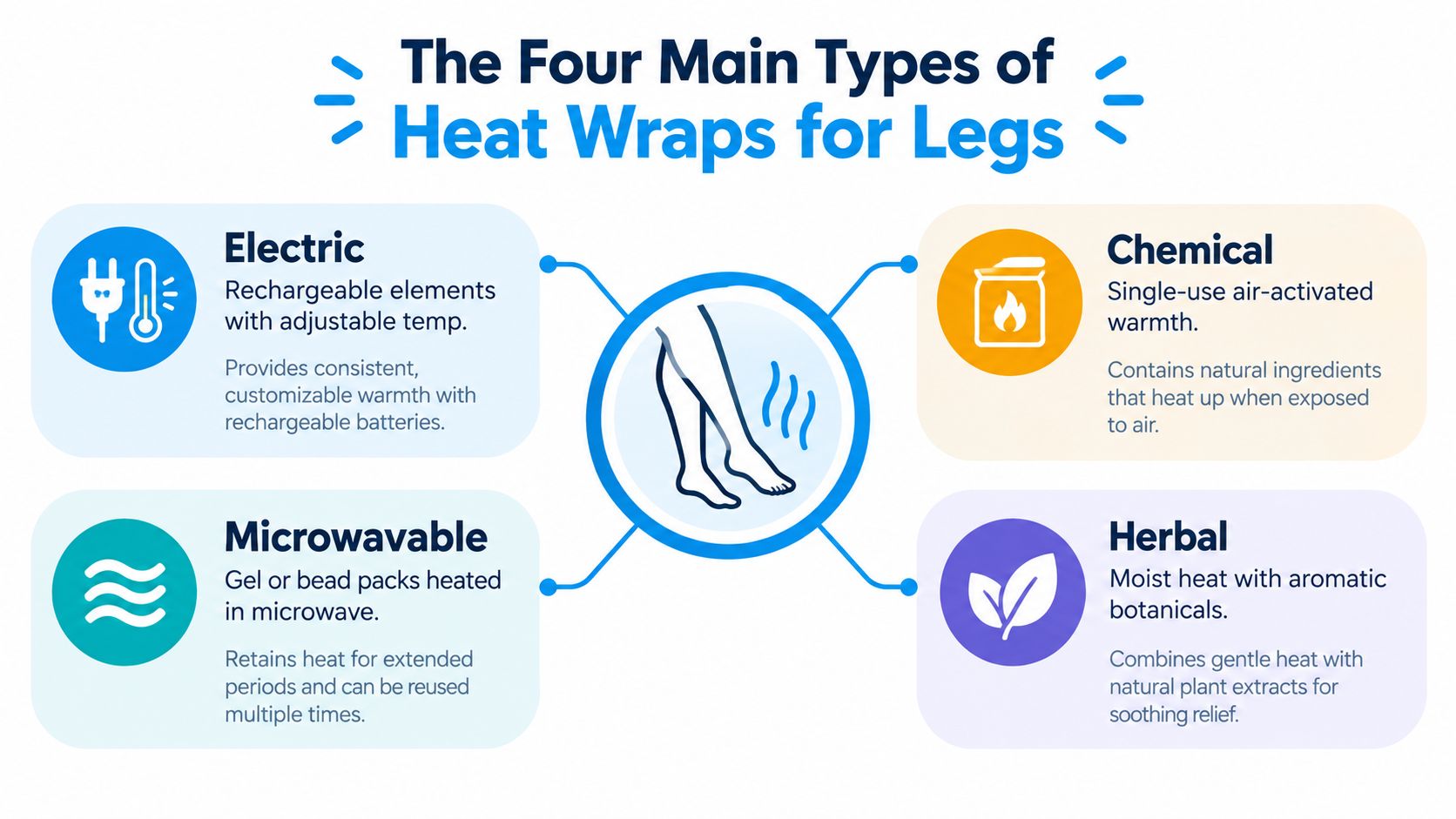
Electric wraps are the control-focused option. They use wired or rechargeable heating elements, usually with adjustable settings, and suit people who want a repeatable session while resting.
Microwavable pads are simpler. Grain, clay, or gel stores heat after warming in a microwave, giving you a short, flexible session without a cable. Disposable chemical wraps use air-activated oxidation, often involving iron powder, to create steady warmth without an outlet or microwave.
Infrared-responsive garments are different from conventional hot packs. They're worn as fabric sleeves or braces, usually producing lower-intensity warmth from body heat and mineral or semiconductor-integrated textiles rather than a visibly hot heating element. They make the most sense when mobility and discreet wear matter more than peak temperature.
The best format is the one that matches your condition and your behavior. A theoretically powerful wrap that stays in a drawer is a poor recovery tool.
The Four Main Types of Heat Wraps for Legs
A sore, stiff knee after sitting calls for a different wrap than a tight calf during a commute. The heat source determines how quickly warmth arrives, how long it lasts, and whether you can move while wearing it. Choose the format around the leg problem and your routine, not the label on the package.
Electric wraps
Electric wraps use heating elements connected to a wall adapter, battery pack, or rechargeable control unit. Their main advantage is temperature control. A lower setting suits a sensitive knee, while a stronger setting can warm a larger muscle group. The highest setting is not automatically the most effective or safest.
Choose one for chronic knee stiffness, seated recovery, or repeated sessions that need the same heat level. Cables, charging, electronic cleaning limits, and the temptation to extend a session are the trade-offs. Battery-powered versions allow more movement, but they still require charging and regular skin checks.
Microwavable pads
Microwavable pads hold grain, clay, gel, or another heat-retaining filling. They work well for a calf, ankle, thigh, or knee while you are seated, and flexible or moist-feeling fills can conform around a joint. They are simple to reuse, but warmth fades as the stored heat dissipates.
Consistency is the weak point. Microwave power, fill material, and heating time all affect the final temperature, so follow the instructions instead of guessing. A pad that feels comfortable during one session can become too hot during another.
Disposable chemical wraps
Chemical wraps activate when exposed to air, producing gradual warmth without a plug or microwave. That makes them useful for commuting, travel, or a workday when preparation is inconvenient. They suit mild muscle tightness during ordinary activity better than a recovery session that demands precise temperature control.
The environmental cost is clear, since each use creates another discarded product. Temperature adjustment is also limited. Place the wrap over a thin clothing layer and check your skin regularly, especially if sensation is reduced.
Infrared-responsive garments
Infrared garments use engineered fabric instead of a conventional hot coil. Some contain mineral or semiconductor-integrated fibers designed to interact with body heat and provide gentle warmth while the wearer moves. They are a practical option for stiffness that responds to low, sustained warmth, particularly when a plug or microwave is impractical.
Treat them as wearable support, not a substitute for a hot pack that delivers concentrated heat. Wearable heat-retaining knee sleeves have been studied for short-term pain relief in people with knee osteoarthritis, making this category more credible than a garment marketed as warmth alone. For topical and warming self-care options, browse ArtNaturals pain relief.
For readers comparing wearable warmth with supportive textile designs, thermal compression wear offers relevant context. Infrared-responsive fabric and electrically heated fabric use different technologies. If a leg is freshly swollen after an injury, or circulation and sensation are impaired, skip self-directed heat and get clinical advice before choosing any format.
The right wrap is the one you will use correctly. A powerful device left in a drawer contributes nothing to recovery.
Comparing Electric, Microwavable, Disposable, and Infrared Wraps
A useful comparison starts with the job, not the product label. Ask whether you need strong heat while resting, gentle warmth during movement, a repeatable setup, or something you can use away from home.
| Criterion | Electric Wrap | Microwavable Pad | Disposable Chemical Wrap | Infrared Garment |
|---|---|---|---|---|
| Heat-up time | Requires power or charging, then warms in a controlled way | Needs microwave preparation | Activates after opening | No conventional heat-up |
| Session duration | Usually adjustable according to the device | Cools as stored heat dissipates | Provides gradual, steady warmth | Provides low-level warmth while worn |
| Temperature control | Strongest control of the four formats | Depends on heating instructions and fill | Limited control | Lower peak warmth, usually passive |
| Portability | Good if rechargeable, limited if corded | Requires access to a microwave | Excellent for travel and work | Excellent for movement and daily wear |
| Reusability | Reusable with care | Reusable | Single-use | Reusable garment |
| Cost per use | Spread across repeated sessions | Spread across repeated sessions | Adds up with frequent use | Spread across repeated wear |
| Comfort during wear | Can feel bulky or tethered | Best while seated | Convenient but may feel adhesive or warm in one spot | Usually the least disruptive during activity |
| Best match | Chronic stiffness and controlled rest | Short, targeted warmth | Unpredictable schedules and travel | Low-level support during light movement |
Electric wraps win when precision matters. They're the most sensible option for someone who wants a repeatable routine around a chronic knee or a seated rehabilitation session. They're less attractive if you need to walk around, work at a desk without cables, or have reduced sensation.
Microwavable pads are the value choice for occasional soreness. They're easy to share between body areas, but they don't provide the same temperature consistency or mobility. Disposable wraps are the convenience choice, not the economical choice for daily use.
Infrared garments suit users who dislike wires, adhesive products, and bulky pads. Their benefit is adherence. If a sleeve stays on while you walk, work, or perform light household tasks, it may be more useful than a hotter device you can only tolerate while sitting. For readers who want a plain-language introduction to the category, this guide to infrared therapy for pain recovery explains the intended use without treating infrared wear as a cure-all.
What the Research Actually Shows for Leg Conditions
A warm wrap can make a stiff knee easier to bend before a walk, or help tight muscles tolerate gentle movement. That benefit is symptom relief, not tissue repair. Heat does not prove that a wrap repairs cartilage, heals a muscle tear, or corrects a vascular disorder. If swelling follows a fresh injury, or circulation is already impaired, warmth may be the wrong tool rather than a useful recovery aid.
The strongest leg-specific evidence involves knee osteoarthritis and selected movement disorders. In a randomized, double-blind pilot trial, 52 patients with knee osteoarthritis used a heat-retaining knee sleeve for 4 weeks. The treatment group reported a 2.5-point reduction in mean WOMAC pain, described by the study as a 16% decrease from baseline, while the placebo sleeve group improved by 9.7% in the trial report. Because the comparator sleeve had similar weight and contact area, the trial could better distinguish the reflective design from simple support. For knee-specific guidance, see whether heat is good for sore knees.
The wider heat-therapy evidence supports a smaller, practical effect. One randomized study assigned 60 people with osteoarthritis to hot-pack therapy at 40 degrees Celsius for 20 minutes. The heat group had significantly less pain on days 8 and 15, with reported p-values of 0.002 and 0.001. A 2024 review found that superficial heat produced an average pain improvement of less than 1/10 on a visual analog scale, with statistically significant effects on pain, function, and quality of life in the heat-therapy review.
Evidence by condition
| Condition | Wrap type studied | Key finding | Evidence strength |
|---|---|---|---|
| Knee osteoarthritis | Heat-retaining infrared-reflective sleeve | Short-term pain improvement compared with a placebo sleeve | Controlled pilot evidence |
| Knee osteoarthritis | Superficial hot pack | Lower follow-up pain and modest average improvement in review evidence | Small-to-moderate evidence base |
| Spastic paraparesis | Heated lower-limb packs with insulation | Walking speed and foot-tap performance improved immediately after heating | Randomized crossover evidence |
| Impaired gait in older adults | Continuous heat wraps on legs and knees | Repeated sessions were associated with better tremor, mobility, balance, and gait measures | Longitudinal crossover evidence |
| Deep tissue healing | Various heat formats | Evidence does not establish structural repair | Limited evidence |
The movement findings apply to specific populations, not every sore leg. In a randomized crossover study of people with hereditary and spontaneous spastic paraparesis, 30 minutes of lower-limb heating plus insulation improved walking speed by 12.2% and foot-tap time by 21.5%, with walking speed still 9.9% better one hour later in the study protocol and results. A separate crossover study of older adults with impaired gait tested continuous heat wraps for 6 days, used 4 hours per day, and reported reduced tremor, better joint mobility, improved balance, and better gait after 6 heat sessions in the gait-analysis study.
Use heat wraps for short-term comfort, stiffness management, and selected movement support. Do not treat these findings as proof of faster healing, especially after acute injury or with circulation-related symptoms.
Matching Wrap Type to Your Specific Leg Problem
Start with the complaint, then choose the format. Don't start with infrared, electric, or chemical as if one technology should solve every leg problem.
Chronic knee osteoarthritis
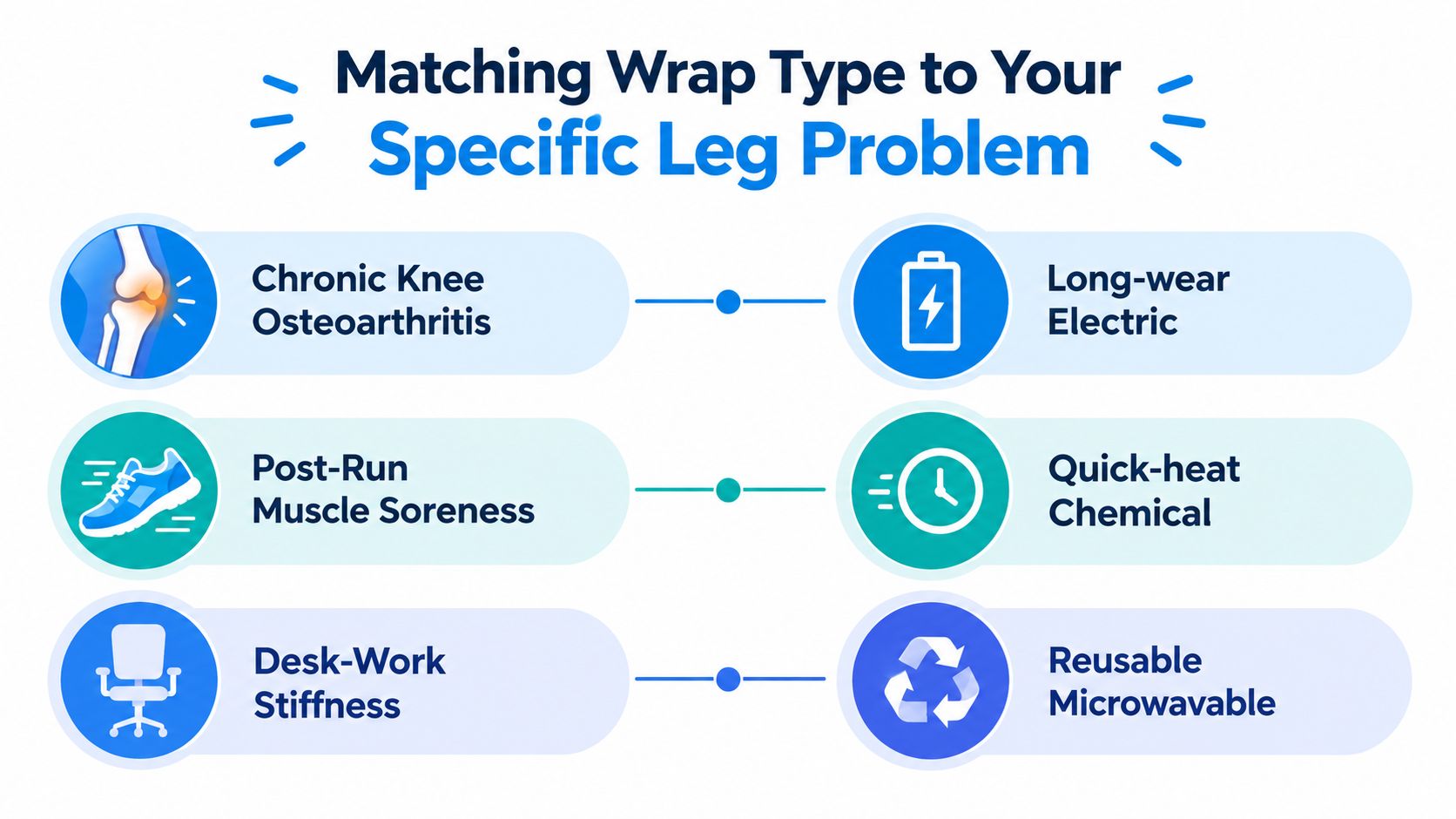
Choose an electric wrap for controlled rest or a gentle wearable garment if you need to stay mobile. The osteoarthritis evidence supports heat as an adjunct for pain and stiffness, not as a substitute for strengthening, weight-bearing activity suited to your ability, or clinical care.
A disposable chemical wrap can work when you need warmth away from home, but its limited control makes it a less appealing everyday choice. For a joint that responds well to predictable warmth, electric control is more practical.
Post-exercise muscle tightness
Use a microwavable pad when you're seated and want broad, comfortable warmth over the calf, hamstrings, or quadriceps. An infrared sleeve is more suitable if your main goal is gentle warmth while walking or completing light recovery work.
Don't use heat to mask sharp pain or swelling after a new injury. If the area feels worse as it warms, stop. That response tells you the tissue may be too reactive for this tool.
Desk-work stiffness
A low-profile infrared garment or rechargeable electric wrap fits this scenario better than a bulky pad. The priority is adherence. You want something that lets you change position and move periodically, because passive warmth works better as a bridge to movement than as an excuse to remain still.
Older adults with stiff ankles or foot arthritis may prefer a shaped microwavable boot or pad when seated. The design should hold warmth without forcing the foot into an awkward position.
Nerve-related or circulation-related discomfort
Self-matching becomes risky. A mild, previously assessed nerve irritation may respond to carefully monitored warmth, but unexplained burning, numbness, exertional calf pain, or one-sided swelling deserves medical evaluation. Heat can make a person feel temporarily better without addressing the cause.
When Heat Wraps Are the Wrong Choice for Legs
Heat is the wrong first move when the leg looks acutely irritated. Fresh sprains, strains, and contusions with swelling can worsen when warmth increases local blood flow. Use the approach recommended for the injury, which may include cold therapy, protection, elevation, or professional assessment rather than a heated wrap.
A painful, swollen, red, or unusually warm calf on one side is not a routine recovery problem. Those symptoms can indicate a serious vascular issue, including deep vein thrombosis, and require prompt medical evaluation. Don't massage the area or apply a heat wrap while waiting for guidance. This resource on warning signs of DVT explains why those symptoms shouldn't be treated as ordinary soreness.
Conditions requiring extra caution
- Reduced sensation: Diabetes-related neuropathy or another sensory disorder can prevent you from noticing excessive heat before skin damage occurs.
- Skin problems: Open wounds, active infection, cellulitis, or irritated dermatitis are poor surfaces for adhesive, electric, or microwavable products.
- Vascular disease: Peripheral artery disease involves impaired arterial circulation. Heat therapy is being studied as a possible adjunct, but it isn't a home diagnosis or a universal treatment.
- Unexplained pain: Persistent, worsening, night-disrupting, or function-limiting leg pain needs a cause-based assessment.
A 2025 review describes passive heat as a promising area for peripheral artery disease and reports improvements in vascular function and walking capacity in the emerging literature in the review of heat therapy for peripheral artery disease. That does not mean people with suspected vascular disease should self-treat aggressively. It means the clinical question is active and requires more than consumer product advice.
Safe Use Guidelines for Leg Heat Therapy
Treat heat like a dose, not a harmless accessory. The goal is comfortable warmth that leaves the leg calmer and easier to move, not intense temperature or prolonged exposure.
Before applying a wrap
- Check the skin and symptoms. Don't apply heat to a leg that is newly swollen, red, numb, infected, or sharply painful.
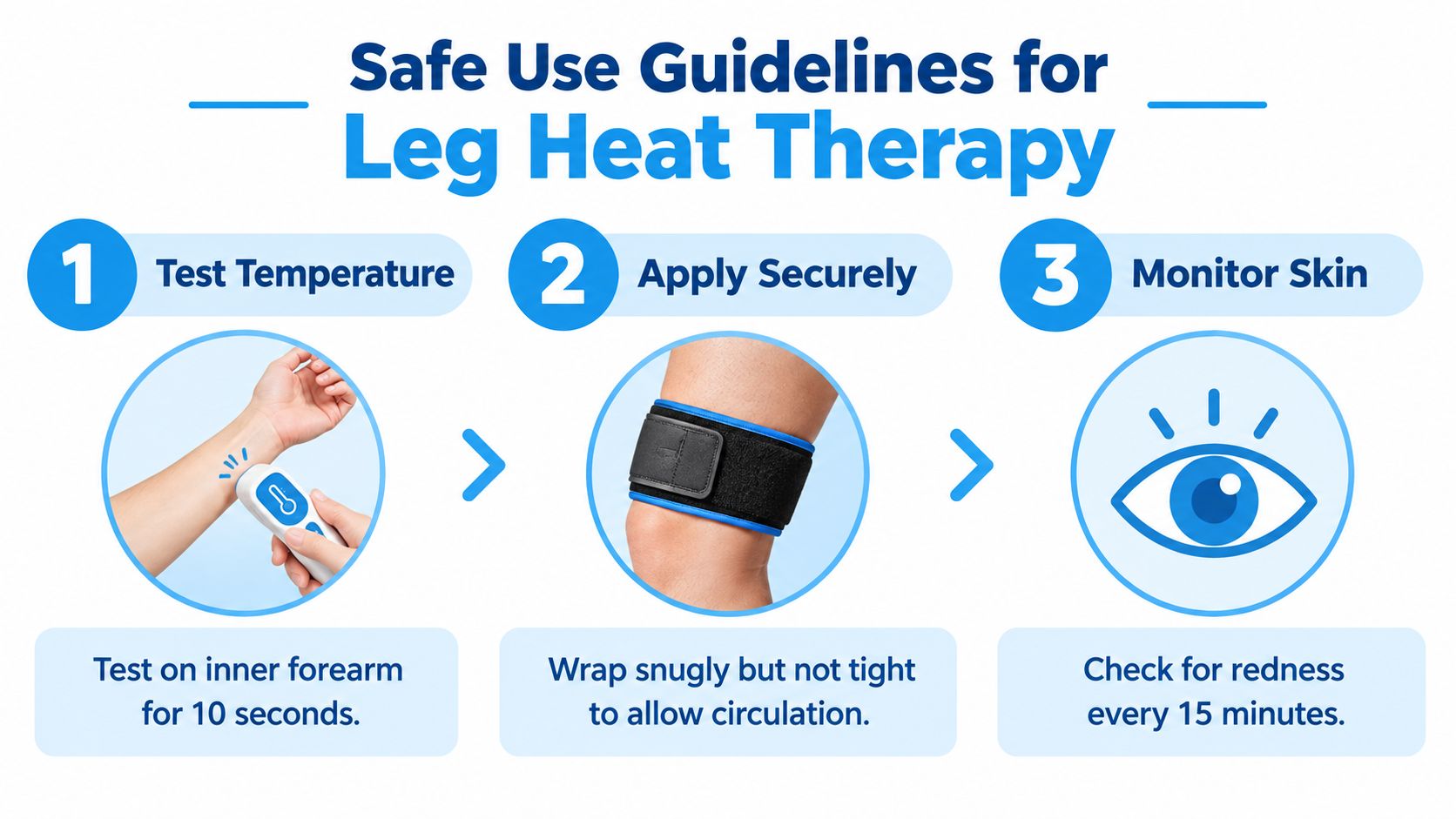
- Test the temperature on your inner forearm. This gives you a quick warning if the wrap feels hotter than expected.
- Use a fabric barrier with direct heat sources, especially over the shin, kneecap, ankle, or another bony area.
- Secure the wrap without constriction. It should stay in place without leaving deep pressure marks or making the foot feel cold.
During the session
Set a timer before you start and follow the manufacturer's duration and temperature instructions. Stay awake, avoid placing body weight directly on the wrap, and inspect the skin during use rather than waiting until the end.
Stop immediately if you notice burning, numbness, blistering, spreading redness, increased throbbing, swelling, dizziness, or a clear increase in pain. Never fall asleep with an active electric, microwavable, or chemical wrap.
People with diabetes-related neuropathy, peripheral neuropathy, a history of thrombosis, poor circulation, or impaired sensation should ask a clinician before using home heat. If symptoms persist, worsen, or keep returning despite sensible self-care, stop treating the wrap as the solution. Use the guidance in this hot and cold therapy overview alongside professional advice.
How to Choose the Right Heat Wrap for Your Routine
Choose by routine first, format second, and premium features last. Paying more for a device that doesn't fit your day won't improve adherence.
Use this filter:
- For desk stiffness or seated recovery, choose a microwavable pad if you want simple, occasional warmth, or an electric wrap if temperature control and repeatability matter.
- For post-exercise tightness, choose the format you can pair with gentle walking, mobility work, or stretching without aggravating symptoms.
- For chronic knee stiffness, favor controlled electric warmth or a low-profile wearable garment that doesn't interfere with daily movement.
- For travel and unpredictable schedules, disposable chemical wraps are convenient, but their single-use design makes them a poor default for frequent use.
- For skin sensitivity or reduced sensation, avoid high-intensity heat and seek clinical guidance before using any heated product. A passive, low-level garment may be more appropriate than an adjustable device, but it still requires skin checks.
- For low maintenance, disposables require the least preparation. For lower waste and repeated use, electric, microwavable, and infrared formats make more sense.
Start with a mid-priced option in the category that fits your actual use. Upgrade only after you've established that the format helps and you'll use it consistently. If you need wearable, body-heat-activated lower-leg support during light activity, Thermo Recovery Wear offers infrared-responsive sleeves and braces designed for warmth and circulation support without conventional powered heating.
If your leg pain is chronic stiffness rather than acute swelling, choose a wrap that supports the way you move and recover. Explore the lower-body recovery garments from Thermo Recovery Wear, then use them as an adjunct to movement and appropriate medical care, not as a replacement for diagnosis.


