


You stand up from your chair and your lower back feels reluctant to straighten. Or you've just rolled out of bed, and putting on your socks already feels like a negotiation. You want to loosen up, but you're not sure whether stretching will help or make things worse.
Learning how to relieve lower back stiffness starts with deciding whether home care is appropriate. Once warning signs are ruled out, the useful approach is usually comfortable movement, gradual strengthening, and a way to tell whether everyday tasks are getting easier.
Table of Contents
- When Stiffness Needs a Clinician First
- Gentle Moves That Loosen a Stiff Lower Back
- Build From Mobility to Strength Over Twelve Weeks
- Where Massage, Braces and Heat Fit In
- Track Progress, Handle Flare-Ups and Know When to Get Help
When Stiffness Needs a Clinician First
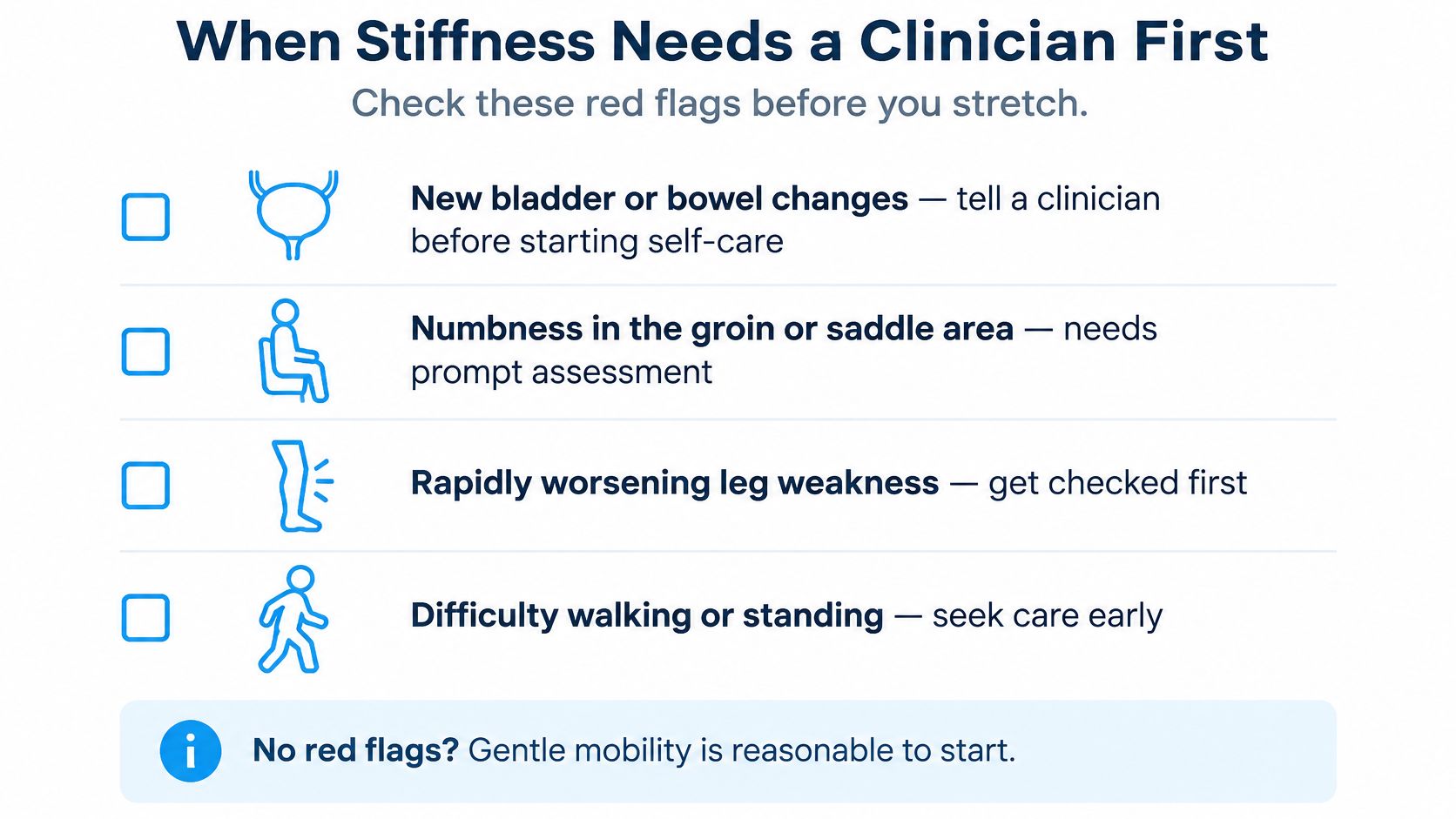
Stop before stretching if stiffness comes with new bladder or bowel changes, numbness around the groin or saddle area, or rapidly worsening leg weakness. These symptoms can indicate serious nerve involvement and need emergency assessment. Don't wait to see whether heat or a walk settles them.
Fever, major trauma, unexplained weight loss, severe unrelenting pain, and new difficulty walking also warrant urgent medical assessment. The Medistik lower-back stiffness guide identifies these warning signs and advises limiting covered heat applications to about 20 minutes, with unsupervised heat avoided when skin sensation is reduced or skin is damaged.
Use this checklist before trying a home routine.
Match the pattern to the next step
The timing and location of symptoms help determine your next step, but they don't establish a diagnosis. A back that's gradually improving after lifting something awkward needs a different response from stiffness accompanied by increasing leg symptoms.
Stiffness patterns and the first step for each
| Pattern | What It May Point To | First Step |
|---|---|---|
| Bladder or bowel change, saddle numbness, fever or major trauma | Possible serious or nerve-related cause | Urgent medical assessment, no self-treatment |
| Leg weakness that worsens quickly or trouble walking | Possible nerve compression | Urgent assessment; emergency care for rapidly progressive weakness |
| Pain or tingling that runs below the knee | Possible nerve root irritation | Arrange prompt clinician assessment |
| Recent strain that eases a little each day | Common mechanical strain | Gentle movement and daily monitoring |
| Morning stiffness returning for several weeks | Persistent stiffness requiring assessment of its cause | Comfortable activity and clinician review if it persists or isn't improving |
Older adults and people with osteoporosis, a cancer history, infection risk, or neurological symptoms should seek review sooner rather than repeatedly testing painful stretches. Persistent morning stiffness shouldn't automatically be labelled tight muscles or arthritis.
If symptoms overlap with hip discomfort, our guide to arthritis in the lower back and hips provides useful background without replacing an examination.
Safety first: A warning sign changes the plan from loosening the back to finding out why it's stiff.
For stiffness mainly noticed after sleeping, review comfort as well as symptoms. Miller Waldrop Furniture & Decor's sleep comfort tips for West Texas homeowners can help you consider your sleep setup, but changing a mattress or pillow isn't a substitute for assessing persistent symptoms.
Gentle Moves That Loosen a Stiff Lower Back
Start with walking, pelvic tilts, and a small hip hinge, rather than the deepest stretch you can tolerate. If warmth makes movement more comfortable, use a warm shower or covered warm pack first. Warmth is optional, not a requirement for exercising safely.
For each movement, start with a small range and move slowly enough that you can stop easily. Breathe normally. You're looking for a comfortable change in movement, not a crack, a strong pulling sensation, or proof that you've stretched far enough.
Choose movements your back accepts
The WHO guideline for chronic primary low-back pain supports individualized structured exercise for adults, including older adults. It doesn't prescribe a universal home routine, so use the following as a conservative starting menu rather than a treatment for every cause of stiffness.
Gentle moves for lower back stiffness
| Move | How to Do It | Dose | Stop If |
|---|---|---|---|
| Warm shower or warm pack | Apply comfortable warmth before moving; place a cloth between the pack and skin | Briefly, while checking the skin | You can't reliably feel the heat, or skin becomes irritated |
| Pelvic tilts | Lie on your back with knees bent; gently flatten the low back, then release | A short set of easy repetitions | Sharp pain or pain into the leg |
| Knee-to-chest stretch | Lie back and bring one knee toward your chest without pulling hard | A brief comfortable hold on each side | Pain increases into the leg |
| Cat-cow | On hands and knees, slowly alternate gentle rounding and arching | A few unhurried cycles | Either direction worsens pain |
| Hip hinge | Stand with soft knees and push your hips back while keeping your spine comfortably neutral | A small set with controlled technique | Pain goes beyond a mild stretch |
| Supported trunk rotation | Lie with knees bent and let them move slowly side to side | Alternate sides within an easy range | Dizziness or leg symptoms |
| Walking | Walk on flat ground at a comfortable pace | Short walks that finish before symptoms steadily increase | Symptoms rise throughout the walk |
The stop column matters more than completing the routine. If knee-to-chest sends pain down your leg, leave it out. Don't assume that an uncomfortable movement becomes useful if you repeat it harder.
A useful movement leaves you able to carry on with your day. It shouldn't require you to recover from the stretching session.
Try a small selection rather than every exercise at once. Notice how you feel immediately afterward and later during ordinary activity; keep the movements that make standing, dressing, or walking easier.
Our guide to yoga poses for lower-back discomfort offers additional options when basic movements feel comfortable. Treat those poses as alternatives, not extra work you must add.
Build From Mobility to Strength Over Twelve Weeks
Mobility helps you get moving; strength training helps you tolerate more of what your day demands. Carrying groceries, getting off a chair, and walking uphill require more than flexibility. The aim is to rebuild that capacity without jumping ahead of what your symptoms allow.
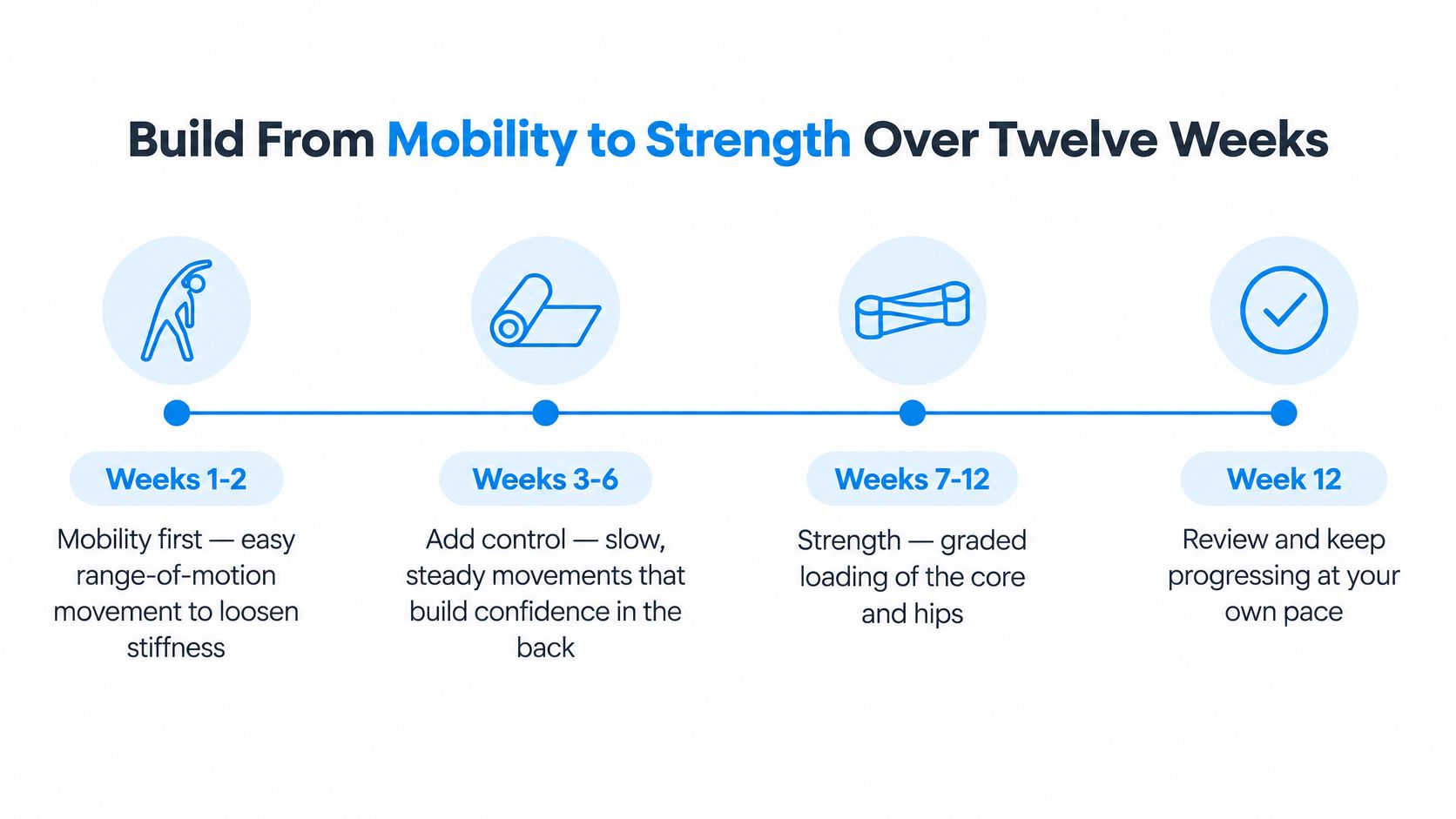
Twelve weeks is a planning framework, not a recovery deadline. Earlier structured-program guidance described up to eight sessions over twelve weeks, while current NICE recommendations for low-back pain emphasize choosing exercise around the person's needs, preferences, and capabilities.
This progression shows the direction of travel, not a schedule you must force yourself to meet.
Begin with repeatable movement
During the opening phase, choose comfortable mobility exercises and manageable walks. Your first target is a routine you can repeat without progressively worsening symptoms, not a particular range of motion.
Keep the effort modest enough that you're not holding your breath or bracing your whole body. If getting onto the floor is difficult, use standing movements and chair-based activity while a physical therapist helps identify accessible alternatives.
Add strength with control
When ordinary movement feels manageable, introduce trunk, hip, and leg exercises. Start with a short set, pause before technique deteriorates, and add work only when the current amount feels repeatable.
- Glute bridge: Lie with knees bent, press through your feet, and lift your hips only as high as you can without arching your back.
- Bird-dog: From hands and knees, slide or lift a limb while keeping your trunk steady. Opposite arm-and-leg movements are a progression, not the starting requirement.
- Dead bug: Lie on your back and move a heel away from you while keeping your trunk comfortable. Add arm movement when you can control it without straining.
- Sit-to-stand: Rise from a firm chair and sit down slowly. Use your hands or a higher seat if that produces a smoother movement.
For a visual exercise reference, preview the movements before attempting them and skip anything that conflicts with your symptoms or clinician's advice.
Later, increase repetitions, resistance, range, or walking duration gradually. Change one variable at a time so you can identify what your back tolerates.
A common mistake is adding longer walks and harder strengthening together after a good day. Keep the pace individualized, including for older adults; age alone doesn't determine the starting load.
Our personal active-recovery workout guide can help organize activities around your current capacity. If an exercise repeatedly needs major modification, a physical therapist can help choose a better fit.
Where Massage, Braces and Heat Fit In
A massage can make your back feel easier without making it ready for every task. A brace can feel reassuring without rebuilding the capacity to lift or walk. Temporary comfort and lasting functional improvement aren't the same outcome.
Hands-on care can still have a useful role. A 2024 randomized controlled trial published in Scientific Reports found that adding manual therapy to core exercises improved Oswestry Disability Index scores by 54.71% after three weeks in adults with chronic low-back pain. That finding concerns a combined treatment, not a guarantee that massage alone will resolve stiffness.
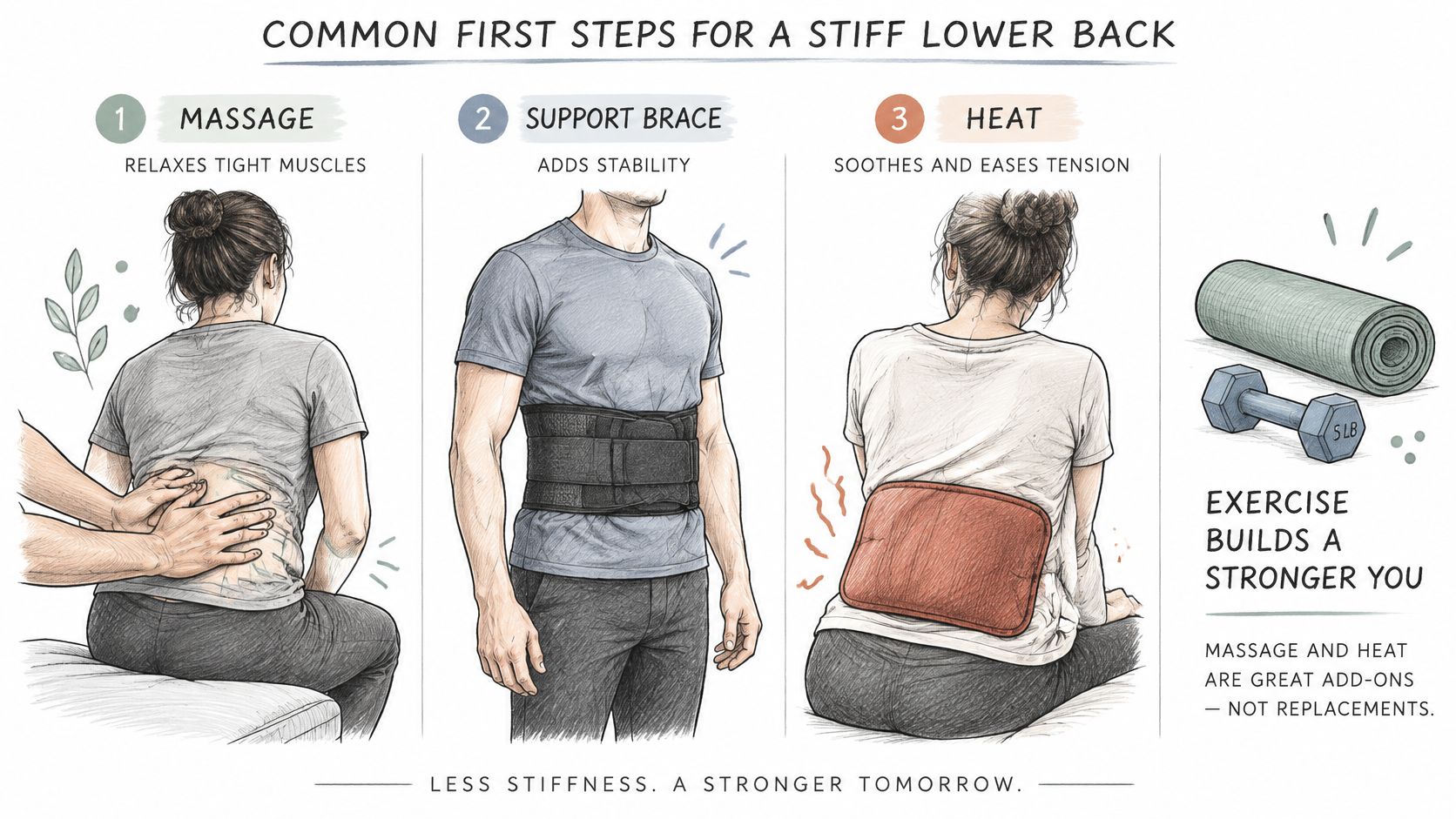
These tools fit best beside an active plan.
Choose the tool for the task
- Massage or mobilization: Consider it when discomfort makes starting exercise difficult. Follow the appointment with a manageable activity, rather than treating hands-on care as the entire rehabilitation plan.
- Heat: Use it for comfort before getting dressed, taking a walk, or doing gentle mobility. More intense heat isn't a better treatment, and sleeping on an active heating pad isn't a useful shortcut.
- A brace or supportive garment: Consider comfort during an activity, but distinguish an optional support from a medically prescribed brace. Follow the prescribing clinician's instructions after injury or surgery.
Our guide to back braces for lower-back pain explains how support can fit into daily life. Don't use a garment to push through symptoms that would otherwise make you stop.
Keep furniture comfort in perspective
If you're already comparing seating, you can browse reclining sofas with heat from Gorins Furniture & Mattress to assess comfort features. Heated furniture is a household preference, not a necessary purchase or a replacement for rehabilitation.
Judge an add-on by what it helps you do afterward, not just how relaxed you feel while using it.
Spinal manipulation alone, repeated passive appointments, or prolonged reclining can leave the active work unfinished. Passive care is most useful when its comfort carries into the movement plan that follows it.
Track Progress, Handle Flare-Ups and Know When to Get Help
Judge progress by what you can do, not just how your back feels at a single moment. You might still notice stiffness while finding it easier to put on shoes, rise from a chair, or finish your usual walk. Those changes matter.
The Cochrane review of exercise for chronic low-back pain supports exercise for persistent symptoms, while showing that average benefits are generally modest. That's a reason to set practical targets rather than expect every session to eliminate discomfort.
Keep a simple weekly record
Use the same everyday tasks so comparisons are meaningful. A brief note on your phone is enough; you don't need a wearable device or a complicated spreadsheet.
| Measure | What to Record |
|---|---|
| Walking tolerance | Where you walked and when stiffness made you slow down or stop |
| Sit-to-stand ability | Whether you needed your hands and how controlled the movement felt |
| Morning stiffness | How long it took to move comfortably after getting up |
| Symptom intensity | A consistent personal rating, recorded at a similar time of day |
Review the notes on the same day each week and compare them with your starting point. Record relevant changes, such as unfamiliar gardening, interrupted sleep, or a longer car journey, so you don't mistake an unusually demanding day for failure of the whole plan.
Respond to a flare without abandoning activity
If your back becomes more uncomfortable after increasing activity, reduce the amount temporarily. Shorten the walk, use a smaller movement range, or leave out the newest exercise while keeping comfortable daily activity.
Post-exercise soreness doesn't automatically mean tissue damage. However, sharp pain, steadily escalating symptoms, or pain spreading down the leg calls for a different response: pause the provoking exercise and arrange assessment rather than repeatedly testing it.
- Keep the tolerable activities: Continue tasks that remain comfortable instead of taking complete bed rest.
- Remove the recent increase: Return to an amount you previously managed before trying to progress again.
- Escalate when the pattern changes: New neurological symptoms or other warning signs override the home routine and require urgent care.
Our hot and cold therapy guide can help you consider comfort measures during a setback. Rx360's resource on spotting warning signs before emergencies also encourages attention to changing symptoms, but don't delay urgent care while seeking online reassurance.
If function stays flat or declines despite a manageable routine, bring your log to a clinician or physical therapist. Seek help sooner when symptoms interfere with sleep, work, or basic self-care.
Our Lite back sleeve is listed as helping with sciatica, disc injuries, pinched nerves, post-surgery recovery, herniated discs, back sprains, fractured vertebra, and muscle or ligament strain, among other conditions. Those listings don't establish that self-treatment is appropriate, particularly after surgery or a suspected fracture.
Move gently every day, and let warning signs decide when self-care must stop. Progress means gradually doing more with confidence, not forcing your back to feel perfect.
Thermo Recovery Wear offers non-compression recovery sleeves and back support designed for home use and light daily activity. Visit Thermo Recovery Wear to explore the Lite Recovery Back Sleeve and sizing guidance if you're considering optional comfort support alongside your movement plan.


