


Are you looking for quick comfort, better support during activity, or a product you can wear long enough to influence your daily routine? Those aren't the same goal, yet many comparisons treat every sleeve, brace, topical, and recovery garment as interchangeable.
That distinction matters because chronic osteoarthritis, an overuse injury, and an aging joint can limit movement in different ways. The most useful joint pain relief products don't necessarily offer the strongest sensation or the most impressive feature list. They offer a reasonable match between evidence, fit, skin tolerance, activity, and expectations.
Table of Contents
- What Actually Helps With Chronic Joint Pain
- Why Non-Drug Support Options Matter Now
- Comparing Joint Pain Relief Product Categories
- How to Choose the Right Product for Your Situation
- Sizing, Wear Schedule, and Care Tips
- When Infrared Recovery Wear Makes Sense
- Common Myths About Joint Pain Relief Products
- Final Guidance for Choosing Smartly
What Actually Helps With Chronic Joint Pain
A buyer with knee pain often arrives after trying several products. One sleeve felt too tight, another slipped during a walk, a warming cream irritated the skin, and a rigid brace made ordinary clothing uncomfortable. The problem wasn't a lack of options. It was choosing by branding or price before identifying the actual limitation.
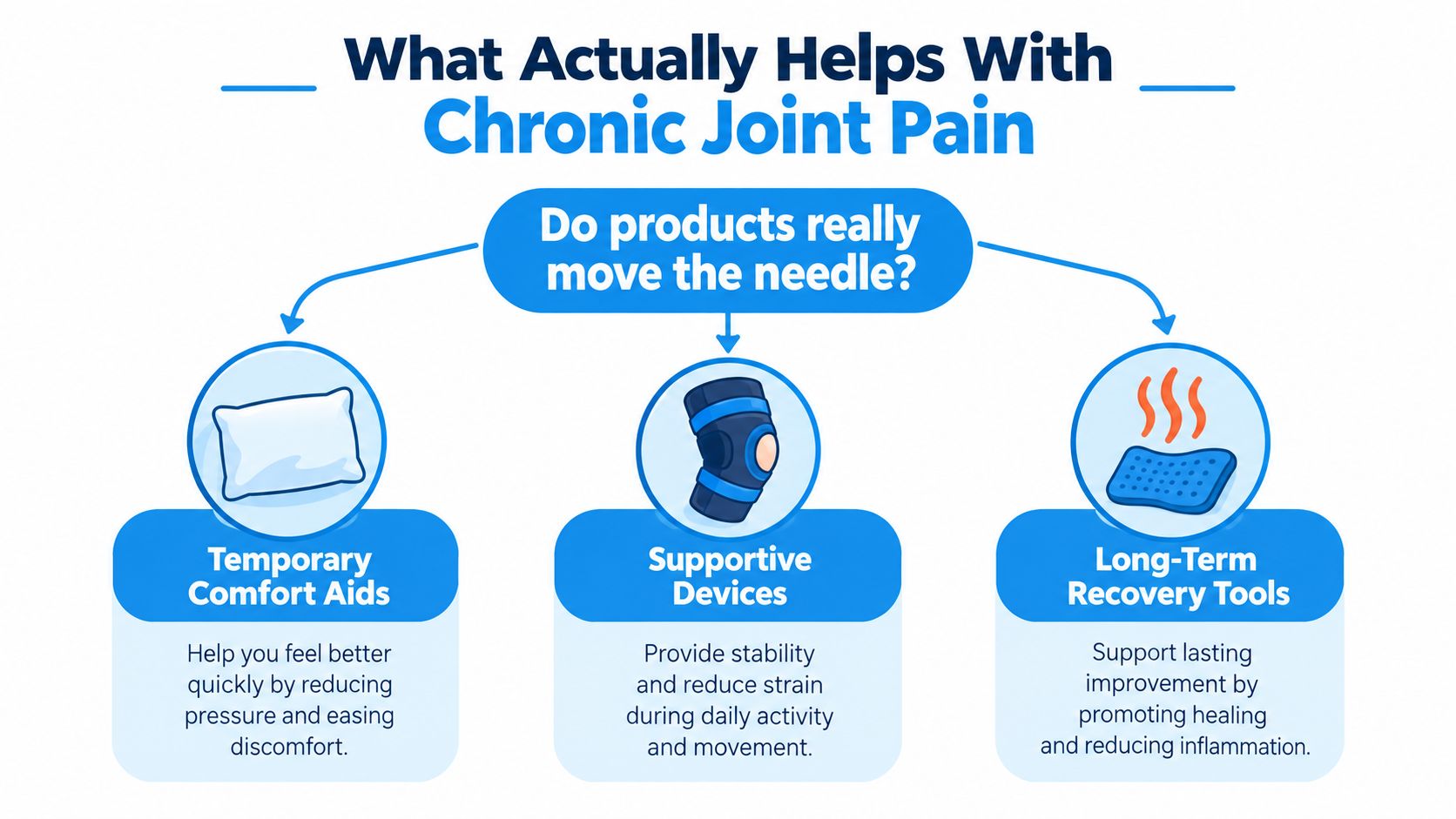
Start with one question: Are you chasing immediate comfort, stability during movement, or a manageable way to support symptoms every day? A topical product may suit a short flare-up. A brace may feel appropriate when instability affects a specific activity. A less restrictive garment may make more sense for stiffness that returns throughout the day.
Comfort is not the same as correction
Compression sleeves, infrared recovery wear, braces, topicals, and other supports address different parts of the experience. Some change how pressure or warmth feels around the joint. Some restrict motion or improve a sense of stability. Others are used for local, temporary symptom relief.
That doesn't make a comfort aid useless. If a product helps you move, rest, or complete a daily task, it may have practical value even when it doesn't alter the underlying joint condition. The mistake is treating that value as proof of disease modification.
Practical rule: Choose the limitation first, then choose the product category. Don't ask which product is universally best.
A useful starting point is to describe your problem in ordinary language: “My knee hurts after stairs,” “my ankle feels unstable on uneven ground,” or “my joints become stiff during long periods of sitting.” A guide to what causes chronic joint pain can help organize that symptom picture before you buy.
Why Non-Drug Support Options Matter Now
Osteoarthritis creates a large and persistent need for symptom management. The World Health Organization reported that about 528 million people worldwide were living with osteoarthritis in 2019, representing a 113% increase since 1990. A later review cited the 2021 Global Burden of Disease study at approximately 607 million affected globally in 2021, a 136% increase over 1990, according to the same market reference.
The commercial response has expanded beyond tablets. An independent estimate places osteoarthritis therapeutics at USD 5.49 billion in 2025, with a projection to USD 10.89 billion by 2033 and a projected 8.88% CAGR from 2026 to 2033. The estimate also places North America at 48.07% of the market in 2025, illustrating how established demand has become in a major consumer region. These are industry estimates, not proof that every product category works.
Joint pain injections show the same broadening of treatment choices. One market estimate values the global category at USD 5.99 billion in 2025 and projects USD 9.16 billion by 2031, with a projected 7.35% CAGR from 2026 to 2031. Single-injection hyaluronic acid represented 58.03% of injection-cycle market share in 2025, while knee and ankle applications represented 43.35%. The figures describe market activity, not clinical superiority.
Why people add non-drug options
Oral medicines and injections can have a role, but many people also want something they can apply or wear at home. Topicals, sleeves, braces, and other supports can fit around work, walking, rehabilitation, or rest without requiring a separate treatment appointment.
That convenience only matters if people tolerate the product. Heat buildup, slipping, pressure marks, odor, difficult washing, and skin irritation can turn a theoretically useful device into something left in a drawer. A person who spends time walking outdoors may also care about freedom of movement, just as someone managing mobility limits may want help with low-impact daily tasks. Even choosing an electric golf caddie reflects this same principle, reduce unnecessary physical demand so activity remains practical.
A realistic aim is usually symptom support, not a cure. Evidence differs sharply between categories, and individual response matters. A product that supports a routine you can sustain may be more useful than one with a stronger sensation that you abandon quickly.
Comparing Joint Pain Relief Product Categories
Feature lists can obscure the decision. The more useful comparison asks whether a product suits the joint, the activity, the skin, and the number of hours you expect to use it.
| Category | Evidence Strength | Best For | Limitations |
|---|---|---|---|
| Compression sleeves | Mixed and dependent on design and user response | Mild support, warmth, proprioceptive feedback, activity | Tightness, slipping, heat, and skin pressure can limit adherence |
| Non-compressive infrared recovery wear | Mixed, with modality-specific evidence | People seeking gentle warmth and discreet, longer wear | Doesn't provide the mechanical stability of a brace, and evidence isn't uniform |
| Braces | Inconclusive for medial compartment knee osteoarthritis | A feeling of stability during selected activities | Can be bulky, restrictive, or difficult to fit; clinical benefit remains uncertain |
| Topical agents | Useful for local, temporary comfort for some users | Short flare-ups and targeted application | Skin reactions, transfer to clothing, and limited effect on deeper joint problems |
| General supports and electrical devices | Variable, often limited-quality evidence | People testing adjuncts for a specific activity or response | Results depend heavily on settings, use conditions, and individual tolerance |
Compression sleeves
A compression sleeve can provide a snug, contained feeling during walking or exercise. That sensation may help some people feel more aware of the joint, but tighter isn't automatically better. Excess pressure can cause discomfort, marks, numbness, or reluctance to wear the garment.
For sensitive skin, inspect seams, fabric texture, moisture retention, and the ability to remove the sleeve quickly. A sleeve may be suitable for activity but unsuitable for desk work or all-day use if it becomes hot or restrictive.
Braces and mechanical supports
Braces are more structured than sleeves. They may feel useful when a person wants support during a particular movement, but they can interfere with clothing, bending, or gait if the design is too rigid.
The Cochrane review of knee braces and orthoses found that, compared with no brace, a knee brace may make little or no difference to pain, function, or quality of life after 12 months. The review rated the evidence as low quality and concluded that the overall benefit for medial compartment knee osteoarthritis was inconclusive. That doesn't mean no one feels helped. It means marketing shouldn't present bracing as a dependable answer for everyone.
Infrared-responsive wear and topicals
Infrared recovery wear prioritizes warmth and low restriction rather than mechanical correction. It may appeal to someone who can't tolerate tight compression and wants a discreet garment for light activity or rest. A practical explanation of different recovery wear types for joint and muscle support can help clarify how garment construction changes the use case.
Topicals work at the application site and are often chosen for convenience. Heat therapy also deserves a place in a broader routine, and this guide to heat therapy for arthritis sufferers offers relevant context. Neither category should be treated as a cure for joint degeneration.
How to Choose the Right Product for Your Situation
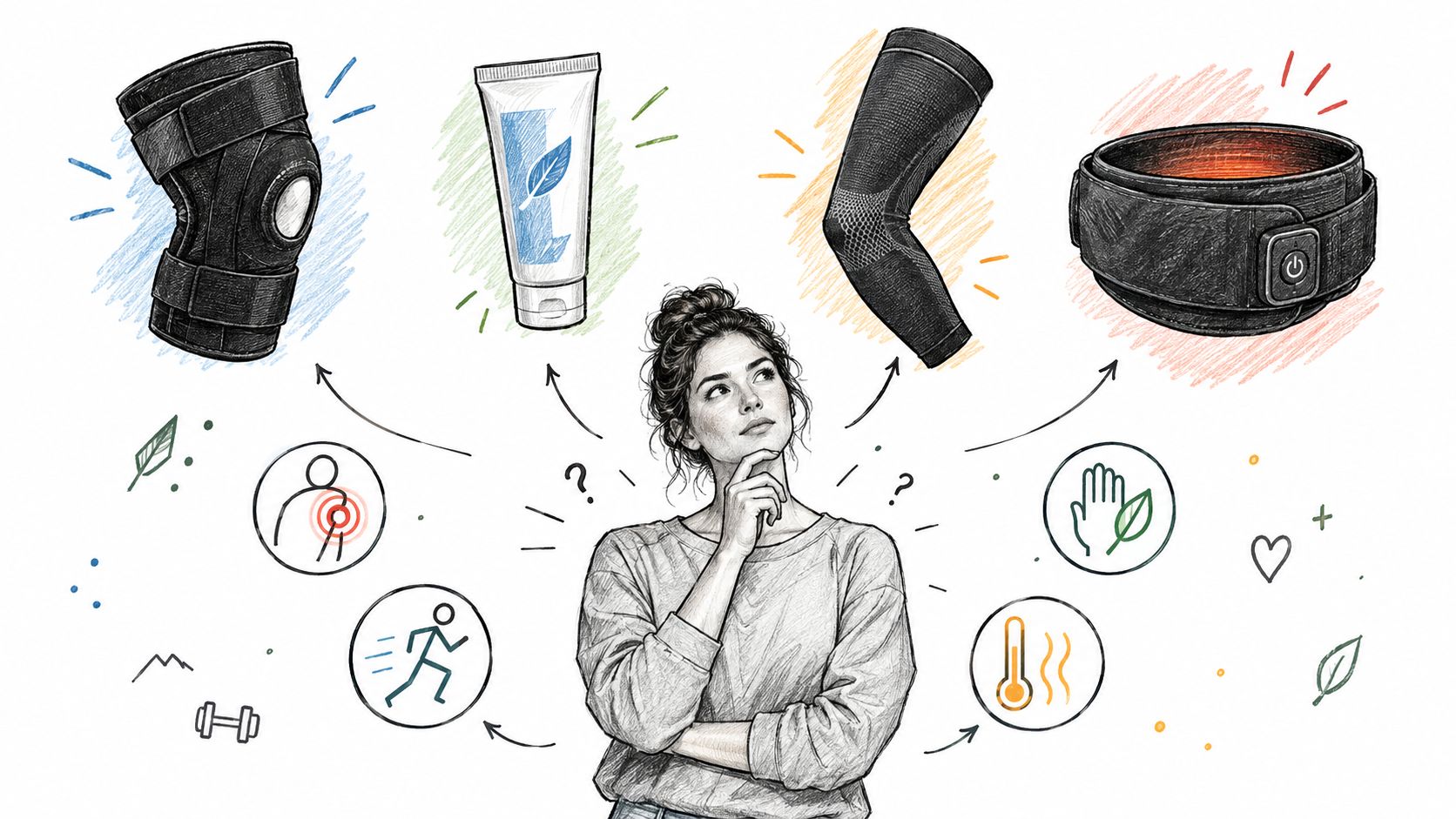
Begin with the activity that exposes the problem. If walking creates a sense of instability, a brace may deserve a controlled trial during that activity. If the main complaint is stiffness while sitting or moving through ordinary tasks, a less restrictive warmth-focused garment may be easier to sustain. If discomfort is localized and episodic, a topical may be the simpler first option.
Match the product to your tolerance
Your diagnosis doesn't determine the best garment by itself. Two people with knee osteoarthritis may have very different needs because one tolerates compression and the other develops itching or pressure marks quickly. Work clothing, climate, dressing ability, and whether you need to sit, climb, or drive also matter.
Use this decision map:
- For movement confidence: Consider a brace or sleeve, but test it during the activity that causes difficulty rather than wearing it indefinitely from the first day.
- For all-day flexibility: Favor a design that doesn't create excessive pressure, heat, or friction. Comfort is a prerequisite for consistent use.
- For a short flare: A topical may offer targeted, temporary comfort, provided the ingredients suit your skin and the label directions are followed.
- For electrical stimulation: Keep expectations measured. A comparative review found that 10 of 13 electrical-stimulation approaches had only limited-quality evidence for meaningful pain or function gains, while guidance noted insufficient evidence for braces, tape, splints, or supports for osteoarthritis, as reported in this review of non-pharmacological approaches.
Try one change at a time. If you introduce a sleeve, a topical, and a new exercise routine together, you won't know which factor affected your symptoms. A useful resource on compression knee support can help you evaluate fit and intended use before testing a garment.
A short symptom log is enough: note the activity, wear duration, comfort, skin response, and what changed afterward. Stop if you develop worsening pain, numbness, marked swelling, or a skin reaction, and seek clinical advice for persistent or worsening symptoms.
Sizing, Wear Schedule, and Care Tips
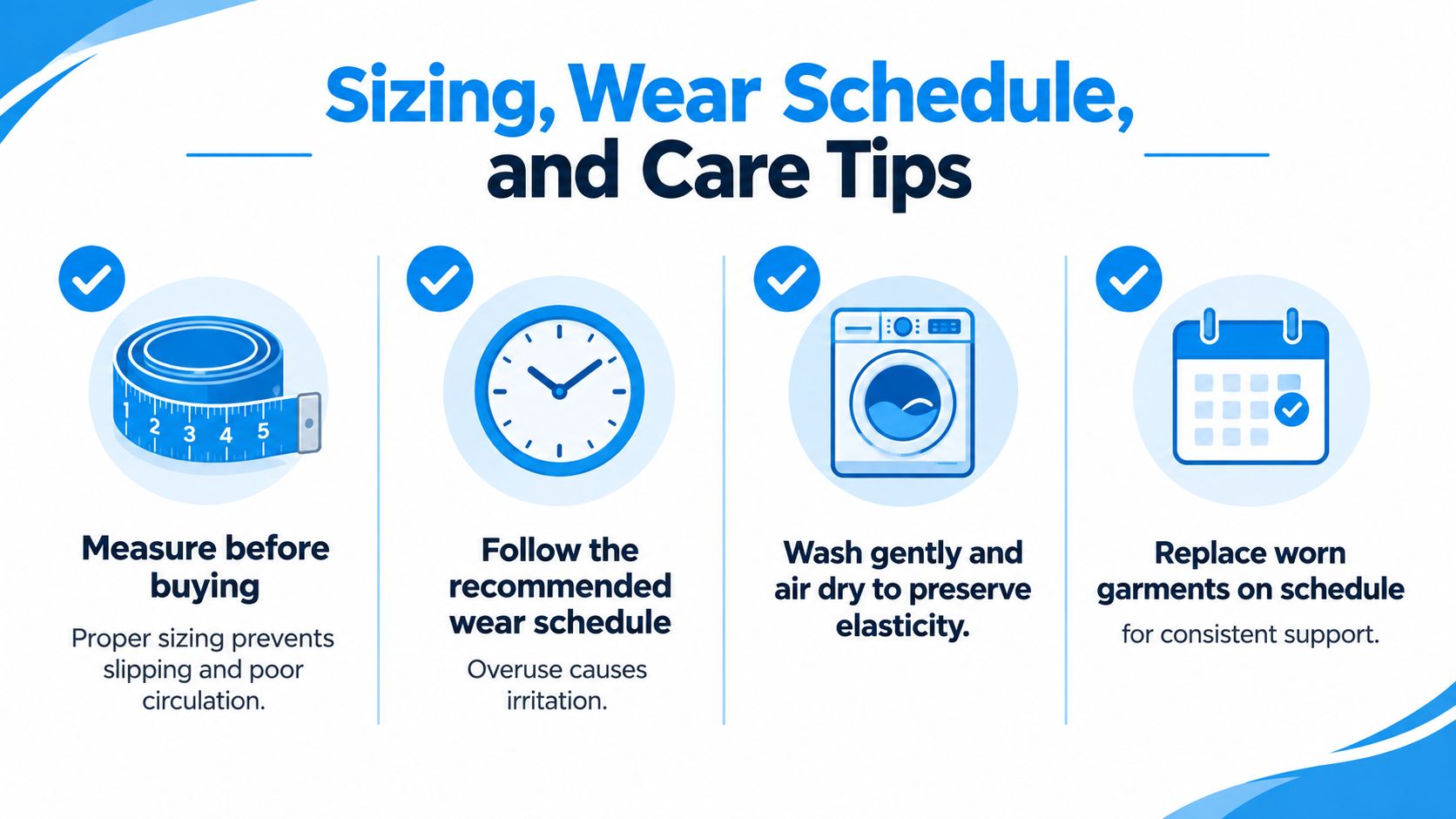
A poorly fitted product can create the exact problems it was meant to avoid. Measure according to the manufacturer's instructions rather than guessing from your usual clothing size, especially when the garment sits around a changing joint contour.
A practical first-use routine
Wear a new sleeve or support for a short period while you can check your skin and movement. Look for rolling edges, slipping, tingling, numbness, pressure marks that persist, or discomfort that changes your walking pattern.
Don't sleep in a compression or support garment unless the manufacturer specifically designs and labels it for overnight use. If the product creates heat or moisture, remove it and allow the skin to dry rather than adding another layer over it.
Care protects the fit
Follow the care label. Gentle washing and air drying generally place less stress on elastic fibers than high heat, aggressive detergents, or rough drying, but the manufacturer's instructions take priority.
- Measure first: Use the brand's measurement points, not an assumption based on shoe or clothing size.
- Increase gradually: Build wear time only when the skin and joint tolerate the product.
- Inspect regularly: Replace a garment when elasticity, seams, or closures no longer provide a consistent fit.
- Wash carefully: Avoid practices that damage fabric structure or leave irritating detergent residue.
A dedicated knee sleeve sizing chart can be useful when measurements fall between standard sizes. If circulation problems, significant swelling, fragile skin, or a recent procedure are involved, ask a clinician before using compression or restrictive support.
When Infrared Recovery Wear Makes Sense
Infrared-responsive recovery wear occupies a different position from a rigid brace. It isn't intended to hold a joint in a corrected position. The appeal is a garment that supplies local warmth and a low-pressure wearing experience for people who want support during ordinary activity, rest, or recovery.
The technology uses semiconductor-integrated fabric intended to respond to body heat and support local warmth and circulation. That description should be kept in perspective. A garment may feel soothing and help someone stay comfortable, but warmth alone doesn't establish that it will reverse joint degeneration or provide the stability needed for an unstable joint.
The strongest case is wearability
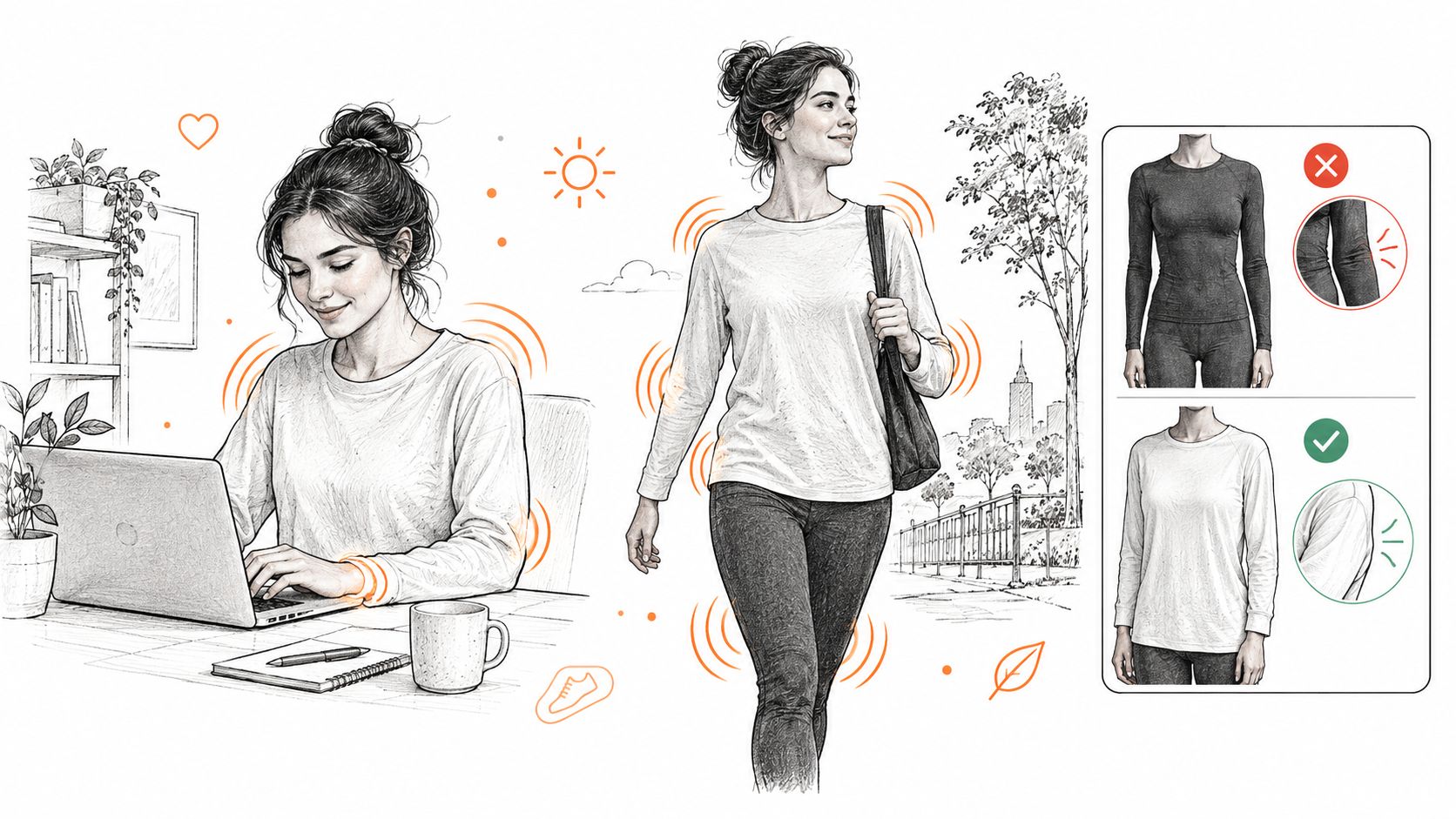
This category makes the most practical sense for someone who dislikes tight compression, wants a discreet layer, or experiences stiffness that returns during daily routines. A softer garment can be easier to tolerate under ordinary clothing than a bulky brace, particularly when the goal is comfort rather than mechanical stabilization.
The evidence for infrared modalities isn't uniform. A systematic review reported that one randomized trial of monochromatic infrared energy at 890 nm found no significant difference versus placebo for several knee osteoarthritis outcomes, while another far-infrared plaster study reported short-term improvements of 12.5% at one week and 25% at four weeks. Across the osteoarthritis studies, the review included 276 patients and emphasized mixed efficacy by modality in this review of infrared radiation for musculoskeletal disorders.
That combination of mixed evidence and strong comfort appeal calls for gradual expectations. Consider infrared therapy for arthritis as an adjunctive approach, not a replacement for diagnosis, rehabilitation, or medical treatment. The right test is whether you can wear the garment comfortably, maintain normal movement, and notice a consistent functional benefit without skin problems.
Common Myths About Joint Pain Relief Products
Myth one, tighter always works better. Excessive pressure can create marks, heat, irritation, or numbness. A garment that stays in the drawer can't support your routine, regardless of how firm it feels on the first try.
Myth two, every brace performs the same job. Braces differ in rigidity, fit, motion restriction, and intended activity. The evidence for medial compartment knee osteoarthritis remains inconclusive, so a brace should be judged by a specific functional goal rather than by its appearance.
Myth three, a topical cream repairs the joint. Topicals may provide local, temporary comfort, but they don't automatically change underlying osteoarthritis. Use them as one part of symptom management and follow ingredient, frequency, and skin-safety instructions.
Myth four, infrared recovery wear is only for athletes. People with chronic stiffness may value warmth and low-pressure wear just as much as someone recovering after exercise. The relevant question is whether the product fits the person's needs and whether the evidence supports the claim being made.
Myth five, a strong sensation proves effectiveness. Cooling, heating, tightness, or tingling tells you what the skin is experiencing. It doesn't by itself demonstrate improved joint function or long-term relief.
Final Guidance for Choosing Smartly
The right joint pain relief product is the one that matches your main limitation and real routine. Pain during a particular activity points toward testing support during that activity. Local flare-ups may suit a topical. Persistent stiffness and intolerance to tight garments may make a low-pressure recovery garment more practical. None of those choices should be made from a product photograph alone.
Use this final filter before buying:
- Name the problem clearly. Is it pain, stiffness, instability, fatigue, or difficulty completing a task?
- Decide how long you'll wear it. A product for a short walk has different requirements from one intended for several hours.
- Check skin and pressure tolerance. Sensitive skin, moisture, seams, and heat can determine adherence.
- Match evidence to the promise. A comfort claim isn't the same as a claim about disease improvement.
- Test one product at a time. Track activity, wear duration, symptoms, and skin response.
- Review the result. Keep it if it improves a meaningful task without creating new problems. Stop if it worsens symptoms or causes a reaction.
Compression sleeves can offer a contained feeling during movement, while braces target stability but have important fit and evidence limitations. Topicals suit targeted, temporary use. Infrared-responsive garments appeal to people seeking warmth and less restrictive daily wear, but they shouldn't be described as a substitute for clinical care. Electrical stimulation and other supports require especially careful expectation-setting because evidence quality varies.
Persistent or worsening joint pain deserves professional assessment, particularly when swelling, instability, weakness, numbness, fever, or a recent injury is involved. A clinician can help distinguish osteoarthritis from other causes and advise whether a brace, compression, topical, exercise plan, or different treatment is appropriate.
Make your next purchase a controlled trial rather than an impulse buy. Choose the category that addresses your main limitation, verify the fit, begin conservatively, and keep only what improves daily function without compromising comfort or skin health.
Thermo Recovery Wear offers compression-lite, infrared-responsive sleeves and braces for areas including the knee, ankle, wrist, elbow, shoulder, and back, with materials and sizing guidance intended for regular use. If a lower-pressure, non-pharmacologic option fits your needs, visit Thermo Recovery Wear to review the available recovery garments.


