


The World Health Organization osteoarthritis fact sheet reports that approximately 365 million people worldwide have knee osteoarthritis. That scale explains why supplement marketing is so crowded, and why ranking matters more than collecting remedies. A natural treatment for knee arthritis isn't automatically a proven one. It's a non-drug approach that still has to show, in trials, that it changes pain or function by a measurable amount.
Viewed that way, the ranking is lopsided. Therapeutic exercise and weight management carry the strongest support. Braces, heat, acupuncture, and mind-body practices sit in a middle tier as adjuncts. Most popular supplements sit below them, not because they're disproven, but because the evidence isn't strong enough to recommend them. That distinction shapes every decision that follows.
Table of Contents
- Natural Knee Arthritis Treatments Ranked by Evidence
- How to Start an Exercise Routine for Knee Arthritis
- Weight Loss and Load Reduction on the Knee
- Braces, Insoles and Heat Therapy Compared
- What the Evidence Shows
- Combining Treatments and Your Next Steps
Natural Knee Arthritis Treatments Ranked by Evidence
Start here: exercise is the foundation, and weight loss joins it if you have overweight. Everything else in this article is an adjunct to those two, not a substitute for them. Passive care alone, whether that's a device, a cream, or a capsule, doesn't rebuild the muscle capacity that helps you walk, climb stairs, and rise from a chair.
The exercise evidence is large but not unlimited. A Cochrane systematic review published in 2024 included 139 randomized trials involving more than 12,000 participants and found exercise probably improves pain and physical function, with certainty ranging from low to moderate. Physical function improved by an average of 11.27 points on a 0-to-100 scale across 24 studies involving 2,536 participants. Read those points plainly. An 11-point gain is meaningful for daily tasks, but it isn't pain removal, and you shouldn't expect any single option to erase symptoms.
Natural Knee Arthritis Options Ranked by Evidence Strength
| Treatment | Evidence strength | Measured effect | Time to notice |
|---|---|---|---|
| Therapeutic exercise | Probable benefit, certainty low to moderate | Pain 8.70 points better than attention or placebo controls on a 0-to-100 scale | Several weeks of consistent training |
| Weight loss, about 10% of body weight | Strong guideline support | Pain and function improve as loss increases, with no single point estimate | Months of sustained loss |
| Supervised physiotherapy | Strong guideline support | Supervised exercise may outperform unsupervised exercise, exact advantage unquantified | Several weeks, with load adjusted per session |
| Knee braces and insoles | Mixed by knee pattern | Comfort or load shift for selected knees, no universal pain effect | Immediate for comfort, weeks to judge pain |
| Heat or infrared therapy | Limited, short-term | Stiffness relief, no established lasting pain effect | Same day, for stiffness |
| Turmeric, glucosamine, omega-3 and other supplements | Insufficient evidence for or against | No reliable effect established | Months, if tried |
Durability is the weak point in this table. Most trials follow people for weeks or months, so long-term benefit is less certain than short-term benefit, and you should judge any option by whether it still helps after the first enthusiastic fortnight. If you're researching a product such as glucosamine chondroitin MSM capsules, place it in the bottom row until evidence moves it, whatever the label claims. A fuller discussion of supplements commonly used for joint pain can help you sort product claims from trial findings.
Reading rule: A few points on a 0-to-100 scale can be worth having. It is not a cure, and stacking modest gains is the realistic strategy.
Pick the exercise row today. Use the rest of the table as a map for what to add, in what order, and with what expectations.
How to Start an Exercise Routine for Knee Arthritis
Exercise works through muscle, not cartilage repair. Your quadriceps and hip muscles share load that would otherwise pass through the joint, guide how the knee tracks during walking, and determine whether you can rise from a low chair without pushing off with your arms. When those muscles weaken, function drops even if pain stays the same. When they strengthen, function often improves first, and pain follows more slowly and less predictably.
That order matters for motivation. Judge the first month by what you can do, such as walking distance, stair confidence, and sit-to-stand repetitions, not only by pain scores. Discomfort commonly rises at first as underused muscle adapts. That's a reason to adjust load, not automatically a reason to stop.
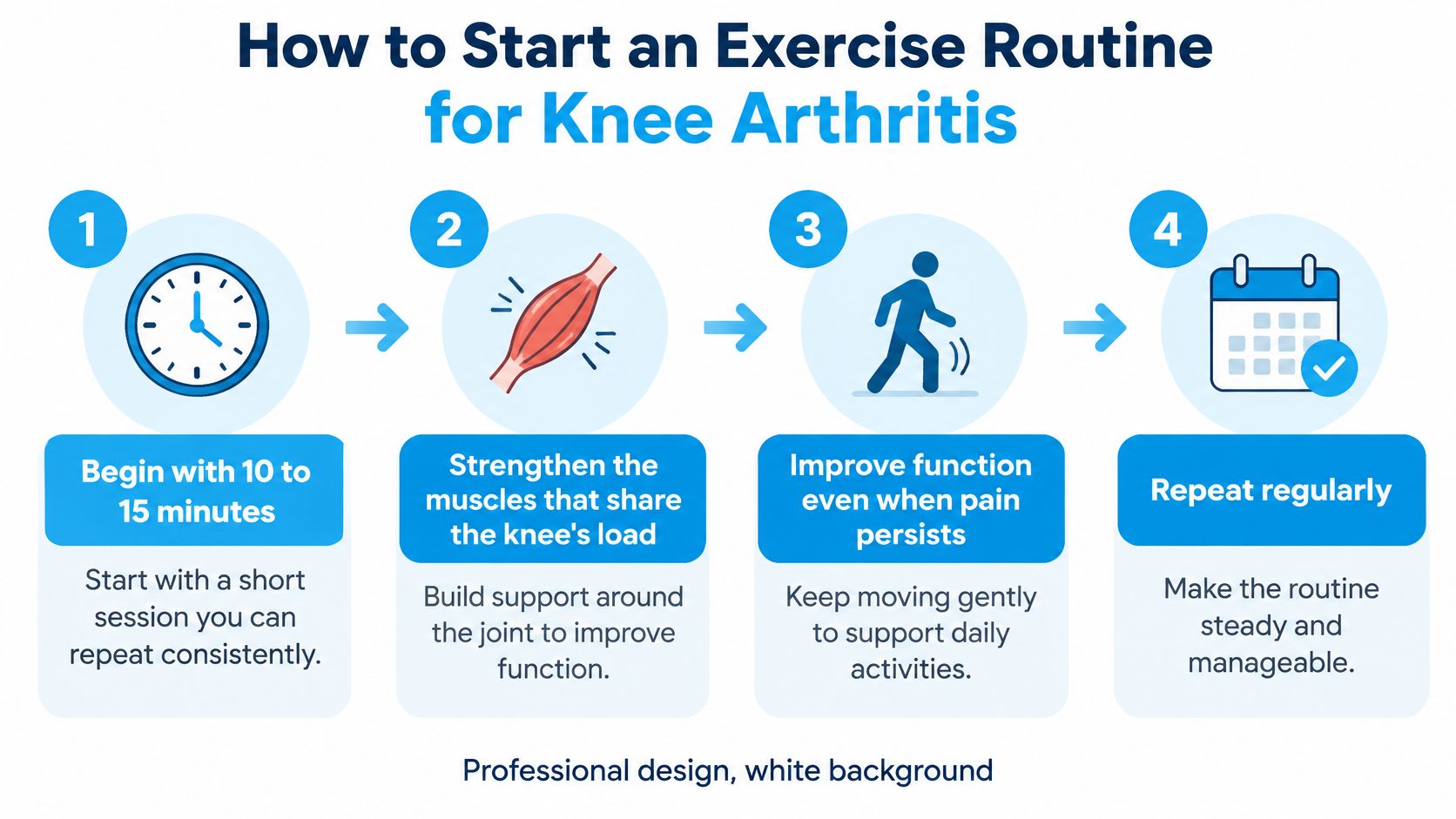
The visual below condenses the starting sequence before the detailed steps.
A Six Step Starting Routine
- Begin with 10 to 15 minutes of low-impact aerobic work. Use stationary cycling or walking on level ground, three to five days a week, at a pace where you can still speak in short sentences. Short, repeatable sessions beat one long walk that leaves you sore for three days.
- Add quadriceps and hip strengthening. Do straight-leg raises, sit-to-stands from a sturdy chair, and bridges for two to three sets of 8 to 12 repetitions through a tolerable range of motion. The common slip is rushing sit-to-stands and letting your knees collapse inward, so move slowly and keep your knees tracking over your feet.
- Add balance work. Stand on one leg while holding a counter, building toward steady, controlled holds on each side. Balance training supports neuromuscular control, which is the steadiness that keeps a stumble from becoming a fall.
- Add gentle flexibility work. Stretch the front and back of the thigh with controlled holds, no bouncing, and stop short of sharp pain. Tight thigh muscles pull on the knee and can make movement feel restricted even when the joint itself is calm.
- Progress the load every one to two weeks. Add repetitions, resistance, or minutes only when pain from the previous level settles within about 24 hours. If it doesn't settle, repeat the same level rather than quitting the program.
- Adjust rather than stop when pain rises mildly. Shorten the range, slow the tempo, or switch to cycling for a few days. Seek clinical review instead for persistent swelling, locking, or rapidly worsening symptoms.
When Land Based Exercise Is Too Painful
Aquatic exercise is the practical alternative when you can't yet load the knee comfortably on land. Water supports body weight while you walk, cycle your legs, or practice sit-to-stand patterns, so you can build aerobic capacity and strength with less joint compression. It's a bridge, not a lesser option, and many people progress from pool sessions back to land-based work as strength returns.
Supervision improves the odds that you'll progress safely. A physiotherapist corrects technique, titrates load to your response, and keeps you accountable during the weeks when benefit is still small. Pair this routine with guided knee mobility exercises you can practice at home if stiffness limits your range before strengthening feels possible.
Mild soreness that settles within a day usually signals adaptation. Swelling, locking, or pain that keeps escalating signals a need for review.
Write your plan down now. Schedule three aerobic sessions and two strength sessions this week, and write the 24-hour progression rule beside them so the decision about increasing load is made by the rule, not by how ambitious you feel on a good day.
Weight Loss and Load Reduction on the Knee
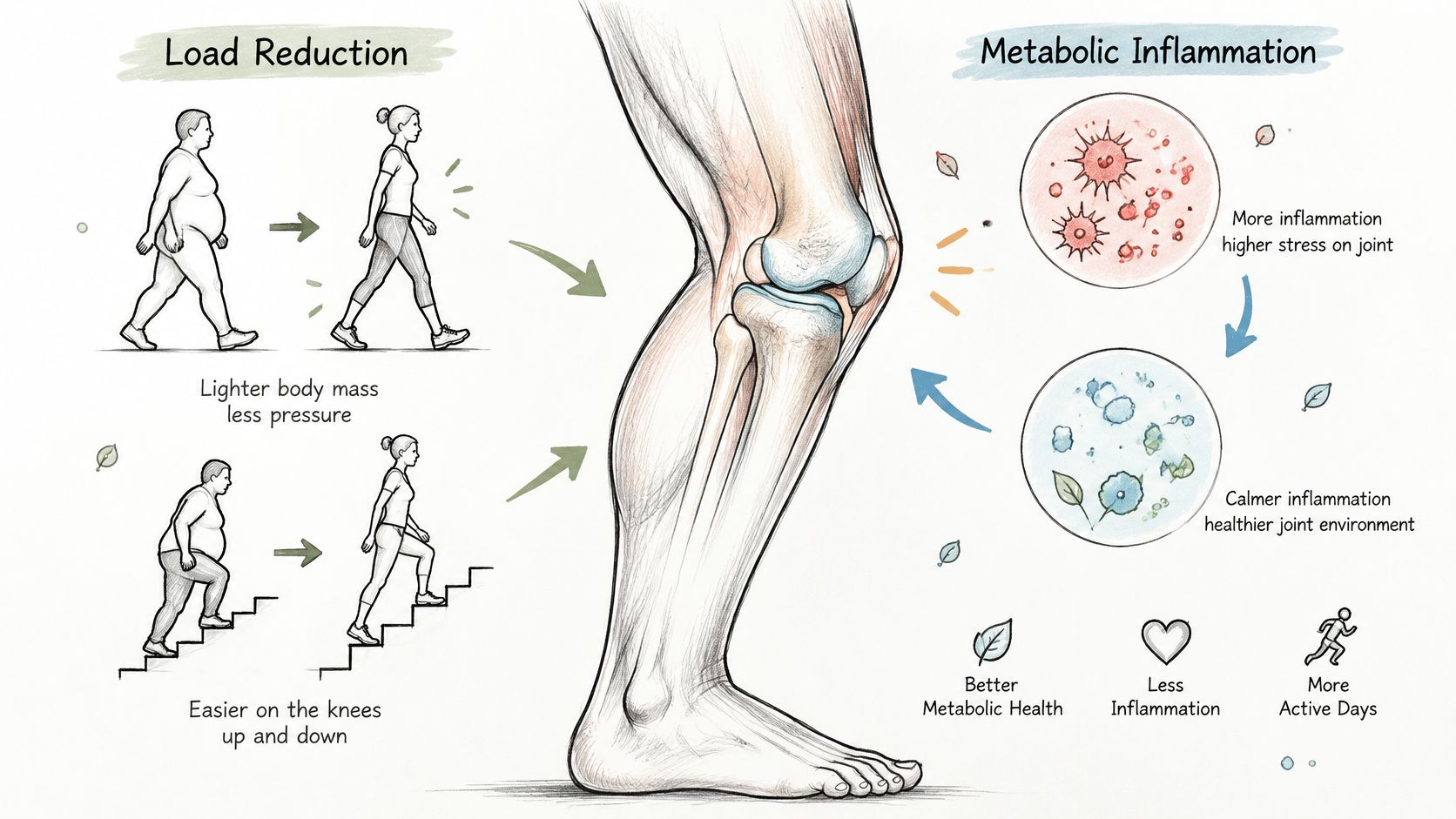
Weight loss helps through two pathways at once. Lower body mass reduces the repetitive compressive and shear loading across your knee during every step and stair, so the joint absorbs less force thousands of times a day. Weight reduction can also ease metabolic inflammation, which may lower pain sensitivity and systemic inflammatory signaling. Neither pathway regenerates cartilage, and you shouldn't let anyone sell it that way. What changes is load-related pain and mobility.
The image below shows those two pathways side by side.
What Target Should You Aim For
The NICE osteoarthritis guideline for people over 16 advises that any weight loss is likely to help, while approximately 10% of body weight is likely to provide greater benefit than 5%. Its evidence review found increasing weight loss was generally associated with progressively better pain, physical function, and quality of life. That graded pattern is useful because it removes the all-or-nothing trap. A 5% loss that you keep beats a 12% loss you regain by spring.
Weight Loss Targets for Common Body Weights
| Starting body weight | 5% loss | 10% loss |
|---|---|---|
| 150 lb | 7.5 lb | 15 lb |
| 200 lb | 10 lb | 20 lb |
| 250 lb | 12.5 lb | 25 lb |
| 300 lb | 15 lb | 30 lb |
Calculate your own figures by multiplying your weight by 0.05 and 0.10. For a deeper explanation of the mechanics, this overview of how weight loss affects joint pain connects body weight changes to joint symptoms in practical terms.
Weight loss works best paired with exercise, and the reason is muscle preservation. Dieting alone costs you lean mass along with fat, which weakens the quadriceps you're counting on to protect the knee. Resistance and aerobic training preserve that muscle, so the functional gains from weighing less last. Footwear and support choices matter during this process too, and this comparison of arch support and compression for everyday comfort explains how foot support influences load further up the leg.
Aim for a sustainable, clinically supervised pace rather than crash dieting. Combine nutrition advice, walking or cycling, and progressive strengthening in one plan instead of running three disconnected efforts. Then track it regularly. Weigh yourself monthly, rate knee pain from 0 to 10 weekly, and review the trend with a clinician or dietitian so you're judging months of direction, not daily noise.
Braces, Insoles and Heat Therapy Compared
Choose an aid by asking what it physically does, not what its packaging promises. A sleeve warms, a brace redirects load, an insole changes foot angle, and a cane removes load outright. Those are different tools for different knees, and buying the wrong category is the most common waste of money in this area.
Manufacturer claims about devices aren't independent proof. Read them as claims, then look for whether the mechanism matches your knee pattern and whether the evidence, thin as it often is, points the same way. Our own knee sleeve only needs to touch the skin to work as designed, which is a product claim you should test against your measured response, like any other.
Braces, Insoles, Aids and Heat Therapy Compared
| Option | What it does | Evidence note | Best fit |
|---|---|---|---|
| Knee sleeve | Warmth and a sense of support | Limited, mostly comfort | Mild, general knee discomfort |
| Unloader brace | Shifts load off the more affected side | Mixed by knee pattern | Pain on one side of the knee, with clinician fitting |
| Lateral wedge insole | Tilts the foot to reduce inner-knee load | Mixed | Inner-knee pain with alignment changes |
| Cane in the hand opposite the sore knee | Reduces load on the joint while walking | Practical benefit for walking | Pain when walking or standing |
| Heat pack | Eases stiffness for a few hours | Short-term relief | Morning stiffness, not hot or swollen joints |
| Infrared or thermal garment | Warmth-based comfort | Limited, mostly small studies | Comfort for people who avoid tight gear |
Matching the Aid to the Knee
An unloader brace only makes sense if your pain concentrates on one side of the joint, and it needs clinician fitting to shift load in the right direction. Fit it wrong and you've bought an expensive sleeve. A lateral wedge insole targets inner-knee pain specifically, so it does little for pain behind the kneecap. A cane looks unglamorous and works mechanically on every step, provided you hold it in the hand opposite the sore knee. If walking distance shrinks despite these aids and travel becomes the barrier, practical mobility planning matters too, as this Dash 3 electric scooter flight guide illustrates for people who use powered mobility on trips.
Heat suits stiffness, not inflammation. A warm pack before morning activity can loosen a stiff knee for a few hours, but applying heat to a hot, swollen joint works against you. This guide to choosing between hot and cold therapy walks through that decision in detail.
Before buying anything, run this checklist:
- Measure first: Wrap a tape around your leg about two inches above the knee and match it to the size chart, which is how we size our sleeves.
- Test comfort over a full day: A device you remove by noon delivers nothing.
- Confirm the return policy: You can't judge fit from a product photo.
- Ask which side is affected: A clinician's answer determines whether unloading or wedging even applies.
Pick one aid, trial it for four weeks, and define the measure in advance, such as walking distance or morning stiffness minutes. Keep it only if that measure moves.
What the Evidence Shows
Supplements are where natural treatment for knee arthritis most often gets oversold. The 2026 VA/DoD osteoarthritis guideline provider summary found insufficient evidence to recommend for or against curcumin, glucosamine, chondroitin, collagen, omega-3 fatty acids, Boswellia, ginger, MSM, and vitamin D. Insufficient doesn't mean disproven. It means the trials, with their inconsistent formulations, doses, and designs, don't support a confident recommendation either way.
That finding applies to every row below, so the table covers only what differs between products, the practical risks and quality issues you'd manage.
Supplements and Topicals Practical Notes
| Option | Practical note |
|---|---|
| Curcumin (turmeric) | Can interact with blood thinners, product quality varies |
| Glucosamine | Some forms come from shellfish, check labels |
| Chondroitin | Product strength and purity vary |
| Collagen | No evidence of cartilage repair |
| Omega-3 fatty acids | Can interact with blood thinners |
| Boswellia | Limited, short-term studies |
| Ginger | Limited, short-term studies |
| MSM | Limited long-term safety data |
| Vitamin D | Check levels before supplementing |
Symptom Relief Is Not Disease Change
Keep two claims separate. A product might, in principle, ease symptoms for some people, but current evidence doesn't establish that popular supplements modify disease progression or regenerate cartilage. "Anti-inflammatory" on a label describes a marketing angle, not a proven knee outcome. Inflammation is one contributor to osteoarthritis pain among several, including load, muscle weakness, and pain sensitivity, so an anti-inflammatory claim doesn't tell you whether your knee will hurt less on stairs.
Topical products sit slightly differently. Capsaicin or menthol creams act locally where you apply them, with more modest evidence than exercise, and they're reasonable to trial because systemic exposure is low. Topical NSAIDs are pharmacologic, not natural, whatever shelf they're sold from. That's not an argument against them, just accurate labeling of what you're choosing.
Three questions before any product: What does the best evidence say? How long will you try it before judging? Which side effects or drug interactions apply to you?
Then run a clean trial. Record a baseline pain score, try one product for a set period, and stop if the score doesn't improve. Look for third-party testing seals, since they address the purity and strength problems that make this category so inconsistent.
Combining Treatments and Your Next Steps
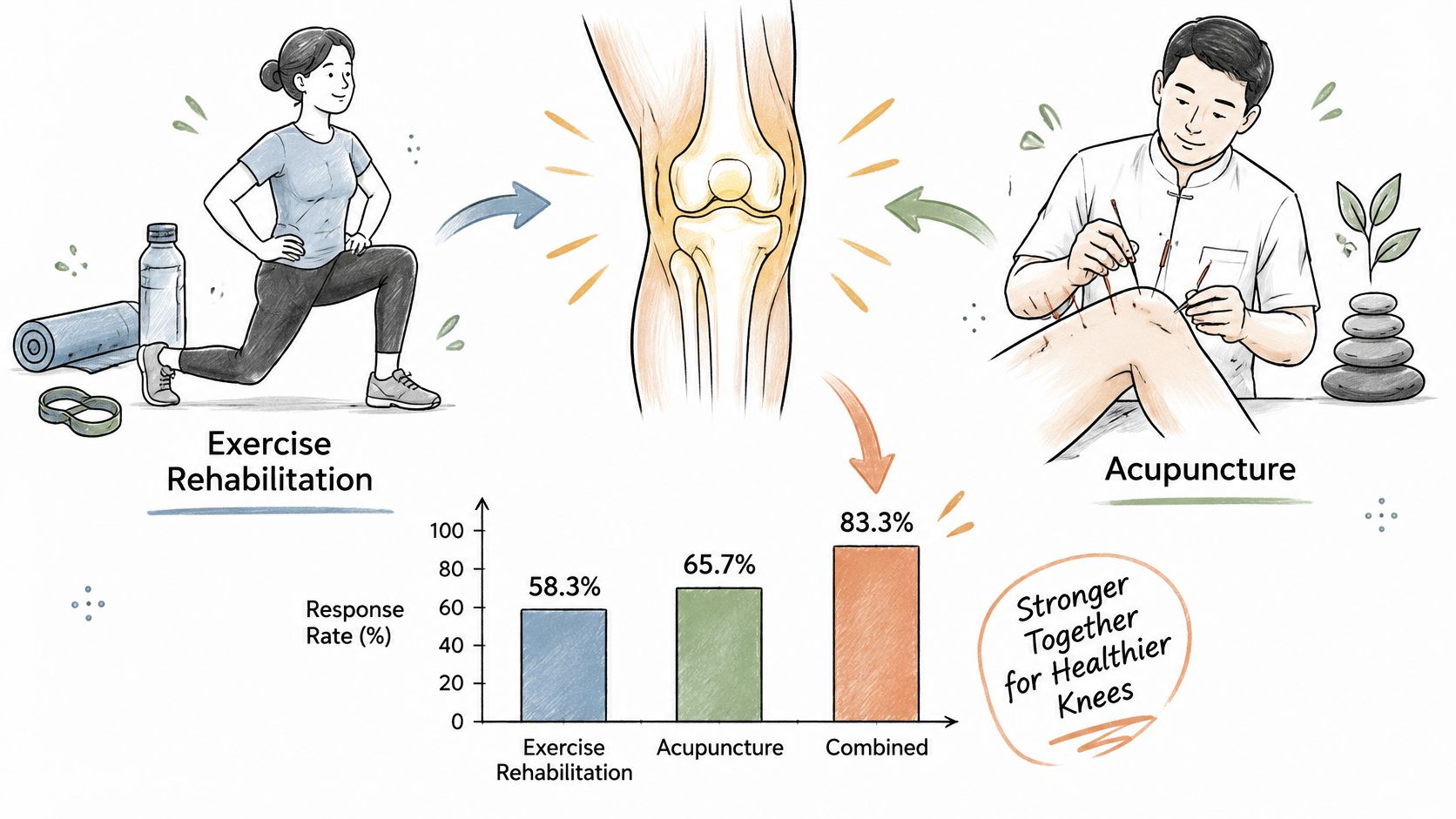
Stacking treatments is where modest effects become useful, but the evidence for specific combinations is thinner than the logic behind them. One 2024 randomized clinical study of combined acupuncture and exercise reported week-four response rates of 58.3% for exercise rehabilitation, 65.7% for acupuncture, and 83.3% for the combination. That's a striking gap from a single trial. It suggests stacking works, it doesn't prove it, and one study's response definition may not match what you'd count as a response.
The diagram below places those three response rates side by side.
Acupuncture, tai chi, and yoga may help some people, and tai chi and yoga add balance and gentle strengthening that overlap with exercise goals. Their effects tend to be small, protocols vary widely between studies, and long-term evidence is limited. Treat them as adjuncts that can support adherence and confidence, not replacements for progressive rehabilitation.
Access is a legitimate reason a good plan fails. If transport is limited or in-person care is hard to reach, digital rehabilitation offers guided programs at home, and virtual-reality exercise is an emerging route. A 2024 systematic review and meta-analysis of virtual-reality exercise in Frontiers in Physiology found virtual-reality exercise significantly improved knee osteoarthritis pain compared with traditional rehabilitation, with a standardized mean difference of −1.53, though the included studies varied. If standard exercise hurts, graded activity and aquatic programs lower the entry load. If earlier treatment failed, that's a reason for clinician review of diagnosis and load, not for abandoning movement altogether.
The short video below demonstrates exercises in the style you'd build into a combined plan.
Your Plan Rules and Red Flags
- Record your baseline. Note pain from 0 to 10 and your comfortable walking distance today.
- Run the foundations together. Keep the exercise routine alongside any weight plan, since each protects the other's gains.
- Add one adjunct at a time. Give it a stop date, and drop it if your measures don't change, whether it's acupuncture, a sleeve, or a supplement.
- Review at eight to twelve weeks. Compare against baseline and decide what earns its place.
Apply rule three to device claims too. Our products have received medical endorsement for significantly enhancing comfort and functionality in grade 1 and 2 osteoarthritis, and our semiconductor-embedded fabric is reported to relieve chronic osteoarthritic joint pain by up to 62%. Those are company-reported figures, not independent trial results, so trial any device against your own baseline measures.
Some symptoms end the self-management experiment. Seek prompt care for persistent swelling, locking or catching, the knee giving way, redness or warmth with fever, or night pain that wakes you. Make one booking this week, a physiotherapist or GP visit for a supervised exercise plan and, if you want a device, a properly fitted one.
If warmth-based comfort fits your plan as an adjunct to exercise, visit Thermo Recovery Wear to see our compression-lite, infrared-responsive knee sleeves designed for rest and light daily activity. They're built for people who can't tolerate tight compression and want discreet, non-drug support they can wear through the day. Measure two inches above your knee, check the size chart, and judge the sleeve the same way as everything else here, against your baseline over four weeks.


