


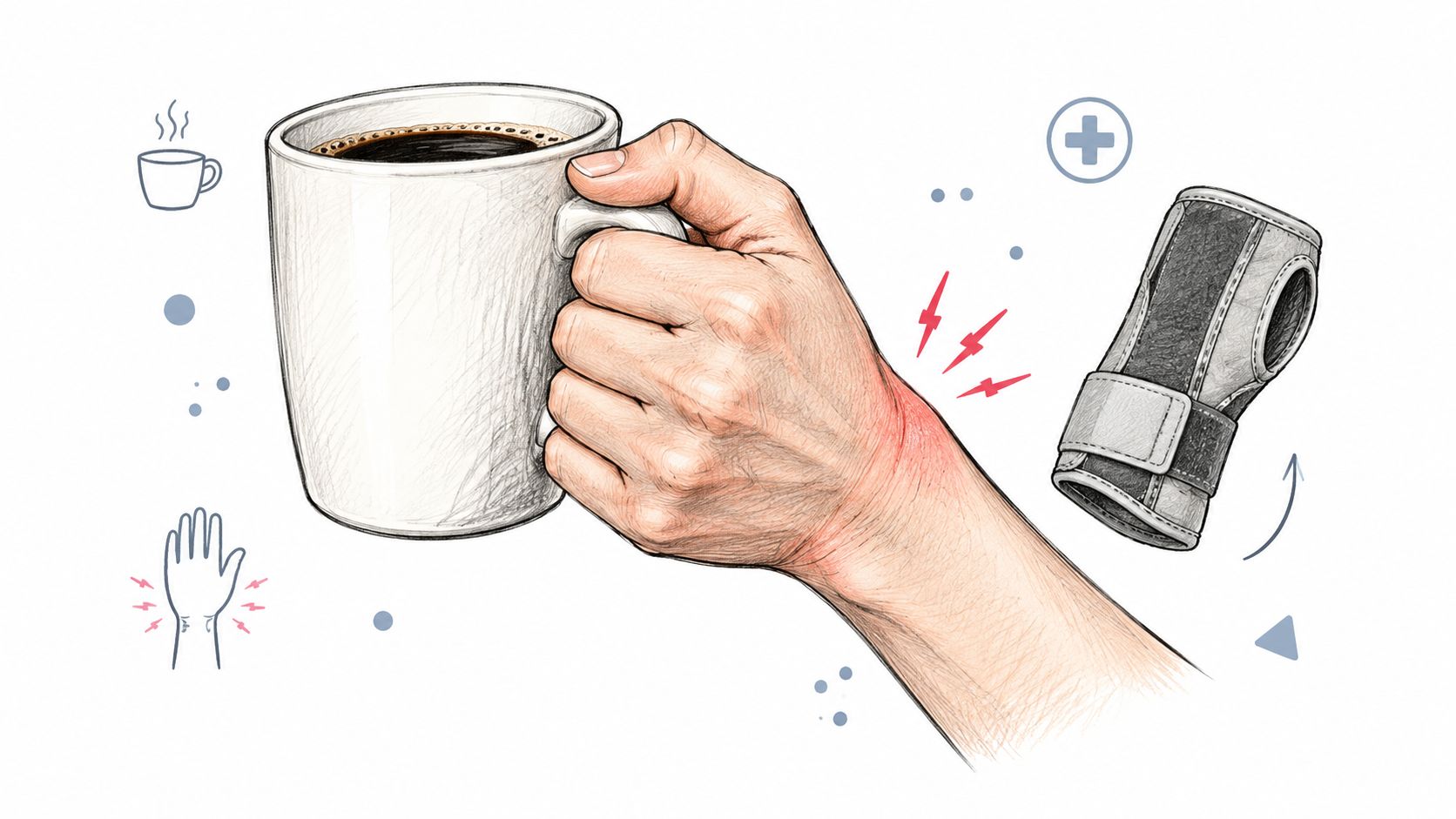
That sharp ache on the pinky side of your wrist often shows up at the worst moment. You reach for a coffee mug, twist a jar lid, push up from a chair, or carry a grocery bag, and the outside of the wrist answers with pain, weakness, or a small click that makes you pull back.
Many people in that spot start searching for an ulnar wrist pain brace and get flooded with mixed advice. Some pages suggest a stiff splint for everything. Others push soft wraps that feel good for an hour but don't change the motion or pressure causing the pain. The missing piece is usually simple: the right brace depends on why the ulnar side hurts.
Table of Contents
- Introduction to Ulnar Wrist Pain and Why Bracing Matters
- Understanding Ulnar Sided Wrist Anatomy and Common Causes
- When an Ulnar Wrist Pain Brace Helps and When It Does Not
- Types of Braces and Splints for Ulnar Wrist Pain Compared
- How to Choose Size and Fit Your Ulnar Wrist Pain Brace
- Daily Wear Care and Usage Scenarios for Lasting Relief
- Finding the Right Support and Next Steps for Recovery
Introduction to Ulnar Wrist Pain and Why Bracing Matters
The ulnar side is the side of the wrist near the pinky finger. It's a small area with a lot happening in it. Rotation, grip, weight-bearing, and joint stability all meet there, so different problems can create pain in nearly the same spot.
That's why bracing can help, but also why it sometimes disappoints. A brace can reduce painful motion, unload irritated tissue, and make daily tasks more tolerable. It can't repair every injury by itself, and it shouldn't be treated like a cure-all.
A good starting rule is least restrictive support first. If a lower-profile brace controls your symptoms during typing, light lifting, or errands, that's often more useful than a bulky device you take off after twenty minutes. People looking for broader support garments sometimes compare options like these types of recovery wear for joint and muscle support, but wrist pain usually needs a more targeted decision.
What people usually want from a brace
Most readers aren't trying to become brace experts. They want to know a few practical things:
- Will it reduce pain during real tasks like gripping, carrying, turning keys, or pushing off the floor?
- Will it let me keep moving enough to work, cook, drive, or exercise lightly?
- Could it make me stiff if I wear it too much?
- Which style fits my problem instead of just immobilizing the whole wrist?
Practical rule: If a brace eases symptoms but causes new numbness, more joint stiffness, or pain in a different area, the fit or brace type is probably wrong.
The goal is support with a purpose. You want enough control to calm the irritated structure, but not so much restriction that the wrist gets lazy, swollen, or hard to move.
Understanding Ulnar Sided Wrist Anatomy and Common Causes
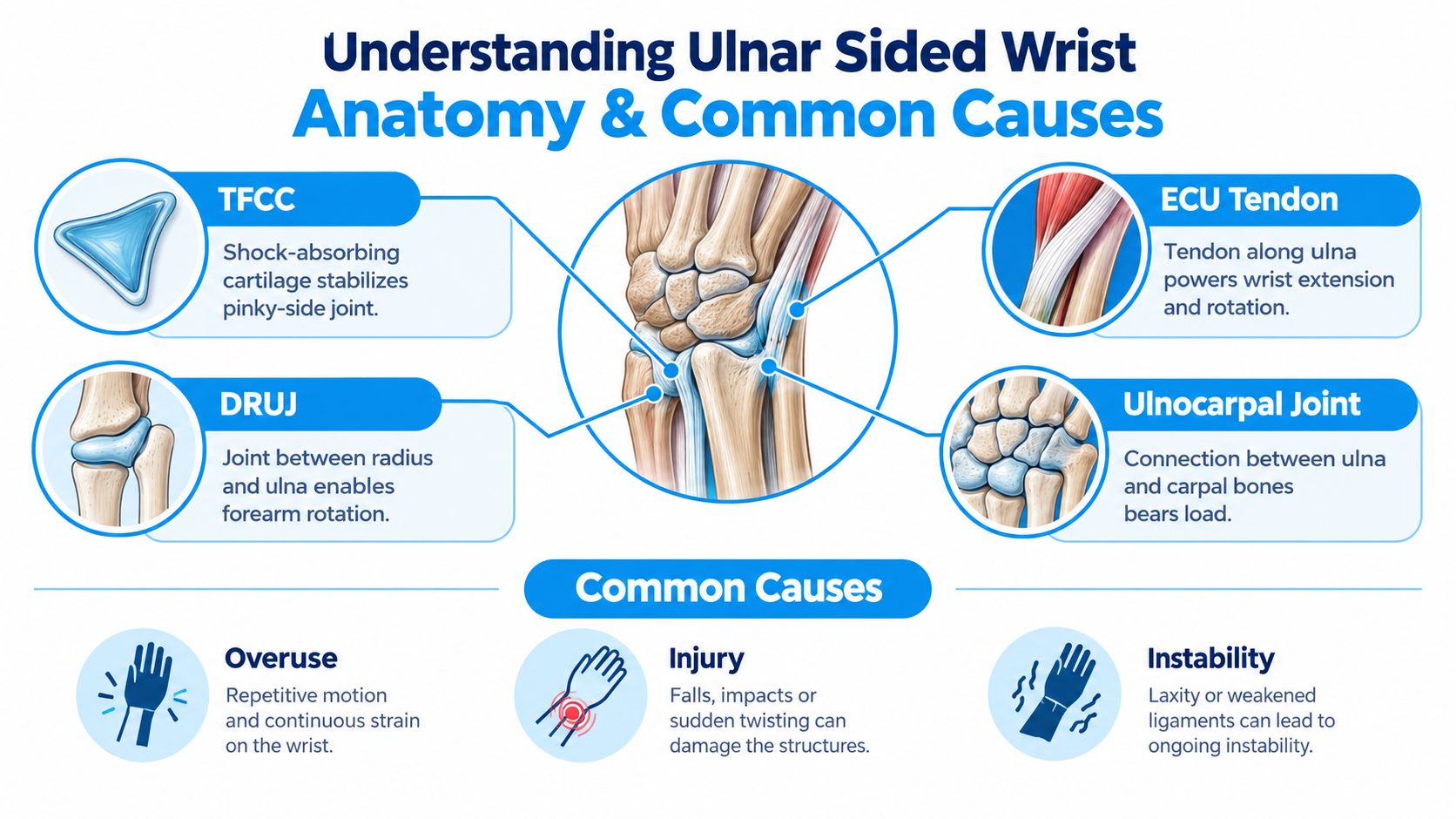
If wrist anatomy feels confusing, use this picture: think of the wrist as a small platform balancing load while also allowing rotation. The thumb side handles one set of forces. The pinky side handles another. When the ulnar side gets overloaded, compressed, or unstable, pain often shows up with twisting, gripping, or bearing weight through the hand.
The main structures on the pinky side
Four structures matter most when choosing an ulnar wrist pain brace.
TFCC stands for triangular fibrocartilage complex. It acts like a small cushion and stabilizer on the ulnar side. It helps the wrist tolerate twisting and weight-bearing.
ECU tendon is the extensor carpi ulnaris tendon. It runs along the outside of the wrist and helps with extension and control during rotation. It can become irritated with repetitive gripping, lifting, or racket and tool use.
DRUJ means distal radioulnar joint. This is the joint between the radius and ulna near the wrist. It helps the forearm turn palm up and palm down.
Ulnocarpal joint is where the ulna side interacts with the wrist bones that receive load. If pressure concentrates there, people often feel a deep ache with compression and side-bending.
If your symptoms also include nighttime numbness or tingling, it helps to separate pain from nerve symptoms. This overview of what causes tingling while sleeping can help you think through whether you may be dealing with nerve irritation as well.
Common causes and how they usually feel
A lot of confusion comes from symptom overlap. Here's the plain-language version.
- TFCC irritation or tear: Often hurts with twisting a doorknob, turning a steering wheel, or pushing off a chair. Some people notice clicking or a sense that the wrist isn't trustworthy under load.
- ECU tendinopathy: Often feels more tendon-like. The pain may track along the tendon and flare with repeated wrist motion, resisted extension, or rotational tasks.
- DRUJ instability: People may describe clunking, shifting, or weakness during turning motions. This can feel less like soreness and more like poor control.
- Ulnocarpal abutment: This often creates a deeper pressure pain, especially with loading, ulnar deviation, or impact.
For some people, the pain doesn't stay neatly at the wrist. It can connect with forearm strain patterns too, especially after repetitive work. If that sounds familiar, this guide on pain that runs from the wrist to the elbow can help connect the dots.
The same task can stress different structures. Turning a jar can irritate a tendon in one person and compress a painful joint surface in another.
Why diagnosis matters for brace choice
A soft wrap may feel pleasant for mild tendon irritation because it adds awareness and a little support. That same wrap may do very little if your main problem is joint instability or painful load at the ulnocarpal joint.
That mismatch is where many brace purchases go wrong. People buy for the location of pain instead of the mechanism of pain.
When an Ulnar Wrist Pain Brace Helps and When It Does Not
An ulnar wrist pain brace helps most when it changes the stress that triggers your symptoms. That can mean limiting side-bending, controlling twisting, supporting the distal radioulnar joint, or redistributing pressure during loading.
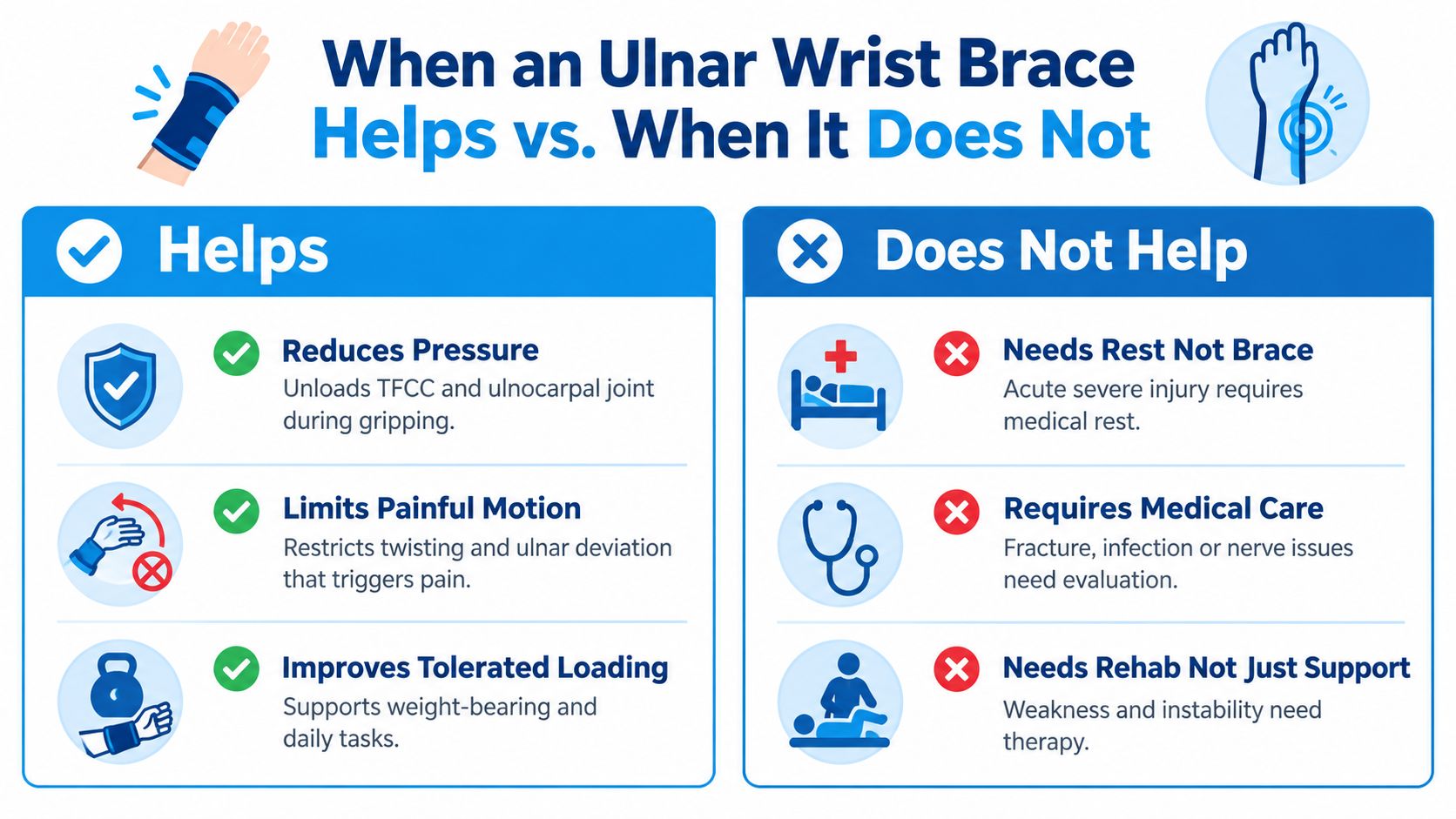
A useful example comes from TFCC-related pain under load. In a 2021 PubMed study summarized at Immumetrix, patients with TFCC lesions had much lower weight-bearing capacity in the affected hand than the unaffected hand before bracing, 16 kg versus 36 kg, and with a brace the relative load improved from 48% to 59% of the unaffected hand. The authors also noted stronger percentage improvement in unstable and traumatic cases than in degenerative cases. That matters because it shows support can improve tolerated loading, especially when instability is part of the problem.
Signs a brace is likely to help
- Pain with twisting or side-bending: A brace that limits those motions may calm symptoms enough for daily activity.
- Pain with pushing through the hand: This is common in TFCC irritation or ulnocarpal loading problems, where external support can make weight-bearing more tolerable.
- Symptoms during work tasks: Bracing can be useful when the goal is to reduce pain while still allowing controlled function.
Later in the decision process, many readers notice that a brace seems to help at first, then starts bothering them. If that's happening, this article on why a wrist brace can make pain worse is worth reading because the issue is often fit, over-tightening, or the wrong level of rigidity.
Here's a quick visual summary before the limits:
When a brace is not enough
A brace won't fix every problem, and sometimes it delays the care you need.
Important: Persistent pain, a clear injury with deformity, marked swelling, severe loss of motion, or ring-and-pinky numbness that doesn't settle deserve medical evaluation.
Bracing is also limited if your main issue is a fracture, major instability, infection, or a nerve problem rather than a mechanical overload problem. And even when a brace is appropriate, prolonged use can stiffen the wrist if you never taper out of it. Recent TFCC-focused guidance summarized by BraceAbility frames braces as tools, not cures, and recommends the least restrictive support that still controls symptoms.
Types of Braces and Splints for Ulnar Wrist Pain Compared
Not all wrist supports do the same job. The key differences are how much motion they limit, whether they control ulnar deviation and rotation, and whether their shape changes joint loading.
Soft support versus structural support
A supportive sleeve or light wrap offers mild compression-like contact and proprioceptive feedback. It's usually best for mild overuse, low-grade tendon irritation, or people who want warmth and reminder support without much motion control.
A wraparound wrist brace adds strap-based support and can reduce painful motion more effectively than a sleeve. It often works well for day-to-day symptom control when you still need finger use.
A short-arm wrist splint is more serious. It limits wrist motion while leaving the fingers and metacarpophalangeal joints freer than a long, bulky immobilizer. In a 2018 retrospective study described in this TFCC conservative management review, a removable short-arm brace used for 4 to 12 weeks was chosen partly because long-arm immobilization had poor compliance. Over follow-up, the mean PRWE score improved from 55 ± 22 to 29 ± 25, an average reduction of 26 points.
An ulnar gutter style splint or more rigid custom support may be used when the pinky-side structures need stronger rest or when a clinician wants more control than a general wrist brace provides.
Geometry matters more than people expect
Some braces help not because they freeze the joint, but because they change where force goes. In a controlled cadaveric study on ulnocarpal loading, both brace setups reduced dorsiflexion, but only the brace with a palmar pad lowered ulnocarpal peak pressure under a 32.13-kg axial compressive load according to PubMed. That finding is especially relevant for ulnocarpal abutment. The shape of the brace matters, not just the fact that you're wearing one.
A brace for tendon pain often needs motion control. A brace for joint compression may also need pressure-redistributing features.
Choosing the Right Ulnar Wrist Support by Diagnosis and Need
| Brace Type | Support Level | Mobility and Comfort | Best For |
|---|---|---|---|
| Supportive sleeve | Low | Highest mobility, easiest for all-day wear | Mild overuse, light support, warmth, symptom awareness |
| Wraparound wrist brace | Low to moderate | Good hand use with more control than a sleeve | ECU irritation, mild TFCC symptoms, work tasks needing grip |
| Short-arm wrist splint | Moderate to high | Less mobile, but more protective | TFCC flare-ups, painful twisting, recovery phase needing stronger rest |
| Ulnar gutter or custom rigid splint | High | Most restrictive | Significant instability, strong symptom provocation, clinician-directed support |
| Brace with palmar pad or wedge feature | Moderate, more targeted | Depends on design | Ulnocarpal loading problems where force redistribution is the goal |
People who don't need rigid immobilization sometimes prefer a lower-profile option such as a wrist compression sleeve, especially for light activity. One example in that category is the Thermo Recovery Wear wrist sleeve, which is designed as a non-compression, light-support option rather than a rigid stabilizing brace.
How to Choose Size and Fit Your Ulnar Wrist Pain Brace
A good brace in the wrong size becomes a bad brace quickly. Most fit problems show up in the first day as slipping, pinching at the wrist crease, numb fingers, or pressure right on the painful spot.
The home fitting checklist
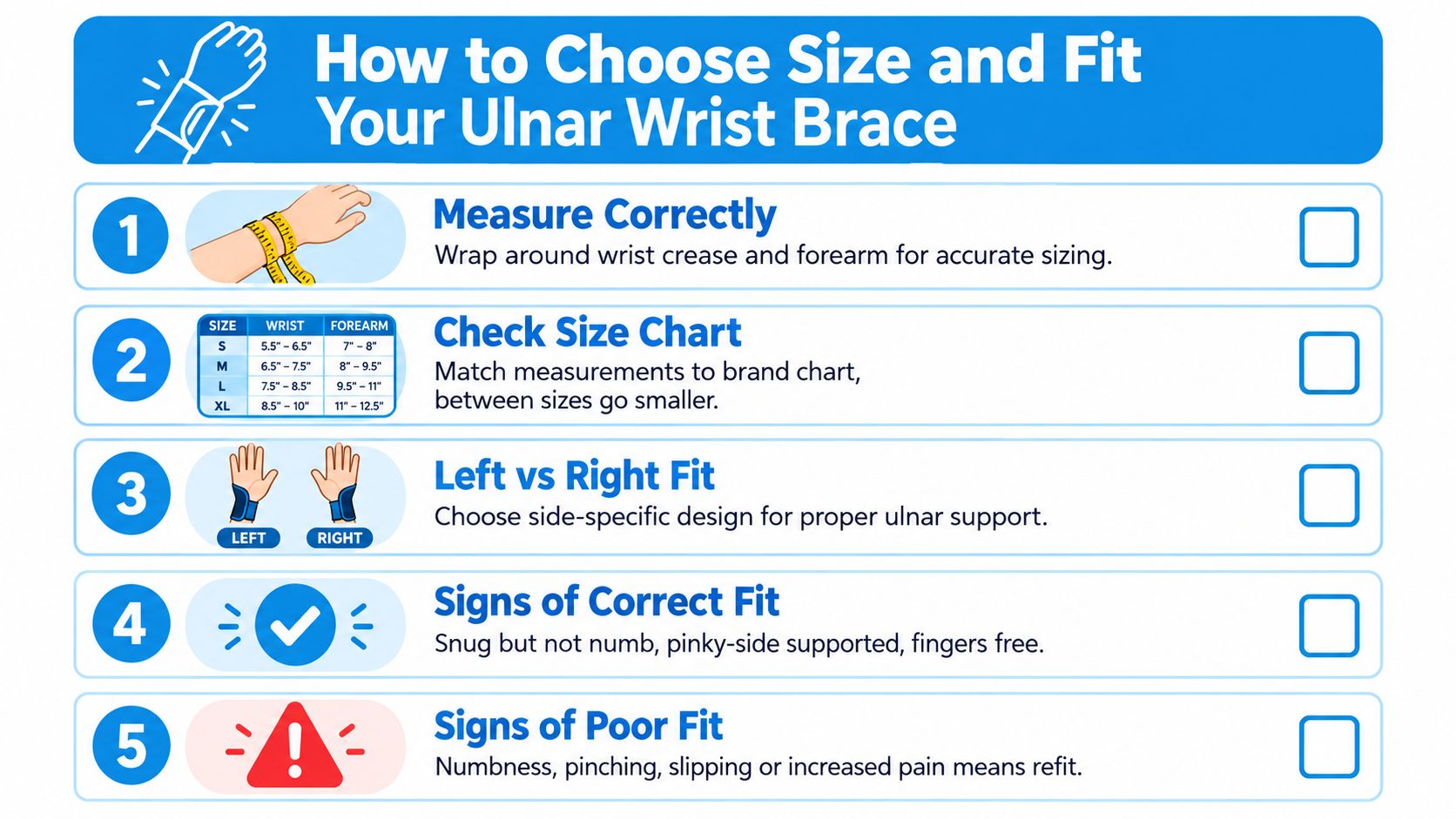
Start with the brand's size chart. Measure where the maker tells you to measure, usually around the wrist crease and sometimes the forearm. Don't guess based on shirt size or glove size.
Then check side-specific design. Some braces are universal. Others are built for left or right wrists so the support lands on the correct side.
Use this checklist after the brace is on:
- Support should land on the pinky side: If the stabilizing strap or rigid stay sits too central or drifts toward the thumb side, it won't target the painful area well.
- Fingers should move freely: You should be able to make a light fist and straighten the fingers without strain.
- Skin should stay normal in color and temperature: If the hand gets pale, cold, or tingly, it's too tight.
- The brace shouldn't slide during tasks: Test it with a mug, a steering-wheel grip, or a gentle door-turning motion.
A slim brace often works better for prolonged use because people keep it on. If you're looking at lighter options, this guide to a lightweight wrist brace can help you think about tradeoffs between bulk and support.
Signs the fit is wrong
Some mistakes are subtle. People often assume more tightness means more help. Usually it just means more irritation.
Fit check: Snug enough to guide motion, loose enough that your fingers stay warm, mobile, and comfortable.
Watch for these warning signs:
- Numbness or tingling after a few minutes.
- A pressure hotspot over the ulnar wrist bone.
- More pain during gripping because the brace folds into the joint.
- Brace migration when you rotate the forearm.
- Skin irritation from trapped moisture or rough seams.
Materials matter too. If you have sensitive skin or plan to wear the brace through long work periods, look for breathable fabric, manageable seams, and a design you can clean easily.
Daily Wear Care and Usage Scenarios for Lasting Relief
Most people don't wear a wrist brace in a clinic. They wear it while working, driving, carrying laundry, typing, or trying to sleep without rolling onto the hand. That's why wear strategy matters as much as brace type.
Use the brace for stressful tasks first
If your pain flares with very specific motions, start there. Wear the brace for jar opening, food prep, lifting pans, shopping bags, gym modifications, yard work, or any task that repeatedly reproduces symptoms.
For chronic ulnar-sided pain, adherence matters. In a cohort of women with ulnocarpal abutment syndrome, a custom aluminum splint worn over a mean follow-up of 8.8 months led to significant improvement in pain and DASH disability, and 7 of 10 continued using the splint while 3 of those 7 reached complete pain remission according to SAGE Journals. The study also noted that constant use during daily activities was associated with better pain scores.
That doesn't mean wearing a brace all day forever. It means that if the brace is appropriate, consistent use during aggravating activity often works better than random use.
A simple tapering approach
As symptoms settle, reduce wear in a planned way instead of stopping abruptly or staying in the brace out of habit.
- Phase one: Wear it during clearly painful tasks and higher-risk chores.
- Phase two: Remove it for light, non-provocative tasks at home so the wrist keeps moving.
- Phase three: Keep it as a backup for flare-prone activities rather than daily default wear.
Protect motion while you protect pain
Bracing works best when paired with gentle movement and gradual reloading. Between tasks, take the brace off for comfortable wrist motion if your clinician has said that's safe. That may include easy flexion and extension, forearm rotation, tendon glides, or hand opening and closing.
Keep the brace on for the job that irritates the wrist. Take it off for the movement that keeps the wrist from getting stiff.
Daily care details people forget
Brace hygiene affects whether you'll keep using it.
- Wash on schedule: Sweat, lotion, and skin cells build up fast and can irritate the skin.
- Dry fully before reuse: Damp fabric softens support and can rub.
- Check strap wear: Velcro that loosens changes fit and support.
- Inspect the skin: Redness that fades quickly is usually less concerning than marks that linger or blister.
If pain keeps returning whenever you try to taper, that's useful information. It may mean the diagnosis needs another look, the brace isn't the right style, or the wrist needs more structured rehabilitation.
Finding the Right Support and Next Steps for Recovery
The most helpful ulnar wrist pain brace is the one that matches the problem you have. Deep load-related pain may need a brace that changes pressure. Rotation pain may need motion control. Instability may need a more structured splint. Mild overuse may only need light support and activity changes.
Start with a simple trial. Choose the least restrictive brace that still reduces your key symptom during the task that usually triggers it. Track three things for several days: pain during activity, confidence using the hand, and stiffness after the brace comes off.
A brace is a good signpost when it helps a specific motion pattern. It's a warning sign when it causes numbness, slipping, skin irritation, or a new ache elsewhere. Those reactions usually mean you need a different fit, a different brace style, or a proper medical assessment.
General guidance from hand and orthopedic sources is consistent on one point. The diagnosis drives treatment. The American Society for Surgery of the Hand notes that ulnar-sided wrist pain has many causes and may be treated with activity modification, splinting or casting, therapy, medication, injections, or surgery depending on the diagnosis, as summarized in this overview from Amazon's research brief. Cleveland Clinic guidance summarized there also notes that a brace, splint, or cast may be needed to hold the wrist in place and reduce pressure while it heals.
If your pain is lingering, worsening, or tied to trauma, don't keep shopping for stronger braces as a substitute for evaluation. Get the wrist examined. The right support should make the path clearer, not more confusing.
If you want lighter daily support options for wrist discomfort, Thermo Recovery Wear offers wrist sleeves and recovery wear designed for comfortable use during rest and light activity. You can explore current options and sizing details at Thermo Recovery Wear and compare whether a low-profile sleeve fits your needs better than a rigid brace.


