


In a community-based UK study of adults aged 50 and older, 11.7% reported ankle pain, while 3.4% had symptomatic, radiographically confirmed ankle osteoarthritis. That's roughly one in nine with ankle pain, compared with one in 29 with this specific form of arthritis, according to the Clinical Assessment Study of the Foot. The difference matters: ankle pain has several possible causes, and a support that makes the joint feel better doesn't necessarily stabilize it or heal the underlying problem.
Choosing ankle support for pain starts with a simple question: do you mainly want warmth and comfort, or does your ankle need help resisting a sideways roll? A sleeve may soothe stiffness, while a semi-rigid brace can limit risky motion after a sprain. Neither replaces a diagnosis or a gradual return to movement.
Table of Contents
- Ankle Support Types and What Each One Does
- Red Flags That Need a Clinician First
- Matching Support to Your Type of Ankle Pain
- How Ankle Support Relieves Pain
- How Long to Wear Ankle Support During Recovery
- Sizing, Fit and How to Fix Common Problems
- Pros, Cons and Non-Compression Options
- Choose Your Next Step for Ankle Pain
Ankle Support Types and What Each One Does
| Support type | Best suited for | Compression or stabilization | Wear profile |
|---|---|---|---|
| Compression sleeve | Mild swelling, warmth and everyday comfort | Light compression, no side stabilization | Low restriction, suitable for everyday wear |
| Lace-up brace | Recurrent instability and sprain recovery | Semi-rigid side support | Medium restriction, adjustable |
| Stirrup brace | Sprains needing side support during activity | Semi-rigid side support | Medium restriction, fits in shoes |
| Elastic bandage or tape | Short-term swelling control and immediate support | Compression or tape-based support | Low to medium restriction, needs reapplication |
| Immobilizing boot or walker | Severe injury under clinical direction | Rigid immobilization | High restriction, clinical use only |
| Infrared non-compression sleeve | Ongoing stiffness and sensitive skin without tight compression | No stabilization established by the cited evidence | Low restriction, comfort adjunct |
First distinguish comfort from control
A compression sleeve fits closely around the ankle, offering warmth and light pressure. That can feel soothing when the joint is mildly swollen or stiff, but a sleeve doesn't provide substantial protection against the ankle rolling sideways. It's a comfort choice, not a substitute for a brace when the main problem is instability.
Lace-up and stirrup braces have a different job. Their structure helps limit sideways movement while allowing some up-and-down motion for walking. Lace-up designs can be adjusted around the foot and ankle; stirrup braces use support at the sides and are commonly worn with shoes. They're options to consider when a sprain or repeated giving-way calls for more mechanical support.
Clinical guidance treats these as different tools, not interchangeable versions of the same product. Functional braces are generally favored over immobilization or compression wraps after acute sprains, and prolonged immobilization can lead to weakness and stiffness. A soft sleeve may provide warmth or compression for osteoarthritis, but it hasn't been systematically studied as a stabilizer. The American Family Physician guidance on ankle sprains distinguishes support for instability from comfort measures and emphasizes early movement over prolonged casting.
Choose the lightest support that does the right job
Think of the options as a protection ladder. A sleeve offers the least mechanical restraint. An elastic bandage or tape adds adjustable pressure or support, but it needs careful application and, in the case of tape, reapplication. A lace-up or stirrup brace adds more structured side support. A boot or walker restricts movement most and belongs under clinical direction, not as a default response to ankle pain.
Ask yourself: Is the problem mainly swelling and aching, or does the ankle give way? If it's mostly mild swelling or stiffness, a comfortable sleeve may be enough to try. If the ankle feels unstable, especially after a sprain, a stabilizing brace is more appropriate to discuss. Severe injury, major pain or uncertainty about the cause calls for assessment rather than stepping up to a more restrictive device.
Practical rule: A comfortable fit is valuable, but comfort alone doesn't show that the ankle is stabilized.
Red Flags That Need a Clinician First
When should a support wait behind medical assessment? If the pain started after an injury, a clinician may need to check for a fracture or another problem before you treat it as a routine sprain. Don't use a brace to push through signs that the ankle needs evaluation.
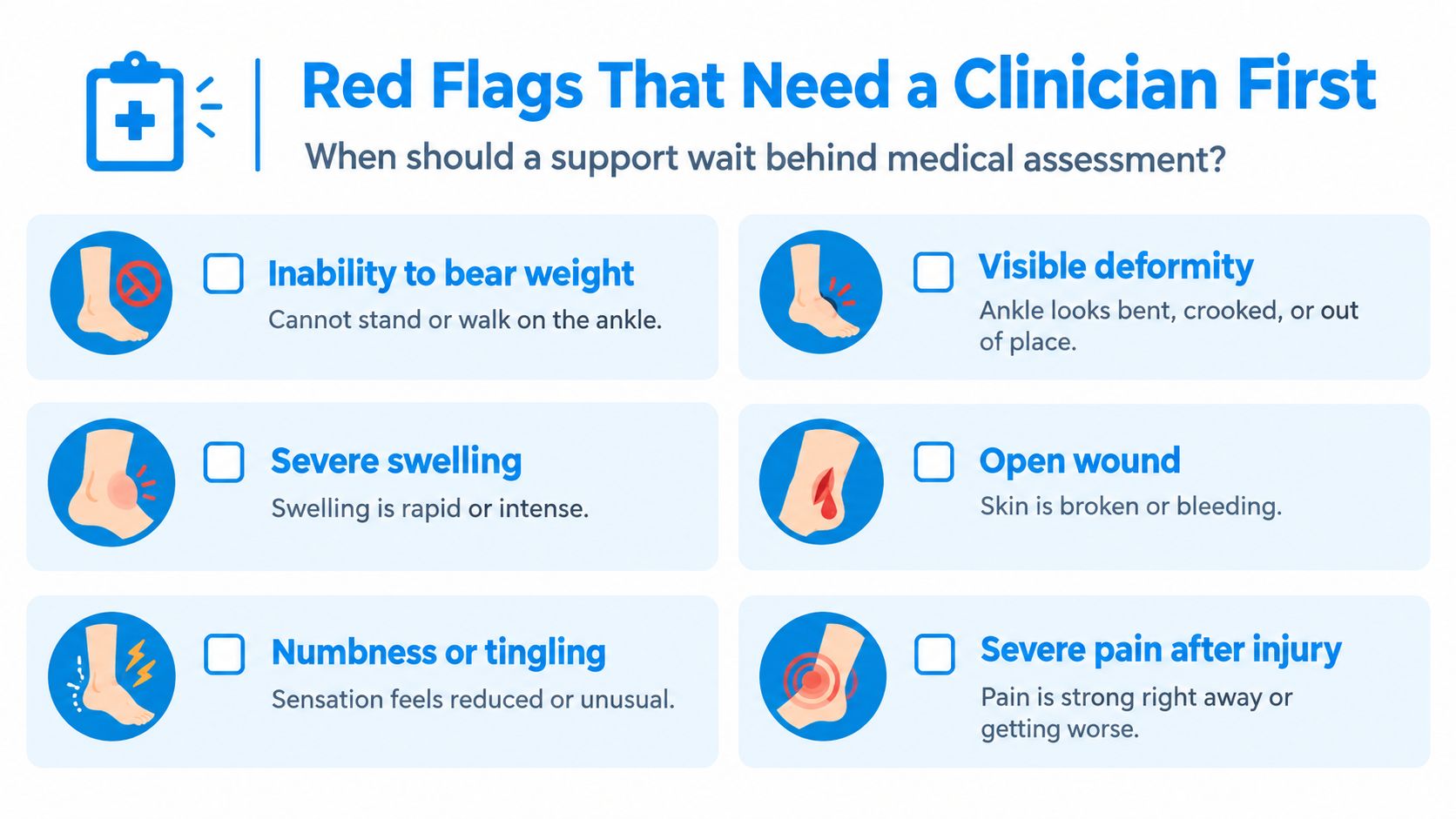
Check for warning signs
Seek medical advice before choosing or continuing a support if you have any of these symptoms:
- You can't bear weight: You're unable to stand or walk on the ankle.
- The ankle looks deformed: It appears bent, crooked or out of place.
- There's marked redness or warmth: These changes are pronounced, especially when they come with unexplained swelling or worsening pain.
- Your foot feels numb or unusually tingly: Reduced or altered sensation needs assessment, not tighter compression.
- You have calf pain or swelling: Don't assume a painful or swollen calf is part of an ankle sprain.
- Swelling has no clear explanation: New or persistent swelling should be assessed, especially if you haven't had a clear injury.
- Symptoms persist: Arrange a review if pain doesn't improve as expected or continues to interfere with walking.
Older adults and people with diabetes, vascular disease or reduced foot sensation should seek advice earlier. These conditions can affect how the foot responds to pressure or injury, so a snug brace that feels ordinary to someone else may cause problems or hide skin irritation.
Don't mistake relief for a diagnosis
A support can make the ankle feel more comfortable or secure without correcting the reason it hurts. Evidence about some compression options is mixed: a Canadian evidence review found that stockings improved some outcomes compared with bandages, but found no significant difference in pain or swelling compared with a placebo. The review also found no significant pain difference between taping and several brace types. See the Canadian evidence review of ankle sprain treatments.
A poorly fitted or overly tight support can irritate the skin and add pressure where you don't need it. If you notice numbness, unusual color changes or worsening discomfort, take it off and seek advice rather than tightening it further.
If any red flag is present, see a clinician before buying or continuing ankle support. The point isn't to assume the worst. It's to make sure a support doesn't delay the care that would address the cause.
Matching Support to Your Type of Ankle Pain
Ankle pain doesn't automatically mean arthritis. In the UK study of 5,109 adults aged 50 or older, 11.7% reported ankle pain and 3.4% had symptomatic radiographic ankle osteoarthritis, defined as ankle pain alongside radiographic disease of grade 2 or higher. Those findings show why the cause matters: previous sprains, instability, tendon disorders and overuse can all hurt without the person having symptomatic ankle osteoarthritis. The study of ankle pain and osteoarthritis in older adults supports treating a support as an aid to comfort, stability or activity, not as a way to reverse joint changes.
| Pain condition | Support approach | Key check |
|---|---|---|
| Acute sprain, grade I to II | Semi-rigid stabilizing brace | Walking pain and swelling should trend down |
| Recurrent instability | Lace-up or stirrup brace during activity | Are there fewer episodes of the ankle giving way? |
| Ankle osteoarthritis | Soft sleeve for warmth and comfort | Track pain and morning stiffness over time |
| Nonspecific chronic pain | Soft sleeve with rehabilitation | Seek clinician review if there's no improvement |
| Tendon overuse | Don't select a stabilizer without advice | Get a clinician's assessment before choosing support |
| Severe injury, deformity or inability to bear weight | Medical assessment first | Don't self-treat |
Match the support to the pattern
For a mild or moderate sprain, a semi-rigid brace can help limit sideways rolling while you start moving again. It should support activity without being used as an excuse to skip rehabilitation. Routine minor sprains don't automatically require a rigid boot or prolonged immobilization.
If the ankle repeatedly gives way, a lace-up or stirrup brace is more relevant than a soft sleeve, particularly during activities that trigger instability. But recurrent giving-way also deserves attention to strength, balance and the cause of the instability. The brace should make activity feel safer while you address those issues.
For osteoarthritis or ongoing stiffness, a soft sleeve may provide warmth and a sense of support without claiming to stabilize the joint. Notice whether it helps with specific tasks, such as walking around the home or starting the day. If pain or stiffness doesn't improve, seek a clinical review rather than assuming a tighter brace will solve it.
With tendon overuse, the painful structure and activity pattern matter. A self-selected brace may not fit the problem, so ask a clinician which kind of support, if any, makes sense. For severe injury, deformity or inability to bear weight, get assessed before trying a product.
If you're sorting out where discomfort is located and what might be contributing to it, this guide to understanding ankle discomfort can help you describe the pattern. Pain at the back of the ankle has its own possible causes, so the guide to posterior ankle pain causes, symptoms and treatments may also help you prepare questions for a clinician.
How Ankle Support Relieves Pain
A support is a bit like a handrail on a staircase. It can guide you away from a risky movement without locking the joint in place. That guidance may make walking feel more secure, but feeling secure doesn't necessarily mean the ankle has healed.
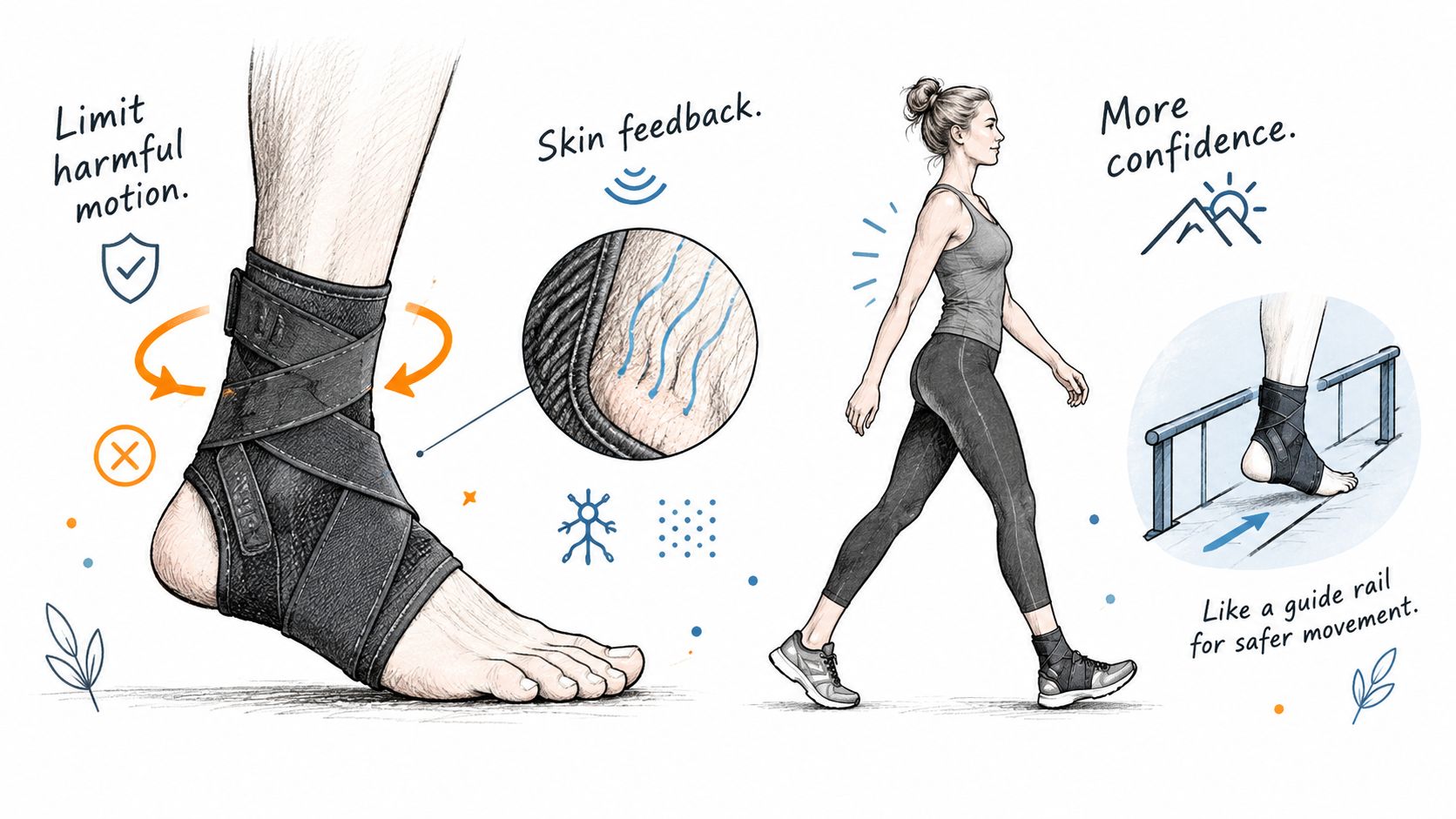
What a support may change
A brace can limit motion that aggravates an injury, provide pressure and touch cues from the skin, and increase confidence during activity. These effects aren't the same. A soft sleeve may feel reassuring but offer little resistance to a sideways roll; a semi-rigid brace can provide more direct mechanical control. A person who feels steadier may also be more willing to walk, which can make everyday movement easier.
Brace design matters. In an experimental study, semi-rigid braces restricted inversion range of motion 21.3% more than tape and 26.2% more than lace-up braces. That comparison shows how much the support's structure can affect the joint's movement. It doesn't mean the stiffest brace is automatically the right choice: limiting motion too aggressively can interfere with normal walking and rehabilitation. The study of ankle bracing, motion and sensory effects also found that a universal improvement in proprioception, the sense of where the joint is, isn't guaranteed.
Here's a short explainer on how a brace can support ankle stability:
Research on sensory effects is mixed. One controlled study found no statistically significant difference in proprioceptive accuracy with versus without bracing. A clinical bandage study, meanwhile, found improved single-leg stance, a more normalized walking stance phase and changes in ground-reaction forces, alongside reported pain relief. These findings don't establish that every support improves balance or that a particular sensation proves recovery.
Judge it by what you can do
Pay attention to walking tolerance, balance, perceived stability and pain during activity. Does the support let you walk more comfortably without pinching or changing your gait? Does the ankle feel more stable during the movements that usually bother it? Those practical checks matter more than assuming a support works by a particular sensory mechanism.
A correctly sized design that feels comfortable is more likely to be wearable. If it creates excessive pressure, restricts ordinary movement or makes walking feel awkward, it may be the wrong fit or the wrong type. Adjust or stop using it and seek advice if problems continue.
A support changes how the ankle moves, not necessarily how it heals.
How Long to Wear Ankle Support During Recovery
After a sprain, the aim is functional protection, not prolonged immobilization by default. Support can make early activity more manageable, but it should sit alongside pain control, progressive movement and targeted exercises. The right duration depends on the injury and what you're returning to.
| Phase | Support use | Typical duration | Basis |
|---|---|---|---|
| Acute sprain | External support during walking and return to activity | About 5 to 10 days | Clinical guidance with pain control and exercise |
| Immobilization, if clinically needed | Restricted protection | No more than 10 days | 2021 ankle sprain guideline |
| Return to sport | Brace during activity for reinjury protection | 6 to 12 months after sprain | Clinical guidance |
| Osteoarthritis or nonspecific chronic pain | Comfort support as needed | Reassess with a clinician | Individual symptoms and function |
Function may improve before pain does
A randomized trial comparing an Aircast brace with an elastic bandage found similar initial pain scores, 6.2 with the brace and 5.8 with the bandage. But the brace group had better average Karlsson ankle scores: 50 versus 35 at 10 days, and 68 versus 55 at one month. The differences were statistically significant at both checkpoints, as reported in the randomized trial comparing ankle bracing and bandaging.
The practical message is that a brace's value may show up in function and confidence, not just a rapid drop in pain. Guidance supports external support for about 5 to 10 days during acute sprain management, together with early functional activity and exercises. If immobilization is clinically needed, the 2021 ankle-sprain guideline limits it to no more than 10 days. For sports, brace use during activity may continue for 6 to 12 months after an initial sprain to help reduce recurrence.
Continue or step down based on function
Chronic arthritis or nonspecific pain doesn't have a universal wear calendar. Reassess with a clinician instead of extending brace use automatically. After a sprain, consider whether you can walk without support and feel stable, whether swelling has settled, and whether you're doing balance exercises as part of your recovery.
If you're still relying on a brace for ordinary walking, or the ankle continues to give way, get guidance before wearing it longer. For a broader sense of what to expect as sprain symptoms change, see this sprained ankle healing timeline. A support can protect activity while you rebuild capacity, but it can't do the strengthening and balance work for you.
Sizing, Fit and How to Fix Common Problems
A brace that pinches, slips or makes your toes tingle isn't doing its job well. Fit affects both comfort and function, and swelling can change how a support sits from one day to the next.
- Measure your ankle. Take the circumference at the narrowest point just above the ankle bone.
- Use the brand's size chart. Choose by your ankle measurement, not your shoe size.
- Put it on over a thin sock. Fasten the support evenly and check that you can slide two fingers beneath its straps.
- Walk briefly and check the fit. After a short walk, look for heel slip, pressure at the stirrups and any change in toe color.
- Check again the next day. If swelling has changed, the brace may need adjusting or a different size.
Diagnose the fit problem before changing the product
| Problem | Likely cause | Fix |
|---|---|---|
| Numbness or tingling | Support too tight | Loosen one strap notch and check toe color |
| Red marks or blisters | Pressure points or wrong size | Try the next size up, add a liner and shorten wear time |
| Slipping or rolling | Too loose or wrong size | Tighten or size down, then check the heel fit |
| Pain at seams or stirrup edges | Seam or stirrup pressing on bone | Reposition, or add a thin sock layer |
| Sweating and odor | Trapped moisture | Wash according to the label and rotate two supports |
| Still feels unstable | Wrong support type for the problem | Consider a semi-rigid brace and consult a clinician |
Numbness or a color change means loosen the support straight away. Check the skin and toe color after adjusting. If the change doesn't resolve, remove the brace and get advice, especially if you have reduced sensation or a circulation condition.
A red mark that fades quickly may call for a shorter wear period or a smoother liner. A blister or repeated pressure spot suggests a poor fit or a support that presses on the wrong area. Slipping, on the other hand, may mean the support is too loose or the design doesn't suit the ankle.
If you're unsure about the order of straps or laces, follow this illustrated guide to putting on an ankle brace. If adjusting it doesn't fix the problem within a few days, consider changing the type of support or consulting a clinician instead of only changing the size.
Pros, Cons and Non-Compression Options
The strongest support isn't always the best choice. A device that helps control a sprain may feel too restrictive for everyday stiffness, while a comfortable sleeve may be too soft for an ankle that repeatedly gives way.
- Quick comfort: A sleeve or wrap may feel soothing when mild swelling or stiffness is the main concern.
- More security during activity: A stabilizing brace can help guide the ankle when sideways movement is a concern.
- Wearability: A low-profile design may be easier to wear with daily clothing and footwear.
- Possible drawbacks: Poor fit can cause skin irritation, slipping or pressure. Relying on a brace alone doesn't restore strength or balance, and a support doesn't reverse joint damage.
Why semi-rigid doesn't mean fully rigid
For an acute lateral sprain, a semi-rigid brace can limit inversion and eversion, the sideways motions that may put stress on the injured ankle, while allowing more up-and-down movement for walking. A clinical review reports that semi-rigid braces can outperform rigid protection for earlier return to sport or work, with improvements reported in pain, swelling, instability, range of motion and satisfaction. The clinical review of ankle sprain treatments describes this trade-off: protect against risky sideways movement without unnecessarily locking the joint.
This doesn't mean braces improve every pain measure or that every person needs semi-rigid support. The support should match the injury and the activity. An unrestricted soft sleeve may be fine for warmth or comfort, but it won't provide the same mechanical restraint when the ankle is unstable.
Consider non-compression options carefully
A non-compression sleeve may suit someone who finds tight garments uncomfortable or irritating. Thermo Recovery Wear offers a non-compression ankle sleeve made with infrared-responsive fabric; the company describes the fabric as intended to support local warmth and circulation. Those product claims aren't the same as independent proof that a sleeve stabilizes a sprain or heals an injury. Consider it a comfort option, not a replacement for assessment or rehabilitation when those are needed.
The wider evidence also cautions against assuming that compression alone will solve pain. A Canadian review found some benefits for stockings compared with bandages, but no significant pain or swelling difference compared with placebo. If you try a comfort support, judge it by whether walking, balance and activity pain improve in a way you can notice. If they don't, reconsider the approach rather than assuming stronger compression is the answer. For another perspective on arch support versus compression, focus on what problem the device is designed to address.
Choose Your Next Step for Ankle Pain
Use this decision path to choose what to do next. The right move depends less on finding the most restrictive product than on identifying what the ankle needs and whether it's safe to manage at home.
- Check for warning signs first. If you can't bear weight, see a deformity, have marked redness or warmth, numbness, calf pain or swelling, unexplained swelling, or persistent pain, contact a clinician before buying or continuing a support. Take this step early if you're an older adult or have diabetes, vascular disease or reduced foot sensation.
- If you've recently sprained the ankle and have no warning signs, consider functional support. A lace-up or stirrup brace may suit activity when you need help limiting sideways motion. Choose by ankle circumference, check the fit and pair support with gradual movement and balance work rather than defaulting to a boot.
- For ongoing stiffness without a new injury, try comfort measures cautiously. A soft sleeve may feel helpful for warmth or mild swelling. Track whether walking and morning stiffness improve, and seek a review if the symptoms persist or worsen.
- If the ankle keeps giving way in a soft sleeve, reconsider the support type. A stabilizing brace may be more appropriate, but recurring instability deserves assessment. Note whether it reduces giving-way episodes without causing pressure or changing your walk.
On the first day, check that the support fits comfortably and your toes keep their usual color. Over time, judge your choice by whether walking feels easier, activity pain settles and the ankle gives way less often. If you're ready to work on movement alongside support, explore these ankle mobility exercises and ask a clinician which are appropriate for your situation.
If tight compression isn't comfortable, Thermo Recovery Wear offers non-compression recovery sleeves, including an ankle sleeve designed for everyday comfort and light activity. Compare its fit and intended use with the support your ankle needs, and consult a clinician if pain, swelling or instability continues.


