


Can a knee brace help osteoarthritis? Yes, for some people, when its design matches the problem. Pooled results for medial knee arthritis show modest gains in pain and function, while other trials found little or no difference in pain, function, or quality of life after 12 months. A brace does not reverse cartilage loss.
A soft sleeve and a rigid unloader both carry the label “knee brace,” but they do different jobs. One can change how the joint feels; the other is designed to shift load away from a painful compartment. Knowing the difference helps you choose a brace that fits your symptoms rather than giving up on walking practice after trying the wrong one.
Table of Contents
- The Short Answer for Arthritic Knees
- Which Brace Fits Your Knee
- What Trials Measured After Months of Wear
- Getting a Fitted Brace Without Guesswork
- How to Trial a Brace on Painful Tasks
- Myths That Waste Money and Delay Care
- Decide What to Wear This Month
The Short Answer for Arthritic Knees
Say you finish a grocery trip and the inside of one knee is the part that burns. You want to know, this week, whether a brace is worth the money. For that walker, the honest verdict is yes only when the device matches the problem, no as a universal fix, and never as a way to regrow cartilage.
Split the word brace into three jobs, because later choices depend on which job you need.
- Soft or recovery sleeve: a reminder wrapped around the joint. It adds warmth, light contact, and a clearer sense of where the knee is in space.
- Hinged brace: a guardrail for a knee that feels wobbly while you walk, so side-to-side slip has a limit.
- Valgus or varus unloader: a small crowbar. It shifts load off the worn inner or outer compartment instead of merely hugging the leg.
Read on if medial or lateral pain shows up during walking, if instability throws off your gait, or if a mild ache might settle with a comfortable sleeve. Don't expect a sleeve to stand in for an unloader when exam or imaging points to predominantly one-compartment disease. Warmth is not the same lever as unloading.
A brace sits beside care, not in front of it. Strength work and weight management, when weight is part of the load, still carry the long plan. For a plain map of those wider options, the options for osteoarthritis of the knee page is a useful companion, and the arthritis treatment insights from MedAmerica Rehab Center walk through how bracing fits with exercise and other joint care rather than replacing them. The matching table in the next section is where the three jobs get paired with real knee patterns.
Which Brace Fits Your Knee
Which brace fits depends on the job your knee needs it to do: improve comfort, steady a wobbly gait, or shift load away from one worn compartment.
For medial osteoarthritis, the knee adduction moment describes how body weight loads the inner side of the knee during a step. A valgus unloader applies an opposing force, like a small crowbar easing pressure off that side. A systematic review of valgus bracing found a significant reduction in knee adduction moment in 20 studies; seven also reported less pain. Some studies noted changes in walking speed, step length, or symmetry.
The mechanism has to match the problem. Use the table to compare the three brace jobs and the designs intended for different knee patterns.
| Brace type | Best matched problem | What it changes | How evidence frames it |
|---|---|---|---|
| Soft or recovery sleeve | Mild ache, swelling awareness, or intolerance of tight compression | Warmth, light contact, and a clearer sense of knee position | Comfort support, not equivalent to a compartment unloader |
| Hinged brace | Instability that impairs walking | Limits some side-to-side motion and adds a guardrail | Consider when gait stability is the main complaint |
| Valgus unloader | Medial-compartment pain or overload while walking | Applies an external valgus moment to reduce knee adduction moment | Reduced that moment in 20 studies; ACR strongly recommends tibiofemoral bracing in selected cases |
| Varus-style unloader | Lateral-compartment disease | Shifts load away from the outer compartment | Uses the same unloading principle in the opposite direction |
| Patellofemoral brace | Kneecap-related osteoarthritis | Aims to improve patellar tracking | Results are less favorable than for medial tibiofemoral disease |
Why guidelines don't agree
The American College of Rheumatology guideline strongly recommends tibiofemoral bracing when osteoarthritis substantially affects walking, joint stability, or pain, provided the person can tolerate the inconvenience. OARSI recommends against routine bracing, while NICE takes a conditional approach, mainly when a brace helps someone exercise or addresses abnormal loading.
A separate 2025 systematic review found more consistent improvement in degenerative knee arthritis than in ligament injury. For medial knee osteoarthritis, pooled results showed a 14.6-point improvement in KOOS Pain and a 13.7-point improvement in WOMAC. Patellofemoral osteoarthritis results were less favorable. These scores describe symptoms, function, and quality of life; they do not mean cartilage has grown back.
Product pages can make sleeves and braces sound interchangeable. This guide to the difference between a knee brace and a knee sleeve explains the practical distinction. An unloader is a more direct match when exam or imaging points to disease mainly on the inner or outer side. For mild symptoms, a soft sleeve may be more comfortable, especially if tight compression has been hard to tolerate.
Four knees, four decisions
Inner-knee pain late in a walk. For a 68-year-old with pain at the medial joint line and imaging showing more wear on that side, an unloader may fit the problem better than a sleeve. Strengthening remains part of the plan.
Giving way on uneven pavement. If buckling is the main complaint, a hinged brace may offer a useful guardrail. Check gait and have the cause assessed so the brace does not mask an unexamined ligament or alignment problem.
Kneecap pain on stairs. A patellofemoral brace is designed to influence tracking. Keep expectations lower than for medial tibiofemoral disease, and do not treat it as an unloader.
Sensitive skin after a tight sleeve. Someone who stopped wearing a sleeve because it squeezed may prefer a breathable, non-compressive option for mild symptoms and light activity. Its role is comfort, not unloading.
Fit check: Walk in the brace. If it slips, presses at the fibular head, irritates the skin, or worsens your gait, the fit or design may be wrong. Discomfort can make regular wear harder.
Use a brace alongside exercise, weight management when relevant, and other care suited to your knee. It does not reverse cartilage loss.
What Trials Measured After Months of Wear
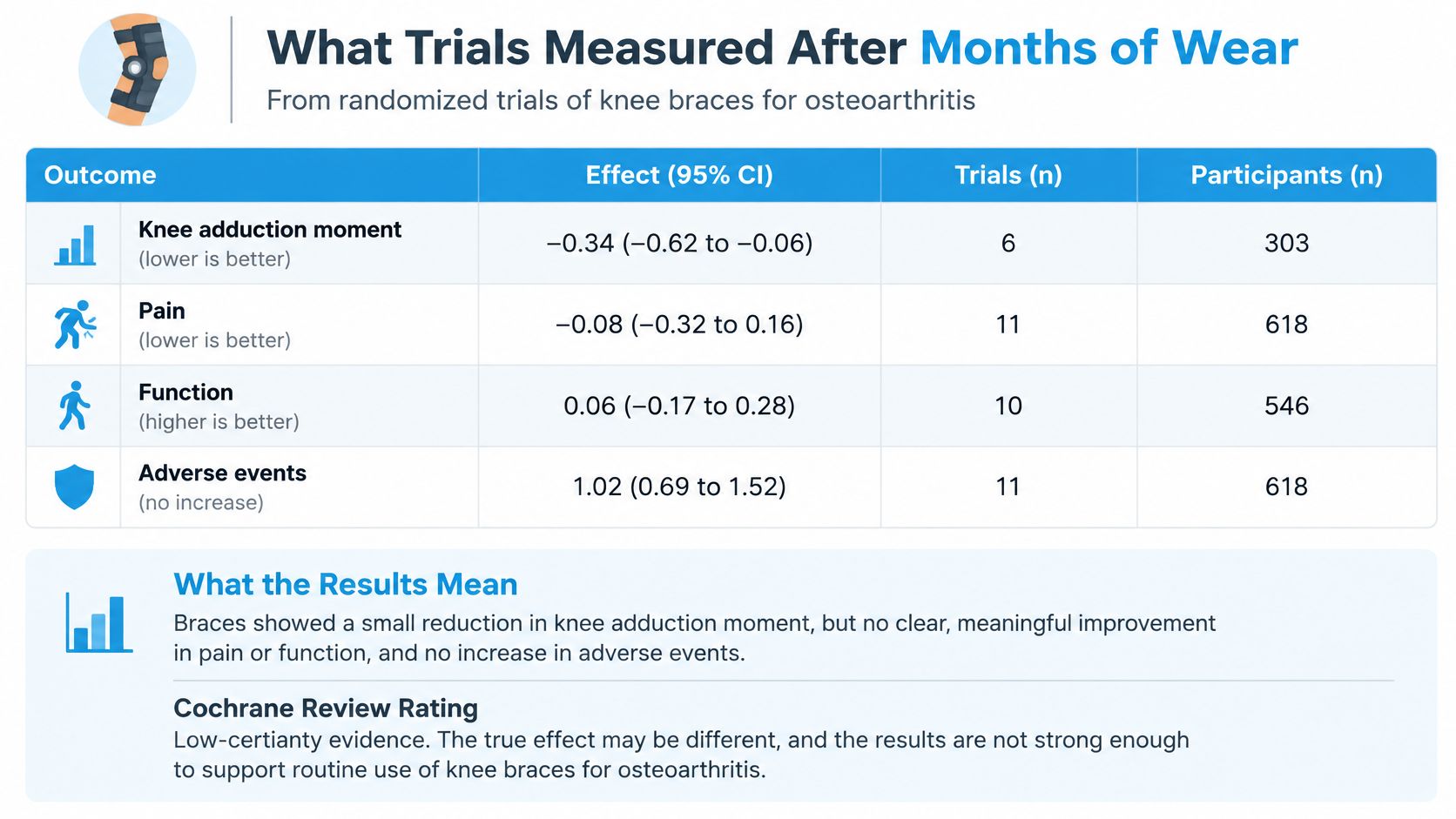
A smaller knee adduction moment is a mechanical change. It isn't automatically a transformed Tuesday. The outcomes below are what months of wear measured.
| Source | What was studied | Result readers should remember |
|---|---|---|
| Cochrane review | Braces and orthoses for knee osteoarthritis | Low-quality evidence; little or no difference in pain, function, or quality of life at 12 months |
| 2024 scoping review | 31 randomized trials and 47 brace interventions | Designs, wear time, and adherence measures varied widely |
| 2025 systematic review | Degenerative knee arthritis versus ligament injury | Medial OA pooled KOOS Pain gain 14.6 points and WOMAC gain 13.7 points; patellofemoral results weaker |
| PROP OA trial | 466 adults, exercise advice with or without brace plus adherence help | Six-month KOOS-5 effect size 0.24; adjusted difference 3.39 points |
What a walker would notice
A Cochrane review judged the evidence low quality and found that, after 12 months, bracing may produce little or no difference in pain, function, or quality of life. Earlier signals of small benefit were dragged down by low compliance. A 2024 scoping review counted 31 randomized trials and 47 interventions, from valgus and varus unloaders to patellofemoral braces, sleeves, hinged braces, and placebo controls. Prescribed wear time and adherence measurement varied enough to scramble the averages.
That spread is why a comfortable sleeve shouldn't be sold as the same thing as a compartment-specific unloader. The sleeve may add proprioceptive confidence or mild support. It doesn't apply the external moment the unloader is built for.
The medial pooled gains describe a noticeable easing on a symptom scale, not a new knee. The PROP OA row is the other face of the same modesty: a real statistical edge that a walker might feel as a slightly easier trip, not as a cure. Judge success on one named task, such as pain on a target walk, a stair flight, or a standing period. Continuous all-day wear isn't the default test.
Keep going only if that task is meaningfully easier and you don't have numbness, skin injury, swelling, or worse pain. If the knee is unstable, badly aligned, or poorly fitted, a clinician or orthotist should reassess before you buy a second device.
This short clinic walk-through shows how an unloader is meant to change load during a step, which is the mechanism the outcome tables are careful not to oversell.
Getting a Fitted Brace Without Guesswork
Guessing from a product photo is how unloaders end up on the wrong side of the knee. Before anyone picks a device, a clinician should locate tenderness on the inner or outer joint line, look at standing alignment on weight-bearing imaging, watch gait on a real walk, and ask about giving-way episodes. Without a mechanical target, a brace is just extra bulk.
Questions worth asking out loud
Ask which compartment the brace is supposed to shift. Ask how fit is measured and later adjusted, not just strapped on in a chair. Ask whether a trial period or return path exists if the device migrates or pinches. Ask how wear gets reviewed at follow-up, including skin and whether you're still doing your exercises.
- Bring the imaging report and a short list of painful tasks, such as the grocery walk or the stairs at home.
- Ask for a walking assessment with the brace on, not only a standing mirror check.
- Confirm the unloader sits on the correct side and doesn't pinch the fibular head.
- Agree on a review date after two to four weeks, while the trial is still fresh.
Cost categories, not price tags
Custom-fitted unloaders and hinged braces are usually billed differently from over-the-counter sleeves. Ask what documentation your plan wants, and whether a letter of medical necessity is part of that path. A sleeve you can order yourself is a different category from an orthosis built to a compartment. Neither category includes a promise about cartilage.
Skip bracing, and put the effort into exercise, weight management, or other clinician-directed care, when the exam shows no mechanical target to unload or stabilize. A sore knee with no compartment pattern and no giving way is a poor reason to add hardware. If you're starting with a soft sleeve while you wait for that visit, use a knee sleeve sizing chart so the first fit isn't a guess that slips or tourniquets the thigh.
How to Trial a Brace on Painful Tasks
Would a brace make your painful walk or stair climb easier? Test it on one specific task rather than wearing it all day and trying to judge the difference from memory. Routine wear while sitting or sleeping is generally discouraged unless a clinician has a specific reason for it.
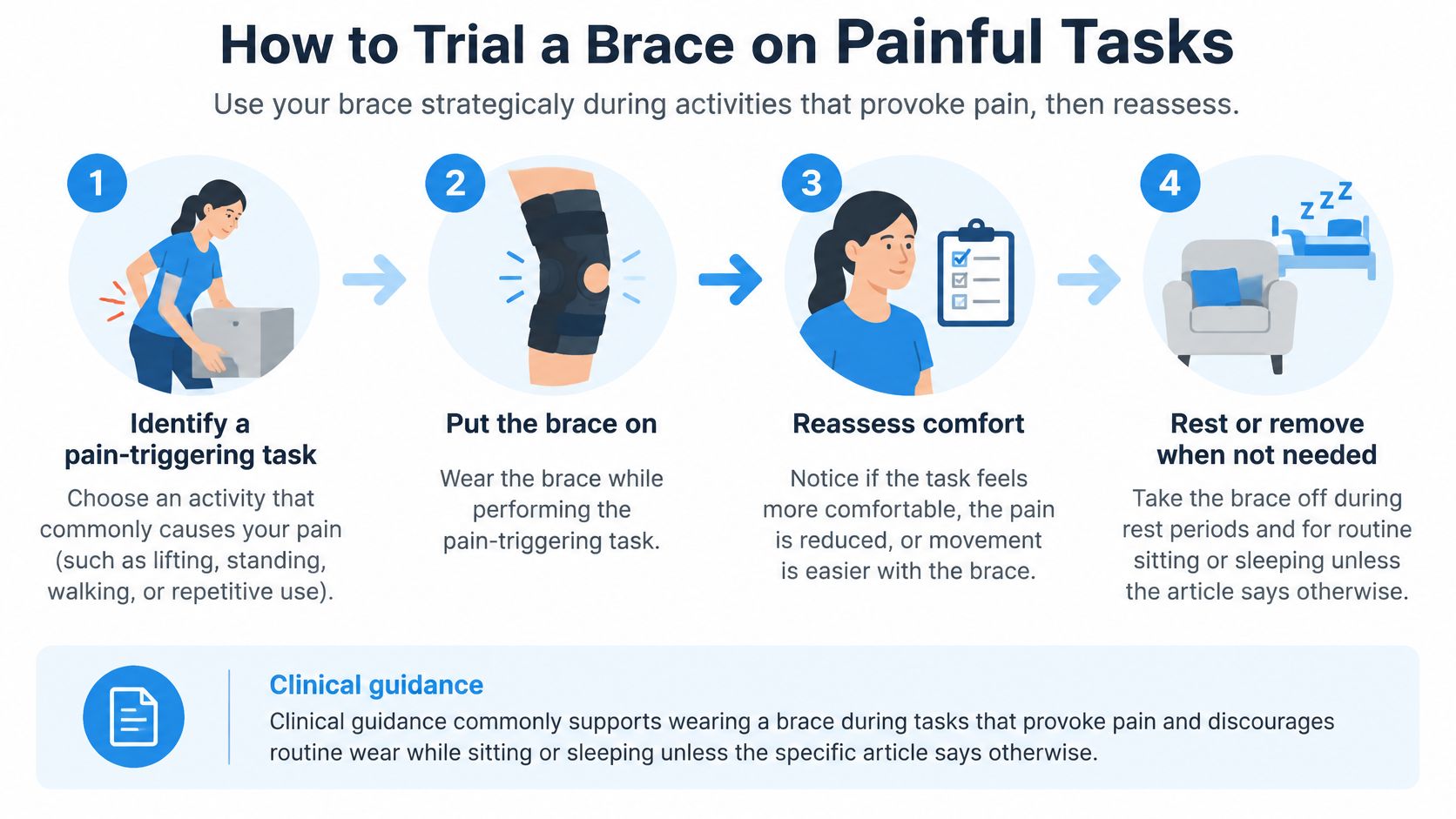
Keep the comparison fair: use the same shoes, route, and pace.
- Choose one painful task. Pick a set walk, one flight of stairs, or standing at the sink, then write down which one you chose.
- Record your starting point. Rate the pain and note how far you get or when you need to stop.
- Wear the matched brace for that task over several days. Check that it stays in place and does not pinch near the fibular head.
- Check your skin afterward for lasting redness, numbness, or rubbing.
- Repeat the same task without changing shoes or route.
- Keep using the brace only if the task feels meaningfully easier and it causes no new pain.
- Pause and seek a clinician or orthotist review if pain, swelling, or your walking pattern worsens. Do the same if instability or malalignment has not been assessed.
Why small trials beat all-day heroics
In the PROP OA randomized trial, 466 adults received advice, information, and exercise instruction alone, or the same program plus a compartment-specific brace and adherence support. At six months, the brace group had a statistically greater improvement in KOOS-5, with an effect size of 0.24 and an adjusted between-group difference of 3.39 points. These results describe a modest average benefit between the trial groups, not a guarantee for any one person.
The adherence support was part of the brace program. Slipping, heat, skin irritation, and restricted movement can make a brace difficult to use. If it makes you skip the walk or strengthening work you planned, it is not serving its purpose, even if it looks sturdy.
If your skin is sensitive, start with breathable, non-compressive fabric and a shorter session. For a painful squat, test that movement on its own using this guide to knee pain while squatting. A brace that helps on a walk may not help in a deep bend.
Myths That Waste Money and Delay Care
A brace rebuilds cartilage. It doesn't. Braces may affect pain, function, and quality of life, but a quieter walk doesn't mean the joint surface has grown back. Strength work, and weight management when body weight adds to the load, still belong in the plan.
Tighter is better. A painful squeeze can shorten a walk instead of making it easier. If a sleeve leaves dents or a hot band, loosen it or try a different design. Stop wearing it at once if numbness appears, and have a clinician check the fit.
Infrared warmth unloads the inner knee. Warmth may make a recovery sleeve feel comfortable, but it does not shift the knee's load the way an unloading brace is designed to. Keep it for comfort if your trial task improves. Don't mistake warmth for mechanical support.
You should wear a brace around the clock. Continuous wear isn't the default for osteoarthritis braces. Start with task-time wear unless a clinician recommends wearing it for rest or sleep.
A failed cheap sleeve proves bracing can't help. A soft tube may be the wrong tool for pain from one knee compartment. The three brace types serve different jobs: a sleeve offers light compression, a hinged brace can address instability, and an unloader is designed to shift load away from a painful compartment. A poor match doesn't settle whether another type might help.
Safety edges aren't optional. Stop wearing the brace if numbness, skin breakdown, new swelling, or a brace-related limp appears. Locking, red-flag pain, or unpredictable giving way calls for a clinician's assessment before another purchase. A package claim can sound certain even when trial results are modest. Judge the brace by what happens during the activity you chose, and get clinical help when warning signs appear.
Decide What to Wear This Month
Three forks cover the choice without another full table.
Walking is limited by medial or lateral compartment pain. Ask a clinician about a fitted unloader, and keep strengthening in the plan. A sleeve doesn't replace that crowbar when one compartment is the clear problem.
The knee feels unstable. Ask about a hinged brace and a gait check. The guardrail is for giving way, not for a worn floorboard you haven't imaged.
Symptoms are milder, skin is sensitive, or tight compression already failed. A non-compressive recovery sleeve is a reasonable adjunct for rest and light activity while a several-day task test runs. Choose it for breathability, fit, and comfort, not for unloading. Thermo Recovery Wear makes compression-lite, infrared-responsive knee sleeves in that comfort category, meant for warmth during light activity rather than for shifting compartment load. Any sleeve, including that one, still has to pass the same single-task test.
If malalignment or giving way is the story, book the orthotist visit before you add another sleeve to the drawer. If a soft sleeve already fits and the exam isn't urgent, start one measured activity test this week and stop if skin or pain gets worse. Home measures that sit beside that test are sketched in joint pain relief at home. The trial result, not a product claim, decides whether the brace stays.
Thermo Recovery Wear offers compression-lite, infrared-responsive knee sleeves for adults who want warmth and light support without a tight squeeze, as an adjunct while you match the right brace to osteoarthritis and test it on one painful task. If a breathable, non-compressive sleeve fits the milder, sensitive-skin fork, visit Thermo Recovery Wear to compare sizes and wear guidance, then keep or return the sleeve based on that task test rather than on marketing.


