


A compression thermal shirt is a snug base layer that combines a compression-style fit with heat-holding fabric, but those two features do different jobs and shouldn't be judged as if they're the same thing. Research on compression garments also shows a mixed picture: a 2022 scoping review found about 85% of 156 studies were published between 2010 and 2020, and older reviews found compression looked more promising for recovery than for immediate performance, which is why the smartest question isn't “Does it work?” but “Work for what?” (research timeline and review context, compression outcomes review).
That runs against the most common shopping advice. Many guides lump compression tops, winter base layers, and recovery shirts into one bucket and imply that tighter automatically means warmer, more supportive, and better for healing. It doesn't.
A compression thermal shirt can help in the right situation. It can also leave you sweaty, annoyed, or oddly underwhelmed if you bought it for the wrong reason. The fit may support body awareness and feel stabilizing. The thermal fabric may help hold warmth near the skin. Neither feature guarantees better athletic output, and neither tells you whether the shirt will feel comfortable after four hours at a desk or under a work jacket.
The clearer way to think about this category is simple. Compression is about mechanical pressure and fit. Thermal is about insulation and moisture behavior. A third category, infrared-responsive non-compression recovery wear, sits alongside them for people who want warmth and circulation support without being squeezed into something that feels like a sausage casing.
Table of Contents
- What a Compression Thermal Shirt Actually Is
- A Short History of Compression and Thermal Layers
- How It Differs from Standard Thermals and Infrared Recovery Wear
- Material and Fabric Engineering Behind the Warmth
- Benefits, Limits, and Common Misconceptions
- How to Pick the Right Option for Your Goal
- Sizing, Wear, and Maintenance Tips
- Choosing by Purpose Instead of by Label
What a Compression Thermal Shirt Actually Is
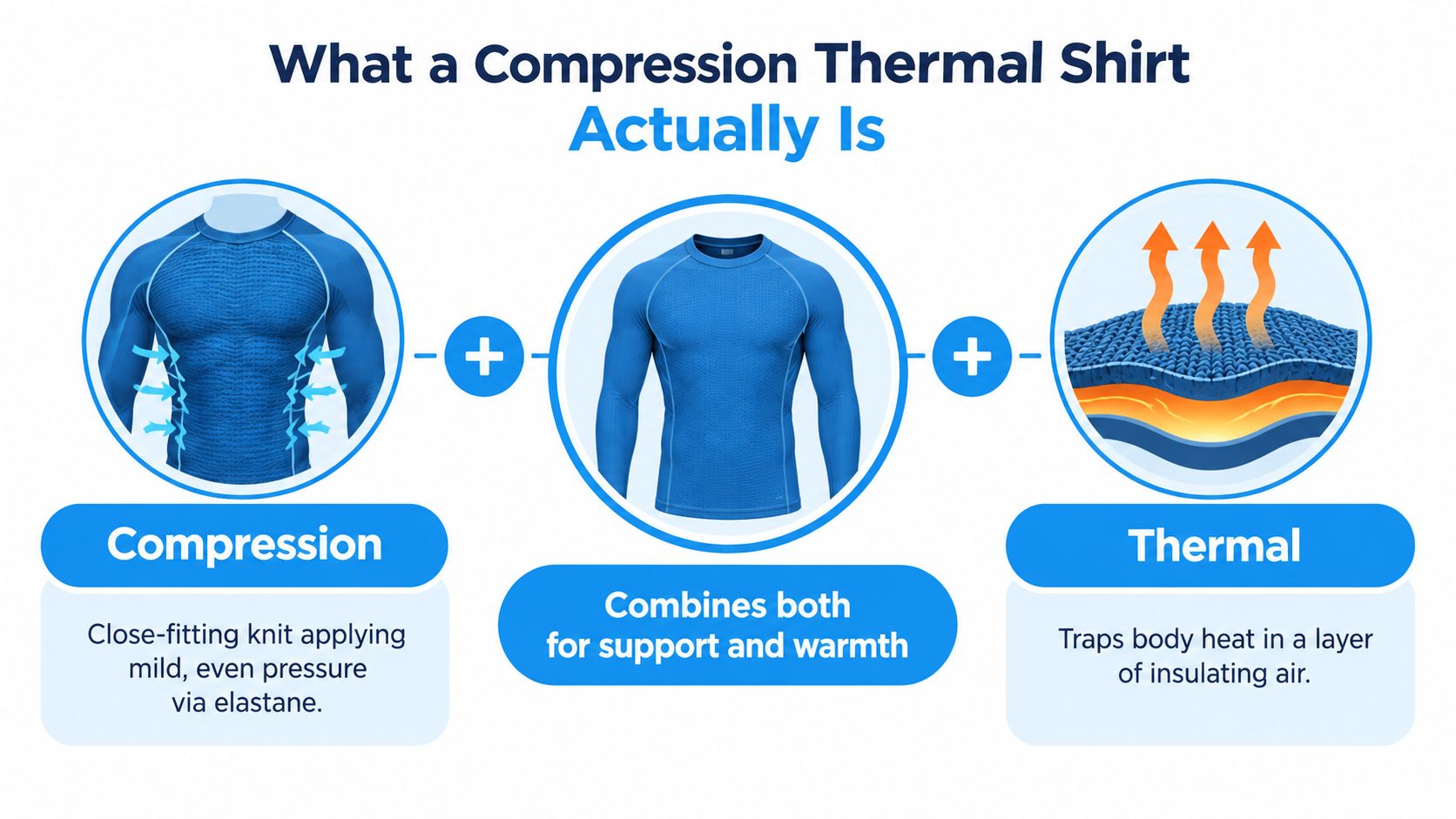
A compression thermal shirt is one garment doing two separate jobs.
The compression half comes from a close-fitting knit, usually with elastane or spandex blended into the fabric, so the shirt stretches around the torso and springs back into shape. That fit creates mild, even pressure across the body. In sportswear, that pressure often feels more like “held in” than medically compressed.
The thermal half comes from the fabric system itself. That can mean fibers, brushing, loft, or knit structure that trap a layer of warm air near the skin while still trying to move sweat vapor away from the body.
Compression and thermal aren't the same function
People often assume a tighter shirt must be a warmer shirt. That's not always true. Compression changes how the garment sits on your body. Thermal performance depends on how well the fabric holds insulating air and manages moisture.
That distinction matters because tight garments can flatten the little pockets of air that help keep you warm. They can also hold sweat closer to the body if the knit isn't built to spread and release moisture well.
Practical rule: If you want warmth, judge the fabric first. If you want a held, supportive feel, judge the fit first.
What the construction usually looks like
Most shirts in this category use a synthetic knit because it stretches well and dries faster than traditional cotton. A common build includes:
- An inner face meant to move moisture: Often polyester-based, sometimes blended with wool or other fibers.
- A structure that holds some warm air: This may be brushed, lightly lofted, or tightly knit depending on the brand's goal.
- An outer layer with stretch recovery: Elastane helps the shirt stay close to the body instead of sagging out after wear.
Some tops marketed as compression are snug performance thermals. That's worth knowing because true compression garments are usually defined by measured pressure systems, while many consumer base layers use “compression” as a fit description rather than a medical or clinically graded one.
What this shirt is best understood as
Think of it as a fitted thermal base layer with pressure-like support, not a miracle hybrid that solves every cold-weather and recovery problem at once.
If your main goal is warmth under outerwear, you may not need much compression at all. If your main goal is post-workout support or a secure body feel, the insulating side may matter less than seam comfort, moisture spread, and whether you can tolerate the fit for more than an hour.
A Short History of Compression and Thermal Layers
Compression wear and thermal layers come from different family trees, even though stores now hang them on the same rack.
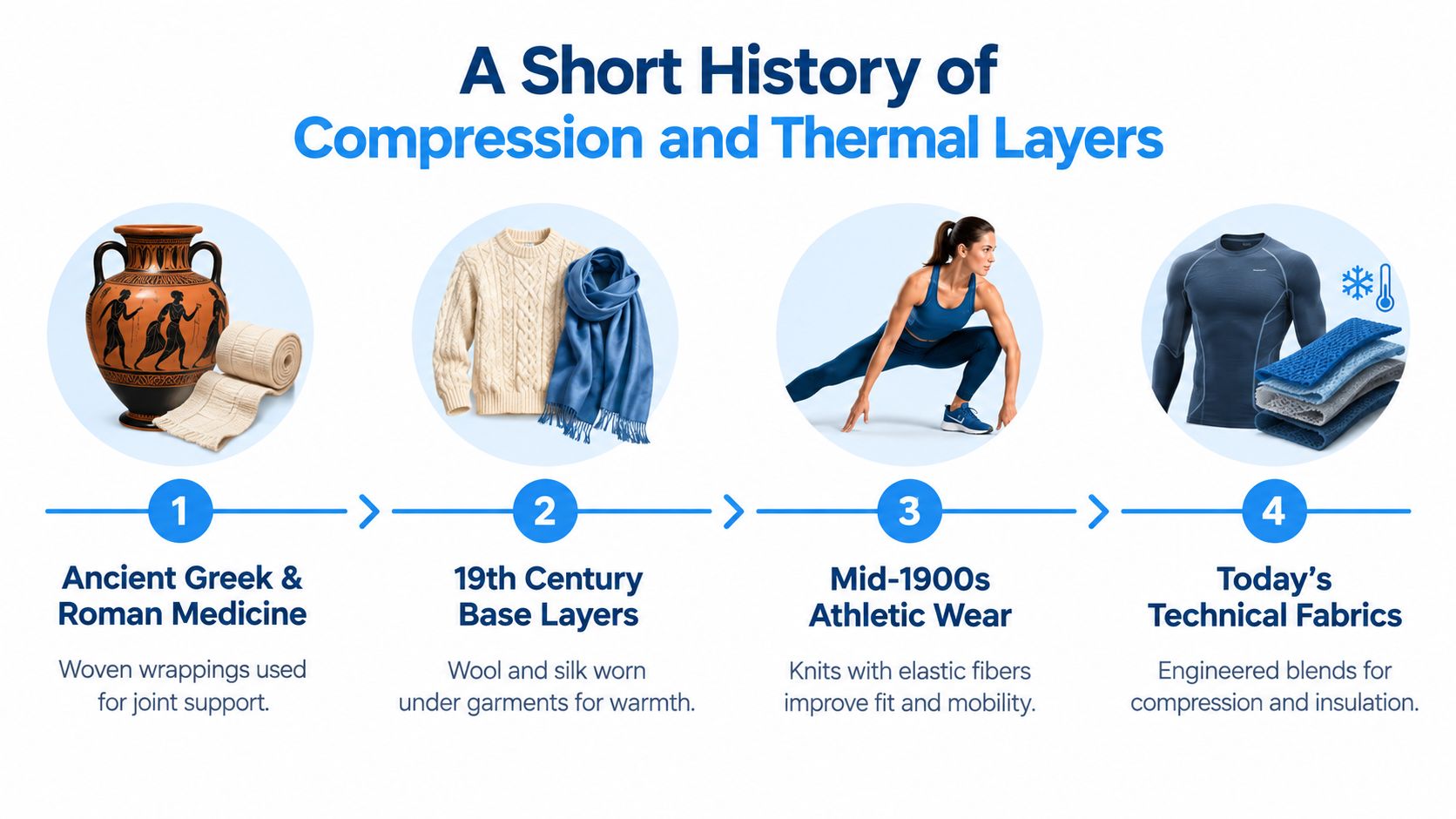
Compression has the older documented medical lineage. The earliest mention of compression therapy is traced to the Corpus Hippocraticum, about 450 to 350 BC, with bandage-based compression for varicose veins in use by 1440, and modern elastic compression stockings with graduated compression developed in 19th-century England (historical review of compression therapy).
Thermal base layers followed a different path. People wore close underlayers for warmth long before modern synthetics existed, but the idea was simple: keep a buffer of warm air near the skin and stop sweat-soaked outer clothing from chilling the body too quickly.
The sportswear version is much newer
The modern mashup of support wear and athletic apparel arrived surprisingly late. In a 2022 systematic scoping review, about 85% of 156 compression-garment studies were published between 2010 and 2020, and the earliest exercise-focused study in that review dated to 1987 (compression garment research timeline).
That tells you something useful. The medical idea is old. The sports-and-recovery version is not. The evidence base accelerated only recently, which explains why the marketing language often sounds more settled than the science really is.
Why this matters for buyers now
Today's compression thermal shirt sits at the intersection of those two traditions. It borrows the snug engineering associated with compression and combines it with the comfort expectations of a base layer.
A newer branch has now joined that line: infrared-responsive recovery wear. That category often skips strong compression and instead focuses on fabric technology meant to support warmth and local circulation response. For people who dislike tight tops, that difference can matter more than any buzzword on the package.
How It Differs from Standard Thermals and Infrared Recovery Wear
Shoppers get confused because these garments can look almost identical on a hanger. The cut may be sleek, the fabric may feel technical, and the product page may mention warmth, recovery, and support in the same breath. But the categories solve different problems.
A standard thermal base layer is built first for insulation and moisture management. It may be fitted, but it doesn't rely on body-hugging pressure as a main feature.
A compression thermal shirt adds a snugger, stretch-driven fit to that warmth job. You get more hold and body contact, but often at the cost of some ease, airflow, and all-day tolerance.
An infrared-responsive recovery garment takes another route. Instead of relying on notable compression, it uses fabric technology intended to interact with body heat. If you're new to that category, this beginner guide to infrared therapy for pain recovery gives useful background on the concept.
Compression Thermal vs. Standard Thermal vs. Infrared Recovery Wear
| Feature | Compression Thermal Shirt | Standard Thermal Base Layer | Infrared-Responsive Recovery Wear |
|---|---|---|---|
| Fit | Snug to very close | Relaxed to semi-fitted | Usually light-fitting or compression-lite |
| Primary job | Warmth plus a held, supportive feel | Warmth and sweat management | Recovery-oriented warmth and comfort without relying on squeeze |
| Typical fabric | Stretch knit with elastane and insulating structure | Thermal knit, wool blend, or synthetic insulating knit | Mineral-, ceramic-, or semiconductor-responsive fabric systems |
| Intended use | Cold training, layered sport use, people who like a secure fit | Daily wear, outdoor layering, general cold-weather comfort | Rest, light activity, chronic stiffness, users who dislike tight compression |
| Key limitation | Can feel restrictive or clammy if moisture management is weak | Less body hold and less “locked-in” feel | Doesn't replace true compression when compression is the goal |
What each one actually solves
Here's the simplest way to sort them:
- You're cold: Start with a thermal base layer.
- You want warmth and a close, athletic fit: Look at a compression thermal shirt.
- You want recovery support but hate pressure: Infrared-responsive non-compression wear may fit better.
The label “compression thermal” doesn't automatically mean infrared technology is included. Those are separate design choices.
Marketing muddies the water. A shirt can be snug without being meaningfully compressive. It can be warm without being good at recovery. And it can be recovery-oriented without feeling tight at all.
Material and Fabric Engineering Behind the Warmth
Warmth in a compression thermal shirt doesn't come from magic fibers. It comes from a series of tradeoffs in the knit, the stretch content, and the way the fabric behaves once sweat enters the picture.
A key issue is air. Insulation works because fabric helps hold a thin layer of warm air near the body. Compression can reduce that air layer, which is why “tighter” isn't automatically “warmer.”
What compression does to insulation
A technical clothing study found that hydrostatic compression alone reduced thermal insulation by 56.8%, and when water loading increased to 1000 g/m², total insulation loss reached 77.6%. In the same study, effective insulation in air fell from 3.36 clo to 2.26 clo at maximal wetting (thermal insulation under compression and wetting).
That's the hard truth behind clammy cold-weather workouts. If the shirt gets wet and stays wet, warmth drops fast.
Why stretch content changes comfort
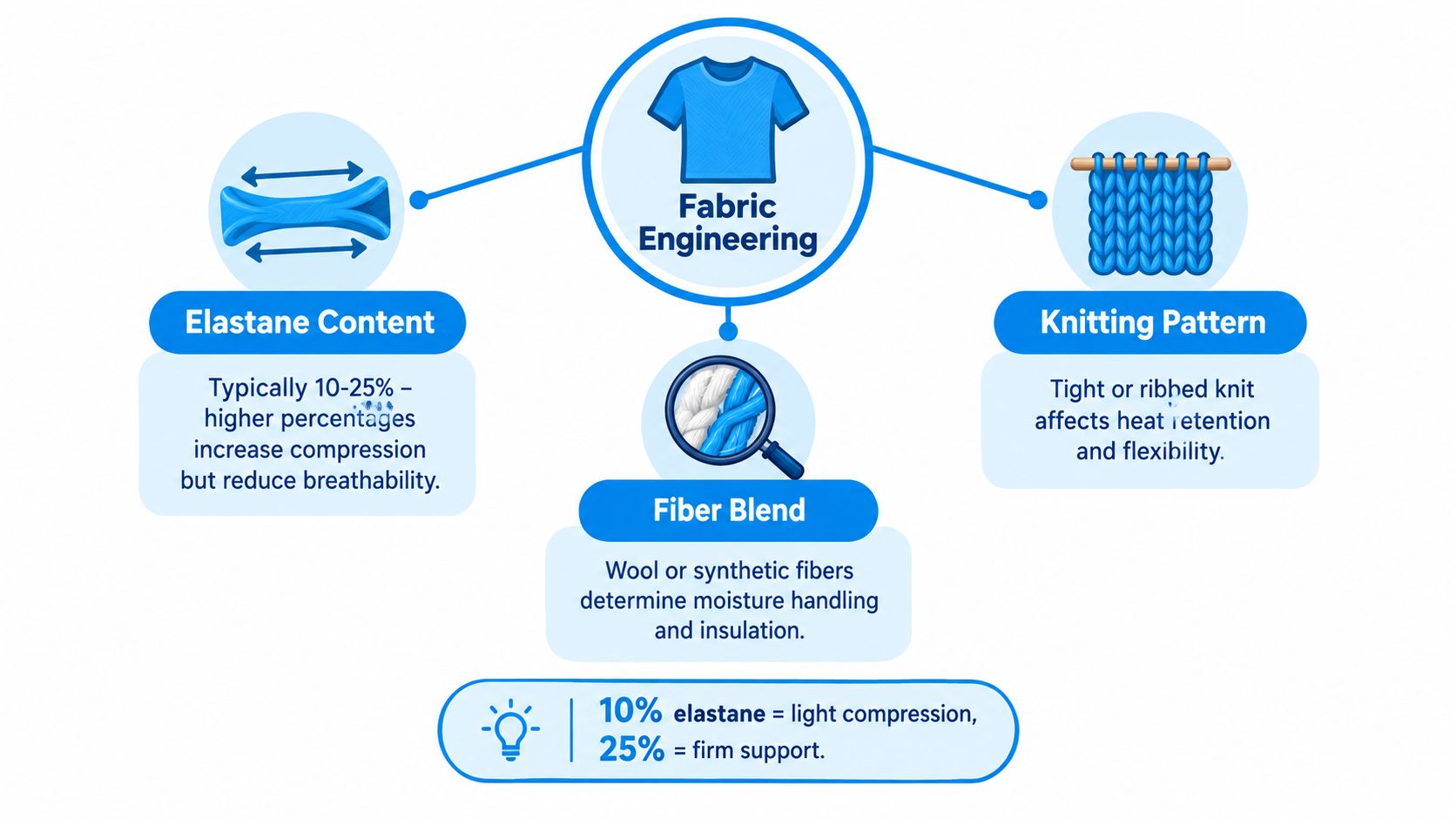
A peer-reviewed comfort study on compression athletic wear found that as elastane proportion and stretch increased, fabrics became heavier and thicker, and thermal resistance increased, but air permeability, water-vapor permeability, and moisture management worsened. The same work noted that higher yarn twist improved air and vapor permeability but reduced thermal resistance and wicking, while another garment-compression study reported that heavier and thicker fabrics had higher thermal conductivity during compression and recovery (thermo-physiological comfort study).
That sounds technical, but the buyer takeaway is simple. More squeeze and more fabric bulk can help a shirt feel warm at first. They can also make it worse at shedding sweat.
Construction details worth checking
A good product page should tell you more than “performance fabric.” Look for:
- Fiber blend: Merino blends often feel less swampy over long wear than basic synthetic-only knits. Synthetics often dry faster.
- Knit surface: Brushed interiors feel warmer against the skin. Smooth knits usually slide better under outer layers.
- Paneling: Underarm and side panels can improve movement and ventilation in a fitted top.
- Seams: Flatlock seams usually reduce rubbing under backpacks, harnesses, or jackets.
If you want a broader primer on how different layers behave outdoors, this outdoor layering guide is a useful companion because it frames base layers in the context of full clothing systems, not isolated garments.
This short video gives a visual sense of how technical layer fabrics are built and why structure matters:
For people comparing technical finishes, it also helps to understand what antimicrobial fabric does and doesn't do. It may affect odor control, but it isn't the same thing as thermal regulation or recovery support.
Benefits, Limits, and Common Misconceptions
The biggest myth in this category is that tighter always means better. Better warmth. Better circulation. Better recovery. Better support. The evidence doesn't support that kind of blanket claim.
Compression garments appear more defensible as recovery-support tools than as reliable performance enhancers. A review of randomized controlled studies found that wearing compression during exercise usually had little effect on immediate performance or delayed-onset muscle soreness, while wearing them during recovery looked more promising, with performance recovery improved in 5 of the studies that measured it and soreness reduced in 3 of those 5 studies (review of randomized controlled studies on compression garments).
What the evidence supports
A later review of runners reported no statistically significant mean effects on race performance, oxygen uptake, blood lactate, or heart rate, yet still found small positive effects on time-to-exhaustion, running economy, perceived exertion, and muscle damage markers, along with large positive effects for post-exercise leg soreness and delayed onset of muscle fatigue. More recent vascular research in that same review stream found sports compression garments enhance venous blood flow at rest, during recovery from, and in recovery after a physiological challenge, while arterial blood flow changes appeared only during a challenge (PubMed-indexed review and vascular findings summarized here).
So yes, there's a case for recovery support and circulation-related effects. No, that doesn't mean your fitted winter top is automatically making you faster or healing you faster.
Compression Thermal Shirts Claim vs Evidence
| Claim | Evidence Level | Practical Reality |
|---|---|---|
| “It boosts athletic performance.” | Mixed | Some users may notice a better body feel or lower perceived effort, but performance gains aren't reliable. |
| “It improves recovery.” | Moderate for recovery support | Recovery use is a more defensible reason to wear compression than chasing immediate output. |
| “It keeps you warmer because it's tighter.” | Context-specific | Tightness can also flatten insulating loft and worsen clamminess if the fabric handles sweat poorly. |
| “It improves circulation.” | Partial and context-dependent | Compression can support venous blood flow in certain conditions, but that isn't the same as a blanket medical claim. |
| “It's the same as medical compression.” | Weak | Athletic compression wear and medical compression garments are not interchangeable. |
Where discomfort enters the picture
Independent reviews also found that skin temperature often rises locally, while core temperature, sweat rate, and performance measures usually do not change, and evidence for performance benefits is described as equivocal. The same review notes perceived soreness may improve without a clear physiological effect, and recent upper-body research found no significant differences in thermoregulatory or cardiovascular responses during exercise, though recovery temperature effects were seen afterward (upper-body compression and thermal response review).
If a shirt feels warmer on your skin, that doesn't automatically mean your whole body is thermoregulating better.
For sensitive skin, long wear can be the test. Research on fit and comfort suggests garment construction may matter more than the compression idea itself. A made-to-measure study found variable pressure profiles did not change skin temperature, but higher peak pressure reduced comfort, and another sportswear comfort study found athletes noticed broader areas of poor cooling in cotton than in sweat-wicking and compression tops (fit, pressure, and comfort findings).
That's why a shirt can look impressive on paper and still become your least favorite layer by lunchtime.
How to Pick the Right Option for Your Goal
Start with the wrong question. They ask, “Which shirt has the most support?” A better question is, “What problem am I trying to solve?”
If you answer that first, the category usually picks itself.
If your goal is pain relief or stiffness reduction
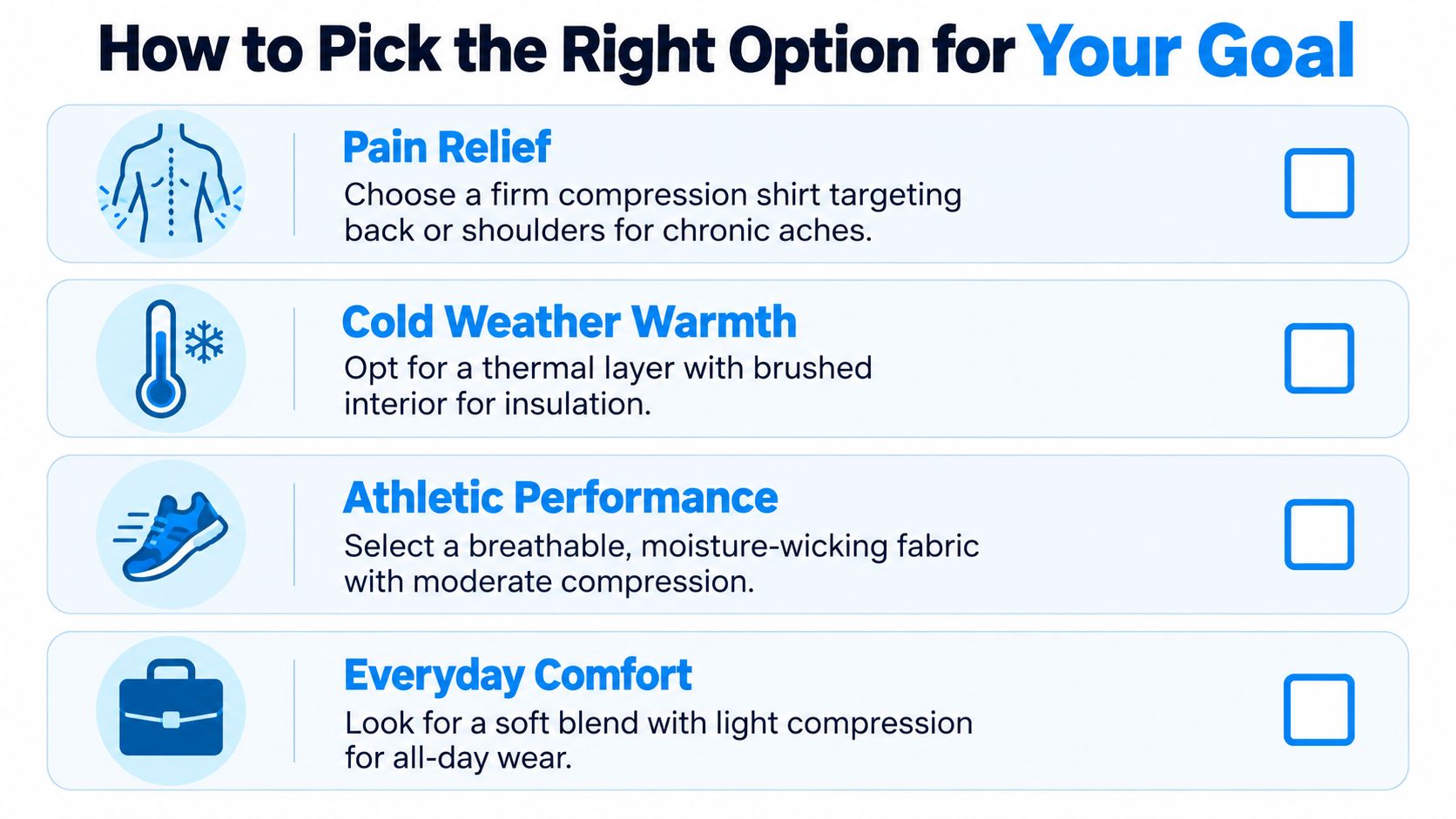
For chronic back or shoulder tension, a tightly compressive thermal top isn't always the friendliest choice. Some people like the braced feeling. Others find that torso pressure gets irritating fast, especially while sitting, driving, or trying to sleep.
If your body responds badly to squeeze, a non-compression recovery option may make more sense. For example, Thermo Recovery Wear focuses on compression-lite, infrared-responsive sleeves and braces intended for local warmth and circulation support rather than strong garment pressure. That approach suits people who want comfort and steady wear more than a locked-in athletic fit.
If your goal is staying warm for hours
For cold offices, outdoor work, walking, or general winter layering, put thermal behavior ahead of compression.
Choose:
- Soft inner surface: Brushed or comfortable next-to-skin fabric helps for long wear.
- Moderate fit: Close enough to layer cleanly, not so tight that you feel compressed all day.
- Moisture-minded construction: Especially if you move between indoors and outdoors.
Skip shirts with aggressive waistbands, thick seam ridges, or torso panels that feel fine for ten minutes and annoying for six hours.
If your goal is athletic recovery after training
This is the strongest case for a compression thermal shirt, but only if your training environment supports it. A snug layer can feel good after sessions in cool weather. It may also suit athletes who like a compact body feel during warm-up and recovery periods.
Prioritize:
- Balanced stretch, not maximum stretch
- Flatlock seams
- Fabric that doesn't stay wet
- Easy layering under a jacket or hoodie
If your sessions are sweaty and high output, don't let “thermal” fool you into buying something too insulated for your real workload.
If your goal is comfort with sensitive skin
Sensitive skin changes the whole decision. Pressure, trapped sweat, rough seams, and heat buildup can matter more than recovery claims.
A practical checklist:
- Can you tolerate close contact on the torso? If no, skip strong compression.
- Do you overheat easily? If yes, avoid thick brushed interiors unless you're in cold conditions.
- Do seams or labels bother you? Look for smooth construction and simple panel layouts.
- Are you buying for arm support rather than a full shirt? A targeted product may serve you better, such as a tennis arm sleeve if the issue is localized rather than full-torso.
Buy for the body part and the situation, not for the most technical-sounding label.
Sizing, Wear, and Maintenance Tips
Fit problems usually start before you ever put the shirt on. People size down because they want “more compression,” then wonder why the shirt rides up, digs into the underarms, or feels colder once they start sweating.
Sizing it correctly
Use the brand's own chart, not your guess based on another top in your closet.
Check three things:
- Chest measurement: This sets most of the garment tension.
- Torso length: Too short, and it creeps upward under outer layers.
- Sleeve reach: Too little length creates pulling across the shoulders and wrists.
If you're between sizes, think about use. For hard training, a cleaner athletic fit may work. For all-day wear, a slightly less aggressive fit is often the more wearable choice.
Wearing it without fighting it
A compression thermal shirt works best as a base layer, not as a punishment device.
Watch for these signs of a bad fit:
- Bunching under the armpits
- Neckline pressure
- Waist hem rolling
- Cold damp feeling after light activity
Those clues usually mean the fabric system or fit isn't right for your body and use case.
Washing it so it still performs
Stretch fibers and moisture-managing finishes don't love rough laundry habits. Wash gently, skip fabric softener, and air-dry when possible to protect the fabric's recovery.
For people who already care for technical support garments, this guide on how to wash knee sleeves applies the same logic. Keep the fabric clean, don't cook the elastane, and avoid residues that interfere with moisture movement.
Replace the shirt when it no longer rebounds, when cuffs bag out, or when the fabric pills enough to change how it slides under other layers.
Choosing by Purpose Instead of by Label
The label on the package can blur more than it clarifies. “Compression.” “Thermal.” “Recovery.” Those words overlap in marketing, but they still point to different functions.
A simple decision filter
Use this short checklist before you compare brands:
- You want warmth first: Start with a standard thermal base layer.
- You want warmth plus a close, athletic hold: Consider a compression thermal shirt.
- You want local comfort and recovery support without squeeze: Look at infrared-responsive recovery wear.
- You only need support in one area: A sleeve, brace, or targeted garment may be more comfortable than a full shirt. This overview of types of recovery wear for joint and muscle support can help narrow that down.
The takeaway most shoppers miss
You rarely need all three functions at once. In fact, trying to combine strong compression, serious insulation, and all-day comfort in one shirt is often what makes a product disappointing in real life.
A useful garment feels right for the job. It doesn't just sound advanced.
If you run cold and want a clean base layer under workwear, buy for warmth. If you like a secure athletic fit for cool-weather training or recovery, buy for that. If tight clothes make you miserable but you still want warmth and circulation-focused support, buy accordingly.
That's the whole point. Choose by purpose, not by label.
If you want recovery-oriented support without the feel of traditional tight compression, Thermo Recovery Wear offers infrared-responsive, compression-lite sleeves and braces designed for warmth, comfort, and daily wear. It's a useful option when your goal is local pain relief or circulation support and a full compression thermal shirt feels like more squeeze than help.


