


You step off a curb, your foot turns inward, and a sharp pain shoots across the outside of your ankle. Within minutes, the practical questions start: Should you keep walking, use ice, wrap it, or buy an ankle brace?
The short answer to “do ankle braces help sprains?” is yes, particularly for mild-to-moderate lateral sprains and for preventing another roll during higher-risk activity. But a brace isn't a repair by itself. It protects healing tissue while you gradually restore movement, strength, balance, and confidence.
Table of Contents
- The Moment You Roll Your Ankle and Wonder About Bracing
- How Ankle Braces Actually Support a Sprained Joint
- What the Clinical Evidence Says About Braces and Recovery
- Matching Brace Types to Sprain Grades and Activity Goals
- How Long to Wear an Ankle Brace After a Sprain
- Where Bracing Fits Inside a Full Sprain Rehab Plan
- Pros, Cons, and Non-Compression Alternatives Worth Knowing
The Moment You Roll Your Ankle and Wonder About Bracing
Consider a common situation. You're walking across a parking lot, step on an uneven edge, and your sole turns inward. The outside of the ankle takes the force, often stressing the anterior talofibular ligament and, with a stronger roll, the calcaneofibular ligament. Swelling may arrive quickly, and the ankle can feel both painful and strangely unreliable.
A brace can help during this early period because it limits the side-to-side motion that caused the injury. A functional ankle brace is designed to reduce excessive inversion and eversion while allowing the ankle to move up and down. That distinction matters. You may need protection from another roll, but complete immobilization can make ordinary walking and progressive rehabilitation harder.
The first 48 to 72 hours are often the most uncomfortable because pain and swelling can make the joint difficult to load. A brace may provide external protection when you begin standing or walking, but it shouldn't be used to force weight-bearing through severe pain. If you can't bear weight, have marked tenderness directly over a bone, or feel that the ankle is grossly unstable, seek an assessment before assuming you have a routine sprain.
What the brace is doing
The support has three practical effects:
- It limits the risky direction. The brace creates a physical boundary against excessive inward rolling.
- It gives sensory feedback. Compression and strap pressure help you notice the ankle's position as you move.
- It can improve confidence. Feeling supported may make it easier to take controlled steps instead of guarding the joint with a stiff, awkward gait.
That doesn't mean the brace takes over the ligaments. It reduces the chance that a healing ligament will be pushed into the same vulnerable position while you regain control. If you're unsure whether your injury is mild, moderate, or severe, this guide to ankle sprain grades and symptoms can help you understand the terminology, but it can't replace an examination.
A brace is one decision inside a longer recovery timeline. The useful questions aren't only whether it helps, but which brace fits the injury, when to wear it, when to remove it, and what rehabilitation must happen alongside it. Those answers depend on both the ligament damage and what you need the ankle to do next.
How Ankle Braces Actually Support a Sprained Joint
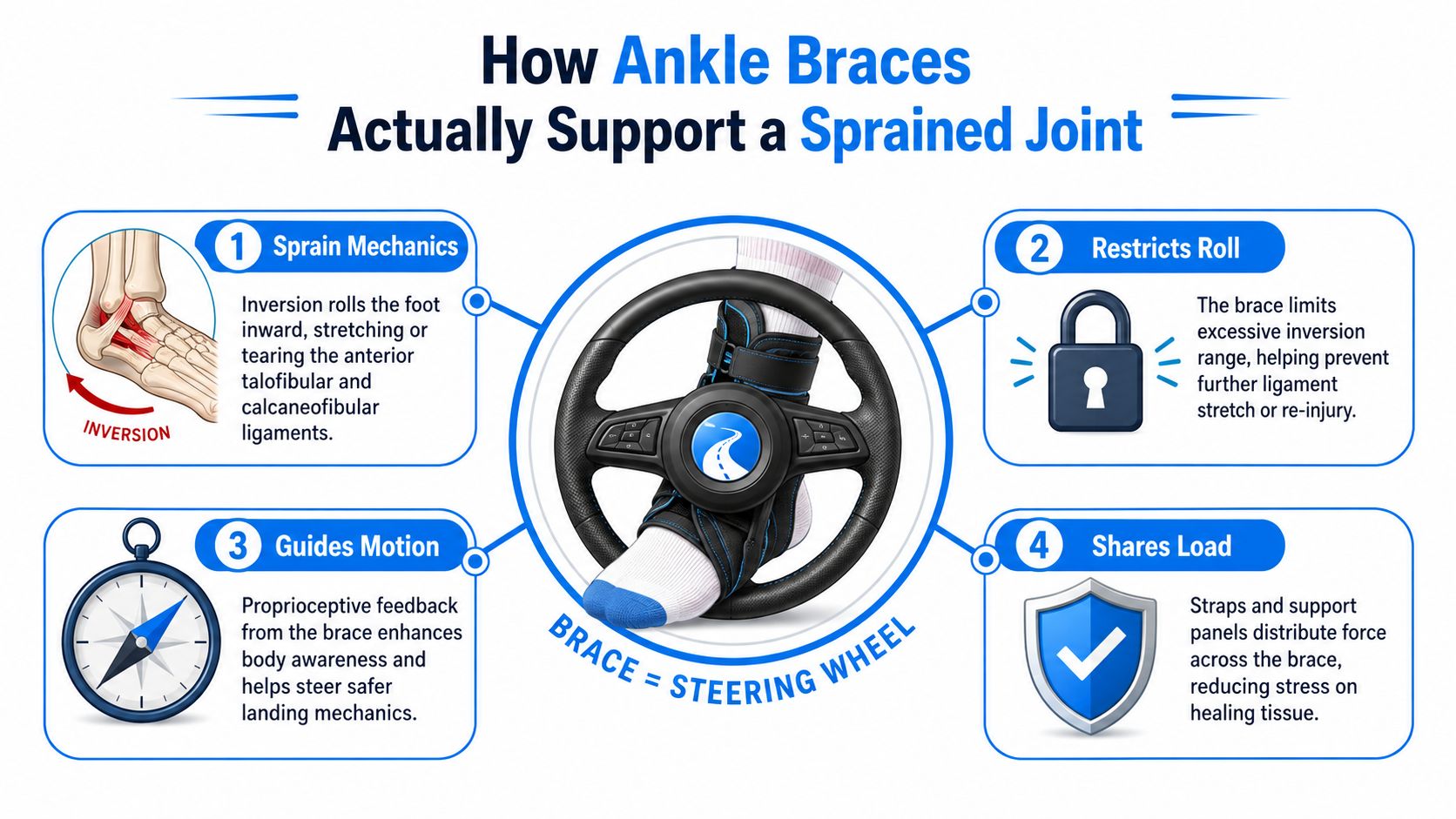
Think of the ankle as a steering system rather than a hinge that should be locked. After a lateral sprain, the damaged tissues need less uncontrolled side-to-side motion, but the joint still needs useful forward and backward movement for walking. A functional brace acts like a steering wheel with a limiter. It guides the ankle away from an excessive roll without preventing every movement.
An inversion sprain stretches or tears ligaments on the outside of the ankle. The brace's side supports, straps, or lace-up panels resist that inward angle. At the same time, a well-fitted functional brace preserves plantarflexion, when you point the foot downward, and dorsiflexion, when you bring the foot upward. This is why functional support differs from placing the joint in a rigid cast.
The amount of support should match the damage
Clinicians commonly describe lateral sprains in three grades:
- Grade I means the ligament fibers have been stretched, with little loss of joint stability. A light sleeve or flexible lace-up brace may be enough for walking and routine activity.
- Grade II means a partial ligament tear with more pain, swelling, and possible looseness. A lace-up or semi-rigid brace generally offers more useful control than a soft sleeve.
- Grade III means a complete rupture or substantial instability. This level needs clinical assessment because a brace may be part of treatment, but a more protective brace or temporary immobilization may be appropriate before ordinary walking.
The mechanical demand increases with severity. A soft sleeve adds compression and body awareness, while a semi-rigid stirrup creates a stronger barrier against inversion. A brace for a severe injury shouldn't be selected only by appearance or marketing language.
Why sensation matters too
Mechanical restriction is only part of the story. Pressure from the brace and contact from its straps give your nervous system information about where the ankle is in space. That proprioceptive input can help you pay attention to foot placement during a step, landing, or change of direction.
The ankle support brace guide for stopping repeated rolling is useful for understanding this distinction. The brace doesn't make the joint strong. It helps control a risky movement while your muscles and balance system learn to manage the load again.
Practical rule: A brace should make controlled movement easier, not give you permission to ignore pain, swelling, or instability.
What the Clinical Evidence Says About Braces and Recovery
The evidence supports functional bracing, but the benefit depends on which outcome you're asking about. A brace can improve short-term function and reduce the chance of another sprain. That doesn't prove the brace independently speeds every aspect of ligament healing.
A randomized controlled trial published in 1996 compared 50 patients with inversion ankle sprains. Patients using an Aircast ankle brace had higher Karlsson functional scores than those using an elastic support bandage at 10 days, with mean scores of 50 versus 35, and at one month, with mean scores of 68 versus 55. Both differences were statistically significant, with the trial reporting p values of 0.028 and 0.029. In plain language, the brace group functioned better over the short follow-up period.
Recurrence prevention is where the signal becomes especially practical for active people. In a 2014 randomized trial of 384 athletes who had a previous lateral ankle sprain, 17 of 126 athletes in the semirigid-brace group had another sprain, compared with 29 of 120 in the neuromuscular-training group. The relative risk was 0.53, with a 95% confidence interval of 0.29 to 0.97, as reported in the British Journal of Sports Medicine trial.
Two different questions, two different answers
| Outcome | Functional Brace vs Immobilization | Brace vs Control for Recurrent Sprain |
|---|---|---|
| Early function | Functional treatment can support better practical recovery than prolonged immobilization in appropriate acute sprains. | Not the main outcome measured in this comparison. |
| Repeat injury | Functional support is useful during rehabilitation and higher-risk activity. | The brace group had fewer recurrences, 15% versus 27%, in the cited trial. |
| What it means for you | A brace may help you load and move the joint more normally. | Continued use during sport can be a meaningful prevention strategy after a previous sprain. |
Reviews describe functional bracing as generally more useful than prolonged immobilization for acute lateral sprains, while comparisons among semi-rigid, lace-up, tape, and other supports are less uniform. The literature also has inconsistencies around brace definitions and limited clarity for severe injuries. A review of functional ankle bracing evidence reflects that more nuanced picture.
The practical conclusion is straightforward. Use the brace to protect function and reduce recurrence risk, but credit rehabilitation for rebuilding capacity. Pain-guided loading, strength work, and balance training still determine whether the ankle can handle the next uneven surface or sudden cut. For broader recovery context, this muscle recovery resource can help separate supportive tools from the work that restores physical ability.
Matching Brace Types to Sprain Grades and Activity Goals
Brace selection becomes easier when you start with the task, not the product label. A person who needs to walk around the house has a different requirement from a basketball player preparing for repeated jumps and cuts. The same ankle may also need more structure early in recovery and less structure later.
Four common support choices
A semi-rigid stirrup uses firmer side supports to control inversion and eversion. It suits an acute injury with noticeable swelling, pain during weight-bearing, or a feeling that the ankle wants to give way. It can be particularly useful when a Grade II or clinically assessed Grade III injury needs stronger protection, although severe instability should be managed with professional guidance.
A lace-up brace surrounds the ankle and uses adjustable straps to provide lateral support while preserving useful up-and-down movement. It often fits the transition from a mild or moderate sprain back to running, court sports, or field activity. Its adjustability also helps accommodate changes in swelling.
A soft sleeve or compression wrap provides light support, warmth, and sensory input. It makes sense for a low-grade sprain, residual swelling, or a stable ankle that needs a reminder during ordinary movement. It isn't a substitute for stronger protection when the joint feels loose.
Athletic tape can provide short-term control for a practice, match, or event. It requires correct application, can loosen with sweat, and may irritate skin. It can be useful when a low-profile option is needed, but it doesn't automatically provide more protection than a properly fitted brace.
| Brace Type | Best For | Activity Use | Key Limitation |
|---|---|---|---|
| Semi-rigid stirrup | Acute moderate support needs | Walking during early weight-bearing | Bulkier and more restrictive |
| Lace-up brace | Mild-to-moderate sprains and return to sport | Running, court sports, and field activity | Straps can loosen or require adjustment |
| Soft sleeve | Stable low-grade sprains and lingering swelling | Daily movement and light activity | Limited control of a true ankle roll |
| Athletic tape | Short-duration support when low profile matters | A specific practice or event | Application, skin tolerance, and consistency matter |
A brace cannot reverse torn tissue. It limits the range that might repeatedly stress the healing ligament. Choose the support level that protects the worst moment in your current activity, then step down as walking, strength, and balance improve. These ankle compression sleeve selection guidelines can help when the ankle is stable enough for lighter support.
How Long to Wear an Ankle Brace After a Sprain
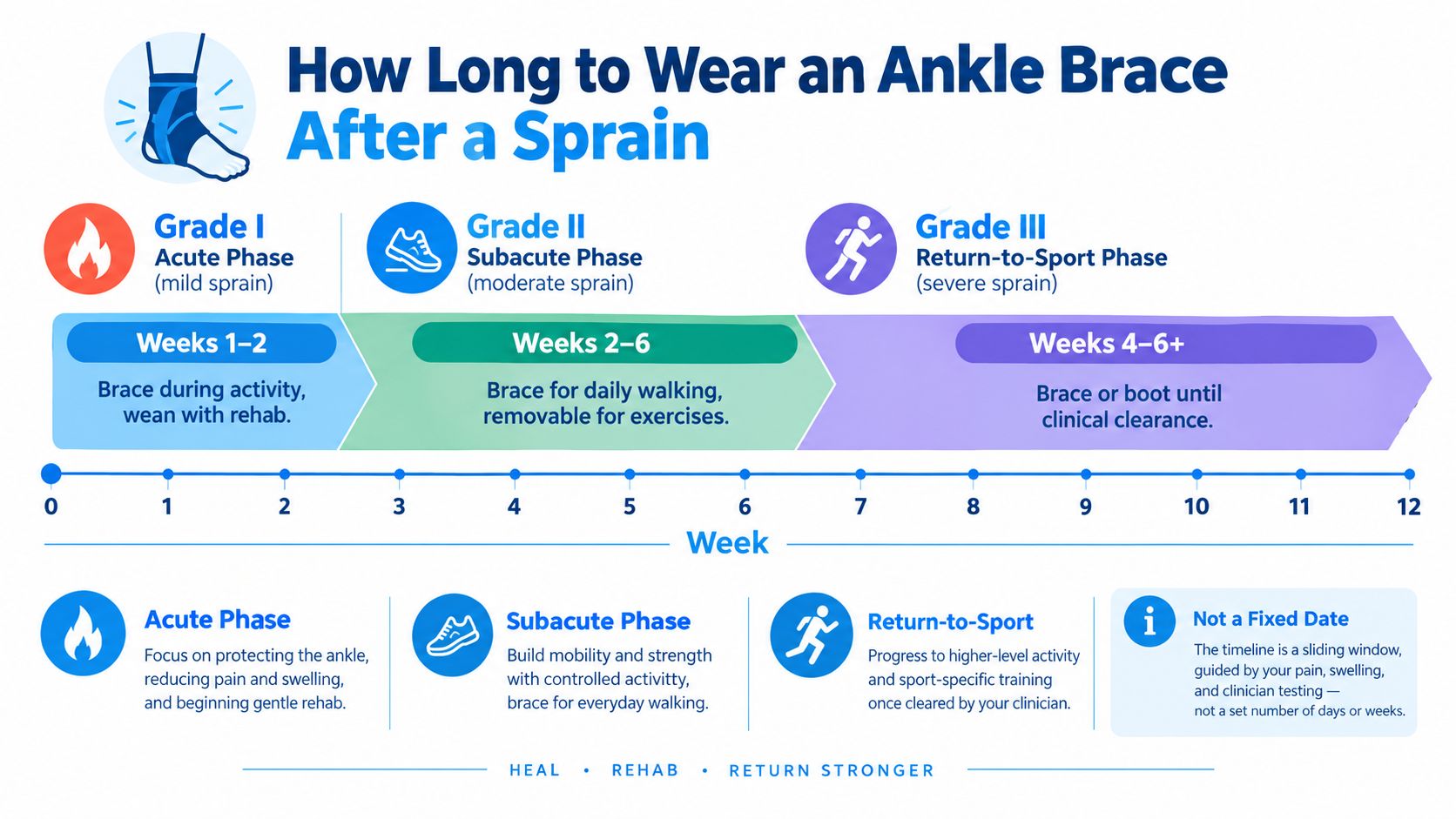
There isn't one universal stop date. A 2024 review found agreement that ankle braces are useful for Grade I and Grade II sprains and for preventing recurrence, but it also highlighted inconsistent brace definitions and limited guidance about duration and the criteria for stopping. The review on ankle brace use and clinical guidance supports a function-based approach rather than a calendar-only rule.
During the acute phase, wear the brace for weight-bearing activity if it makes walking more controlled and comfortable. That can include ordinary trips across the house, work, or uneven outdoor surfaces. Remove it when you're resting unless a clinician has instructed otherwise, and check the skin, swelling, and fit regularly. Sleeping in a brace isn't automatically necessary, and routine removal allows hygiene and skin inspection.
A practical taper
Use these questions to decide whether support can reduce:
- Can you walk without a limp? If the brace is the only reason you can move normally, keep using it for walking and get guidance before progressing.
- Has swelling settled after ordinary activity? A flare later that day means the current load may be too high, even if the brace feels comfortable.
- Can you complete rehabilitation drills with control? Range-of-motion, calf strength, and balance should improve without the ankle repeatedly buckling.
- What is the risk of the activity? Uneven trails, cutting sports, jumping, and contact play justify continued activity-only bracing longer than quiet household movement.
A sensible pattern is more support during the vulnerable phase, activity-only use during return to sport, then as-needed use for high-risk sessions. Don't treat those stages as fixed prescriptions. Pain, stability, strength, and clinician testing should determine the transition.
The following video demonstrates additional context for ankle support and recovery:
Where Bracing Fits Inside a Full Sprain Rehab Plan
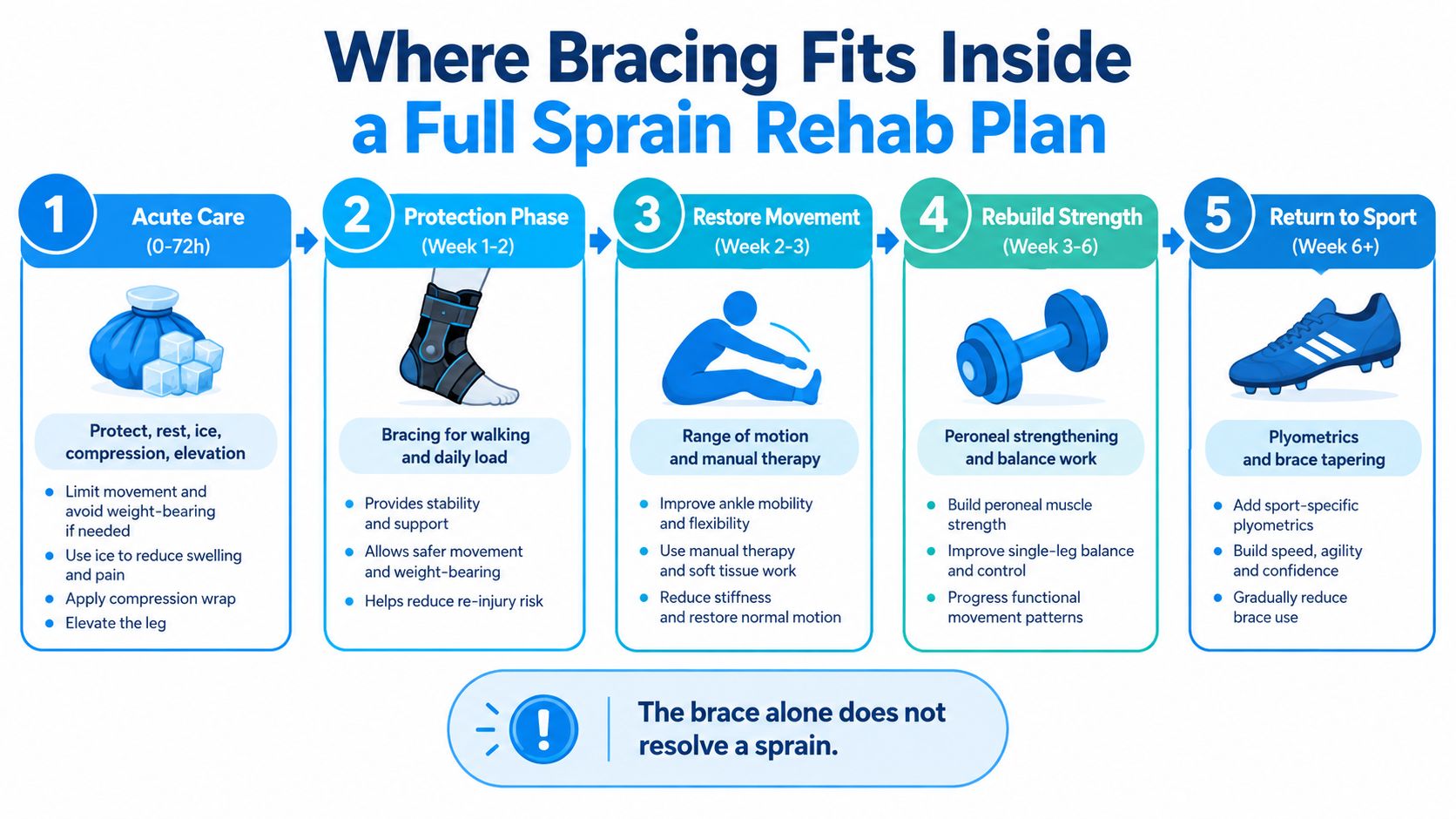
A brace protects the ankle, but it doesn't restore the abilities that prevent future injury. If you wear support while avoiding movement, strengthening, and balance work, you may feel safer without becoming more capable. The best use of a brace is to create a controlled environment in which normal loading can resume.
Early protection and comfortable movement
During the first 48 to 72 hours, focus on protection, relative rest, ice, compression, and elevation as tolerated. A brace or stirrup can protect the ankle when you begin weight-bearing, provided the injury has been assessed when symptoms are severe. It should reduce painful rolling, not force the joint through sharp pain.
As the ankle settles, begin gentle range-of-motion work outside the brace. Ankle alphabets, towel slides, and easy calf movements can help you explore motion without repeatedly challenging the injured direction. These ankle mobility exercises should be adjusted to your symptoms rather than performed aggressively.
Rebuilding capacity
Once basic movement is tolerable, rehabilitation usually progresses toward:
- Strength: Resisted inversion and eversion, controlled calf raises, and progressive lower-leg loading.
- Balance: Single-leg standing, reaching tasks, and unstable-surface work when appropriate.
- Sport control: Hops, deceleration, landing, and change-of-direction drills introduced gradually.
Perform exercises without relying completely on the brace so the ankle's muscles and sensory system learn to manage the joint. Wear the brace for activities where a missed step or rapid roll remains likely. The support buys time for healing biology and motor learning to catch up, but it doesn't replace either one.
For additional practical advice on managing discomfort at home, these sprained ankle healing tips from MEDISTIK can complement, rather than replace, an individualized rehabilitation plan.
A brace is a safety net during loading. It isn't the net that carries the entire recovery.
Pros, Cons, and Non-Compression Alternatives Worth Knowing
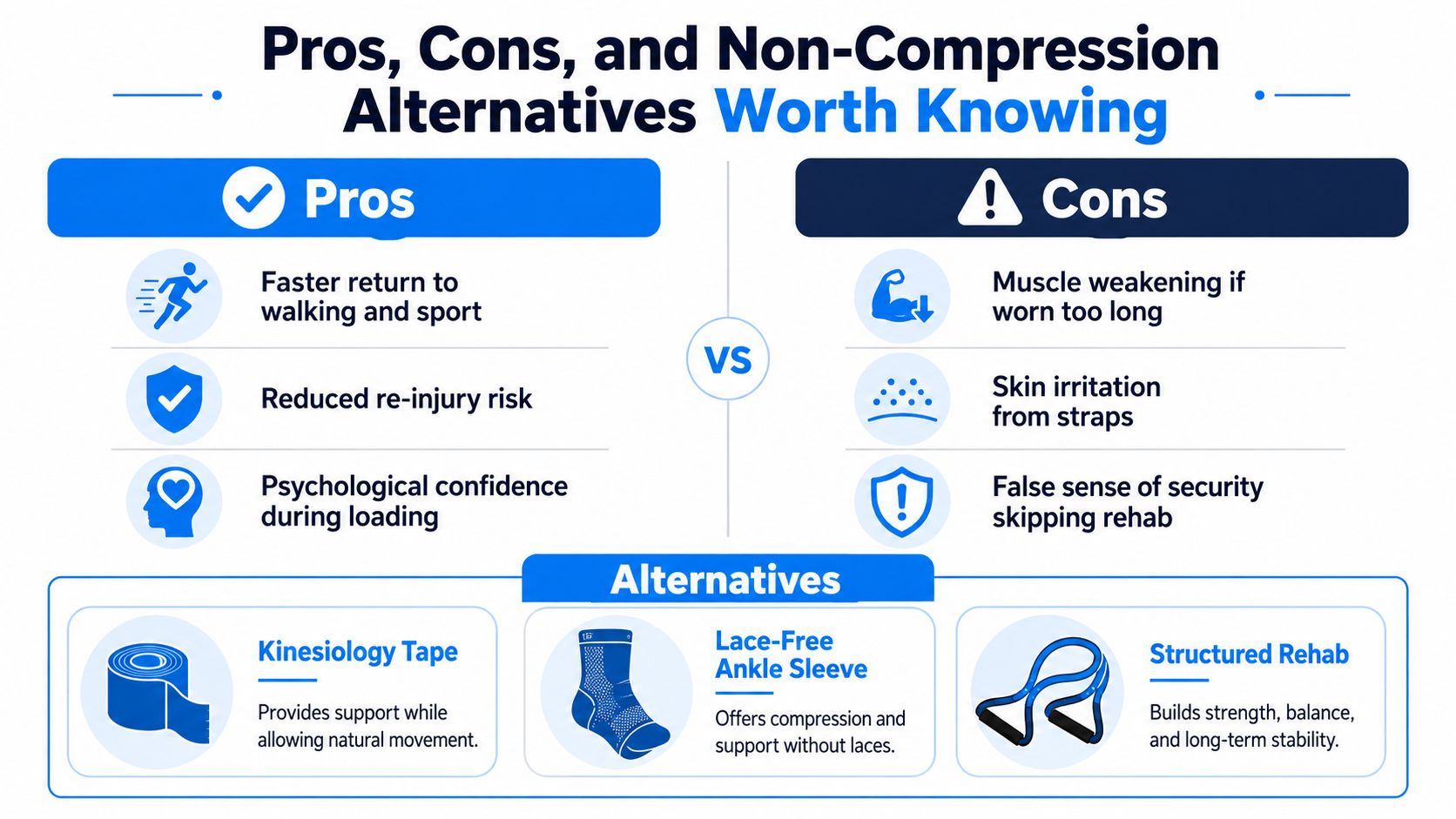
The main advantage of an ankle brace is practical. It can help you walk with less apprehension, protect the joint during a vulnerable activity, and lower the likelihood of another inversion event. In active people with a previous lateral sprain, the randomized trial described earlier found fewer repeat injuries with semirigid bracing than with the comparison approach. That makes recurrence prevention a reasonable reason to keep a brace available for sport.
Confidence also has value, as long as it leads to better movement rather than reckless movement. A person who trusts the ankle enough to load it gradually may participate more consistently in rehabilitation. The risk comes when the brace creates a false sense of security and the wearer returns to cutting, jumping, or uneven terrain before strength and balance have recovered.
The trade-offs you notice in daily life
Semi-rigid shells can trap heat and sweat. Stirrup edges or straps may rub the skin, while lace-up braces can loosen during activity and need retightening. A brace that's too tight can cause numbness, tingling, color changes, or increasing discomfort, which are signs to remove it and reassess the fit.
Use a moisture-wicking sock, keep the skin dry, and inspect pressure points after wearing the brace. People with diabetes, reduced sensation, or circulation problems should be especially cautious with tight compression because they may not notice irritation or excessive pressure early. Ask a clinician or qualified fitter for advice if sensation is reduced.
When lighter support makes sense
A soft sleeve, athletic tape, or a non-compression recovery sleeve may be reasonable when the ankle is stable and the goal is comfort, warmth, or a mild reminder during ordinary movement. Thermo Recovery Wear offers a Thermo Lite Recovery Ankle Sleeve, described as a non-compressive sleeve for flexible support during movement and recovery routines. It isn't designed to provide the mechanical stabilization needed for an ankle at high risk of inversion.
The selection principle is simple: choose support for the activity, not for the product's marketing promise. A rigid option may be appropriate when the ankle is unstable, while a lighter option may be comfortable after control has returned. Neither option replaces progressive loading and balance training.
If you've recently rolled your ankle, start by protecting weight-bearing, assess whether the injury needs professional evaluation, and choose a brace that matches your current stability and activity. For lighter support during everyday recovery, explore Thermo Recovery Wear, then pair any sleeve or brace with a gradual rehabilitation plan rather than treating it as a standalone fix.


