


Achilles pain isn't automatically a sign that you need more compression. A sleeve may feel warm, secure, and reassuring, yet the same pressure that feels helpful around one part of the tendon can irritate another. The most useful question isn't “Does compression help Achilles tendonitis?” It's which type of Achilles tendinopathy do you have, and what mechanical load does the sleeve create?
That distinction matters because the Achilles tendon can hurt in different locations and for different mechanical reasons. Pain where the tendon meets the heel bone is managed differently from pain in the tendon several centimeters above the heel. A recovery sleeve can be a comfort and proprioceptive aid, but it can't replace a progressive loading plan or clinical assessment when symptoms persist.
Table of Contents
- The Surprising Truth About Compression and Achilles Pain
- Understanding Insertional and Midportion Achilles Tendinopathy
- What the Latest Research Says About Compression Loading
- How to Use a Compression Sleeve Safely with Achilles Pain
- Comparing Compression Sleeves with Other Evidence-Based Approaches
- When to Seek Professional Evaluation Instead of Self-Treating
- Your Practical Recovery Strategy Moving Forward
The Surprising Truth About Compression and Achilles Pain
A compression sleeve can make Achilles pain feel better while placing more pressure on the part of the tendon that is already irritated. The right question is not whether compression is good or bad. It is whether the sleeve matches the location and mechanical behavior of your pain.
A 2025 randomized trial in 42 sport-active adults with chronic insertional symptoms lasting more than three months (randomized trial on low-compression rehabilitation) tested this issue directly. Both groups performed progressive tendon-loading exercises. One program also reduced compression at the tendon's heel-bone attachment by limiting ankle dorsiflexion, removing calf stretching, and using heel lifts. The other allowed more compression at that sensitive interface. The low-compression approach produced larger functional improvements at both measured follow-ups.
Why location changes the answer
Insertional tendinopathy affects the section attached to the heel bone. As the ankle bends upward, this area can be pressed against the calcaneus, particularly during uphill walking, stair climbing, or movement in restrictive footwear. A sleeve that grips the rear heel may add pressure to an already sensitive contact point. For this pattern, comfortable support around the ankle does not automatically mean helpful support at the insertion.
Midportion tendinopathy affects the tendon farther above its heel attachment. The tendon still requires gradual load management, but the pressure problem is different. A sleeve that provides gentle warmth, sensory feedback, or light support may feel useful if it does not push the ankle into a painful position. The same garment can therefore suit one pain pattern and aggravate another.
Practical rule: Judge a sleeve by the tendon's response after activity and the following morning, not only by how comfortable it feels while worn.
A sleeve may support light activity and improve comfort, yet it has not been established as a cure for tendon degeneration or a substitute for strengthening. For context on how warmth and compression garments differ, see this overview of thermal compression wear.
Understanding Insertional and Midportion Achilles Tendinopathy
Start with the location of your pain. If tenderness sits directly where the Achilles meets the upper rear heel, you may have an insertional pattern. If the discomfort is farther up the tendon, several centimeters above the heel bone, you may have a midportion pattern. Location alone can't provide a diagnosis, but it gives you an important starting point for choosing sensible support.
Approximately one-third of Achilles tendon pathology cases involve the insertion according to peer-reviewed biomechanical research on insertional Achilles tendinopathy and compression. Researchers describe a mechanical problem that resembles a rope repeatedly pinched against a hard edge. As the ankle moves into dorsiflexion, the tendon-to-bone interface can become compressed against the calcaneus. Repeated exposure may contribute to increased stiffness, tissue adaptation, and pathology.
Two pain patterns, two mechanical questions
Insertional pain often becomes more noticeable when you walk uphill, climb stairs, squat low, or wear rigid shoes that press against the back of the heel. Some people also have enlargement at the upper rear heel. Earlier clinical research cited in the biomechanical literature reported that approximately 80% of patients with insertional Achilles tendinopathy had this enlargement, commonly called a Haglund's deformity. That figure comes from a particular patient group and doesn't mean every bump causes pain.
Midportion pain usually sits above the heel attachment rather than directly on it. You may notice stiffness when you first get up, discomfort during running, or soreness after an increase in walking, jumping, or training. The tendon still needs gradual loading, but the insertion-specific concern about direct compression against the calcaneus may be less central.
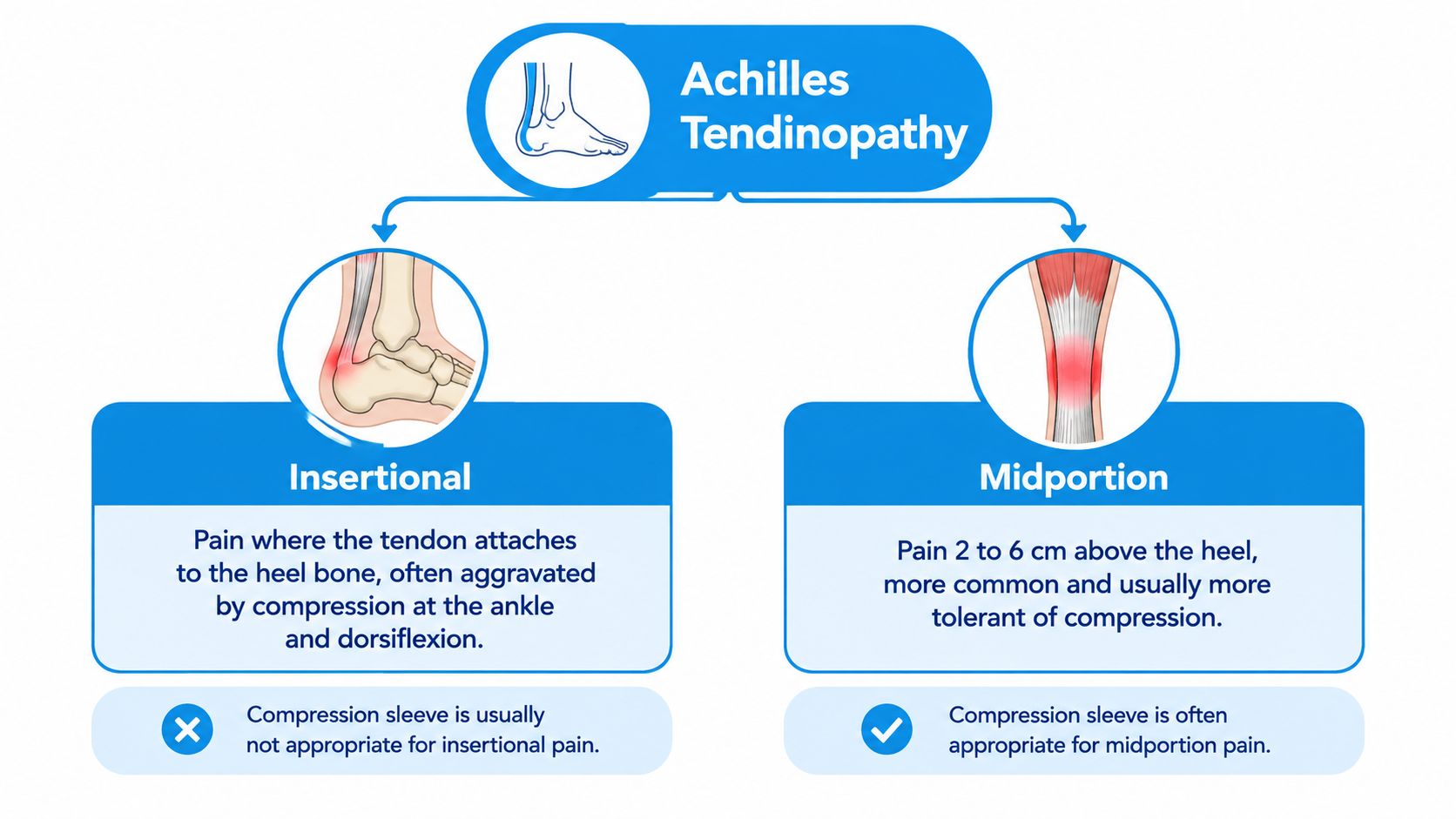
A sleeve can't tell you which pattern you have. Use these clues as a reason to modify activity and seek assessment, not as a substitute for one. The guide to posterior ankle pain can also help you think through other possible sources of discomfort around the back of the ankle.
What the Latest Research Says About Compression Loading
Compression is not automatically helpful or harmful for Achilles pain. Its effect depends on where the tendon hurts and how much pressure the support places on that area. For insertional tendinopathy, pressure at the heel attachment can act like a thumb pressing on an already sensitive spot. A sleeve may feel supportive around the tendon while still aggravating the insertion.
The 2025 investigator-blinded randomized trial described in the previous section helps separate compression from exercise. Because both groups performed progressive tendon-loading exercises, the outcome gap isolates one variable: how much mechanical compression reached the insertion during rehabilitation. The low-compression approach also reduced positions that can increase pressure, including deep ankle dorsiflexion and calf stretching, while using heel lifts.
The primary measure was the VISA-A score. The low-compression group improved by 24.4 points at 12 weeks and 29.0 points at 24 weeks. The higher-compression group improved by 12.2 points and 19.3 points at those same time points. The between-group differences were 12.9 points at 12 weeks and 10.4 points at 24 weeks, and both were statistically significant.
That pattern supports a practical principle: build tendon capacity while reducing the specific mechanical load that provokes insertional pain. It does not establish a universal compression setting, and it does not mean every sleeve will worsen symptoms.
Compression rehabilitation outcomes at 12 and 24 weeks
The table summarizes the results from the 2025 trial described earlier.
| Time Point | Low-Compression Group | Higher-Compression Group | Difference |
|---|---|---|---|
| 12 weeks | 24.4-point VISA-A improvement | 12.2-point VISA-A improvement | 12.9 points |
| 24 weeks | 29.0-point VISA-A improvement | 19.3-point VISA-A improvement | 10.4 points |
The study tested rehabilitation programs, not a retail sleeve as an isolated treatment. A garment that presses firmly against the rear heel, or encourages painful ankle bending, therefore deserves more caution for insertional symptoms. Midportion pain may respond differently because the sore area sits above the attachment, away from direct contact with the heel.
A flexible sleeve that offers gentle sensory feedback without forcing dorsiflexion may be easier to tolerate than a rigid or tightly fitted product. For general context on how compression products are positioned for recovery, see this leg recovery compression resource. Choose support according to symptom location, not the product's marketing label.
How to Use a Compression Sleeve Safely with Achilles Pain
Treat a sleeve as an experiment in symptom management, not as a prescription for tendon healing. There isn't an established Achilles-specific compression dose, and current clinical guidance reports contradictory evidence for orthoses. Exercise therapy remains the most evidence-based and cost-effective management approach, while increased blood flow from intermittent pneumatic compression hasn't been clinically investigated as a treatment for tendinopathy, according to the 2024 Achilles clinical practice guideline.
A cautious fitting process
Begin with a short period during light activity, such as easy walking on level ground. Don't start by wearing the sleeve through a long hike, a demanding workout, or sleep. The garment should feel secure without creating throbbing, sharp pressure, skin color changes, or a pinching sensation over the tendon insertion.
Check the rear heel carefully. If the sleeve's seam or tightest section sits directly over your painful attachment, consider a different design or stop using it. A sleeve that feels pleasantly warm may be giving useful sensory feedback, but warmth doesn't prove that the tendon is healing.
Use the next-day test
Assess your symptoms during wear, several hours afterward, and the next morning. Stop or modify use if you notice:
- More localized heel pain: The garment may be adding pressure to the insertion.
- Numbness or tingling: The fit may be irritating a nerve or restricting comfortable tissue movement.
- Skin irritation or color change: Remove it and inspect the skin before trying again.
- Increased next-day stiffness: The activity and garment combination may have exceeded your current tolerance.
- A need to push through pain: Support shouldn't give you permission to ignore a load-management plan.
A sleeve can make movement feel easier without making the tendon ready for more work.
Never use compression as permission to increase running, hills, jumping, or walking volume abruptly. Pair it with a clinician-guided or pain-guided loading program, and use this compression sleeve application guide for general fitting considerations.
Comparing Compression Sleeves with Other Evidence-Based Approaches
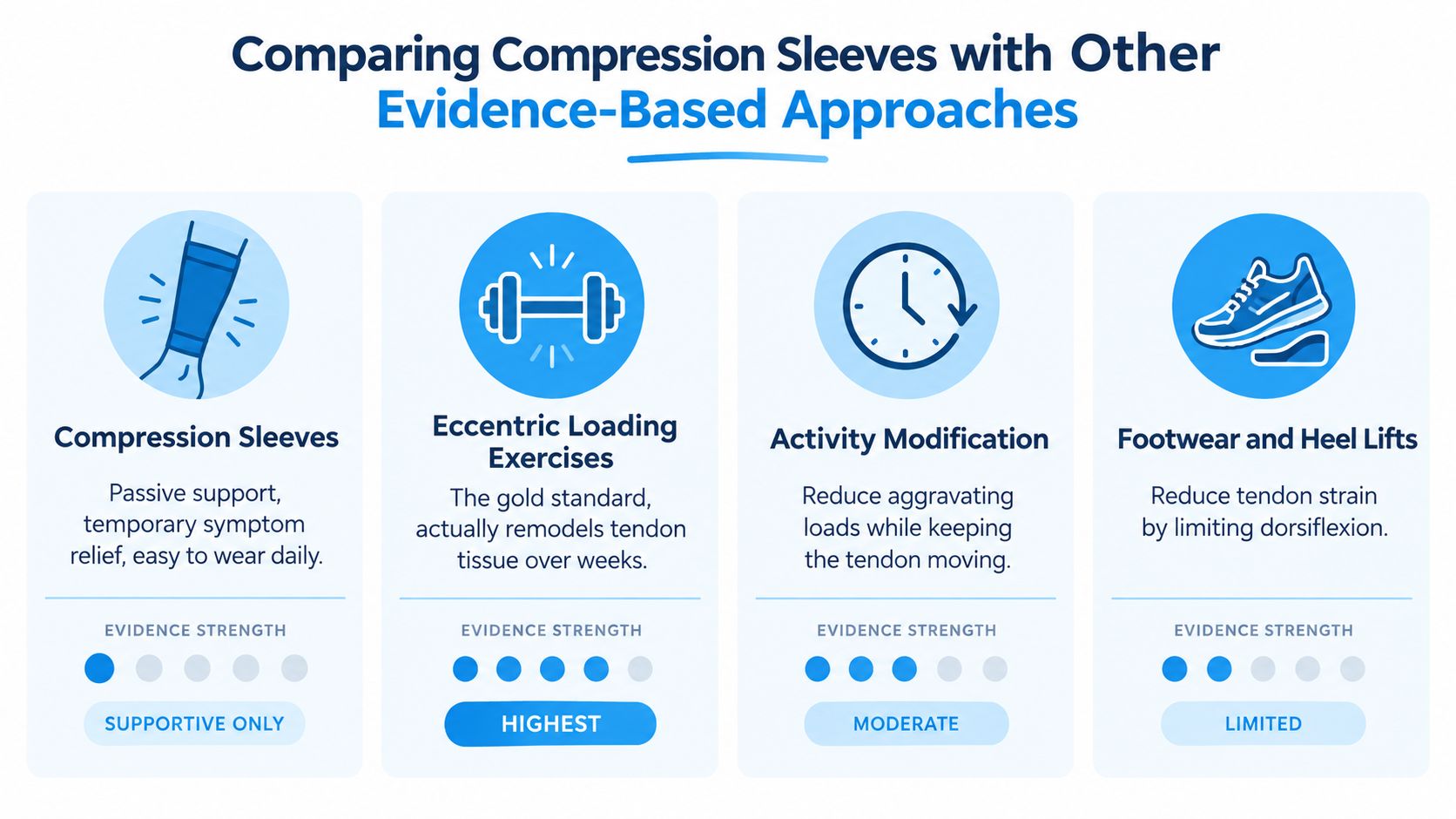
Compression is one tool in a larger plan. It may offer perceived support, warmth, and proprioceptive feedback, but passive comfort doesn't create the same training stimulus as progressive tendon loading. The right combination depends on whether your pain is insertional, midportion, or caused by another condition.
| Approach | Main purpose | Where it may fit | Important limitation |
|---|---|---|---|
| Compression sleeve | Sensory feedback and perceived support | Light activity or recovery when tolerated | No established tendon-healing dose |
| Progressive loading | Gradually build tendon capacity | Core rehabilitation for many tendinopathy cases | Must be adjusted to symptoms and function |
| Heel lifts | Reduce ankle dorsiflexion and insertional compression | Often considered for insertional symptoms | Should be selected and monitored appropriately |
| Activity modification | Reduce aggravating exposure while maintaining suitable movement | Early symptom management and flare control | Complete rest can make return to loading harder |
Progressive loading deserves priority because the 2025 trial used it in both rehabilitation groups. The difference in outcomes came from how the programs managed compression and ankle mechanics, not from replacing exercise with a passive garment.
Heel lifts can be relevant when dorsiflexion repeatedly aggravates pain at the insertion. Activity modification might mean temporarily choosing level walking instead of hills, reducing jumping, or changing the amount of running while retaining tolerable movement. These are examples of adjusting load, not instructions to stop all activity.
Non-compression infrared recovery wear is another category for people who dislike tight garments or whose insertional symptoms react to pressure. It may provide warmth and a sensory layer without squeezing the tendon attachment, but it should still be considered an adjunct rather than a proven tendon repair treatment. For a wider look at supportive products, see these joint pain relief products. Readers also comparing symptom-support options may find this guide to anti-inflammatory creams useful, while remembering that topical products don't replace diagnosis or rehabilitation.
A short visual explanation of loading and support can help make the difference clearer:
When to Seek Professional Evaluation Instead of Self-Treating
A sleeve is not the right first step after a sudden snap, sharp pain, or immediate loss of pushing strength. Those symptoms can indicate a more serious injury, including rupture, and need prompt assessment rather than compression and continued activity.
Arrange an evaluation when pain persists, swelling doesn't settle with sensible load reduction, or symptoms continue to worsen despite modifying activity. Numbness and tingling also deserve attention because nerve irritation may be contributing to the problem. Achilles tendinopathy can resemble bursitis, nerve-related pain, or referred pain from the lower back, and a sleeve won't identify the source.
A sports medicine clinician, physiotherapist, podiatrist, or other qualified healthcare professional can examine the painful location, assess calf strength and ankle movement, and determine whether imaging or another diagnostic step is appropriate. Bring the sleeve if you use one, and explain whether symptoms change during wear or the following morning.
People who need help locating an in-person service can find their nearest Telomyx clinic, although the appropriate provider depends on the symptoms and local availability. The main principle is straightforward: persistent or escalating pain needs an explanation, not stronger compression.
Your Practical Recovery Strategy Moving Forward
Use a three-part decision process.
First, locate the pain. Direct tenderness at the heel attachment raises concern about insertional mechanics. Pain farther up the tendon suggests a midportion pattern, although a clinician should confirm the diagnosis when symptoms are persistent or unclear.
Second, test support conservatively. For midportion symptoms, a gentle sleeve may provide useful sensory feedback during light activity if it doesn't increase discomfort. For insertional symptoms, avoid assuming that a tighter sleeve is better. A design that presses the rear heel or encourages painful dorsiflexion may be the wrong match.
Third, build capacity gradually. Progressive tendon-loading exercise should remain the foundation. Adjust walking, running, hills, stairs, and footwear according to your response, and use passive support only if it helps you follow the plan without worsening symptoms.
A quick decision guide can keep the next step practical:
- Pain is mild and stable, with no warning signs: Modify aggravating activity and discuss a gradual loading program with a qualified professional.
- Pain is at the heel attachment and reacts to ankle bending: Reduce compression and dorsiflexion exposure, then seek guidance on insertional rehabilitation.
- A sleeve feels comfortable but symptoms worsen later: Stop or change the garment and judge the response over the next day.
- Pain is sudden, severe, associated with weakness, or accompanied by numbness: Arrange prompt professional assessment instead of self-treating.
Compression Achilles tendonitis advice should never be reduced to “wear a sleeve” or “avoid compression.” The useful answer depends on anatomy, mechanical triggers, fit, and how your tendon responds over time.
Thermo Recovery Wear offers non-compression infrared-responsive recovery sleeves and braces designed for warmth and support during rest or light daily activity. If tight garments aggravate your heel symptoms, explore Thermo Recovery Wear as one supportive option to discuss alongside an appropriate loading and evaluation plan.


