


You finish a long day at the keyboard, pick up your phone, or grip a dumbbell, and your wrist gives you a warning. Maybe it's a dull ache across the joint. Maybe one small spot stings whenever you twist a lid. Perhaps your hand tingles at night, then feels weak when you turn a doorknob. Don't treat all of these patterns as the same injury.
The practical answer to how to treat wrist pain from overuse starts with identifying the location and trigger. Reduce the load that provokes symptoms, keep comfortable movement, and match support and exercises to the likely tissue involved. A brace can help, but the wrong brace, worn too tightly or for too long, can leave you stiffer and no closer to solving the problem.
Table of Contents
- What Overuse Wrist Pain Actually Feels Like
- Stop the Pain Without Stopping All Movement
- At-Home Rehab Exercises and Stretches
- Choosing a Brace, Splint, or Recovery Sleeve
- Red Flags and When to See a Doctor
- Preventing Overuse Wrist Pain From Coming Back
What Overuse Wrist Pain Actually Feels Like
Overuse pain often appears after ordinary tasks, not one dramatic accident. Typing, scrolling, gaming, gripping tools, lifting a child, carrying bags, climbing, golf, tennis, and weight training can all load the wrist repeatedly. At first, you may notice stiffness when you wake up or a dull ache after work. Later, a specific movement, such as opening a jar or pushing up from a chair, may produce a sharp, localized pain.
The symptom's location matters more than its intensity. Pain on the thumb side often points toward irritation of the thumb tendons, while pinky-side pain can involve different tendons or structures around the ulnar wrist. Numbness and tingling suggest nerve involvement rather than a simple sore muscle. Wrist pain can also come from arthritis, ligament problems, a cyst, inflammation, or an injury that you didn't recognize at the time, so a generic “rest and brace it” plan often misses the target. A clinical overview of common wrist pain causes and treatment options provides useful background on these distinctions.
Start with the pattern, not the product
Use this quick sorting guide:
- Thumb-side pain: Symptoms worsen with gripping, lifting, texting, or moving the thumb. Possible de Quervain tenosynovitis deserves a thumb-specific approach.
- Pinky-side pain: Rotation, racquet sports, lifting, or deviation toward the little finger aggravates symptoms. Tendon or deeper joint structures may be involved.
- Central wrist ache: Pressure, pushing, or repeated bending may irritate tendons or the joint. Clicking, catching, or swelling makes an examination more important.
- Numbness or tingling: Symptoms in the thumb, index, middle, and radial half of the ring finger, particularly at night, fit a possible median nerve pattern and may indicate carpal tunnel syndrome.
- Forearm pain with wrist symptoms: Irritation can travel beyond the wrist. Use this guide to pain in the wrist to elbow when discomfort extends up the arm.
Clinical rule: Don't choose treatment from the word “overuse.” Choose it from the pain location, the provoking motion, and whether sensation or strength has changed.
If keyboard work is the main trigger, changing input method can reduce repetitive keystrokes while you address the cause. Voice typing to avoid wrist pain is one practical option for reducing hand and wrist repetition during messages, notes, and longer documents. It won't correct an existing tendon or nerve disorder, but it can lower exposure while irritated tissue settles.
Stop the Pain Without Stopping All Movement
Complete rest sounds sensible, but it's usually the wrong default. Stop the movement that provokes pain, not every comfortable movement your wrist can perform. Prolonged immobilization can increase stiffness and make the return to work, sport, or lifting harder.
Use relative rest. Find the exact activity that causes the flare, then change one variable at a time:
- Reduce repetitions or shorten the work interval.
- Lower the force of the grip.
- Keep the wrist closer to neutral instead of holding it bent forward or backward.
- Switch hands, use a larger-handled tool, or share the task.
- Take brief movement breaks before symptoms build.
For suspected mild or mild-to-moderate carpal tunnel symptoms, avoid sustained wrist flexion, forceful gripping, and vibration. A neutral wrist position during sleep and repetitive tasks is more useful than forcing the wrist into extension. Conservative care commonly begins by reducing irritation while preserving comfortable movement, and evidence supports a time-limited trial of neutral splinting rather than indefinite immobilization. The randomized splinting study and broader evidence review found meaningful improvement with splint use, but extending the trial from 6 to 12 weeks did not add overall benefit.
Choose cold or warmth based on the symptom
Use a cold pack when the wrist feels newly irritated, warm, or swollen after a task. Wrap the pack in cloth and keep the application brief. Don't numb the area and then return to heavy gripping, because reduced pain can hide excessive loading.
Use gentle warmth when the main problem is stiffness before movement. Warmth can make a short mobility session more comfortable, but it doesn't give an irritated tendon permission to tolerate more force. The practical differences between these approaches are outlined in this guide to hot and cold therapy.
Over-the-counter pain medication or a topical anti-inflammatory may help you perform necessary daily tasks, but treat it as a temporary bridge. Follow the product label and ask a clinician or pharmacist before using medication if you have relevant medical conditions, take blood thinners, or have concerns about interactions. Pain relief should support load reduction and rehabilitation, not help you push through a painful workout.
At-Home Rehab Exercises and Stretches
A useful home routine should make the wrist feel freer, not attacked. Start with gentle motion, add nerve or tendon gliding when the symptom pattern fits, then introduce low-load strengthening as irritability falls. Exercises should complement activity modification and diagnosis, not replace them. In a randomized trial of people with intermediate-stage carpal tunnel syndrome, standard conservative treatment outperformed exercise-only care, while gliding exercises appeared most useful as an addition to conventional treatment. The clinical trial and review of tendon and nerve gliding support that sequence.
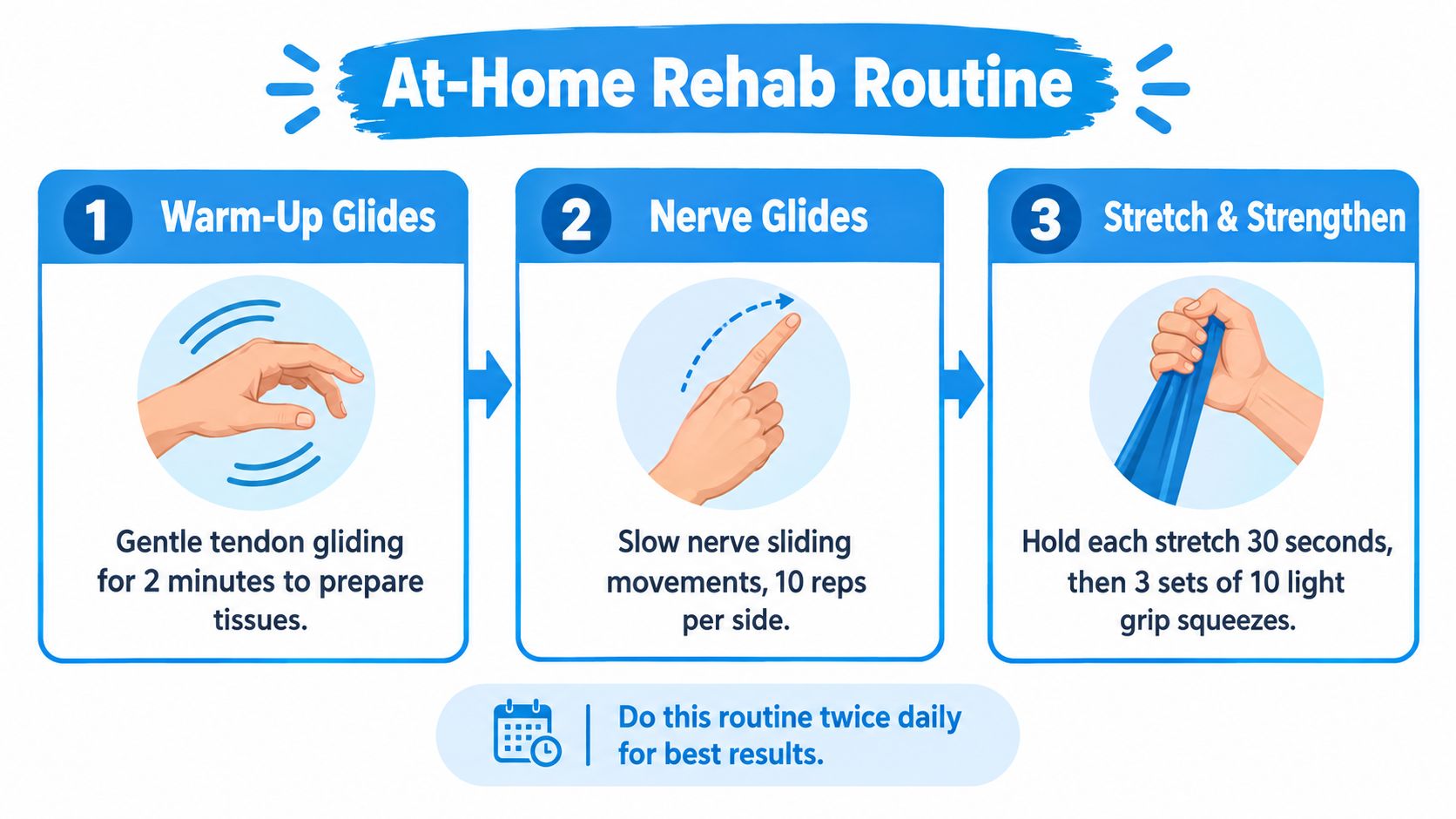
Use a short, controlled routine
Run this routine for about 10 to 15 minutes, once or twice daily, provided symptoms remain calm:
- Warm-up glides: Slowly open and close the hand, then move the wrist through comfortable flexion, extension, and side-to-side motion. Spend roughly two minutes. Keep the movement easy and stop before the painful edge.
- Tendon glides: Move through relaxed hand positions, such as an open hand, hook fist, full fist, and straight fist. Perform several slow cycles without squeezing hard.
- Median nerve glide: If numbness or tingling follows a median nerve pattern, use a gentle nerve-flossing sequence taught by a clinician. The goal is sliding, not stretching. Stop if tingling intensifies or lingers.
- Isometric grip: Hold a rolled towel or soft ball. Apply light pressure without provoking wrist pain, hold briefly, and relax. Repeat several times rather than chasing fatigue.
- Wrist isometrics: Place the other hand against the palm or back of the affected hand and resist gentle flexion or extension without allowing movement. Keep the wrist neutral.
- Controlled strengthening: Once daily tasks no longer trigger a flare, use a very light load for slow wrist flexion, extension, or thumb movement. Lower the weight slowly, and keep the range controlled.
A mild sense of effort is acceptable. Sharp pain, escalating tingling, new weakness, or a flare that lasts after the session means the dose is too high. Don't aggressively stretch an irritated tendon, and don't skip progression just because the wrist feels good on one day. Consistent, modest loading is more reliable than a hard session followed by several days of avoidance.
For a clinician-guided progression, physio management with Vanta Sports can help you understand how assessment and rehabilitation fit together. You can also use these wrist-strengthening exercises as a reference, but modify any movement that reproduces your specific symptoms.
Choosing a Brace, Splint, or Recovery Sleeve
A support should solve a defined problem. It shouldn't become a permanent substitute for movement, diagnosis, or stronger work capacity.
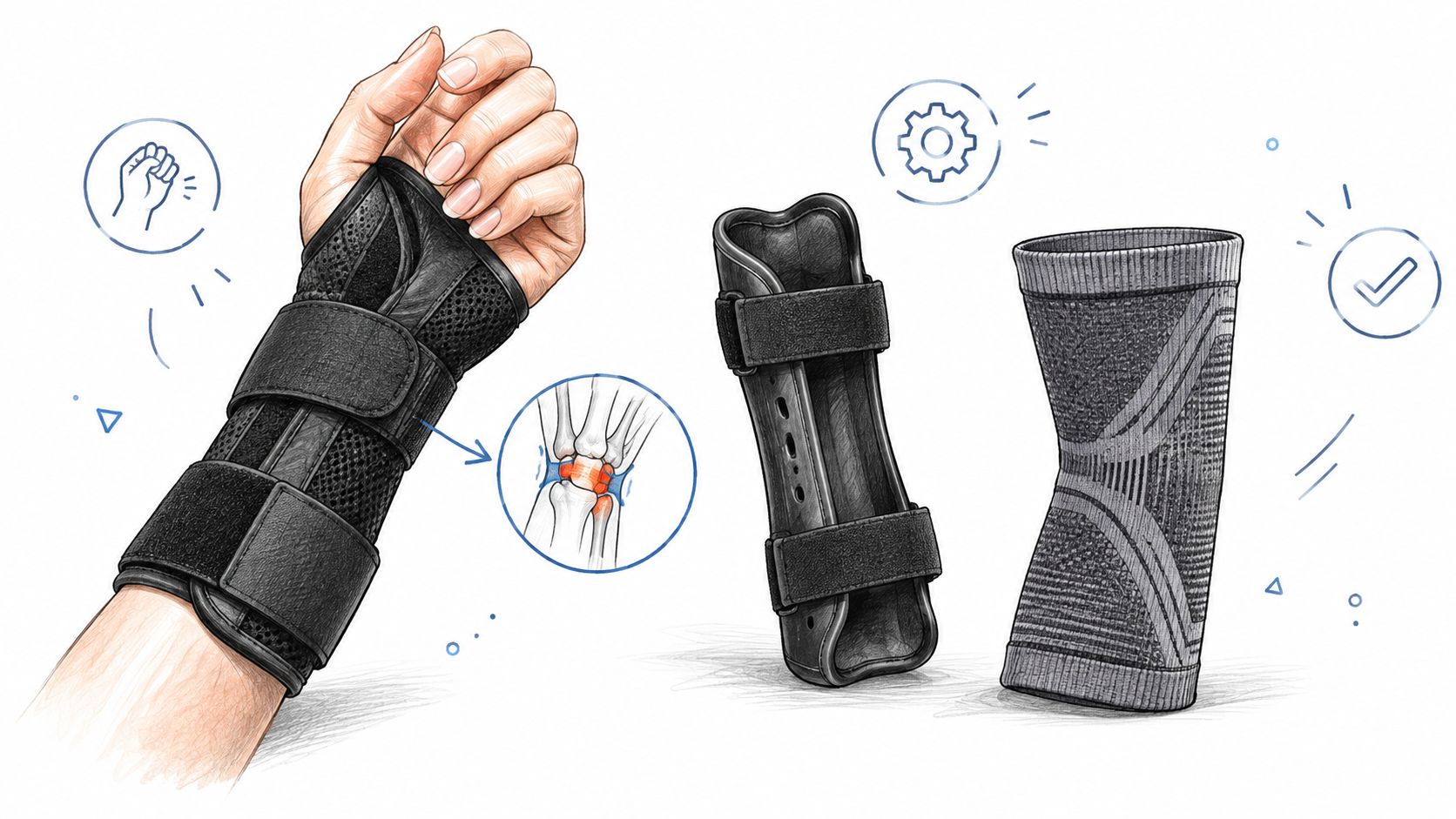
| Support | Best fit | Main caution |
|---|---|---|
| Neutral wrist splint | Nighttime symptoms or suspected mild-to-moderate carpal tunnel syndrome | Don't strap it tightly or force extension |
| Thumb-spica orthosis | Thumb-side pain aggravated by thumb motion and gripping | It must control both the thumb and wrist |
| Flexible compression sleeve | Light daytime support and warmth when movement remains comfortable | It won't diagnose or stabilize a significant injury |
| Recovery garment | Non-compressive warmth during light activity or rest | Use it as an adjunct, not as treatment by itself |
For nerve-related symptoms, a neutral-position wrist splint at night is the most defensible first choice. A practical trial lasts approximately 6 to 12 weeks, with reassessment of night symptoms, sensation, grip, and function along the way. Extension or “cock-up” positioning has produced less symptom relief in comparative evidence, so don't assume a visibly rigid brace is automatically better.
Thumb-side pain needs a different tool. A properly fitted thumb-spica orthosis limits thumb movement as well as wrist motion while keeping the fingers mobile and circulation unobstructed. A generic wrist sleeve that leaves the thumb free may feel comfortable but fail to reduce the motion irritating the tendons.
A flexible sleeve can be appropriate when you want warmth or a reminder to avoid extreme positions during light activity. Thermo Recovery Wear's wrist sleeve is a non-compression recovery garment intended for light support and warmth, so it belongs in that adjunct category rather than replacing exercise or clinical assessment. Follow the manufacturer's sizing and wear instructions, and stop if you develop color change, numbness, throbbing, or skin irritation.
If you're comparing fit, structure, and daily wear, this guide to a lightweight wrist brace gives another way to evaluate support options.
A brace should allow normal finger movement and leave the hand warm and normally colored. Remove it for regular comfortable motion, hygiene, and exercises unless a clinician has told you otherwise. As symptoms settle, reduce reliance gradually by using the support for the trigger task or sleep rather than wearing it automatically all day.
Red Flags and When to See a Doctor
Mild soreness after an unusual task can often be managed with load reduction and observation. Neurologic change, progressive weakness, major swelling, or trauma changes the decision. Don't keep testing a wrist that is losing function.
Book an assessment promptly when
- Numbness persists: Constant numbness, repeated night waking, or tingling that spreads into the hand deserves examination.
- Strength declines: Dropping objects, losing grip, or developing weakness around the thumb or hand is not routine soreness.
- Swelling changes the wrist: Marked swelling, warmth, discoloration, or a visible deformity needs medical attention.
- Pain followed trauma: A fall, direct blow, sudden twist, or forceful impact can cause a fracture or ligament injury even when you can still move.
- The wrist catches or clicks: Central pain with catching, or pinky-side pain that worsens with rotation, may require targeted evaluation.
- Thumb-side symptoms persist: Pain with gripping and thumb motion that doesn't settle after modifying the load may need assessment for de Quervain tenosynovitis.
Seek prompt care if you can't move the wrist or fingers, can't grip, develop sudden severe pain, or notice rapid swelling. Those findings are not a reason to try a tighter brace or a more aggressive stretching routine.
At an appointment, expect questions about the exact task that triggers symptoms, a hand and wrist examination, and strength and sensation testing. Depending on the findings, a clinician may consider imaging for bone or joint concerns. If nerve involvement is uncertain, electrodiagnostic testing can help assess nerve function. Use this explanation of the difference between carpal tunnel and tendonitis to prepare for that conversation, but don't use online symptom matching as a diagnosis.
Preventing Overuse Wrist Pain From Coming Back
Your wrist usually doesn't need a perfect posture. It needs fewer long, uninterrupted exposures to force, repetition, and awkward angles.
Set the keyboard so your elbows stay near a right angle and your wrists remain close to neutral. Keep the mouse close to the keyboard rather than reaching forward, use a larger or ergonomic grip when possible, and avoid pressing the wrist into a hard desk edge. During phone scrolling, gaming, or sustained gripping, change position before the familiar ache arrives.
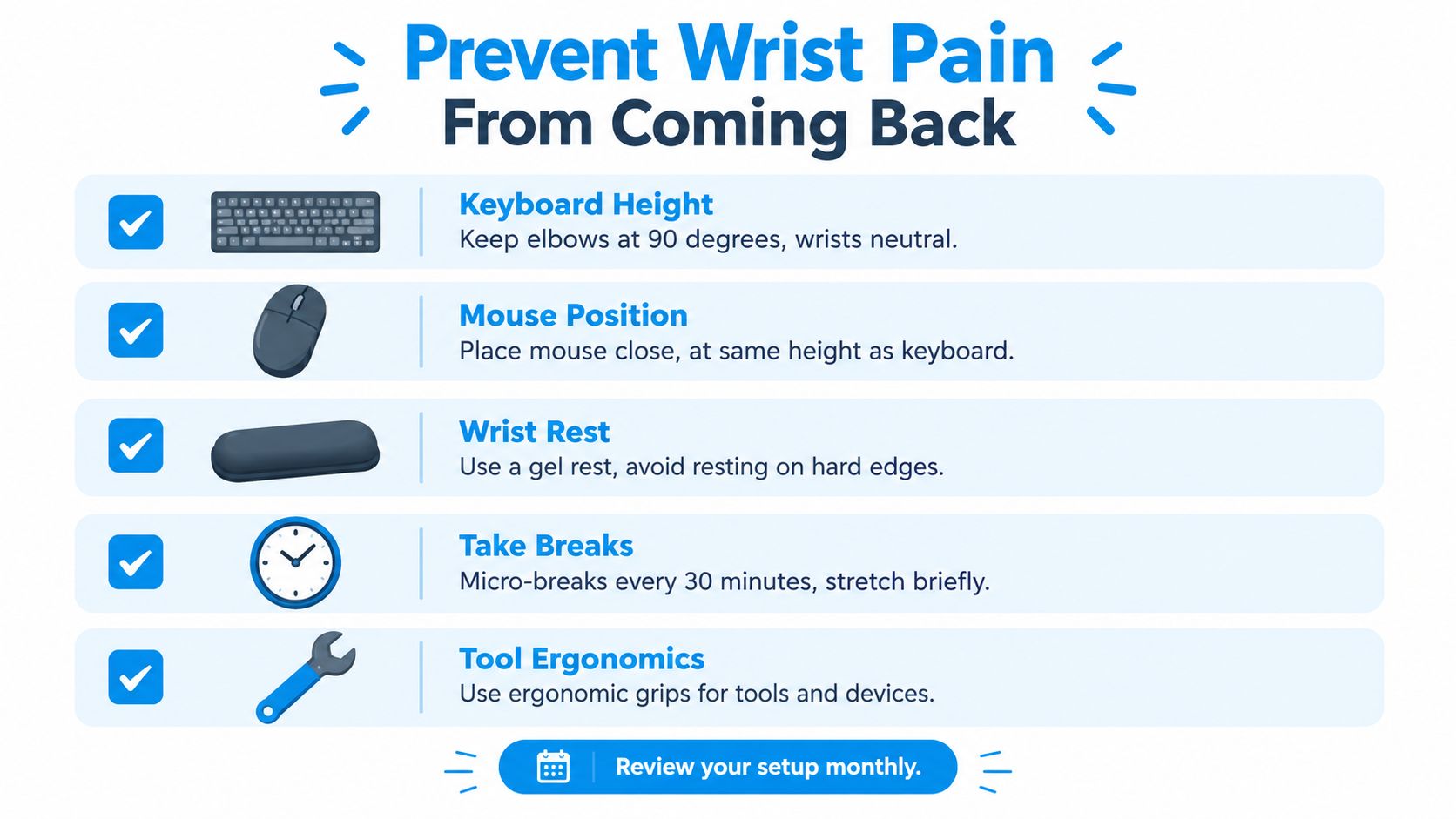
Before heavy gripping, spend a few minutes opening and closing the hands, moving the wrist through comfortable ranges, and rehearsing the task with less force. Add training load gradually for lifting, golf, tennis, climbing, and manual work. If a sleeve or recovery garment keeps the wrist comfortably warm during light activity, use it as a support for that plan, not as permission to increase load suddenly.
Keep a simple weekly check
- Grip: Can you open jars, carry bags, or use tools without compensating?
- Stiffness: Is morning movement easier, unchanged, or worse?
- Triggers: Which task still produces symptoms?
- Sensation: Any new numbness, tingling, or altered feeling?
- Recovery: Does discomfort settle after activity, or does it linger and spread?
A workplace-medicine evidence summary reports that roughly 75 percent of patients may achieve a successful conservative outcome within one month for mild-to-moderate carpal tunnel syndrome, although the study definitions and patient populations vary. The summary and its limitations are available here. Use that as encouragement to start appropriate conservative care, not as a promise that every wrist problem will follow the same course.
Revisit a clinician if weakness progresses, sensation stays altered, symptoms recur quickly after returning to normal activity, or your weekly check keeps moving in the wrong direction. A screenshot-friendly maintenance plan is simple: neutral setup, frequent task changes, comfortable movement, gradual loading, and early action when function declines.
Thermo Recovery Wear offers non-compression wrist recovery wear designed for warmth and light daily support, which can complement ergonomic changes and rehabilitation for overuse-related discomfort. Visit Thermo Recovery Wear to review the wrist sleeve and choose support that fits your activity without replacing appropriate clinical care.


