


You finish a ride feeling strong. The route was longer than usual, but nothing hurt while you were pedaling. Later that evening, or the next morning, a dull ache appears around one knee when you climb stairs, stand from a chair, or bend the leg.
If your knees hurt after cycling, the answer usually isn't to change the saddle immediately or abandon riding altogether. Knee symptoms reflect the combined effect of workload, pedaling mechanics, bicycle setup, strength, and recovery. The most useful first step is to identify where the pain is and when it appears.
Table of Contents
- Why Your Knees Hurt After Cycling
- Common Causes of Post-Cycling Knee Pain
- Bike Fit Mistakes That Aggravate Knee Pain
- Recovery Strategies and Support Options
- Red Flags and When to See a Professional
- Conditioning and Return-to-Ride Plan
- Preventing Knee Pain on Future Rides
Why Your Knees Hurt After Cycling
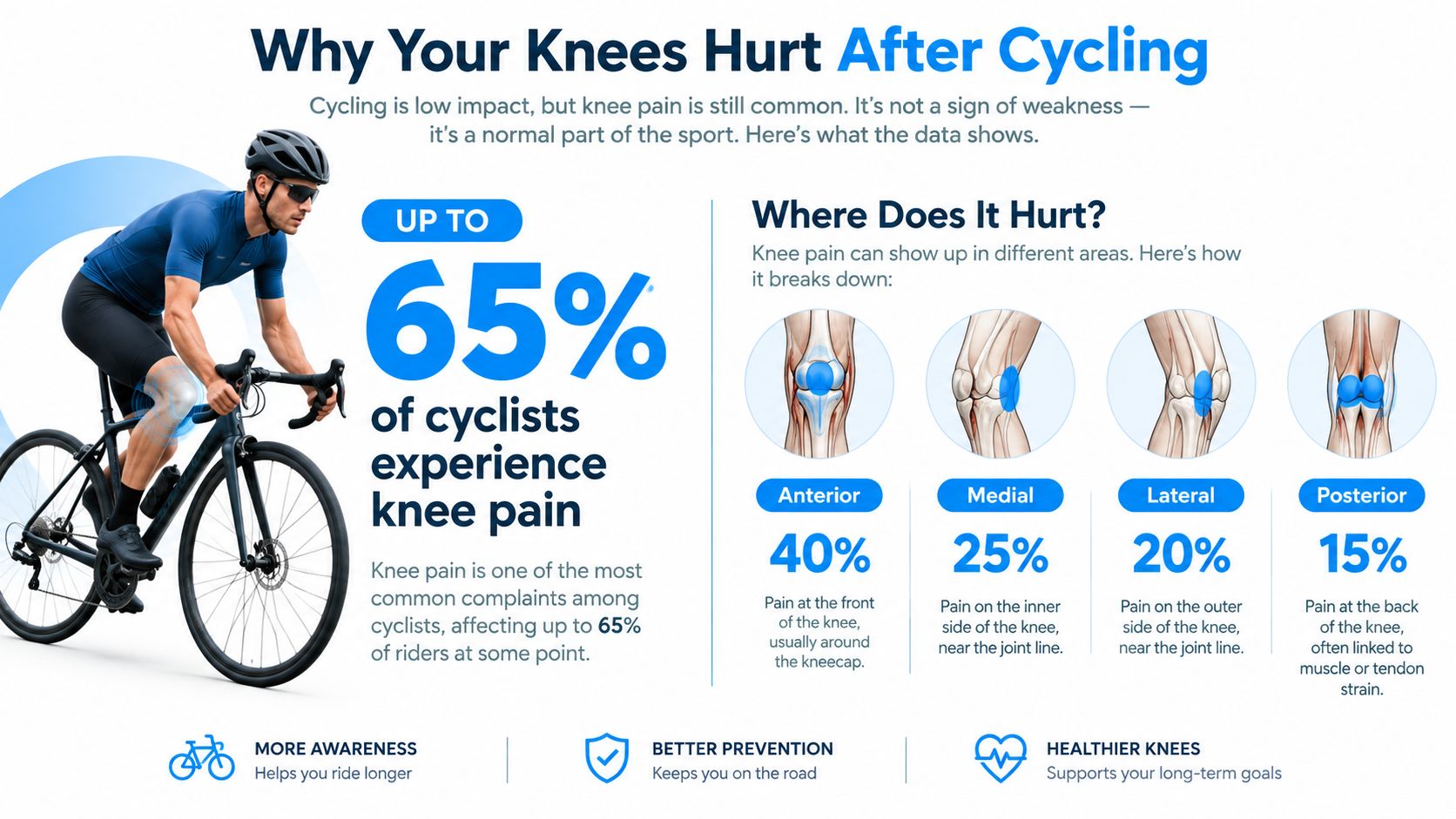
A knee that feels fine on the bike can start aching later that day or the next morning. That delay is common with overuse problems. Cycling repeats the same motion thousands of times, so a small mismatch in load, joint position, or tissue capacity can build up before you notice it.
Knee discomfort is one of the more familiar complaints in cyclists. A systematic review of cycling injuries reported that knee pain or knee injury in cyclists involved in long-duration pedaling appeared in about 14.8% to 33% of participants, depending on the population and study design. In a separate study of active cyclists in Saudi Arabia, 25.8% reported knee pain during a 12-month period, including 27.6% of amateur cyclists and 15.9% of professional cyclists.
The same study showed that the pattern changed by discipline. Road racers reported the highest prevalence, at 50.0%, while commuters reported the lowest, at 16.7%. That does not prove one type of riding directly caused the pain. It does show why symptoms need context. Training volume, intensity, terrain, and how abruptly your riding changed all affect how much stress reaches the knee.
A frequently cited survey of 224 recreational cyclists in California found that 85% reported at least one overuse injury, and 36% of those injuries required medical attention.
The key point is simple. A common symptom is not a single diagnosis. Pain at the front of the knee often reflects a different loading pattern than pain on the outside, inside, or back. That is why a one-step fix, like raising the saddle, helps some riders and irritates others.
The knee works like a hinge guided by several moving parts above and below it. Every pedal stroke asks it to bend and straighten while transferring force from the hip to the foot. Increase mileage, climbing, sprinting, or return to riding after time away, and the total demand rises fast, even though cycling is usually described as low impact.
Use the pain as a clue, not a verdict. Note where it hurts, when it starts, and whether it settles quickly or lingers into daily activity. If you want a broader comparison of symptom patterns beyond cycling, this guide on what causes sudden knee pain without injury is a useful reference. If pain keeps worsening, brings swelling or instability, or changes how you walk, self-adjustments should give way to clinical assessment.
Common Causes of Post-Cycling Knee Pain
Pain location narrows the possibilities, but it doesn't establish a diagnosis. Think of it as a map that helps you choose what to observe before you make a change.
Anterior pain around the kneecap
Pain at the front of the knee often involves the patellofemoral joint, where the kneecap moves against the femur. Repeated knee flexion under load can increase contact stress, particularly when the knee stays relatively bent through the power phase. A saddle that's relatively low can contribute to that position, although saddle height isn't a universal explanation and shouldn't be changed aggressively.
Riders may notice this pain during climbs, high-force efforts, or after a ride that demanded more from the quadriceps than usual. The discomfort may feel diffuse around the kneecap rather than sharply localized to one small spot.
Lateral pain on the outside
Pain on the outer knee can involve the tissues around the iliotibial band, especially when the knee repeatedly tracks in a way that irritates the lateral side. Cleat rotation, foot position, saddle height, hip control, and a rapid increase in riding volume can all contribute to the pattern.
Lateral symptoms often become clearer as a ride continues. If the pain appears in a consistent position or after sustained pedaling, record that detail rather than immediately moving the saddle or cleat.
For a practical explanation of lateral symptoms and activity modification, see this resource on managing iliotibial band syndrome. Persistent joint pain can also overlap with broader mobility conditions, so Life Primary Care mobility conditions provides useful context for symptoms that extend beyond cycling.
Medial or posterior pain
Pain on the inside of the knee may reflect altered tracking, foot position, or overload of the structures along the medial side. A rider might notice the knee drifting inward on each stroke, but visual observation alone can't identify the exact tissue involved.
Pain behind the knee deserves particular caution when it appears with a sensation of reaching at the bottom of the stroke. Saddle height, saddle fore-aft position, foot position, hamstring loading, and overall fatigue may all influence the pattern. Don't treat posterior pain as proof that the saddle is too high. Use it as a reason to assess the entire position.
This short visual guide can help you observe how setup and movement interact:
A sharp spot, visible swelling, locking, or pain that affects walking needs clinical evaluation rather than a trial-and-error bike adjustment.
Bike Fit Mistakes That Aggravate Knee Pain
A bike fit can help, but it isn't a universal fix. Cycling-related knee discomfort reflects the interaction of workload, pedaling mechanics, and bicycle setup, and the available evidence doesn't prove that one saddle height or cadence prevents pain for every rider.
A systematic review of extrinsic biomechanical factors found that cadence, power output, crank length, saddle height, saddle fore-aft position, and foot position can affect knee loading. Yet only 14 studies met the review criteria, only four included cyclists with knee pain, and the study samples ranged from 9 to 24 participants. The findings are useful for forming a testable hypothesis, not for issuing a one-size-fits-all prescription.
What the main variables can change
| Variable | Effect on knee mechanics | Likely pain pattern |
|---|---|---|
| Workload and power | Higher workload was associated with greater knee extension and abduction moments and higher vertical and medial pedal-reaction forces | Symptoms after climbing, hard efforts, or a sudden volume increase |
| Cadence | Higher cadence increased anterior and vertical pedal-reaction forces and the knee-flexion moment | Discomfort during sustained fast spinning or fatigue |
| Saddle height | A higher saddle increased peak anterior shear forces at the tibiofemoral joint | Posterior or diffuse symptoms when the rider reaches at the bottom of the stroke |
| Saddle fore-aft position | Changes the relationship between the hip, knee, and pedal during force production | Location varies according to the rider's compensation pattern |
| Foot position | Alters how the knee and foot rotate through the crank cycle | Medial, lateral, or rotational symptoms |
The review behind these findings had small samples and generally low to moderate evidence quality, so use adjustments carefully. For anterior patellofemoral symptoms, sports-medicine guidance commonly uses approximately 30 degrees of knee flexion at maximum extension as a practical target. That isn't a magic number. Raise or lower the saddle in small increments, test on an easy ride, and monitor symptoms during cycling and over the following 24 hours.
Practical rule: Change one variable at a time. If you alter saddle height, cleat rotation, cadence, and training volume together, you won't know what helped or irritated the knee.
Start with the variable most closely connected to the symptom pattern. Don't move cleats because a friend recommends it if your pain began after a large increase in climbing. Likewise, don't blame training load when the pain appears only after a clear change in saddle position.
Cyclists returning to the sport can also find useful equipment and riding context in these PADL outdoor recreation tips. For broader beginner guidance, review these essential road biking tips, then apply the same principle here: change the demand gradually and observe your response.
Recovery Strategies and Support Options
Recovery starts with reducing the irritation without making the knee completely inactive. If a ride leaves you sore, replace hard climbing or high-power work with easier movement while you assess the pattern. Gentle walking, comfortable range-of-motion work, and a temporary reduction in cycling demand may be more useful than forcing complete rest or repeatedly testing the painful motion.
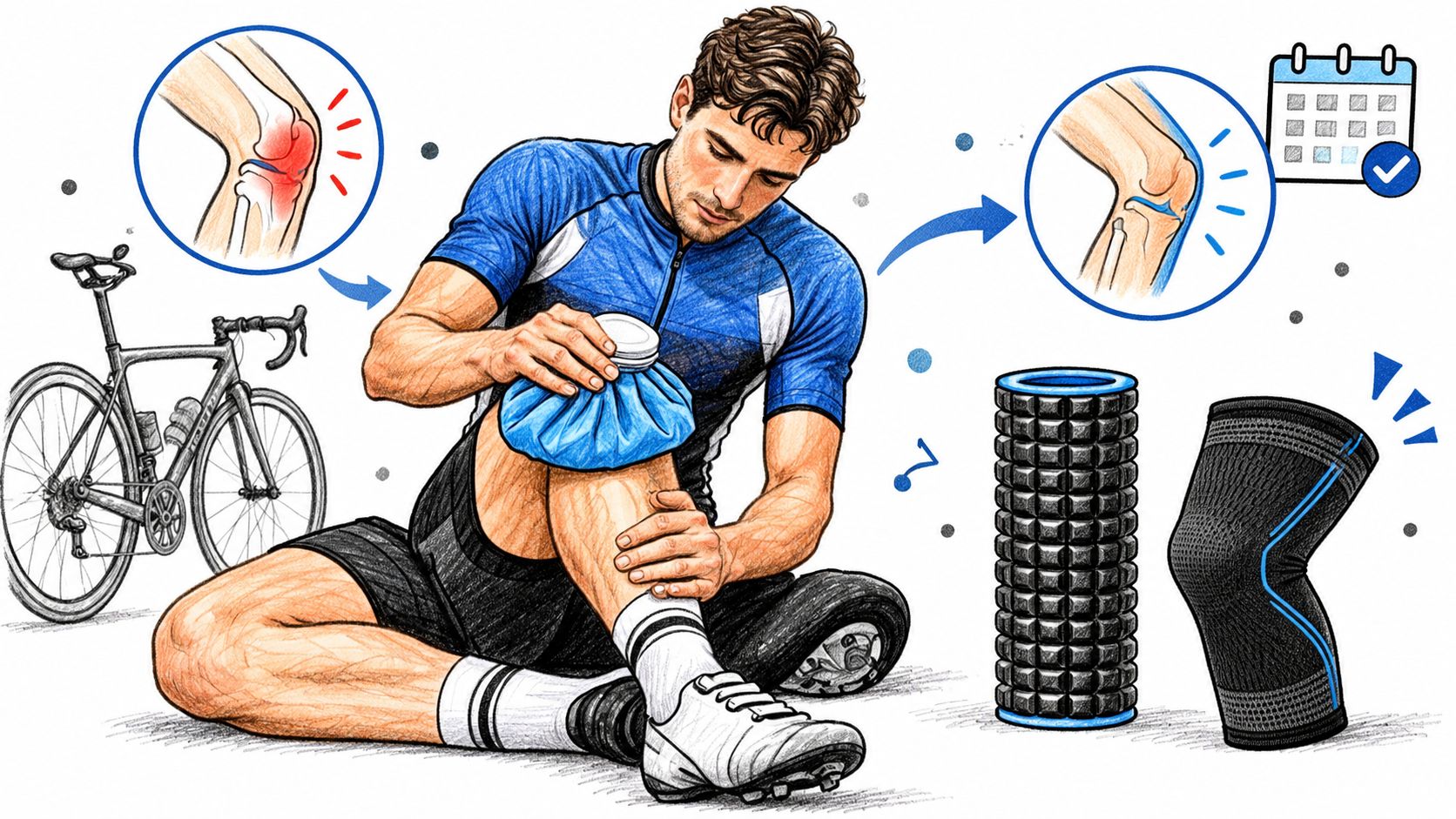
Ice or warmth can be selected according to what feels more comfortable, while strengthening addresses the longer-term capacity problem. Hip and thigh exercises can help the leg control the pedal stroke, but exercise selection should match your symptoms and tolerance. A physical therapist can adjust loading when pain persists or keeps returning.
Where recovery wear may fit
Some riders want support during rest or light activity but dislike tight compression. Thermo Recovery Wear offers compression-lite infrared-responsive knee sleeves and braces made with semiconductor-integrated fabrics intended to support local warmth and circulation. These garments are an adjunct, not a treatment for an unidentified injury, and they shouldn't replace assessment when symptoms are concerning.
The practical choice depends on sensitivity, daily routine, and how the garment feels during movement. Moisture-wicking materials, flexible construction, and a non-compressive design may suit someone who finds conventional compression restrictive. Other riders may prefer no sleeve at all and respond better to a clear exercise and workload plan.
For people comparing broader supportive approaches, longevity treatment options from OneTwenty offer additional context around health maintenance and treatment decisions. Keep the same standard for any product or service: it should complement, not distract from, identifying the cause of recurring pain.
You can also compare the role of sleeves and braces in this guide to the best knee compression sleeves. The right support is the one you can use comfortably while you rebuild tolerance, not the one that encourages you to ignore worsening symptoms.
Red Flags and When to See a Professional
Mild stiffness or a manageable ache that settles as you reduce the load can often be monitored conservatively. The decision changes when the knee becomes more painful from ride to ride or develops signs that suggest more than ordinary exercise sensitivity.
Arrange clinical assessment when you notice
- Persistent worsening pain: Symptoms continue to build despite reducing cycling demand.
- Swelling: The knee becomes visibly swollen or feels full and pressured.
- Instability: The joint gives way, feels unreliable, or changes your walking.
- Locking: The knee catches or won't move normally through its range.
- Sharp localized pain: A precise, severe spot hurts with a specific movement or load.
- No meaningful improvement: Reasonable workload changes and conservative care don't alter the pattern.
A sports-medicine clinician or physical therapist may examine your walking, squat or step control, hip and thigh strength, knee movement, and cycling position. They can also separate a load-management problem from a condition that needs a different investigation.
The limited evidence for many bike-fit adjustments makes professional input more valuable when self-experimentation isn't working. A sleeve, brace, ice pack, or saddle change may reduce discomfort, but none of them can identify the source of swelling, instability, or locking.
For symptoms involving both the back and knees, this resource on back and knees pain may help you recognize when the problem isn't confined to the joint you feel most strongly.
Conditioning and Return-to-Ride Plan
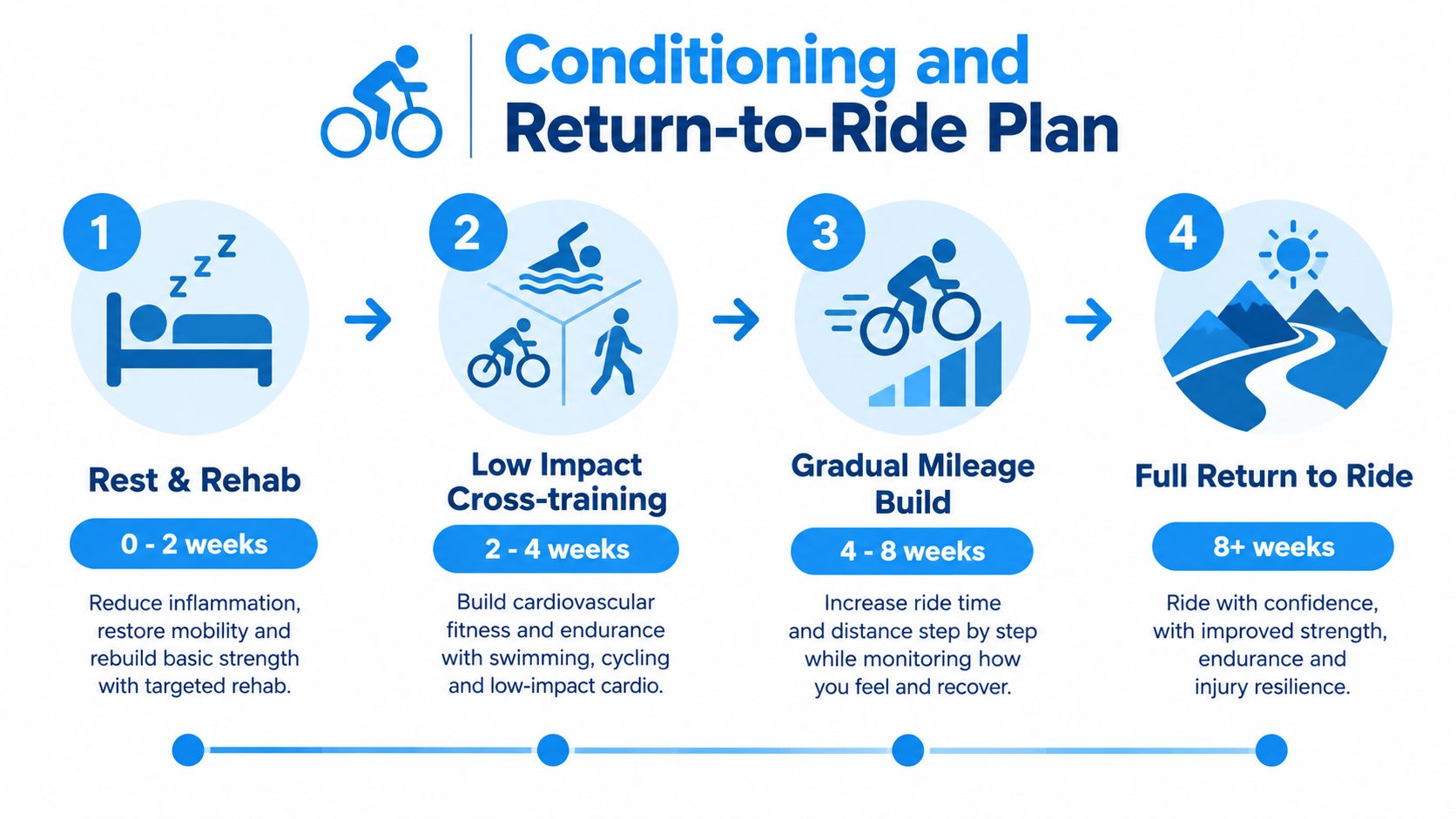
A return to cycling should build tolerance, not test it. Begin with the easiest version of riding that doesn't provoke a clear increase in symptoms, then use your response during the ride and over the next 24 hours to decide whether to progress.
A practical progression
- Settle the flare. Reduce the activity that provokes symptoms. Keep comfortable daily movement, but don't repeatedly test sharp pain.
- Restore basic strength. Use controlled exercises for the quadriceps, hamstrings, glutes, and trunk. Choose loads that don't create a marked increase in symptoms later that day or the next morning.
- Reintroduce easy cycling. Use a comfortable route and a pace that avoids hard grinding or repeated climbs. Keep the setup unchanged while you establish a baseline.
- Add one demand. Increase either ride duration, terrain, intensity, or climbing. Don't raise several demands in the same session.
- Review the next 24 hours. If symptoms return more strongly, step back to the last comfortable level. If the response remains stable, repeat that level before adding another challenge.
Cadence deserves individual testing rather than a universal target. Higher cadence can increase some pedal-reaction forces, while lower cadence at high power can increase other demands. Choose the rhythm that lets you pedal smoothly without bracing, grinding, or provoking the known pain location.
If you test a saddle adjustment, make the change small and keep every other factor consistent. Ride easily, record the symptom location and intensity in plain language, and compare the response later that day and the following morning. Stop the progression if swelling, instability, locking, or worsening pain appears.
Preventing Knee Pain on Future Rides
Prevention means managing the relationship between capacity and demand. A well-positioned bike can still irritate a knee if you suddenly add difficult terrain, and strong legs can still struggle when the setup forces an uncomfortable movement pattern.
Use this quick checklist before and after demanding rides:
- Warm up gradually: Start with easy pedaling before asking for high force.
- Watch the workload: Increase one training demand at a time, such as duration, climbing, or intensity.
- Check the pain map: Note whether symptoms are anterior, medial, lateral, or posterior.
- Adjust cautiously: Change one bike-fit variable, then test it under easy conditions.
- Build hip and thigh strength: Off-bike conditioning helps the leg tolerate repetitive work.
- Review the next day: Your 24-hour response matters as much as how the knee feels during the ride.
- Use support appropriately: A comfortable recovery sleeve may support rest or light movement, but it doesn't diagnose the problem.
- Respect warning signs: Swelling, instability, locking, sharp pain, or worsening symptoms call for professional assessment.
You don't need to solve every knee symptom with a single saddle-height change. Treat the location, timing, workload, mechanics, and recovery response as separate pieces of information, then make the smallest useful change.
Thermo Recovery Wear offers infrared-responsive, compression-lite knee sleeves and braces for warmth and flexible support during rest or light activity. If that type of adjunct fits your routine, visit Thermo Recovery Wear and review the available knee recovery options.


