


Moisture-wicking fabric moves perspiration away from the skin, while antimicrobial treatment inhibits microbial growth in the textile. They're related but distinct functions, and silver-based treatments may use approximately 0.05–0.1 mg/L as a minimum inhibitory concentration against E. coli, though that figure doesn't prove infection protection or finished-garment performance.
You've worn a recovery sleeve for most of the day. At first, it feels supportive and comfortable. Hours later, trapped sweat can leave the skin clammy, friction may become noticeable, and an odor can linger even after the fabric appears dry.
That experience explains why moisture wicking antimicrobial fabric sounds appealing. One function manages liquid. The other manages microbes inside the textile. A good product label should tell you which function has been tested, how it was tested, and what the claim doesn't promise.
Table of Contents
- The Two Science Principles Behind Dry, Clean Recovery Wear
- How Wicking and Antimicrobial Mechanisms Work
- Material Choices, Bamboo Charcoal, Carbon, and Germanium
- Interpreting Textile Testing Standards
- Antimicrobial Claims vs. Reality
- Care and Washing Guidelines for Longevity
- Why This Matters for Your Recovery Routine
The Two Science Principles Behind Dry, Clean Recovery Wear
A recovery sleeve may feel comfortable during work, walking, rest, or light exercise, then become clammy after hours of wear. Perspiration can remain near the skin, friction can become more noticeable, and odor may persist even when the surface looks dry. These effects point to two different textile jobs.
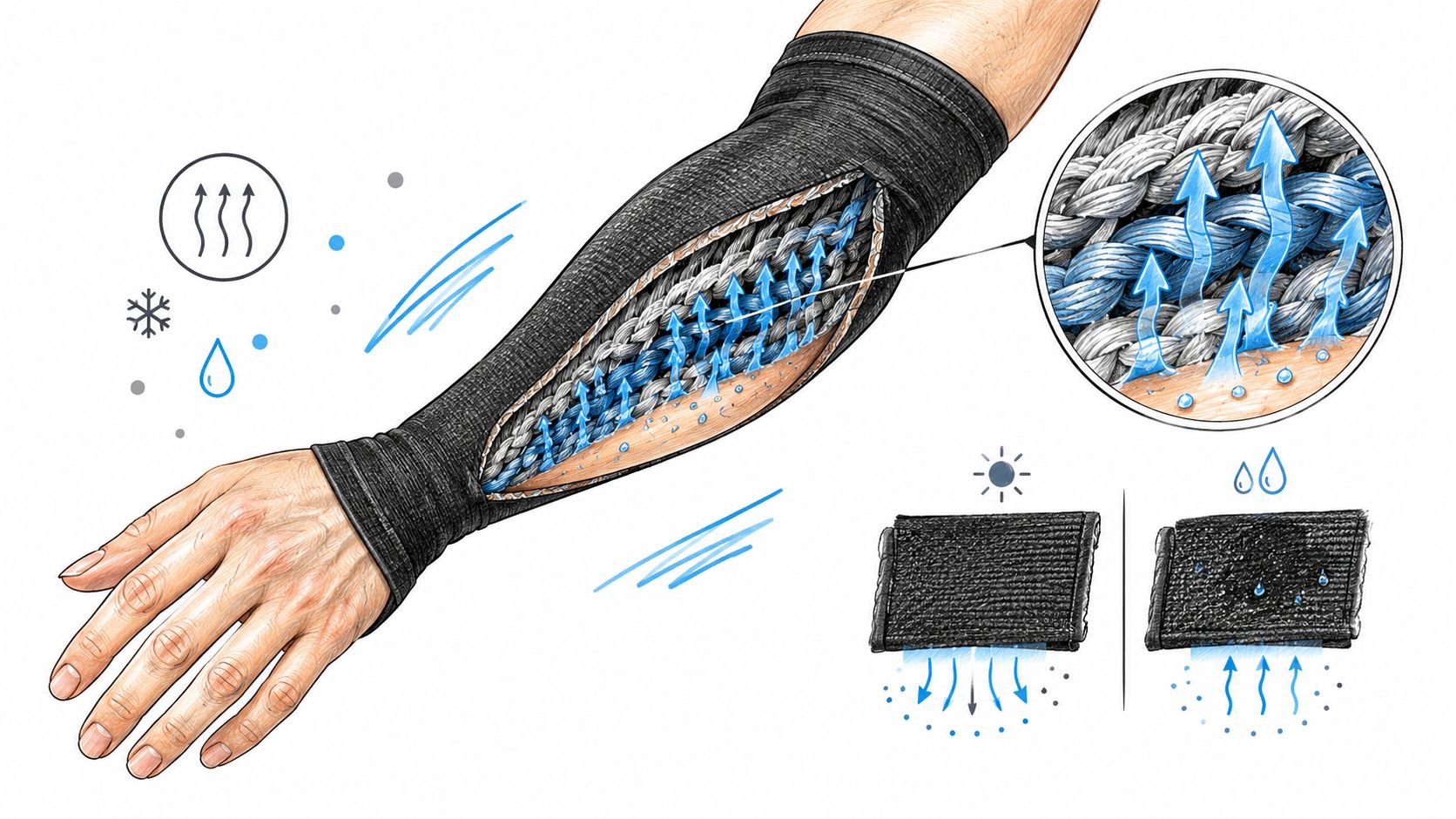
Moisture management controls where liquid goes. Fiber shape, yarn construction, and surface properties form tiny pathways through the fabric. Capillary action pulls perspiration along those pathways, spreading it across a broader outer area. Airflow can then support evaporation, much like a thin film of water dries faster than a droplet in one place.
Antimicrobial treatment addresses microbial growth within the textile. It does not move sweat. Silver is one antimicrobial metal used in fabrics. Silver ions can interact with microbial cell surfaces and disrupt cellular processes, although activity depends on how much bioactive silver is available when moisture is present. The U.S. Environmental Protection Agency's SilvaClean label describes treatment intended to inhibit bacteria, mold, and mildew in treated articles. It also prohibits claims that the garment protects the wearer against bacteria, viruses, or disease organisms.
Why the distinction matters
A sleeve may move sweat effectively and still develop odor if microbes grow in damp fabric. Another textile may inhibit microbial growth yet feel wet because it holds perspiration close to the body. Drying speed, odor control, and bacterial reduction are separate performance questions.
The review in Textile Research Journal found different bacterial loads among fibers after a sweat challenge. It also explains why fiber names alone cannot predict everyday performance. Fabric density, porosity, odor retention, water-repellent finishes, and antimicrobial treatments interact. This matters for recovery wear and sensitive skin because a dry-feeling garment, an odor-control claim, and a tested reduction in bacteria describe different outcomes. Wash durability also needs separate evidence, since treatment performance may change as the garment is laundered.
Practical rule: Check whether the product has evidence for moving sweat, limiting odor, reducing bacteria, or all three. Read the test method and claim boundaries before treating “antimicrobial” as a promise of freshness or protection.
How Wicking and Antimicrobial Mechanisms Work
A recovery sleeve can feel dry while odor still develops, or resist odor while remaining damp against the skin. The difference comes from two separate mechanisms: wicking moves perspiration, while antimicrobial treatment acts on microbes that may grow in the fabric.
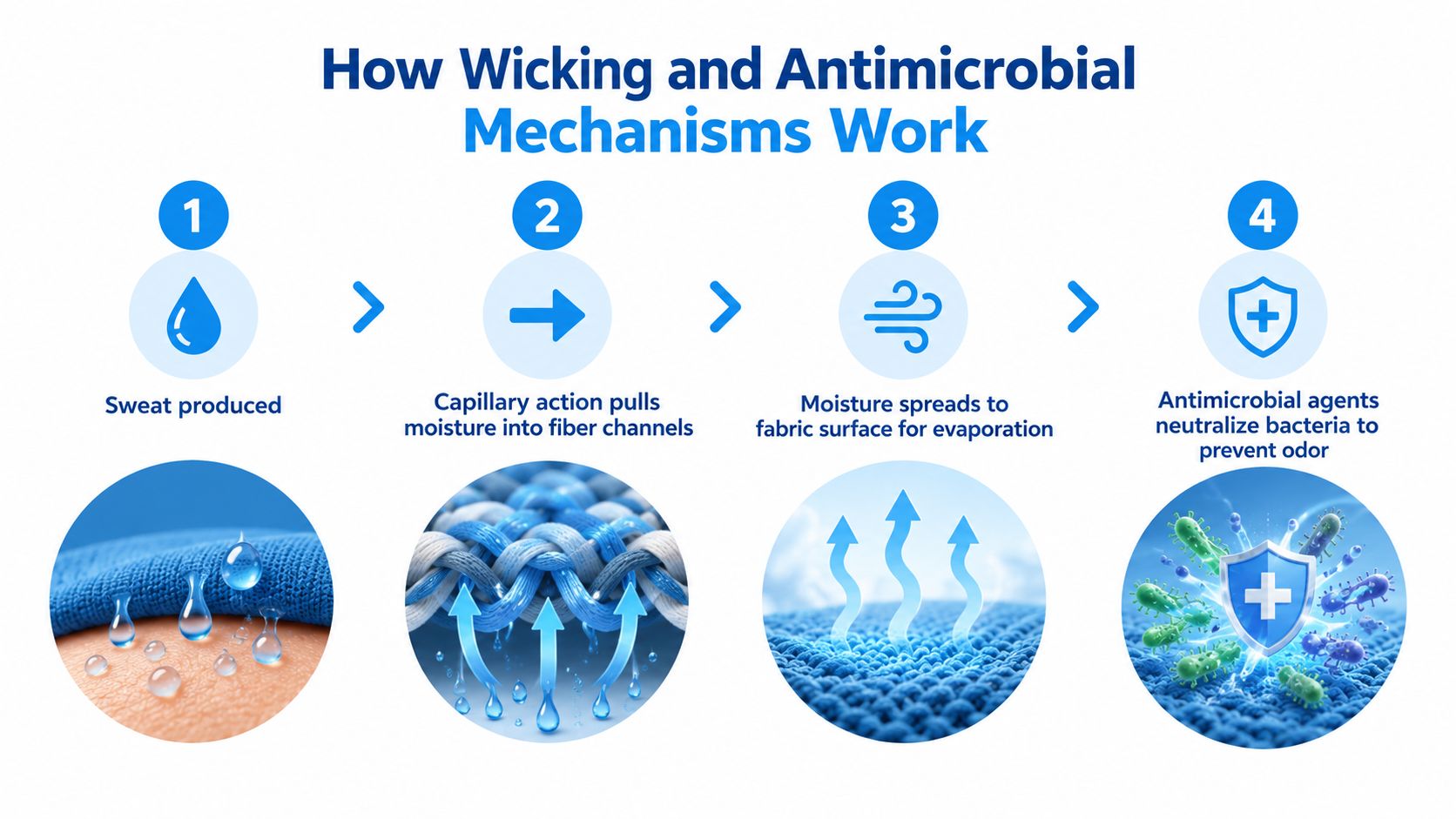
Wicking starts when sweat enters the spaces between fibers and yarns. Surface tension and capillary forces pull the liquid along these narrow pathways, much as water travels through a thin channel. Knit geometry can then spread moisture across the outer face, increasing the exposed area available for evaporation.
Fabric construction determines whether that movement improves comfort. A textile may absorb liquid quickly but hold it inside, or move moisture outward without distributing it widely enough to dry efficiently. The label “quick-dry” therefore describes only part of the experience.
Antimicrobial activity uses a chemical or physical mechanism. In silver-based systems, silver ions interact with microbial cell surfaces and interfere with cellular processes. Humidity and moisture can affect how much active silver becomes available, so results depend partly on the wearer's environment. The EPA label cited above lists approximately 0.00016%–0.0014% silver on fibers, equivalent to 1.6–14 parts per million. Those values describe the treated article, not protection for the person wearing it. The EPA label cited above also makes that boundary clear.
Read the claim as a sequence
Four steps connect fabric contact with odor control:
- Sweat reaches the inner surface. Fit, skin contact, and knit geometry affect how quickly perspiration meets the textile.
- Capillary channels move the liquid. Spaces within the fabric draw moisture through the structure.
- The outer surface spreads it. A larger wet area can support faster evaporation.
- The treatment interacts with microbes in the material. Antimicrobial agents may inhibit growth. They do not sterilize the garment or shield the wearer from disease.
“Controls odor” also needs careful reading. Odor depends on sweat chemistry, drying time, fabric retention, washing, and the organisms present. Wicking may reduce dampness without reducing bacterial growth, while an antimicrobial finish may reduce microbial activity without making the fabric feel dry.
For practical comparisons of breathable, moisture-managing garments, see Nuage Wears on picking the right pair. Thermo Recovery Wear's antimicrobial fabric guide provides further product-focused context. Sensitive-skin users should also check the treatment details and wash guidance, because comfort and performance can change as a finish wears down.
Material Choices, Bamboo Charcoal, Carbon, and Germanium
Material names on a recovery garment can sound like performance guarantees, but each describes a different design choice. Bamboo charcoal, carbon, and germanium may appear together, yet they shouldn't be treated as interchangeable antimicrobial technologies.
Bamboo-charcoal constructions are often selected for their porous structure and moisture-handling potential. In a finished knit, those properties may support ventilation, liquid distribution, and odor management. The outcome still depends on yarn arrangement, fabric density, treatment chemistry, and contact with the skin. A porous material isn't automatically antimicrobial, and a soft hand feel doesn't prove bacterial reduction.
Carbon-containing fibers can contribute to the textile's physical behavior, including thermal response, surface characteristics, and moisture transport. Carbon also appears in systems designed to interact with heat or infrared-responsive constructions. The product label should clarify whether carbon is present as a fiber component, coating, additive, or part of a semiconductor-integrated structure.
Germanium is commonly discussed in semiconductor-integrated fabrics. In recovery wear, the relevant question isn't just whether germanium appears in the fiber blend. It's how the finished construction is intended to function, what testing supports the claimed infrared response, and whether the textile remains comfortable during extended contact with the skin.
Separate the material from the result
A sensible label-reading approach looks like this:
- Bamboo charcoal: Ask how the fabric manages moisture and whether odor or antimicrobial claims apply to the finished garment.
- Carbon: Ask what role it plays in the construction, such as thermal behavior, conductivity, or fiber engineering.
- Germanium: Ask what evidence supports the specific semiconductor or infrared-related claim.
- Antimicrobial treatment: Ask for the organism tested, method, contact time, wash conditions, and measured outcome.
The most useful product comparison separates moisture regain, drying time, odor retention, bacterial reduction, breathability, stretch, and skin comfort. A material may perform well in one category and less well in another.
For readers comparing cellulosic textiles used in other products, this Tencel mattress protector guide offers helpful context about how fiber choice affects softness, breathability, and moisture behavior. For a closer look at germanium and carbon recovery-wear constructions, visit Thermo Recovery Wear's germanium carbon collection.
Interpreting Textile Testing Standards
A product claim becomes more useful when it names the measurement behind it. “Moisture-wicking” can describe several different behaviors, so shoppers should look for test methods and results rather than relying on a fiber name.
AATCC TM195 evaluates liquid-management behavior by measuring absorption time, spreading rate, and one-way transport across the inner and outer fabric surfaces. AATCC TM197 measures vertical wicking to a defined distance. AATCC TM198 measures horizontal wicking. The AATCC testing standards provide the framework for distinguishing these measurements.
What to look for on a test report
| Standard | What It Measures | Why It Matters |
|---|---|---|
| AATCC TM195 | Absorption time, spreading rate, and one-way liquid transport | Shows whether moisture moves across and through the fabric rather than simply soaking in |
| AATCC TM197 | Vertical wicking distance | Helps indicate how far liquid travels upward through the textile |
| AATCC TM198 | Horizontal wicking distance | Shows how widely moisture spreads across the fabric surface |
A short absorption time can sound impressive, but it doesn't answer every comfort question. If liquid spreads rapidly and remains inside the knit, the sleeve may still feel damp. If one-way transport is strong but the outer surface doesn't provide enough area for evaporation, drying may remain limited.
Test the finished construction
Raw fiber specifications aren't enough for a recovery sleeve. A finished product combines yarn blend, 3D knitting, dyeing, seams, stretch, antimicrobial treatment, and any semiconductor-integrated components. Each part can change liquid movement.
Ask whether the test used the finished fabric or only a fiber sample. A useful report should identify inner- and outer-surface absorption time, maximum wetted radius, one-way transport capability, and drying time under stated temperature and humidity. Those details make it easier to compare bamboo-charcoal and carbon-containing constructions without treating “quick-dry” as a complete performance description.
Thermo Recovery Wear's technology overview is one example of a product resource shoppers can consult alongside test documentation. The important habit is to compare the test method, sample, conditions, and reported result, not just the marketing phrase.
Antimicrobial Claims vs. Reality
“Antimicrobial” doesn't mean sterile, infection-proof, or safe from every organism a wearer may encounter. It usually means that a treatment is intended to inhibit or reduce microbial activity within the treated textile under specified test conditions.
That distinction matters because laboratory efficacy depends on the organism, contact time, moisture level, fabric construction, and measurement method. A large bacterial-reduction figure without those details tells you very little about how a sleeve will behave during repeated sweating, resting, laundering, and skin contact.
A 2025 review reported an example in which bacterial reduction against Klebsiella pneumoniae and Staphylococcus aureus remained near 100% through 10 washes but declined after 15 washes. The point isn't that every antimicrobial textile follows that pattern. It's that performance can change with laundering, and the wash protocol must accompany the headline result. The review on antimicrobial textile durability discusses why detergent, temperature, cycle length, water quality, fabric construction, and test methods affect durability.
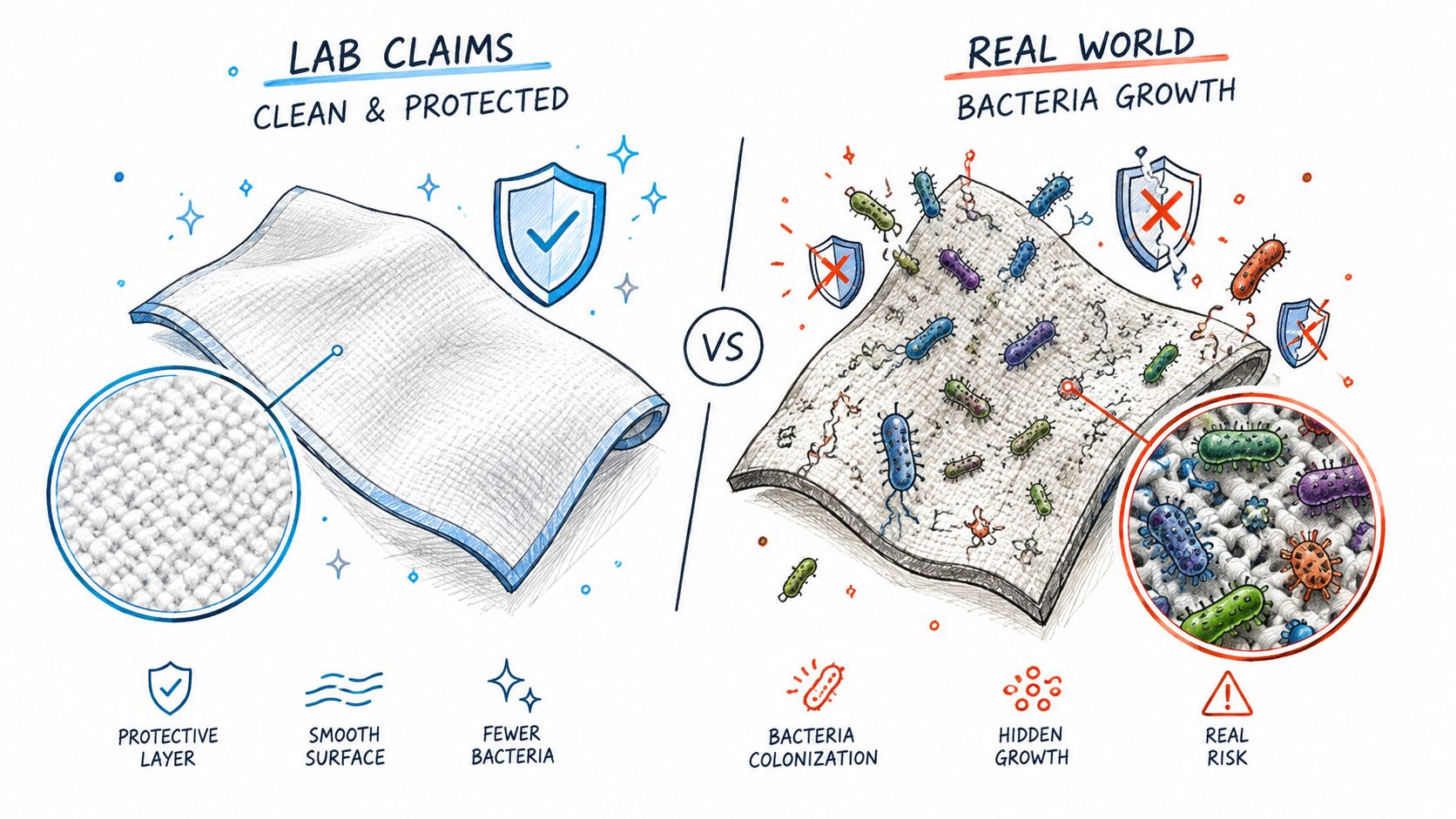
What the evidence proves, and what it doesn't
A credible claim should answer four questions:
- Which organism was tested? Results against one bacterium don't automatically apply to mold, fungi, viruses, or every bacterial species.
- What did the test measure? Inhibition, bacterial reduction, odor reduction, and infection prevention are different outcomes.
- How long did contact last? A laboratory contact period may not match all-day wear.
- Was the finished garment tested? A treated swatch may behave differently from a shaped, stretched, stitched sleeve.
Silver release also deserves attention. Earlier textile research cited in the 2025 review measured approximately 2.7 parts per billion of total silver released per gram of AgCl-treated textile after the first wash, or 2.4 parts per billion when a binder was included. That finding shows why laundering and environmental release belong in a complete product discussion, without proving that every silver-treated garment releases the same amount.
Sensitive-skin users should ask whether the treatment changes fabric feel, causes irritation, or releases active substances during washing. Antimicrobial performance may be useful for textile hygiene, but it doesn't replace ordinary washing or establish reduced infection risk. Thermo Recovery Wear's article on copper and therapeutic claims offers another reminder to separate a material's presence from a clinically meaningful outcome.
Care and Washing Guidelines for Longevity
Care instructions protect both comfort and tested performance. Laundering can remove or deactivate active agents, while heat, abrasion, detergent chemistry, and water conditions can alter the knit itself.
A 2025 review reported that some silver-enhanced smart fabrics retained antibacterial activity after 30 laundry cycles, while more recent experimental work on an integrated fabric reported antibacterial activity above 99% against both E. coli and S. aureus after 50 washing cycles, alongside improved moisture transport. These findings show that engineered or embedded systems can be durable, but they don't establish a universal lifespan for every sleeve. The ACS Omega review and experimental textile discussion also notes that silver addition can slightly alter moisture-management behavior.
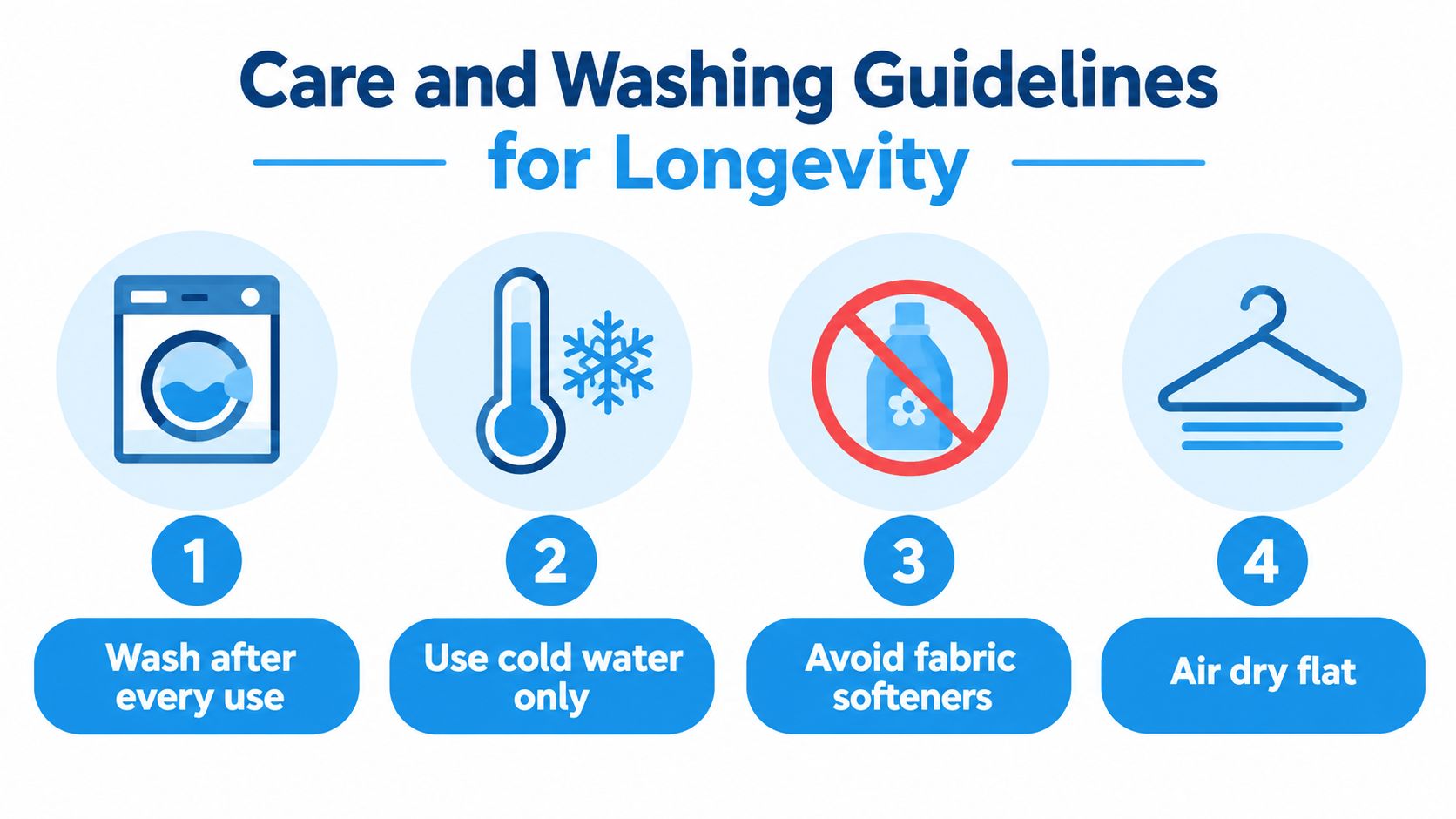
Build a gentler routine
- Follow the garment's care label first. Manufacturer instructions should take priority because fiber blends, treatments, and elastic structures differ.
- Use the mildest suitable cycle. Avoid unnecessary abrasion and aggressive chemistry when the label permits a gentler option.
- Skip fabric softener unless the manufacturer specifically allows it. Coatings can interfere with moisture transport and change the fabric surface.
- Choose drying conditions that protect stretch and treatment. Excessive heat may stress elastic components or alter finishes, so air drying can be preferable when allowed.
- Wash often enough to remove sweat and skin oils. Antimicrobial treatment isn't a substitute for normal laundering.
For people managing repeated loads of technical clothing, a professional wash and fold service can be convenient, but the service still needs the garment's care requirements. A sleeve shouldn't be treated like a disposable towel or a generic cotton item.
Thermo Recovery Wear provides dedicated washing instructions, which shoppers should check before cleaning a specific product. Replace a garment when its fit, surface, odor behavior, or fabric integrity changes noticeably, even if the original antimicrobial claim remains on the label.
Why This Matters for Your Recovery Routine
A recovery sleeve that feels damp, traps odor, or irritates sensitive skin can become difficult to wear consistently. A textile that manages sweat while limiting microbial growth may support a more comfortable routine, but only when its claims match tested performance and the garment receives appropriate care.
For someone with chronic joint discomfort, a sprain, or an overuse injury, comfort affects whether support fits naturally into rest and light activity. Moisture transport helps manage the skin environment. Antimicrobial treatment addresses microbial growth in the fabric. Neither function should be confused with infection prevention or a guarantee of therapeutic results.
Choose garments with clear material descriptions, finished-product testing where available, organism-specific antimicrobial data, wash-cycle information, and practical care instructions. For sensitive skin, introduce any new textile gradually and stop using it if irritation develops.
Thermo Recovery Wear offers compression-lite sleeves and braces made with technical constructions that include moisture-managing bamboo-charcoal textiles and selected germanium-carbon variants. Review the product specifications and care guidance at Thermo Recovery Wear, then choose the garment and size that fit your recovery routine.


