


The most popular advice about knee pain relief products for elderly people is also the least reliable: if a knee hurts, add more support. A tighter sleeve, a rigid brace, or extra straps may feel reassuring, but more restriction can interfere with movement, irritate fragile skin, or encourage someone to rely on a device that doesn't address weakness, instability, or poor mechanics.
Knee osteoarthritis is common with age, but it isn't confined to retirement years. The Osteoarthritis Action Alliance evidence summary reports that 43% of people with osteoarthritis are aged 65 or older, while 88% are at least 45. It also identifies ages 55 to 64 as the period with the highest annual incidence of knee osteoarthritis and notes that more than half of people with symptomatic knee osteoarthritis are younger than 65.
That age distribution matters because an older adult who wants comfortable walking support has different needs from someone managing instability, a healing sprain, or a specific compartment of osteoarthritis. The right product is usually the least restrictive option that supports the intended activity without replacing exercise, assessment, or clinician-directed care.
| Support type | Pain evidence | Function benefit | Comfort level | Best for |
|---|---|---|---|---|
| Soft compression sleeve | May provide subjective comfort and pain reduction, but disability benefit isn't established | Usually limited | Often high when correctly sized | Mild symptoms, warmth, proprioceptive comfort |
| Hinged brace | May help selected users with instability or defined mechanical needs | Can be meaningful in some users | Variable, often lower for prolonged wear | Instability or selected compartmental loading |
| Elastic wrap | Mainly provides adjustable light support | Limited evidence for restoring function | Depends heavily on application | Short-term activity support |
| Neoprene sleeve | May improve comfort during movement | Less established than structured bracing | Warm, but may feel hot or tight | Users who tolerate warmth and light support |
| Padding or patellar support | Useful for localized pressure or tracking concerns in selected cases | Situation-dependent | Usually good | Specific contact or alignment problems |
Table of Contents
- Why Most Knee Support Choices Miss the Mark
- What Makes Elderly Knee Support Different
- Comparing Knee Support Options for Older Adults
- How to Choose Based on Your Situation
- Real-World Scenarios and Product Matching
- Putting It All Together Practical Recommendations
- Implementation and Next Steps
Why Most Knee Support Choices Miss the Mark
A knee support doesn't work just because it surrounds the joint. The product has to match the problem. A flexible sleeve may make walking feel more secure, yet it won't correct every instability pattern. A rigid brace may alter loading in a selected compartment, but it can also become uncomfortable enough that the wearer stops using it.
The American Academy of Orthopaedic Surgeons guideline says brace treatment could be used to improve pain, function, and quality of life in adults with knee osteoarthritis. That is conditional guidance, not a promise that every older adult will benefit from a brace. The same guideline strongly recommends supervised, unsupervised, or aquatic exercise over no exercise for improving pain and function.
Why evidence changes the buying decision
A Cochrane systematic review found low-quality evidence that knee braces may make little or no difference to pain, function, or quality of life after 12 months. Many participants discontinued treatment because they felt the effect was insufficient. That doesn't mean braces are useless. It means marketing language such as “supports every painful knee” goes beyond the evidence.
The distinction between a sleeve and a brace is practical, not merely semantic. A clinical comparison of knee braces and sleeves can help readers understand whether they need light, flexible contact or a more structured device.
Practical rule: Choose support for a defined purpose, such as comfort during walking or management of instability, then judge it by movement and daily function rather than by how substantial it feels.
Older adults also face a greater cost from unnecessary restriction. If a brace makes standing, turning, or stair practice harder, it may reduce the activity that helps preserve strength. The appropriate question isn't “Which product gives the most support?” It's “Which product helps this person move safely and consistently?”
What Makes Elderly Knee Support Different
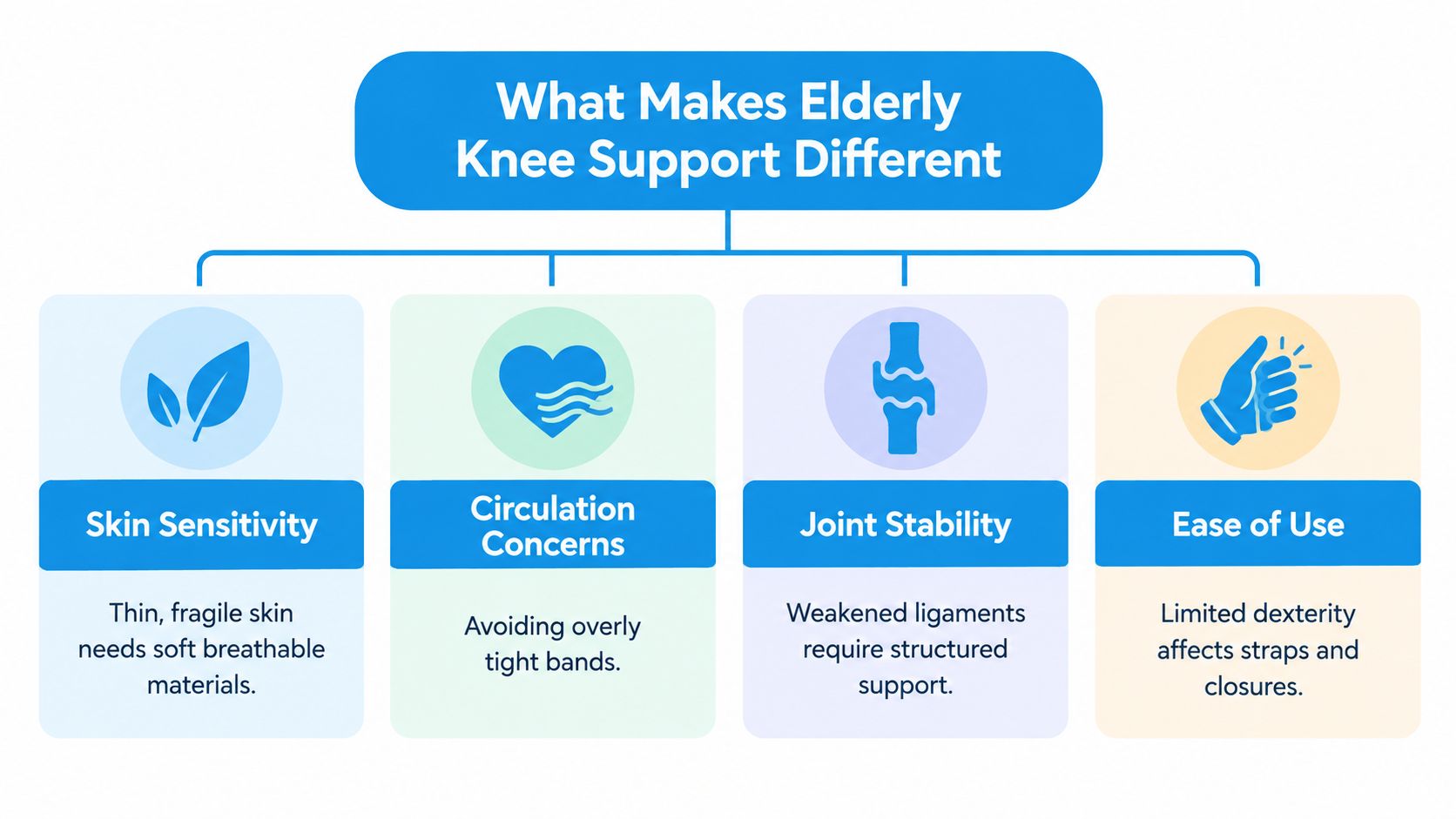
An older knee is only part of the decision. Skin condition, circulation, dexterity, balance, muscle strength, and confidence all affect whether a product remains useful after the first few wears. A support that looks effective on a product page may fail if the wearer can't put it on independently or removes it because the edge rubs.
Fragile skin deserves particular attention. Seams, straps, heat, and concentrated pressure can create irritation that isn't obvious until the product has been worn during ordinary activity. Tight bands may also be poorly tolerated by someone with circulation concerns. Fit should feel secure, not constrictive, and numbness, color change, increasing swelling, or persistent skin marks are reasons to stop and seek advice.
Stability isn't the same as immobilization
A person who has repeated giving-way episodes may need an assessment for ligament weakness, alignment, muscle control, or a fall risk. A structured brace can be appropriate in selected situations, but a rigid device that limits ordinary knee motion may create another problem. Geriatric-focused evidence warns that immobilizing braces can contribute to muscle weakness and may worsen frailty in older adults.
This is why more support isn't automatically safer. A light sleeve may be preferable for an older adult who needs warmth or proprioceptive reassurance during a walk, while a hinged device may be more appropriate when instability is the dominant issue. The choice should preserve useful movement wherever possible.
Ease of use determines adherence
A caregiver should check whether the wearer can identify the front and back, align hinges if present, manage fasteners, and remove the product without pulling the skin. Swelling can change the fit from morning to evening, and hand arthritis can make small straps difficult to operate.
For readers comparing materials and wear patterns, this guide to lightweight knee support for arthritis is a practical reference. The product still needs to pass an individual test: comfortable skin, stable positioning, and no interference with walking.
Comparing Knee Support Options for Older Adults
Different supports solve different problems, and some offer mainly a comfort signal rather than a proven functional change. The evidence is strongest when the device is matched to a defined mechanical need, not when it is sold as a universal pain solution.
| Support type | Pain evidence | Function benefit | Comfort level | Best for |
|---|---|---|---|---|
| Compression sleeve | May reduce pain and create subjective improvement, but disability benefit isn't established | Limited or uncertain | Usually comfortable if breathable and correctly sized | Mild osteoarthritis symptoms, warmth, confidence during activity |
| Hinged brace | May help selected instability or loading patterns | More promising for defined functional goals | Moderate to variable | Giving-way, selected compartmental osteoarthritis |
| Elastic wrap | Little condition-specific evidence | Mainly positional support | Adjustable, but easy to overtighten | Brief activity use when a clinician has advised it |
| Neoprene support | May improve perceived comfort | Not established as a disability treatment | Warm and flexible, though heat can bother some users | Users who prefer warmth and tolerate the material |
| Padding or patellar support | Depends on the source of pain | Useful only for a matching pressure or tracking issue | Generally light | Localized contact sensitivity or selected patellar concerns |
A randomized trial of 120 elderly patients compared a neoprene sleeve, a hinged brace without alignment correction, and no brace during daily activities for three months. Pain improved within all groups, but between-group pain differences weren't statistically significant, with p=0.210. The hinged-brace group did show significantly better results in WOMAC measures, general health and functional capacity measures on the SF-36, and the six-minute walk test. The walk-test difference was statistically significant, with p=0.010, as reported in the trial summary.
Adjuncts deserve separate scrutiny
A support may be combined with exercise, a cane, physical therapy, or another conservative measure. TENS showed a modest pain benefit versus control across six trials, with a standardized mean difference of −0.45 and a 95% confidence interval from −0.70 to −0.20, according to a clinical-practice review. The same review described thermotherapy evidence as low quality and inconsistent, so warmth should be treated as a comfort feature rather than proof of therapeutic effect.
Topical products and supplements require medication and clinician review, especially when an older adult takes several prescriptions. For readers researching nonprescription approaches, find knee pain CBD products from HempWell USA, but discuss CBD with a pharmacist or clinician before use because product quality, interactions, and suitability vary.
A broader overview of joint pain relief products can help organize options, but no accessory should displace exercise-based care, which has stronger support for improving knee osteoarthritis pain and function.
How to Choose Based on Your Situation
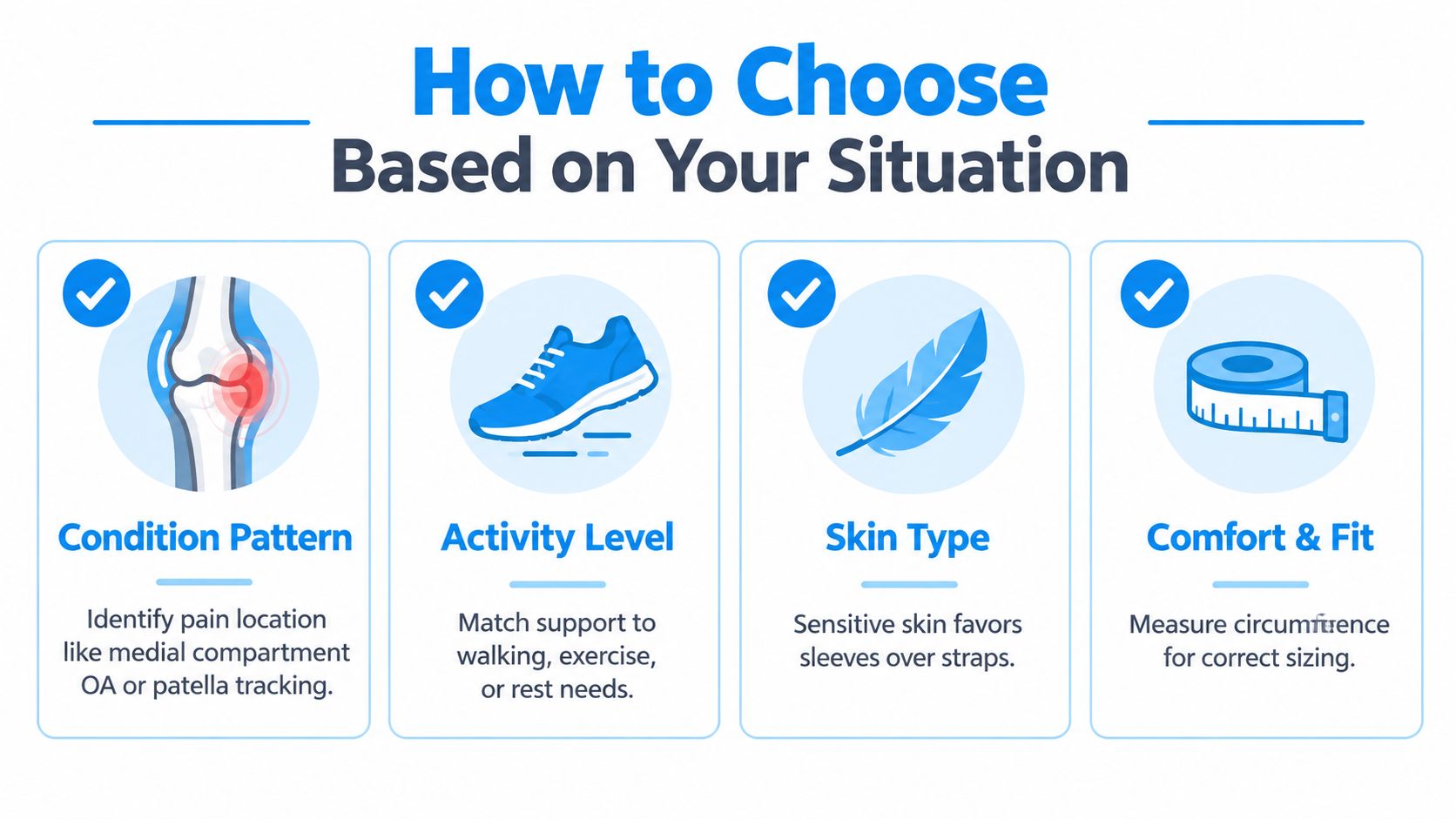
Start with the symptom pattern, not the product category. Pain on the inner side of the knee, a sensation of giving way, diffuse stiffness, and discomfort from pressure can point toward different choices. A clinician or physical therapist may need to assess alignment, instability, swelling, or the specific osteoarthritis compartment before recommending a structured brace.
Match the device to the job
Use a soft sleeve when the main goal is light contact, warmth, or confidence during ordinary walking and the knee is stable. Consider a hinged or unloading design only when instability or a defined mechanical loading problem has been identified. A wrap may offer short-term adjustability, but it is easy to apply unevenly or too tightly.
Activity changes the answer. Someone who walks daily needs secure retention and comfortable bending. Someone who mainly needs support during transfers may need a different design, and someone who experiences pain at rest should not assume that wearing a brace continuously will solve the underlying problem.
Test fit before committing
The support should stay in place without rolling, digging into the back of the knee, or causing tingling. Check the skin after removal and inspect for increasing redness, pressure marks, or swelling. If the knee feels weaker, movement becomes more guarded, or walking is less confident, the product isn't meeting its purpose.
Sizing matters more than brand language. Use the manufacturer's measurement point and compare it with the actual product chart. This knee sleeve sizing chart can help readers understand why circumference, rather than a guessed clothing size, should guide selection.
A useful test: After wearing the support during the intended activity, ask whether walking, turning, or standing felt easier. If the only noticeable effect is pressure, the product may be too restrictive or poorly matched.
Exercise remains part of the plan. The AAOS guidance cited earlier supports exercise over no exercise, so a sleeve should make appropriate movement more manageable, not become a reason to avoid strengthening and mobility work.
Real-World Scenarios and Product Matching
Consider a 72-year-old who has mild medial-compartment osteoarthritis and walks daily. If the knee is stable and the goal is comfort during walking, a breathable sleeve may be a reasonable first trial. An unloading brace could be considered if a clinician identifies a loading pattern that warrants it, but starting with a rigid device would add complexity without a clear reason.
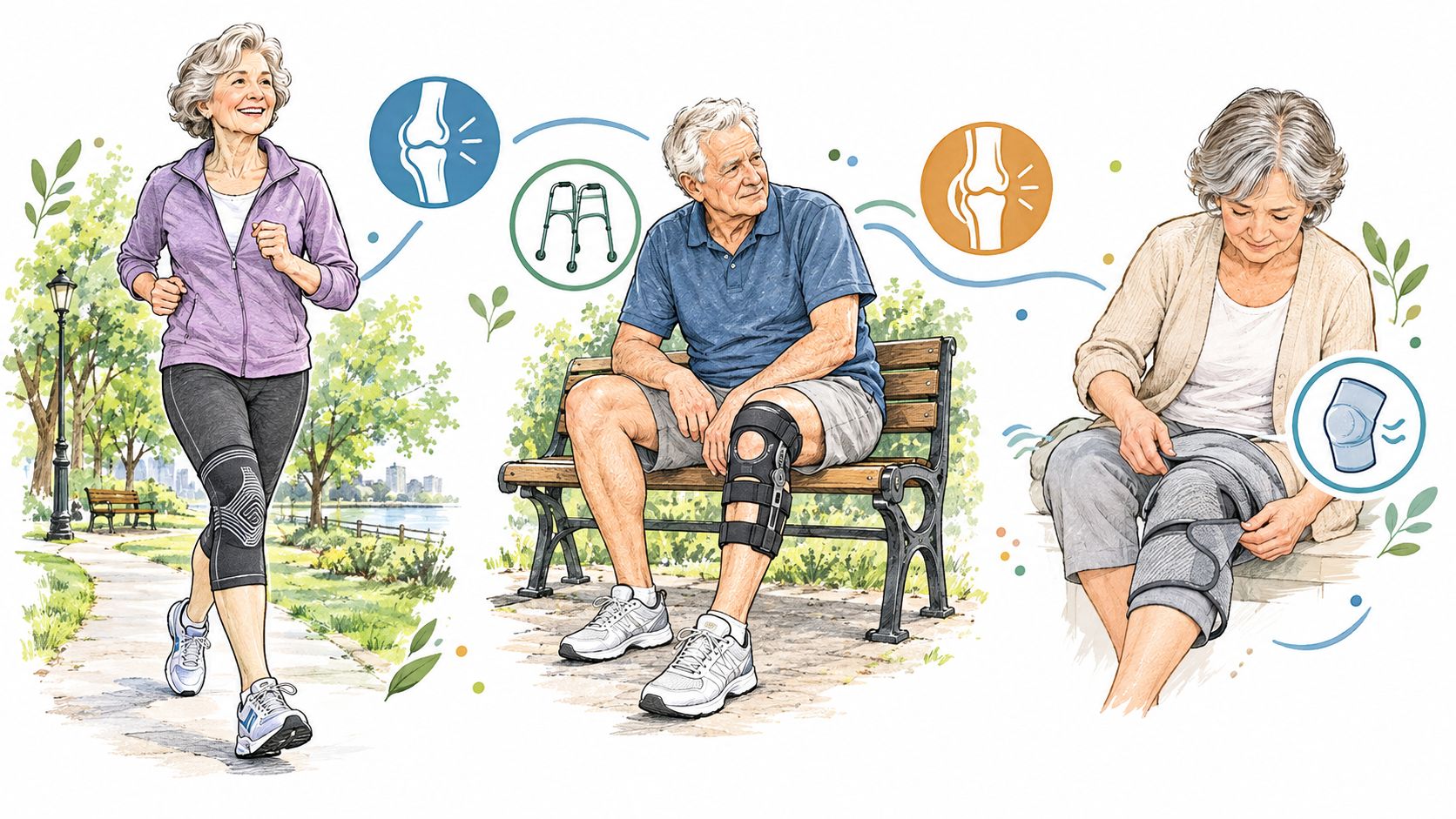
A 78-year-old with recurrent giving-way episodes needs more than a generic compression product. Repeated instability raises concerns about falls, ligament support, muscle control, and alignment. A hinged brace might be appropriate after assessment, but the treatment plan should also address strength, balance, and safe mobility. A sleeve alone may provide reassurance while leaving the mechanical problem unchanged.
Skin and recovery change the recommendation
An older adult with sensitive skin who can't tolerate tight compression may do better with a soft, low-pressure sleeve or no knee support until the skin issue is addressed. A product that causes itching, blistering, or persistent marks isn't a successful treatment, even if its design appears clinically advanced.
Someone recovering from a sprain may need temporary structured support during vulnerable activities, followed by a gradual return to movement. Long-term immobilization without reassessment can encourage weakness. The appropriate duration and brace type should come from the treating clinician, particularly if swelling, bruising, or instability persists.
The same matching principle applies across situations. A knee compression sleeve guide may help compare designs, but the expected outcome should remain modest and specific: more comfortable activity, steadier movement, or protection during a defined phase of recovery.
Putting It All Together Practical Recommendations
The best knee pain relief products for elderly users aren't necessarily the strongest products. They're the ones that support a clear goal while preserving movement, tolerating daily wear, and avoiding unnecessary pressure.
Choose a sleeve first when the knee is stable and the intended benefit is light support, warmth, or confidence during activity. Consider a hinged or unloading brace when instability or a specific compartmental loading problem has been assessed. Avoid treating a brace as a substitute for strengthening, balance work, weight management, or professional evaluation.
The NICE osteoarthritis guidance advises against routinely offering braces, splints, tapes, or supports unless the joint is unstable or biomechanically overloaded, exercise has been ineffective or unsuitable, and the device is likely to improve movement or function. That is a useful standard for consumers because it shifts attention from product features to functional need.
Seek professional assessment for unexplained pain, marked swelling, repeated giving way, a hot or red joint, new deformity, inability to bear weight, or symptoms after a significant injury. A physical therapist can also help determine whether a support improves gait or merely changes how the person guards the knee.
For an older adult, a product that can be worn comfortably during ordinary movement may be more valuable than a highly restrictive brace that sits unused. The evidence supports careful, adjunctive use, not universal bracing or guaranteed pain relief.
Implementation and Next Steps
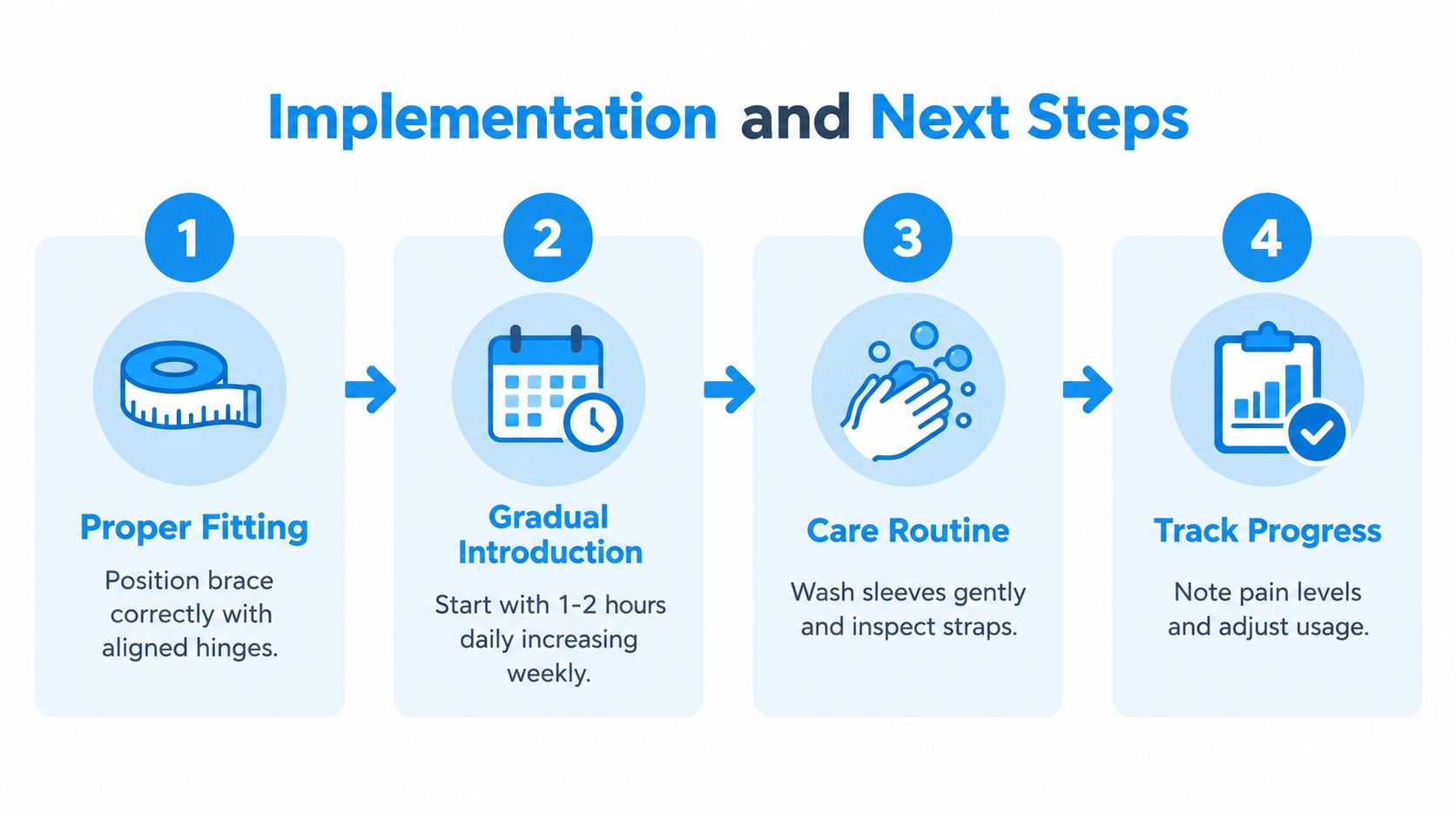
Begin with correct positioning. A sleeve should sit smoothly without folds behind the knee, while a hinged brace needs its hinges aligned with the joint and its straps secured evenly. Don't tighten progressively to chase a stronger sensation. The goal is stable contact without numbness, discoloration, worsening swelling, or skin irritation.
Introduce the product during a controlled activity, such as a short walk at home, rather than wearing it for an entire day immediately. Remove it and inspect the skin, then decide whether the knee felt more capable, unchanged, or more restricted. If the product creates problems, adjust the fit once, and stop using it if symptoms continue.
Track function, not just pain
Write down the activity, wearing time, comfort, walking confidence, swelling, and skin response. A product may not reduce pain immediately yet still help someone complete a walk more naturally, or it may reduce discomfort while causing poorer movement. Those observations are useful when deciding whether to continue, resize, change product type, or consult a clinician.
Wash fabric supports according to the care instructions and let them dry fully. Inspect seams, elastic, hook-and-loop fasteners, and hinges for wear. A stretched sleeve or damaged strap may shift pressure and change the way the knee moves.
Know when to involve a professional
Ask a physical therapist, orthotist, physician, or pharmacist for guidance when the knee is unstable, symptoms persist, skin is fragile, circulation is a concern, or the product is difficult to apply. Professional fitting is particularly valuable for a brace intended to alter loading or manage repeated giving way.
Support works best as one part of a broader plan that includes suitable exercise, weight management when relevant, activity modification, and clinician-directed treatment. Reassess the product when the knee changes, the person becomes less steady, or the device no longer improves the intended activity.
Thermo Recovery Wear offers compression-lite recovery sleeves and braces designed for light daily activity, with materials and fit guidance intended for users who prefer less restrictive support. If you're comparing comfortable adjuncts for chronic joint discomfort or recovery, visit Thermo Recovery Wear to review its knee-support options and wear-care information.


