


Many people with general knee pain find that no, they shouldn't sleep in a standard compression or rigid knee brace unless a clinician told them to. Overnight, the leg stays still, the calf-muscle pump is inactive, and a snug brace can start acting like a tourniquet, which is why individuals wake up with tingling, numbness, or extra swelling instead of relief.
That blunt answer goes against a lot of popular advice, because many articles treat more brace time like more healing. I don't buy that. After reviewing the clinical guidance, and after wearing both tight support braces and softer recovery sleeves myself, the better question isn't should I sleep with my knee brace on. It's what kind of brace are you talking about, and what is it doing to your leg for hours while you can't feel the warning signs quickly enough.
A locked post-op brace, a snug neoprene sleeve, and a non-compressive recovery garment do not belong in the same bucket. One can be necessary. One can be annoying but manageable. One can create the exact morning symptoms people blame on their knee problem. If you want a practical answer, you have to sort the brace before you answer the bedtime question.
Table of Contents
- Why the Brace Question Is Really a Brace-Type Question
- What Happens to Your Knee Overnight Without You Noticing
- Compression Braces vs Non-Compression Braces at Bedtime
- When Clinicians Actually Want You to Sleep in a Brace
- How to Sleep in a Brace Safely If You Must
- When You Should Not Sleep in a Knee Brace
- Warning Signs That Mean Take the Brace Off and Call a Doctor
- A Simple Decision Framework for Tonight
Why the Brace Question Is Really a Brace-Type Question
The biggest mistake people make is assuming longer wear equals better healing. That's not how knee bracing works. A brace only helps when its job matches the problem. If the brace is meant to protect a surgical repair, control motion, or hold extension, overnight wear can make sense. If it's just squeezing your knee because it feels supportive during the day, bedtime is a different story.
The question is simple. Does your brace compress, restrict, or immobilize the leg, or does it mostly provide warmth and light support without squeezing it?
Two very different brace categories
Most sleep advice gets sloppy because it lumps together devices that behave nothing alike. A hinged brace, a post-op immobilizer, and a tight compression sleeve all add mechanical pressure or motion control. A softer recovery sleeve with little to no compression doesn't carry the same overnight circulation risk profile.
If you need a clear breakdown between those categories, this guide on the difference between a knee brace and a knee sleeve is useful because it separates structure from simple coverage.
Here's the practical split I use:
- Mechanical or compressive braces: Hinged braces, immobilizers, unloader braces, neoprene sleeves, and firm compression supports.
- Non-compressive recovery garments: Sleeves that focus more on warmth, fabric response, and comfort than on squeezing the joint or calf.
My rule: If the brace leaves deep strap lines, changes how your knee bends, or feels “secure” because it's tight, don't assume it's safe for sleep just because it feels good at dinner time.
Clinical intent matters more than habit
There is also a huge difference between prescribed overnight bracing and self-directed bedtime bracing. Guidance reviewed by Mass General Brigham is direct on this point. An orthopedic surgeon there says braces are best used during activities that provoke pain, and they should not be worn while sitting still or sleeping for most people with general knee pain.
That's why I push back on blanket advice. If your brace changes circulation or presses on skin for hours, type matters more than the label on the box. And if your brace doesn't compress much at all, the conversation changes completely.
What Happens to Your Knee Overnight Without You Noticing
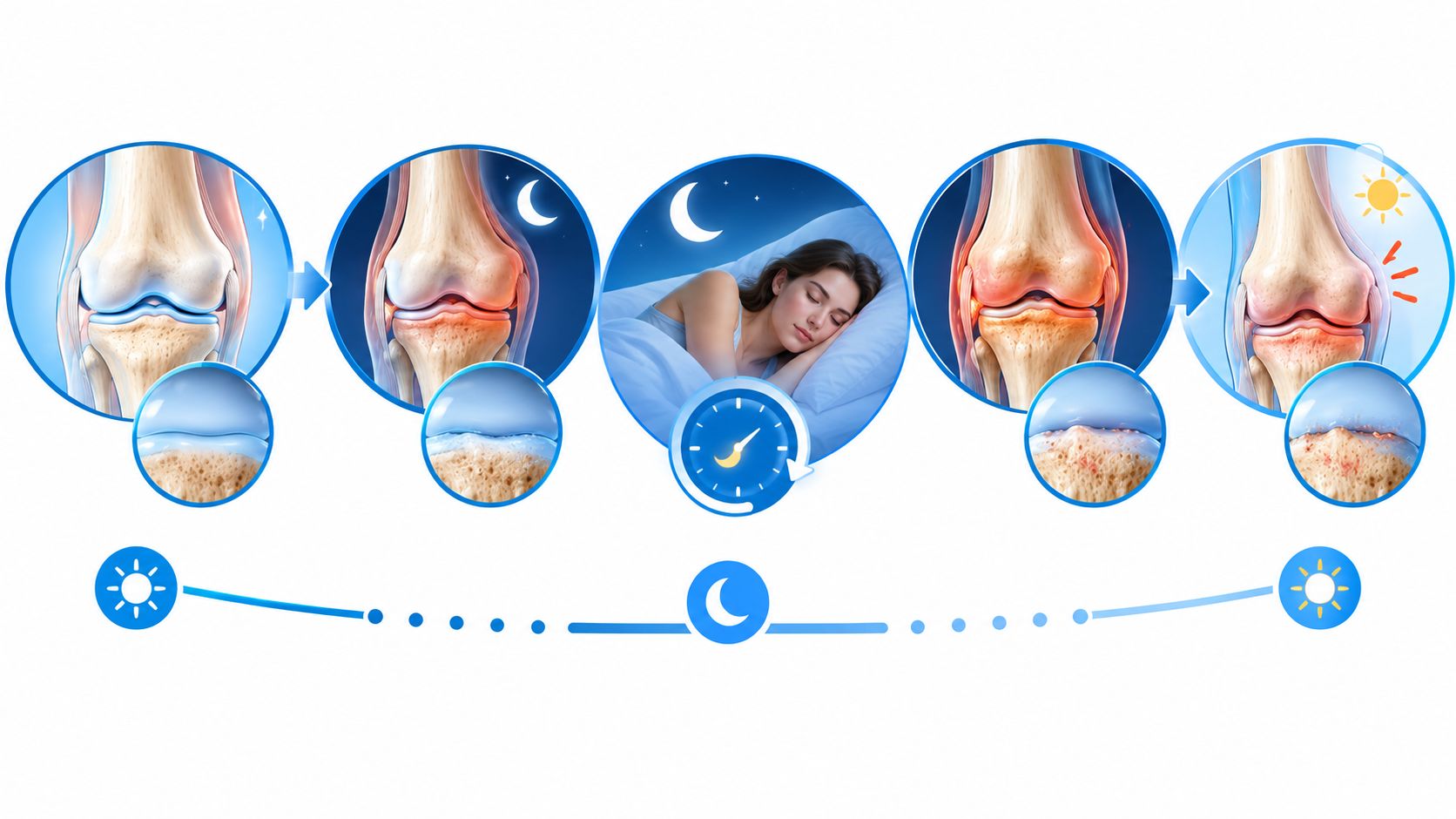
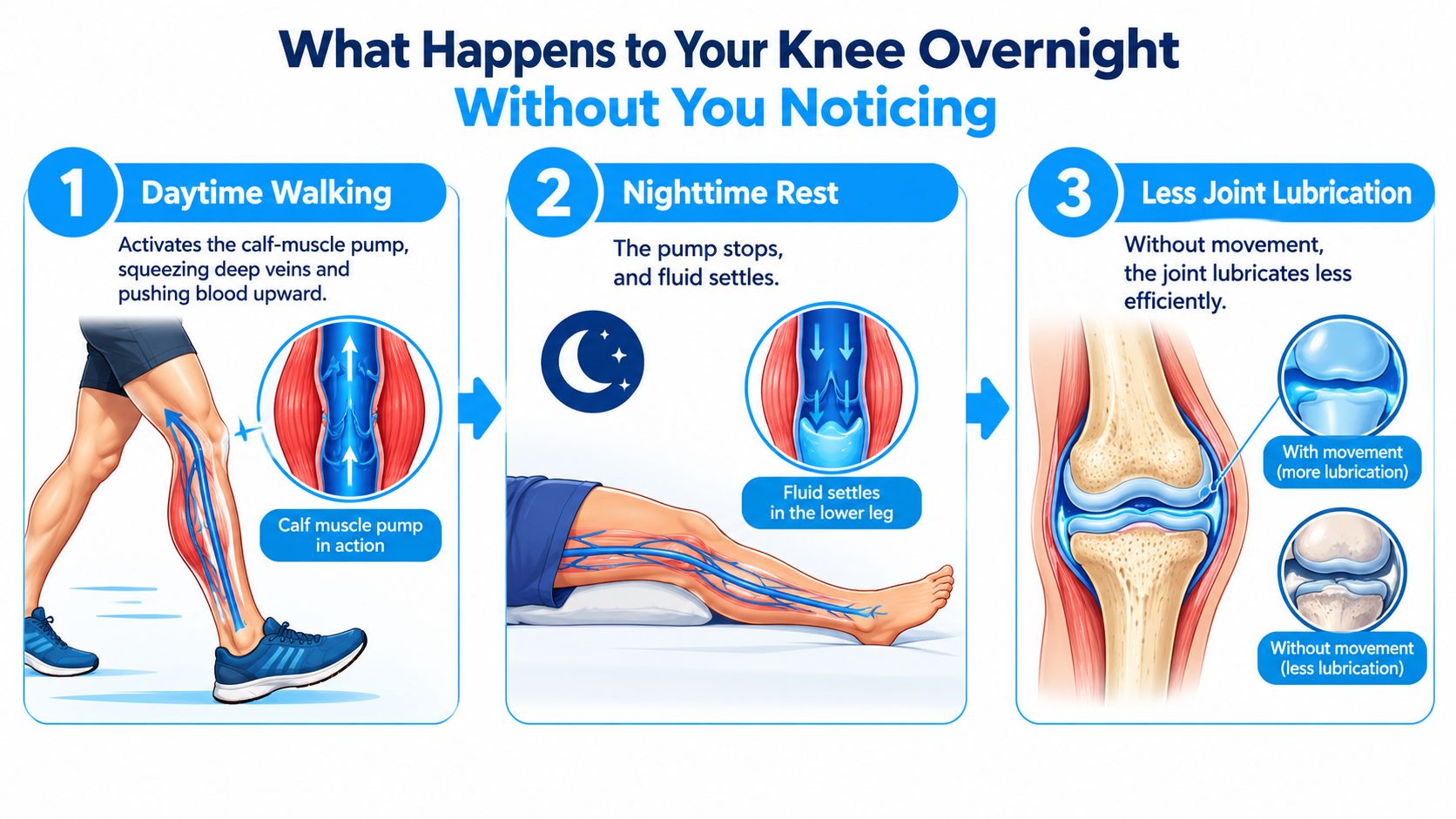
Your knee at night is dealing with a completely different mechanical environment than your knee during the day. While you're walking, your calf muscles keep squeezing deep veins and helping move blood and fluid back upward. When you're asleep, that pump goes quiet. The leg is still. The tissues sit under the same pressure points for hours.
That matters because a brace that feels fine when you're moving can behave very differently when your leg is parked in one position all night.
The calf-muscle pump goes offline
During the day, motion rescues a lot of bad brace fit. You shift, stand, walk, and naturally change pressure. Overnight, you lose that protection. Guidance summarized by NJIT's review of sleeping in a knee brace explains the key biomechanical issue well. When the leg is immobile for hours and the calf-muscle pump is inactive, a brace that's even slightly too tight can interfere with venous return and raise the chance of morning swelling, numbness, or tingling.
That's the hidden problem many miss. They think, “It wasn't too tight on the couch.” Fine. But seven quiet hours is not the couch.
Why morning symptoms fool people
A lot of people wake up stiff, puffy, or tingly and assume the knee itself got worse overnight. Sometimes the brace caused it. If a strap, seam, or sleeve edge sits on a slowly swelling leg, it can create a low-grade tourniquet effect. Not enough to trigger panic right away, but enough to leave you with calf marks, irritated skin, pins and needles, or a foot that feels oddly cold.
If mornings are rough, this article on how to handle morning knee stiffness gives a good broader look at what can drive those first-step symptoms.
- Less movement: Fluid has fewer chances to redistribute.
- Longer pressure time: The same tissues get pressed for hours.
- Lower awareness: You don't notice small warning signs in your sleep.
- More skin friction: Braces migrate, bunch, and rub while you roll.
A brace can feel supportive when you're awake and become irritating once your leg swells under it overnight. That's not rare. It's physics.
Compression Braces vs Non-Compression Braces at Bedtime
That's where the decision gets practical. If you're deciding whether to sleep in your brace, you need to place it on the right side of the line. Compression and rigid braces are the ones that cause most overnight trouble. They either squeeze, anchor, or restrict. That's useful in the right scenario, but it's also why they can leave you worse by morning.
By contrast, non-compression recovery sleeves are a different tool. They're closer to wearable warmth than immobilization. That doesn't make them automatically right for everyone, but it does make them a completely different bedtime conversation.
The overnight trade-off in plain English
A tight brace can reduce unwanted movement. It can also press on skin and soft tissue all night. A non-compressive sleeve usually won't control motion much, but it's less likely to create the classic wake-up complaints of indentations, tingling, and below-brace swelling.
If you want a deeper look at how mechanical pressure changes the feel of support, this piece on compression knee support is a solid companion read.
Here's the side-by-side view that matters most.
Compression vs Non-Compression Knee Braces at Bedtime
| Feature | Compression / Rigid Brace | Non-Compression Infrared Sleeve |
|---|---|---|
| Primary action | Squeezes tissue, restricts motion, or both | Adds light coverage and warmth without meaningful squeeze |
| Typical examples | Hinged brace, immobilizer, neoprene sleeve, firm compression support | Infrared-responsive recovery sleeve, fabric-based low-pressure sleeve |
| Best bedtime use | Only when a clinician specifically wants overnight control | General comfort use, if it fits comfortably and doesn't irritate skin |
| Main overnight risk | Pressure marks, circulation restriction, nerve irritation | Heat or fabric sensitivity if you don't tolerate the material |
| Side-sleeper comfort | Often poor, hardware and seams dig in | Usually easier to tolerate |
| Morning downside | More likely to leave swelling, numbness, or grooves if too snug | More likely to be simply neutral, either comfortable or unnecessary |
| Who should be cautious | Anyone with skin fragility, nerve symptoms, or circulation concerns | Anyone with skin sensitivity or unexplained nighttime swelling |
Where garments fit on that spectrum
General education around compression garments from Lake City Physical Therapy is helpful here because it reminds people that compression is a tool, not a default comfort setting. At bedtime, that's even more true.
This is also the one place I'll mention a specific product category. Thermo Recovery Wear makes non-compression, infrared-responsive sleeves intended for rest or light activity, which puts them in the lower-pressure category rather than the rigid or squeeze-heavy category. That's the right lane for someone who wants fabric-based comfort without the main overnight drawback of mechanical compression.
If your brace works by force, assume bedtime risk is higher. If it works mainly by comfort and warmth, bedtime may be more reasonable, assuming the fit is comfortable and your skin tolerates it.
When Clinicians Actually Want You to Sleep in a Brace
The answer is not a straightforward yes or no. It depends on the brace and the reason you are wearing it. Clinicians prescribe overnight bracing when a rigid or hinged brace has a specific job, such as protecting alignment, limiting motion, or preserving surgical work. A non-compressive infrared sleeve serves a different purpose and does not replace that treatment.
When night wear is actually prescribed
The strongest case for sleeping in a brace is post-operative rehabilitation. A controlled study summarized by Biology Insights found that patients who wore a rehabilitation brace at night had significantly better knee extension at 4 weeks and 8 weeks after surgery than patients who did not. That benefit applies to a defined surgical recovery plan, not ordinary knee discomfort.
Hospital instructions can be equally specific. The St George's NHS hinged knee brace patient guide directs some patients to wear a brace while sleeping. It also identifies skin pressure areas as a main risk and says red marks should disappear within 30 minutes after the brace comes off.
Common reasons for prescribed overnight bracing include:
| Scenario | Typical brace type | Overnight instruction | Main safeguard |
|---|---|---|---|
| Post-op extension protection | Hinged rehabilitation brace or immobilizer | Follow the surgeon or rehabilitation team | Keep the prescribed position |
| Meniscus or ligament repair | Locked or range-limited brace | Use during early healing if ordered | Do not change the angle yourself |
| Acute instability | Hinged or rigid brace | Wear short term under clinical direction | Check skin and circulation regularly |
| Fracture or patella stabilization | Immobilizer or prescribed hinge brace | Use only during the ordered recovery phase | Follow fitting and follow-up instructions |
Prescribed overnight bracing is treatment. Habitual bracing for routine pain is not. A brace can protect healing tissue when its settings and wear schedule come from a clinician. It can also create pressure, tingling, or morning swelling when someone chooses a rigid, compressive brace without that guidance.
If your surgeon, orthopedist, or physical therapist told you to sleep in one, follow the plan and report warning signs. If you bought a brace because your knee hurts after work, do not treat yourself like a post-operative patient. The indication, brace type, and required settings are different.
How to Sleep in a Brace Safely If You Must
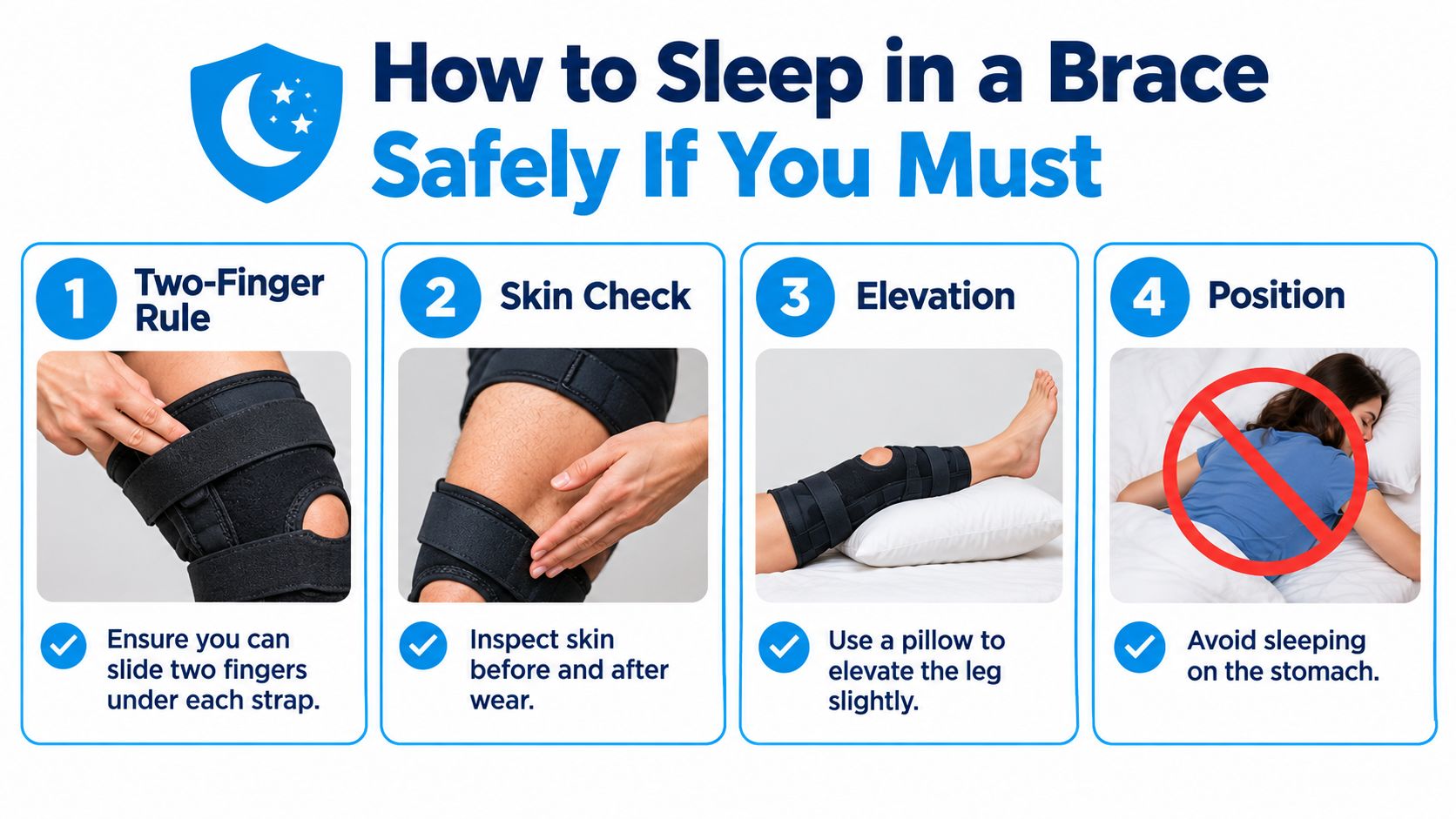
Sleeping in a knee brace is not automatically safer. The setup depends on the brace. A rigid compression brace can restrict movement and squeeze tissue for hours, while a non-compressive infrared sleeve may provide warmth and coverage without the same mechanical pressure. If overnight wear is prescribed, aim for controlled support, not maximum tightness. Overnight compression is often the hidden reason a knee feels more swollen or a foot tingles in the morning.
Fit the brace for lying down
Use the two-finger rule under every strap. You should be able to slide two fingers beneath the brace without forcing them, while the brace remains positioned correctly. A strap that feels fine while walking can become restrictive once your leg is still and horizontal. For placement and strap order, follow this how to wear a knee brace guide.
Set the brace up after you get into bed:
- Lie down first: Horizontal positioning changes the fit.
- Loosen daytime tension: Back off straps tightened for walking.
- Check each strap: A single tight lower strap can create pressure below the knee.
- Use a thin layer underneath: A light, moisture-wicking barrier can limit rubbing.
Do not add extra wraps, padding, or a second support to make the brace feel more secure. That can increase pressure without improving protection.
Choose a position that reduces pressure
Back sleeping usually keeps the brace flatter and makes pressure points easier to identify. A small pillow under the lower leg may improve comfort, and gentle elevation can help you avoid tightening the brace to control discomfort. These ideas on adjustable bases for better rest may help you change leg position without forcing the knee into a painful angle.
Before sleep, move the knee and ankle gently and compare both legs for temperature, color, and sensation. Remove the brace and seek medical advice if the supported leg becomes cold, pale, numb, or increasingly swollen.
Check the knee and lower leg again in the morning. If the brace caused tingling, new swelling, or worsening pain, do not repeat the same overnight setup. A non-compressive sleeve may be more suitable for comfort, but prescribed rigid bracing takes priority over personal adjustments.
When You Should Not Sleep in a Knee Brace
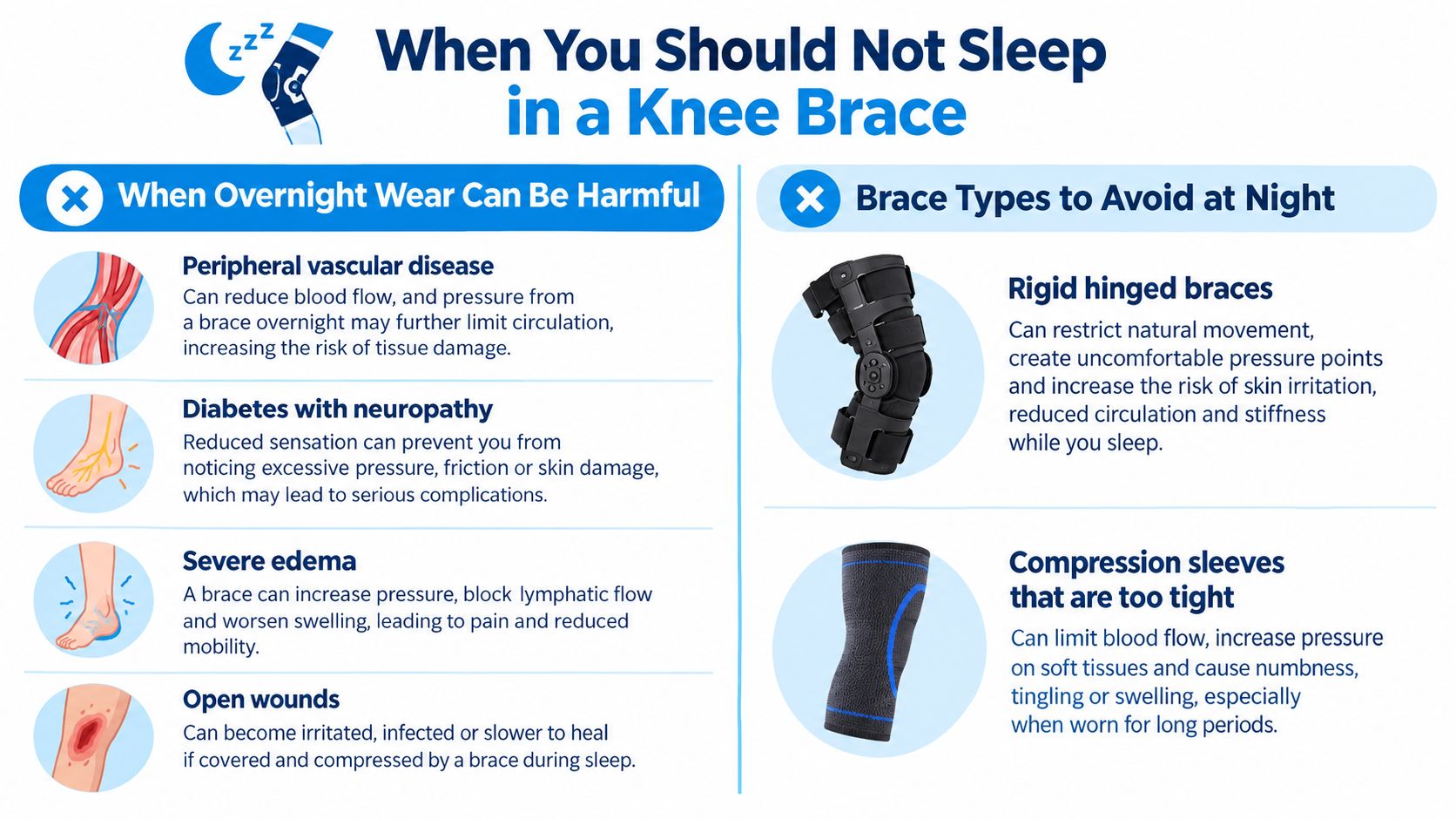
Some people need a hard no. Not “maybe if it's comfortable.” Not “try it and see.” Just no. If you have poor circulation, fragile skin, reduced sensation, or you're wearing a rigid brace without a prescription, sleeping in it is a bad bet.
The people who shouldn't experiment
If you have diabetes-related neuropathy, peripheral vascular disease, or chronic venous problems, you may not feel pressure building soon enough to protect yourself. That's what makes bedtime bracing risky. The tissue can get compressed for hours before you notice anything is wrong.
Skin matters too. Eczema flares, recent shaving, fragile skin, or existing irritation under the knee make overnight friction more likely to turn into breakdown.
Brace types that are especially poor bedtime choices
There are also braces that people misuse at night because they confuse daytime benefit with nighttime safety.
- Rigid post-op braces you weren't told to wear overnight: These are treatment devices, not comfort gear.
- Unloader braces for arthritis in bed: Useful during load-bearing, much less compelling when you're lying still.
- Tight sports sleeves and neoprene supports: They often feel “good tight” by day and “bad tight” by morning.
- Any brace that already slips, bunches, or digs in: Sleep will make that worse, not better.
A quick visual summary can help if you're deciding whether your situation belongs in the stop category.
If your reason for wearing the brace is “it seems like more support must help,” that's usually the moment to take it off before bed.
Warning Signs That Mean Take the Brace Off and Call a Doctor
Sleep should not leave you with a numb foot and a brace-shaped imprint. If symptoms show up, stop treating this like a comfort question and treat it like a fit problem, or a medical problem.
Remove it now if you notice these
Numbness, tingling, coolness, swelling, discoloration, or bruising are not signs that the brace is working. They point to circulation restriction or nerve compression. The same logic applies if the brace feels fine when you lie down but you wake up with a different leg than the one you went to sleep with.
Take the brace off and reassess if you notice:
- Pins and needles or numb patches
- Toes or foot feeling cool
- New color change below the brace
- Worsening swelling after sleep
- Raw spots, blisters, or persistent pressure marks
- Pain that is sharper with the brace than without it
If you are trying to tell brace irritation from something more serious, read warning signs of DVT and take calf swelling, pain, and shortness of breath seriously.
Know the difference between urgent and same-week problems
Some problems need a prompt clinic review. Others need urgent care now.
Same-week appointment:
- Recurrent morning tingling
- Pressure sores under straps
- Repeated swelling after overnight wear
- Brace migration that keeps creating a hot spot
Urgent care now:
- New one-sided calf swelling with significant pain
- Chest pain
- Sudden shortness of breath
If the brace already caused nerve symptoms or obvious skin injury, do not put it back on the next night just to test it again.
Your body already gave you the answer.
A Simple Decision Framework for Tonight
If you're still asking should I sleep with my knee brace on, use this five-question filter before bed. It cuts through the noise fast.
Ask these five questions in order
-
Did a clinician specifically tell you to wear this brace overnight?
If yes, wear it as prescribed, unless you already have warning signs. -
Is this brace rigid or compressive?
If it's a hinged brace, immobilizer, neoprene support, or anything that feels secure because it squeezes, assume bedtime risk is higher. -
Do you have circulation, skin, or nerve risk factors?
If you have poor sensation, fragile skin, or circulation concerns, that's a strong reason not to self-prescribe overnight brace wear. -
Are you already getting red flags?
Tingling, numbness, swelling, discoloration, and persistent marks mean stop. -
Can you verify the fit for sleep, not just for walking?
If you can't loosen and recheck it properly, don't sleep in it.
Your three practical outcomes
This is the part most need spelled out.
- Wear it as prescribed if you're following a surgeon's or rehab protocol and you're not having neurovascular or skin warning signs.
- Skip the compression brace and consider a non-compression option if your issue is general knee discomfort, nighttime achiness, or stiffness rather than post-op protection.
- Take it off and call a clinician if the brace is causing numbness, color change, bruising, persistent marks, or worsening swelling.
That middle lane is the one most general knee-pain readers belong in. If you want something on the knee overnight, a non-compressive infrared sleeve makes more sense than a mechanical brace because it avoids the hidden problem that trips people up, overnight squeezing on a motionless leg.
One sentence to keep in your head tonight: brace type and clinical intent decide whether you should sleep in it, not how supportive it feels at bedtime.
If you want overnight knee support without the usual squeeze-and-strap trade-off, Thermo Recovery Wear offers compression-lite, infrared-responsive recovery sleeves designed for rest and light daily use. If your current brace leaves you waking up with grooves, tingling, or a puffy lower leg, it's worth comparing your setup to a non-compressive option that's built for comfort instead of force.


