


Yes, infrared heat therapy can provide short-term relief for joint pain and stiffness, but results depend on the type of infrared, the dose, and the condition being treated. The evidence is mixed: a review covering three osteoarthritis studies with 276 participants found some encouraging results, but it doesn't show that every infrared product works the same way.
Does warmth help because it relaxes the area, or because a device delivers a specific kind of light at a specific dose? That distinction matters. Far-infrared thermal products and near-infrared photobiomodulation use different mechanisms, and a passive infrared-responsive garment isn't the same as a powered light source.
Here's how to separate those approaches, interpret the clinical evidence, and choose a home option with realistic expectations. The central idea is simple: evidence applies to the device and treatment tested, not automatically to every product carrying the word “infrared.”
Table of Contents
- A Direct Answer Before the Deep Dive
- The Two Kinds of Infrared and Why They Behave Differently
- A Brief History of Infrared in Medicine
- What the Clinical Evidence Actually Shows
- Matching the Tool to the Job at Home
- Safe and Practical Use at Home
- What the Marketing Gets Wrong
- Deciding Whether Infrared Therapy Is Worth Trying
A Direct Answer Before the Deep Dive
Infrared heat may ease stiffness and some joint discomfort for a time, particularly when warmth itself feels soothing. But it hasn't been shown to work equally well for every condition, or to repair damaged cartilage. A sleeve that holds warmth against a joint, a sauna that heats much of the body, and a clinical light panel deliver different kinds of treatment.
For osteoarthritis, findings are mixed. In a systematic review, one trial reported no statistically significant treatment effect, while another found improved knee osteoarthritis outcomes with far-infrared-emitting plasters. Those results are promising but limited, and they don't establish a guaranteed benefit for consumer wearables. The review concluded that pain scores generally decreased in infrared-treated musculoskeletal patients, while small study numbers and differing treatment methods constrained confidence in the findings. (2022 systematic review of infrared radiation for musculoskeletal conditions and chronic pain)
This guide distinguishes thermal infrared from photobiomodulation, puts the medical history in context, and looks at findings for joint pain and a specialized circulation-related use. It also offers practical ways to compare products and use a sleeve cautiously.
Realistic expectation: Think of an infrared garment as a possible comfort aid, not a replacement for diagnosis, prescribed care, or rehabilitation.
The Two Kinds of Infrared and Why They Behave Differently
The word “infrared” covers approaches that can act quite differently. Far-infrared thermal products deliver warmth. Red and near-infrared photobiomodulation use light at low intensity with the aim of influencing cellular signaling. One useful comparison is a radiator versus sunlight reaching a solar cell: both involve energy, but they don't produce the same effect.
A far-infrared sauna or wrap is intended to warm the body or a local area. In plain terms, the experience may resemble a hot towel: the warmth can feel relaxing, and heat can make a stiff area feel more comfortable. By contrast, photobiomodulation describes light absorbed by cellular components. Mechanistic research links red and near-infrared light with mitochondrial cytochrome-c oxidase signaling, nitric-oxide release, ATP production, and regulated reactive-oxygen-species pathways. Those pathways may influence inflammation and tissue repair, but a plausible mechanism doesn't prove that any specific consumer product produces a clinical benefit.
The distinction becomes especially important with clothing. An infrared-responsive textile is passive: it relies on body heat and its material properties rather than a powered source emitting a controlled light treatment. That means claims made about a calibrated light device can't be carried over to a sleeve. For another plain-language comparison of the terminology, see this overview of red light vs infrared for clinics.
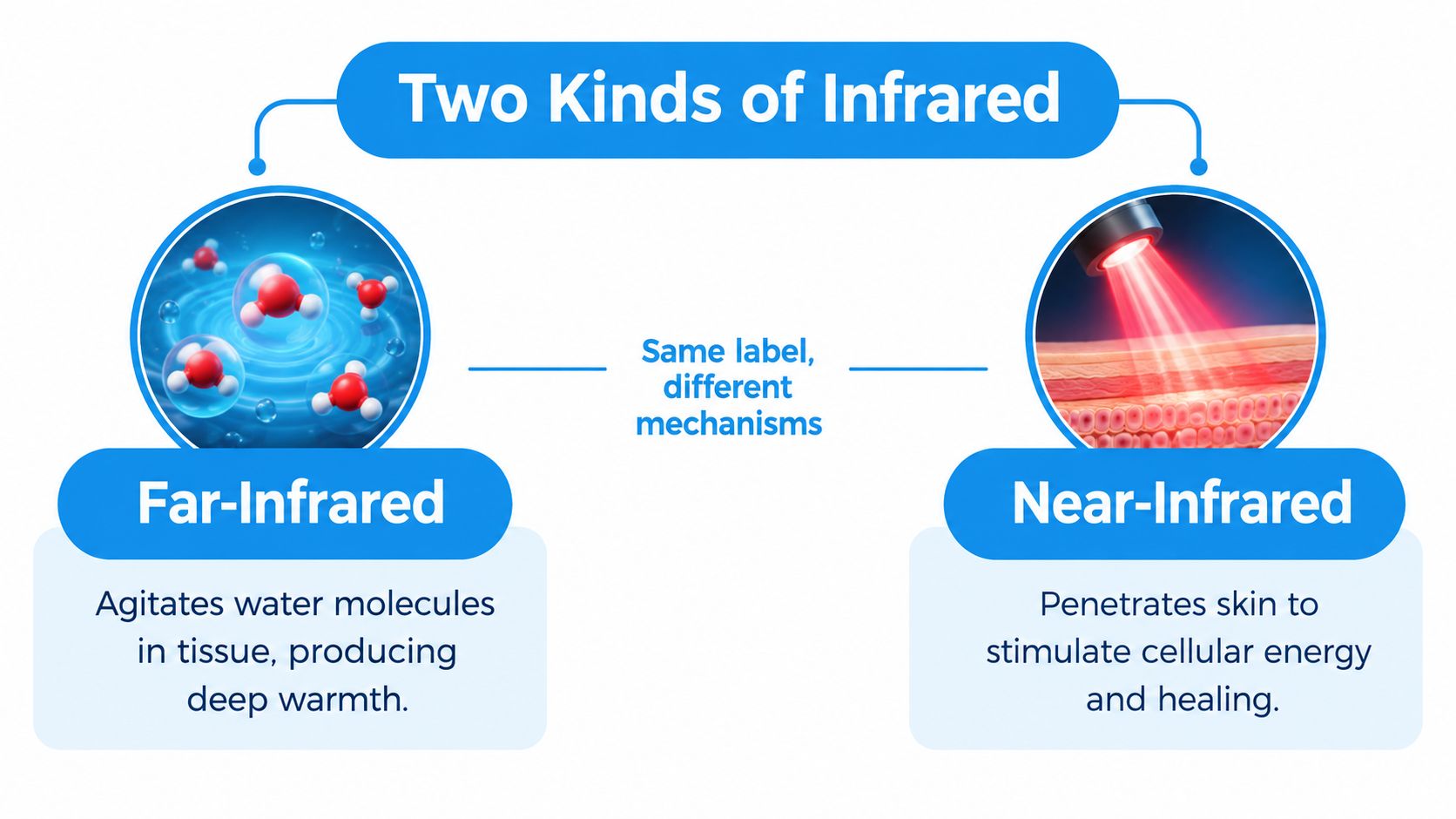
Dose matters for photobiomodulation. Responses can be biphasic, meaning too little energy may have no measurable effect, while too much may reduce or reverse a desired response. Reviews discuss different wavelengths and dose ranges for light-delivery systems, but those figures can't be assumed to describe passive textiles; dose at the skin needs to be measured under real wearing conditions. If you're weighing warmth against cooling for comfort, this guide to hot and cold therapy provides useful context. The key question is always which mechanism, dose, and product generated the evidence.
A Brief History of Infrared in Medicine
Infrared therapy reached clinics decades before recovery sleeves existed. Researchers began developing whole-body hyperthermia with infrared irradiation in the 1960s. In 1960, Martin Heckel presented a whole-body hyperthermia device that used near-infrared energy as an alternative to hot-water baths. From 1965 onward, Manfred von Ardenne advanced related hyperthermia concepts. These milestones document sustained clinical interest in infrared energy. They say nothing about whether a modern sleeve eases joint pain. (Historical review of infrared hyperthermia)
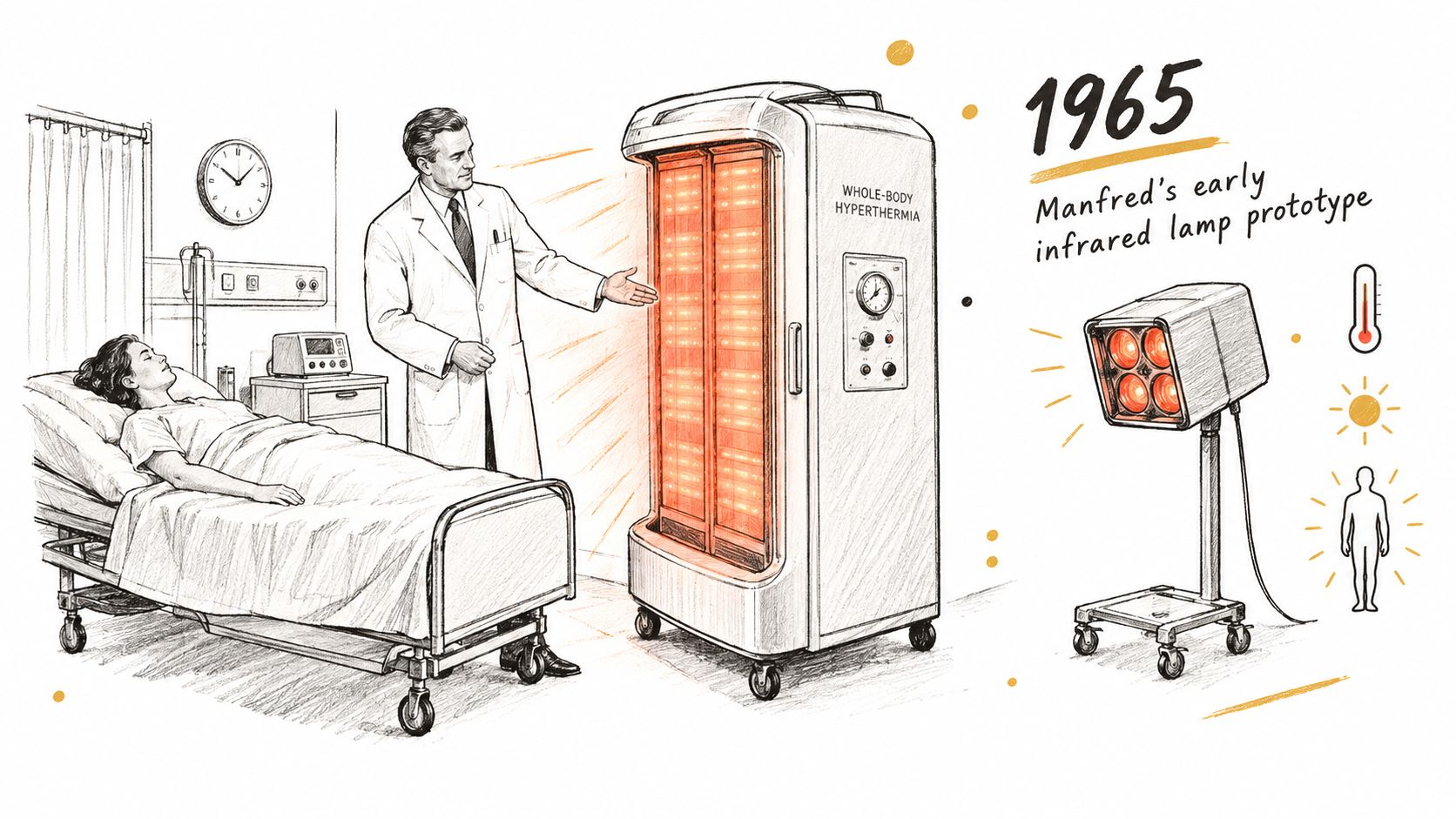
Medical infrared then branched into very different applications. Whole-body hyperthermia units, far-infrared therapy studied in dialysis vascular access care, and light panels aimed at painful joints share a wavelength label and little else. Each delivers a different dose to different tissue for a different purpose, much as a heating pad and an operating-room warming system both produce warmth yet answer separate clinical questions. Findings from one application cannot be transferred to another without new testing.
A short timeline separates what history establishes from what it does not:
- Early hyperthermia devices: researchers explored whole-body heating with infrared energy.
- Specialized clinical applications: studies examined specific uses such as vascular access, with results covered in the clinical evidence section.
- Consumer recovery wear: passive textiles arrived later as a distinct product type that needs its own testing.
The research record is a reason to keep investigating infrared, not a shortcut to a product claim. The device, target condition, and measured outcome still decide what any study means.
The video below offers another visual introduction to infrared-based therapy.
What the Clinical Evidence Actually Shows
Reading infrared research fairly works like reading drug trials: the compound, the dose, and the delivery route all decide the result, and a finding with one cannot be credited to another. For people asking whether infrared might help knee osteoarthritis, the honest answer is possibly, but the evidence is limited and inconsistent. A 2022 systematic review examined infrared radiation for musculoskeletal conditions and chronic pain, including three osteoarthritis studies published from 2012 to 2019 with 276 participants in total. Two were randomized controlled trials and one was observational. One trial reported no statistically significant treatment effect. Another found that far-infrared-emitting plasters improved knee osteoarthritis outcomes by 12.5% after one week and 25% after four weeks. A plaster worn against the joint on a set schedule is a specific intervention; those numbers describe that product and protocol, not every infrared sleeve or garment. (Review of infrared therapy and osteoarthritis)
The same review found that pain scores generally decreased among infrared-treated musculoskeletal patients, though the small study count, differing methods, and inconsistent results keep certainty low. A positive result with one device says nothing about whether another device delivers the same wavelength, dose, or effect. For readers focused on joint pain, this guide to infrared therapy for arthritis covers the condition in more depth.
Evidence varies by condition
Circulation research demands the same careful reading. In the clinical review summarized earlier, far-infrared therapy for dialysis arteriovenous fistulas saw 11 of 123 treated patients and 23 of 126 control patients require interventions. That is a promising signal in a specialized vascular setting. It says little about whether a garment improves circulation in a healthy joint or speeds recovery from a strain, because the tissue, the dose, and the clinical question all differ.
| Condition | Evidence strength | Key finding | Realistic expectation |
|---|---|---|---|
| Knee osteoarthritis | Limited and mixed | One trial found no statistically significant effect; another reported improvements with far-infrared-emitting plasters | Possible short-term symptom relief, not a guaranteed result |
| Musculoskeletal pain | Limited | Pain scores generally decreased, but study methods and findings varied | Consider infrared an adjunct, not a substitute for medical care |
| Dialysis fistula outcomes | Specific to this setting | Fewer interventions were reported among treated patients | Don't apply vascular-access findings directly to joint sleeves |
The evidence supports a cautious, product-specific reading: match each claim to the exact device, wavelength, and dose that generated it.
Matching the Tool to the Job at Home
At-home products differ in how they deliver heat or light. Before comparing labels, ask whether the device is powered or passive, whether it measures its output, and whether its evidence relates to the condition you want to address.
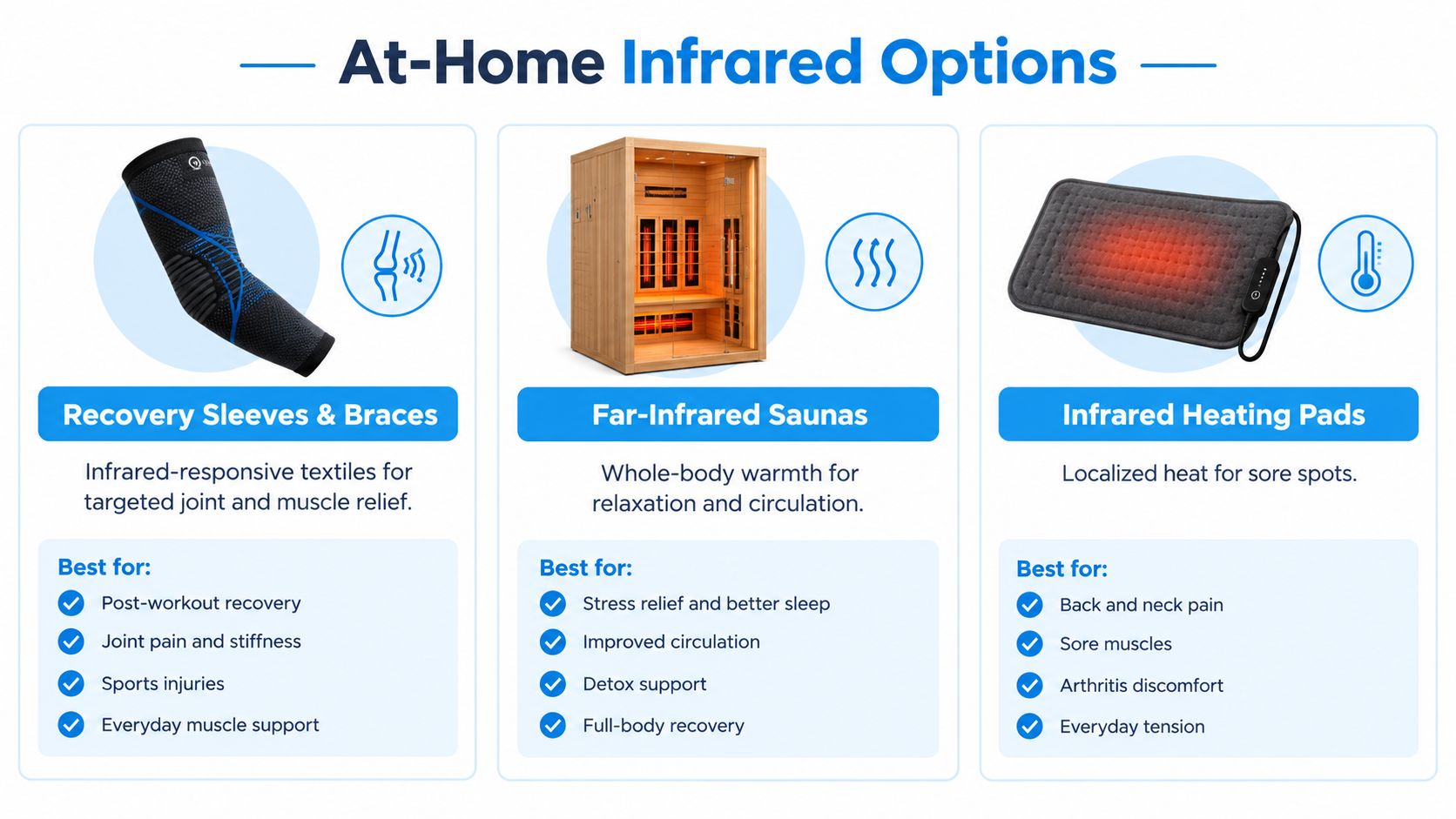
| Option | Delivery | What to check | Potential fit |
|---|---|---|---|
| Recovery sleeve or brace | Usually passive, using infrared-responsive fabric and body heat | Whether the brand explains the textile and how output or skin-level dose is measured | Targeted warmth during rest or light activity |
| Far-infrared sauna or wrap | Powered heat over a larger area or a localized region | Heat settings, intended use, and safe operating instructions | General warmth or relaxation |
| Red or near-infrared light panel | Powered light with specified wavelengths and dose | Wavelength, irradiance, fluence, distance, and treatment schedule | A condition-specific light-therapy approach, when guided by appropriate evidence |
| Far-infrared plaster | Applied to one area | The exact product and condition studied | Local use where the evidence relates to that type of plaster |
A passive textile doesn't work like a lamp. It relies on body heat and infrared-responsive fibers, rather than a calibrated light source. Without measurements under actual wearing conditions, it's difficult to know how much energy reaches the skin or to compare its dose with published photobiomodulation protocols.
Session time also depends on the device's instructions and the evidence for that device. Don't assume a session length from a sauna or light-panel protocol applies to a sleeve. For leg-focused warmth, this guide to heat wraps for legs can help you think through the format and intended use.
Thermo Recovery Wear is one example of a brand offering compression-lite sleeves and braces made with infrared-responsive textiles for at-home wear and light activity. That describes the product category, not proof that its passive fabric has the same effect as a powered light device or a studied plaster.
Safe and Practical Use at Home
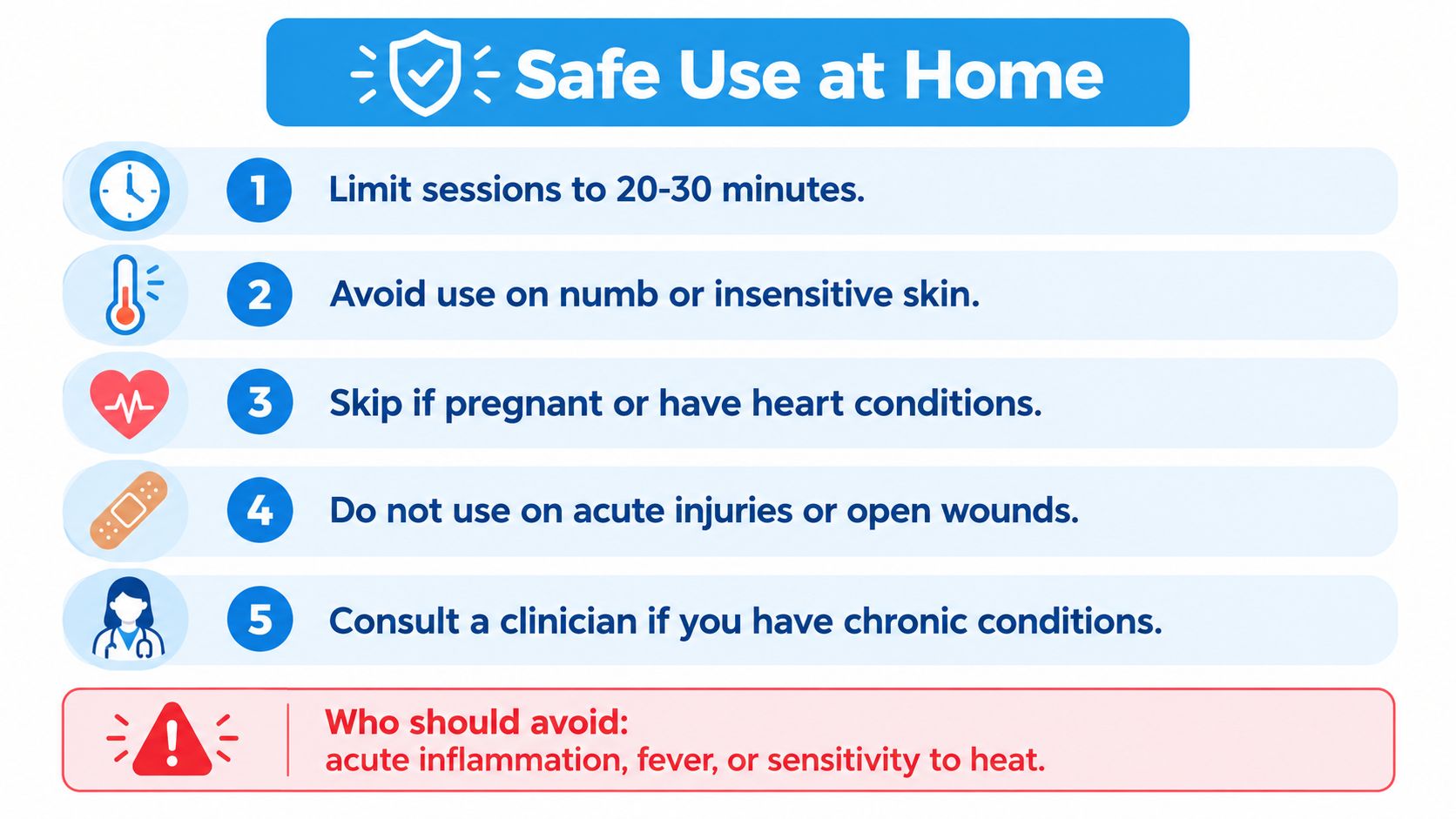
Start cautiously, especially if you haven't used a heat-based product before. Follow the product's wear instructions, check your skin regularly, and stop if the area becomes irritated, unusually flushed, or uncomfortably hot. A garment shouldn't cause pain or make you feel that you need to push through discomfort.
Some people should avoid heat-based therapy or discuss it with a clinician first. This includes people with reduced ability to feel heat, certain sensory neuropathies, open wounds, active infections, or an acute injury with substantial swelling or inflammation. If a medical condition affects circulation, sensation, or skin health, ask a clinician whether the product is appropriate. A sleeve isn't a substitute for assessment when pain is new, severe, or getting worse.
A cautious routine
- Test tolerance first. Wear the garment for a short period and check your skin before extending use.
- Reduce direct contact if sensitive. A light clothing layer may make the warmth more comfortable, if the product instructions allow it.
- Avoid stacking heat sources. Don't place a heating pad over an infrared garment. Combined heat can make overheating harder to notice.
- Remove it if your skin reacts. Stop using it if you notice persistent redness, irritation, or an unpleasant rise in heat.
- Check the fit and instructions. Choose the size carefully, look for breathable materials, and read the wear-and-care guidance before regular use.
A product described as sensitive-skin friendly still may not suit every person. Review the materials and care guidance, and discuss concerns with a clinician. For a plain-language overview of possible infrared therapy side effects, focus on what symptoms should prompt you to stop and seek advice.
What the Marketing Gets Wrong
The biggest source of confusion is the jump from a specific result to a universal promise. A percentage measured in one study doesn't predict the outcome for every person, product, or joint. A clinical light panel and a passive textile sleeve may both be described as infrared, but that label alone doesn't make their dose or mechanism equivalent.
The same caution applies to circulation claims. A warm area may feel more comfortable, but “increased circulation” is a physiological claim that requires measurement. Evidence from a vascular-access study can't establish that a consumer garment improves circulation in a different tissue or condition.
A 2025 review of infrared and related light therapies noted that much of the evidence comes from preclinical research and small clinical trials, with unresolved questions about wavelength, irradiance, duration, frequency, and the role of heat versus light-mediated signaling. A separate 2025 narrative review reported generally favorable pain findings in musculoskeletal disorders, while also identifying substantial variation in study design, sample size, and dose reporting. (2025 review of infrared and related light therapies)
Read product claims closely: Look for the exact condition studied, the device or textile tested, and the dose or wavelength reported. If those details aren't clear, a broad promise of therapeutic benefit is difficult to evaluate.
A useful discussion of far-infrared claims and cellular health can help readers separate a proposed mechanism from demonstrated results. Mechanistic plausibility is a starting point for research, not a guarantee of what a garment will do.
Deciding Whether Infrared Therapy Is Worth Trying
If your goal is short-term comfort for stiffness or mild joint pain, a sleeve or wrap may be reasonable as an adjunct to movement, medical care, and other approaches recommended for your condition. It isn't a structural fix for cartilage loss or severe joint damage, and it shouldn't delay care if symptoms are worsening.
To judge whether a garment helps you, record how your pain, stiffness, and daily function feel before use and during a consistent trial. If practical, compare your experience with a period when you aren't wearing it. Stop if symptoms worsen, and ask a clinician for guidance when pain persists or interferes with daily life.
Thermo Recovery Wear offers compression-lite sleeves and braces made with infrared-responsive textiles for people seeking targeted warmth during rest or light activity. If you're comparing passive recovery wear with other infrared options, explore Thermo Recovery Wear and review the product details and wear instructions before choosing.


