


You ease out of bed, test the sore knee, and reach for the stair rail before it has time to complain. By breakfast, you've already adjusted the day: the elevator instead of the stairs, the shorter walk instead of the garden, and no deep squat to pick up a grandchild. These small decisions can gradually change what you believe your body is capable of.
That experience is common with chronic knee pain, especially osteoarthritis. The World Health Organization reports 365 million people living with osteoarthritis worldwide and identifies the knee as the joint most frequently affected in its osteoarthritis fact sheet. Knee pain relief without surgery deserves a careful, layered approach, not an automatic jump from occasional ibuprofen to an operating room.
Table of Contents
- The Reality of Living With Knee Pain Every Day
- Why Knee Pain Happens and How Non-Surgical Care Targets It
- Exercise and Weight Management as First-Line Relief
- Braces, Sleeves, and Infrared Garments for Daily Support
- Injections, Heat Therapy, and Lifestyle Add-Ons
- Common Beliefs That Keep People Stuck on the Surgery Track
- Red Flags to Watch For and Your 30-Day Starter Plan
The Reality of Living With Knee Pain Every Day
Chronic knee pain changes ordinary decisions. You may avoid kneeling in the garden, choose level pavements, or look for a chair with arms because standing from a low seat feels uncertain. A short shopping trip can require planning around distance, stairs, rest points, and the discomfort you expect later.
The physical symptom is only part of the burden. Repeatedly calculating what your knee can tolerate can reduce confidence and gradually shrink your activities. The goal of non-surgical care is therefore broader than making the joint hurt less for a few hours. It is to help you move with more confidence and handle daily demands more reliably.
Why a single response is often incomplete
During a flare, an anti-inflammatory medicine may seem like the simplest answer. Surgery can appear equally definitive when imaging shows cartilage changes. Medication can be appropriate for some people, and surgery has a role when symptoms and clinical findings justify it, but neither option replaces work on strength, movement tolerance, and the loads placed on the knee.
A conservative plan can be adjusted to the person and the day. Exercise may begin with small, tolerable doses. Weight management can reduce the load carried during routine movement when that is relevant. A brace, sleeve, or heat may make activity more comfortable, while injections can be discussed with a clinician when other measures have not provided enough relief. If compression clothing irritates the skin or intense exercise is unrealistic, lower-burden choices can still be combined rather than abandoned.
Progress also needs a fair test. Conservative care is rarely a single quick fix, and improvement may require consistent use of several approaches. Some options reduce symptoms enough to make movement possible, while exercise and gradual load changes address capacity over time. The trade-off is patience, adjustment, and professional guidance when progress stalls.
Practical rule: A quieter knee helps today, while a stronger and more capable knee supports tomorrow.
Education helps you tell a manageable flare from symptoms that need assessment. This plain-language guide to back and knee pain explains how posture, movement, and daily habits can interact, but persistent or worsening symptoms still warrant professional evaluation.
The aim is not to promise that every knee can avoid surgery. It is to make conservative care specific enough to try, monitor, and revise, while keeping medical assessment part of the decision.
Why Knee Pain Happens and How Non-Surgical Care Targets It
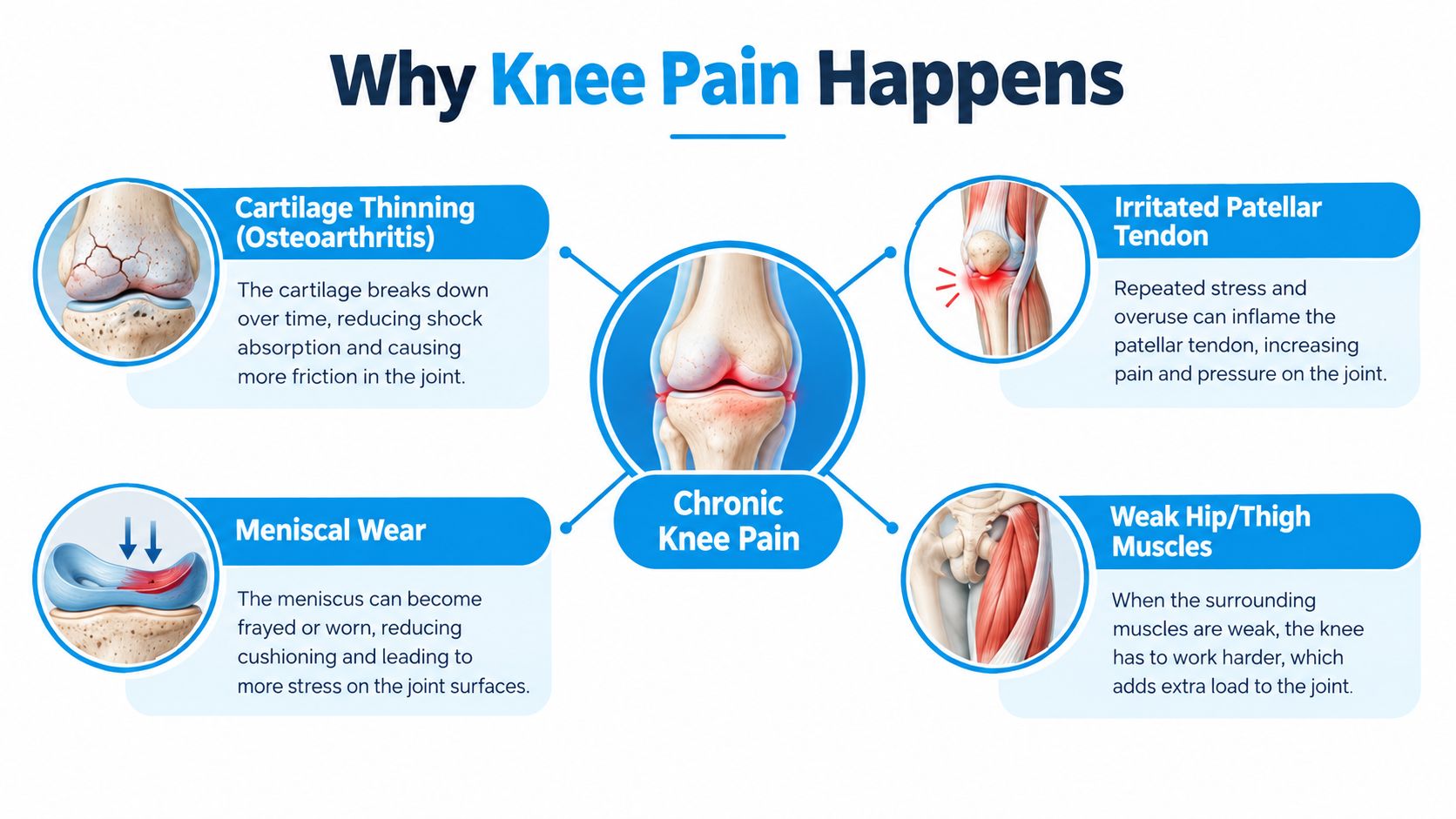
A knee can hurt during stairs, walking, or standing from a chair, yet the source is not always the same. “Knee pain” identifies a location, not a diagnosis. Osteoarthritis affects cartilage and surrounding joint tissues. Patellar tendon irritation involves the strong tendon below the kneecap. Meniscal wear can change how force travels through the joint, while weaker hip or thigh muscles can make ordinary movements more demanding.
Think about the whole system
A misaligned car tyre offers a useful comparison. Uneven wear appears on the rubber, but the wheel, suspension, and frame may also influence the problem. Soothing the tyre may help briefly without changing the forces causing the wear. The knee works similarly. Less pain can make movement easier, but it may not change how the joint handles stairs or a chair transfer.
Non-surgical care addresses different parts of that system:
- Education and self-management help you select tolerable activity instead of alternating between overexertion and complete rest.
- Strength training improves the contribution of the quadriceps, gluteal muscles, and other muscles that control the leg.
- Weight management can reduce the load handled during repeated movement when it applies to you.
- Braces and canes may alter or reduce force during selected tasks, though they do not replace rehabilitation.
- Heat can ease muscle guarding and make movement more comfortable before activity.
- Injections may provide a temporary period in which walking or exercise feels more manageable.
The World Health Organization includes exercise, weight control, education, and bracing among relevant non-operative approaches for osteoarthritis WHO osteoarthritis guidance. The useful combination depends on the main driver, such as load sensitivity, instability, stiffness, tendon irritation, or another condition. If intense exercise or compression gear is difficult to tolerate, lower-burden options can still support the plan.
Why diagnosis still matters
A comfortable sleeve may support an arthritic knee without addressing repeated giving way. A strengthening routine suited to mild stiffness could irritate an acutely affected tendon. An assessment by a clinician or physical therapist can reduce months of guesswork when the cause remains unclear. For background, this knee osteoarthritis resource explains common features and symptoms, but online information cannot examine the joint or test its stability.
The practical idea is simple: treat the joint, the surrounding muscles, the activity pattern, and the barriers that make care difficult to follow. That broader view helps non-surgical treatment become a coordinated plan rather than a list of disconnected remedies.
Exercise and Weight Management as First-Line Relief
A painful knee often makes movement feel risky, so exercise can seem like the wrong prescription. Used carefully, it gives the muscles and joint a manageable signal, then gradually raises what they can tolerate. Clinical guidance identifies exercise therapy as first-line care for knee osteoarthritis, combining strengthening, aerobic activity, and flexibility work American Family Physician guidance.
Build a dose you can repeat
Begin with controlled effort rather than sharp pain. Quadriceps contractions, supported sit-to-stands, heel slides, bridges, and gentle hip strengthening can be adapted to a chair, bed, wall, or kitchen counter. Resistance work is commonly performed two to three nonconsecutive times per week. Moderate aerobic activity can build toward at least 30 minutes on most days, provided symptoms remain manageable RACGP exercise guidance.
Use the knee's 24-hour response to adjust the dose. Mild discomfort during the session that returns to its usual level by the next day suggests the workload may be appropriate. Swelling, limping, or pain that stays higher means reducing the range, repetitions, resistance, or duration.
The best exercise dose is the one your knee can recover from and your life can accommodate.
Walking, cycling, and swimming allow movement with less repeated impact than running or jumping. If walking is difficult, use short bouts spread through the day. Water walking can reduce the sensation of body weight, while chair-based strengthening can restart muscle work when getting down to the floor is not realistic.
Exercise does not need to be intense to count. A few minutes completed consistently may be more useful than a demanding routine abandoned after a flare. The aim is to build capacity gradually, not to prove that pain can be ignored.
Weight management offers another way to reduce the load placed on the knee. Guidance supports weight loss for patients with a body mass index above 25 kg/m² and reports better pain, function, and body composition when a calorie-restricted diet with a 25% to 30% reduction is added to aerobic and strength training rather than relying on exercise alone. Weight change does not need to become a separate fitness project. Adjusting portions, improving meal structure, and seeking appropriate clinical support can complement a knee-friendly activity plan. For ideas about practical weight loss without working out, choose methods that do not depend on painful exercise.
What first-line treatments offer
| Treatment | Evidence strength | Typical benefit |
|---|---|---|
| Progressive strengthening | Strong first-line support | Better muscle capacity, function, and movement confidence |
| Low-impact aerobic activity | Strong guideline support | Improved activity tolerance and reduced stiffness |
| Weight management | Strong guideline support | Lower overall joint demand and improved function |
| Flexibility work | Useful as part of a programme | Easier movement when stiffness limits exercise |
| Passive treatment alone | Limited as a standalone strategy | Temporary comfort without rebuilding capacity |
The combination matters. Stretching may briefly make the knee feel freer, but it does not provide the same loading stimulus as strengthening. A brace may make walking more comfortable, while strength work trains the muscles that support the leg. Heat or another comfort measure can help someone complete movement, yet comfort alone does not rebuild capacity. A practical plan uses lower-burden relief to make useful activity possible.
For personalised exercise ideas, knee mobility exercises may help, but stop any movement that causes sharp pain, new instability, or a lasting increase in swelling. A physical therapist can adapt the plan when symptoms, strength, or confidence make generic instructions unsuitable.
Braces, Sleeves, and Infrared Garments for Daily Support
A brace can make a painful walk feel more manageable, while a sleeve may make the knee feel warmer and easier to monitor. These devices solve different problems, so begin with one question: what problem are you trying to solve?
An unloader brace suits selected patterns of osteoarthritis, especially when one compartment carries more load than another. Its corrective force may shift pressure away from the more painful area. Patellofemoral braces are intended for some kneecap-tracking or front-of-knee problems. Both options depend on an accurate diagnosis and careful fitting. If the diagnosis is wrong, the brace may feel bulky, costly, or uncomfortable without improving movement.
A neoprene sleeve is less corrective. It offers warmth, light compression, and sensory feedback, which can help you notice the knee during activity. That awareness may make movement feel more controlled, but the sleeve does not realign the joint or rebuild muscle. Sweating, slipping, and skin irritation are possible, particularly if the material is tight or worn for long periods.
Infrared support requires realistic expectations
Infrared-responsive garments and other physical modalities may appeal to people who cannot tolerate tight compression. Evidence for far-infrared wraps and related devices is less established than evidence for active rehabilitation. Some users report modest changes in pain or stiffness, while others notice little difference. Treat these products as add-ons that may improve comfort, not as replacements for assessment or progressive loading.
Heat has a similar role. A review of clinical studies in knee osteoarthritis reported improvements across pain, stiffness, function, quality of life, and general health perception review of heat therapy. The practical value is greatest when warmth helps you start moving or tolerate a useful activity. Comfort is a doorway to movement, not a substitute for the work that maintains capacity.
| Option | Best candidate | Evidence strength | Typical cost | Main drawback |
|---|---|---|---|---|
| Unloader brace | Selected compartmental osteoarthritis | More established for appropriate diagnoses | Varies widely | Fit, bulk, and skin pressure |
| Patellofemoral brace | Some front-of-knee or tracking problems | Diagnosis-dependent | Varies | May slip or irritate |
| Neoprene sleeve | Mild support and comfort during activity | Modest supportive evidence | Usually lower | Doesn't correct joint mechanics |
| Infrared garment | People wanting warmth without tight compression | Emerging or limited evidence | Varies by product | Benefits may be modest and inconsistent |
Use a simple sequence: diagnosis first, fit second, comfort third, and cost fourth. If a clinician identifies compartmental osteoarthritis, ask whether an unloader brace matches your knee pattern. If your main goal is warmth and awareness during a walk, a sleeve may be enough. If compression causes itching or pressure, a non-compressive infrared garment may be easier to tolerate. Check the return policy, and do not treat a higher price as proof of stronger clinical evidence.
For the practical distinction between these options, read this comparison of knee braces and knee sleeves. Remove any device that causes numbness, colour change, worsening pain, or skin damage.
Injections, Heat Therapy, and Lifestyle Add-Ons
A flare can make walking or sleeping difficult even when you are following a longer-term rehabilitation plan. An injection may create temporary breathing room, but it does not rebuild the whole knee or replace strength and movement practice.
Corticosteroid injections are often considered when pain and inflammation become especially troublesome. Relief may be short-lived, and repeated injections involve trade-offs that you should discuss with the clinician treating your knee. Hyaluronic acid has mixed evidence and uneven results, so it may be considered after other options have not helped enough rather than treated as a routine answer. Platelet-rich plasma is usually more expensive, and its inconsistent results do not support a blanket recommendation. Across major guidelines, education, self-management, exercise, and weight management receive broader support, while injections and braces depend more on the individual diagnosis and goals.
Use warmth to prepare for movement
Heat can make the start of activity more comfortable, especially when stiffness is the main barrier. Evidence for heat remains limited compared with exercise, but warming the joint briefly before movement may reduce stiffness and help you begin activity more easily. It works like loosening a stiff hinge before asking it to move, not like repairing the hinge itself.
Apply comfortable warmth before gentle range-of-motion exercises, walking, or strengthening. Keep the temperature moderate and stop if the skin becomes painful or irritated. Avoid heat over an acutely swollen or recently injured area, and take extra care if reduced sensation makes it difficult to judge temperature.
Small lifestyle adjustments can support the main plan:
- Sleep: Poor sleep can make pain feel more intrusive and reduce consistency with exercise.
- Food pattern: A balanced pattern built around minimally processed foods can support weight management and general health.
- Smoking cessation: Stopping smoking supports circulation and recovery capacity.
- Footwear: Comfortable, stable shoes can make walking feel more predictable.
- Walking aids: A cane or walking pole may reduce load and improve confidence when a professional helps you set it up.
The useful question is what symptom relief allows you to do next. If medication, warmth, or an injection helps you walk, strengthen, or attend therapy, it can support capacity. If it only encourages another week of inactivity, its practical value is smaller. People who cannot tolerate intense exercise or tight compression can combine gentler options, such as brief warmth, manageable movement, stable footwear, and appropriately guided walking support. For more detail on using infrared approaches at home, see this overview of infrared light therapy for knee pain.
Common Beliefs That Keep People Stuck on the Surgery Track
A worn-looking knee on an X-ray can feel like a verdict. It is not a complete forecast of function, pain, or how well rehabilitation may help. Symptoms come from the joint and the tissues around it, but also from strength, movement habits, sleep, fear, and how much load the knee carries each day.
Surgery can help when pain and disability stay severe despite good conservative care, or when a specific structural problem needs it. For many adults with osteoarthritis, it should not be treated as the automatic next step. A conservative-first approach gives you time to test reversible options and learn what actually changes daily function.
Rest is not the same as recovery
Complete rest may calm an acute flare, but long periods of inactivity reduce the muscle support that helps steady the knee. Then a return from too little activity to a full workload can trigger another spike in pain. The better pattern is relative rest from the movement that provokes symptoms, followed by gradual reloading.
NSAIDs can reduce pain for some people, but longer use needs medical judgement because of cardiovascular, gastrointestinal, and kidney risks. Paracetamol is also less useful than many patients expect. A 2025 German guideline says people with knee osteoarthritis should not routinely receive paracetamol unless specific reasons exist, while the same guideline synthesis notes that oral opioids are strongly not recommended international guideline synthesis.
Pain relief can make movement possible, but it does not automatically make the knee stronger.
Persistent pain also deserves attention to the nervous system, stress, and learned protective responses, without treating symptoms as imaginary. Readers who want a broader conversation can explore these episode 266 chronic pain insights from Dr Howard Schubiner. The point is not to ignore structural findings. It is to avoid assuming that an image alone decides your future.
A surgical opinion matters more when the knee repeatedly locks, cannot bear weight, shows major instability, or follows a significant injury. Conservative-first does not mean surgery never helps. It means the intervention should match the problem, and useful rehabilitation should not be dropped just because a procedure is available.
Red Flags to Watch For and Your 30-Day Starter Plan
Home care is reasonable only when the symptoms fit a stable, manageable pattern. Seek prompt medical evaluation after sudden swelling from trauma, if you can't bear weight, or if the knee locks or catches. Night pain at rest, fever with a hot joint, significant redness, numbness, tingling, or a new deformity also need attention because they may point to infection, fracture, nerve involvement, or a more serious injury.
A cautious four-week starting point
Week one: Reduce movements that sharply increase pain. Use comfortable positioning, brief walks on level ground, and gentle quadriceps sets. A quadriceps set can be as simple as tightening the front thigh while the leg rests supported, then relaxing without forcing the knee straight.
Week two: If symptoms have stayed stable, add low-load stationary cycling with minimal resistance or short bouts of water walking. A sleeve may provide comfort during activity, but it shouldn't cause tingling, colour change, or pressure marks.
Week three: Add supervised physical therapy if pain remains persistent, function is limited, or exercise selection feels uncertain. Continue manageable strength work and use heat before exercise if it improves movement tolerance. An infrared session or garment can be considered as an adjunct, but it shouldn't replace loading practice.
Week four: Reassess function rather than relying only on a pain score. Can you stand more easily, walk with less hesitation, manage stairs more predictably, or recover faster after activity? If yes, progress one variable at a time. If not, maintain a tolerable dose and schedule a clinical review.
Stop and escalate: New swelling that doesn't settle, worsening night pain, repeated giving way, inability to bear weight, fever, a locked knee, or neurological symptoms are reasons to stop self-directed progression and seek medical advice.
Don't increase distance, resistance, and exercise complexity at the same time. Keep a brief record of the activity, symptoms during the session, and how the knee feels the next morning. That information helps a clinician distinguish a dose problem from a diagnosis that needs further investigation.
Thermo Recovery Wear offers compression-lite knee sleeves and braces with infrared-responsive fabric for people who want non-pharmacologic warmth and support during rest or light movement. Use a garment as an adjunct to a broader plan, and visit Thermo Recovery Wear to review the available knee support options and sizing information.


