


You finish a walk, peel off your leggings or knee sleeve, and start scratching. The garment is new, so you blame the fabric. But you also stayed in sweaty clothes while making lunch, and your skin was already tight after a hot shower.
If you're asking, “Why is my skin so sensitive and itchy?”, the answer often involves several overlapping factors: a weakened skin barrier, irritation from contact, or an inflammatory condition such as eczema. A true allergy is another possibility, but itching alone doesn't prove one.
Table of Contents
- Match Your Itch Pattern to a Likely Cause
- Which Triggers Cause Itch and How to Tell
- How the Skin Barrier Turns Dryness into Constant Itch
- When Itchy Skin Needs a Doctor
- Daily Routine for Calming Reactive Skin
- Choosing Sensitive-Skin Friendly Clothing and Textiles
- Keep a Two-Week Trigger Log Before Changing Products
Match Your Itch Pattern to a Likely Cause
Say a runner starts itching after buying new leggings. The discomfort happens only when they stay in the leggings after exercise, not when they wear them briefly while cool. That pattern makes trapped sweat and friction worth investigating before declaring a fabric allergy.
Where the itch appears, when it starts, and what accompanies it are more useful clues than the product's label.
Itch patterns and their likely causes
| Itch Pattern | Likely Cause | Typical Clue | First Move |
|---|---|---|---|
| Burning and itch shortly after contact | Irritant contact dermatitis | Confined to the touched area; soap, sweat, wool, or friction involved | Stop the exposure and gently rinse the skin |
| A delayed red, itchy patch after a product or accessory | Allergic contact dermatitis | Rash follows the contact area and may recur with exposure | Stop the suspected item; seek assessment if persistent |
| Constant dry, tight, itchy skin that flares in winter | Barrier dysfunction or eczema | Roughness, recurring flares, sometimes a personal or family history of allergy | Use a fragrance-free emollient; see a doctor for recurring flares |
| Itch in skin folds that worsens at night and returns | Atopic dermatitis, a form of eczema | Flexural patches and a history of eczema or allergies | Arrange clinician assessment for appropriate treatment |
| Itch with heat, exercise, or sweat, plus small bumps | Sweat or heat irritation | Starts during heat or exertion and eases after cooling | Cool down, change sweaty clothes, and loosen layers |
| Intense night itch shared by household members | Scabies | Possible tracks or burrows; others at home also itch | Seek medical evaluation; close contacts may need treatment |
Eczema is common: in 2024, 7.7% of U.S. adults had diagnosed eczema, according to the National Center for Health Statistics figure summarized by the Asthma and Allergy Foundation of America. That makes it a reasonable possibility in recurring itch, not a diagnosis you can make from prevalence alone.
Use the pattern without overinterpreting it
A rash under a sleeve doesn't identify which component caused it. Fabric texture, detergent residue, seams, and retained moisture can produce similar-looking discomfort. The guide to whether bamboo charcoal works offers context for separating textile claims from the question of personal tolerance.
For descriptions of overlapping burning and itching sensations, Mesoderm RX's resource on how to find relief for skin irritation provides additional reading, not a substitute for diagnosis.
This table is a starting map. Persistent or generalized itch deserves clinical assessment, particularly when there's no clear contact pattern.
Which Triggers Cause Itch and How to Tell
Irritation is direct skin injury; allergy is an immune reaction to a substance you've become sensitized to. Irritation can happen quickly, especially on already-damaged skin, but repeated low-level exposure can also cause it gradually. Allergic contact dermatitis usually develops later, so yesterday's exposure may matter more than what you touched immediately before scratching.
Previous tolerance doesn't rule out either mechanism. You can develop sensitization after repeated exposure, or begin reacting to an old product because your skin is now more vulnerable.
Common triggers by mechanism and timing
| Trigger | Mechanism | Typical Timing | Clue to Confirm |
|---|---|---|---|
| Fragrance and preservatives | Irritation or allergy | Immediate or delayed | Symptoms follow the application area |
| Nickel in clasps, watch bands, and bra hooks | Allergic contact dermatitis | Delayed after contact | Redness and itch beneath the metal |
| Detergents and fabric softeners | Irritation from residue | Gradual with repeated exposure | Improvement after simplifying laundry products and rinsing thoroughly |
| Coarse wool and rough knits | Mechanical friction | During wear | Improvement with a smooth cotton layer underneath |
| Synthetic dyes and fabric finishes | Allergic or irritant reaction | Often delayed; irritation may occur sooner | Rash follows garment contact |
| Adhesives and brace fastenings | Contact allergy or irritation | Often delayed | Rash resembles the adhesive or strap shape |
| Sweat held against skin | Irritation and moisture-related softening | During or after sweaty activity | Worse in heat, better after cooling and changing |
These clues support a suspicion; they don't confirm an allergy. For broader context, the British Journal of Dermatology global modelling study estimated atopic dermatitis prevalence at 2.6% overall, illustrating how common an underlying inflammatory condition can be alongside contact triggers.
Separate the garment from the wearing conditions
Look for a repeatable outline. Does the rash sit beneath a watch clasp, along an adhesive edge, or across every area covered by a freshly washed shirt? Improvement after removing that exposure supports a contact-related cause.
For a sleeve reaction, compare fastening position, washing products, activity, and sweating rather than changing the entire setup. This guide to managing a compression sleeve rash addresses those garment-specific considerations.
A sensitive-skin label is a reason to consider a product, not proof that your skin will tolerate it.
A dermatologist may use formal patch testing to investigate contact allergy. A home wear trial can reveal discomfort, but it can't identify the responsible allergen.
How the Skin Barrier Turns Dryness into Constant Itch
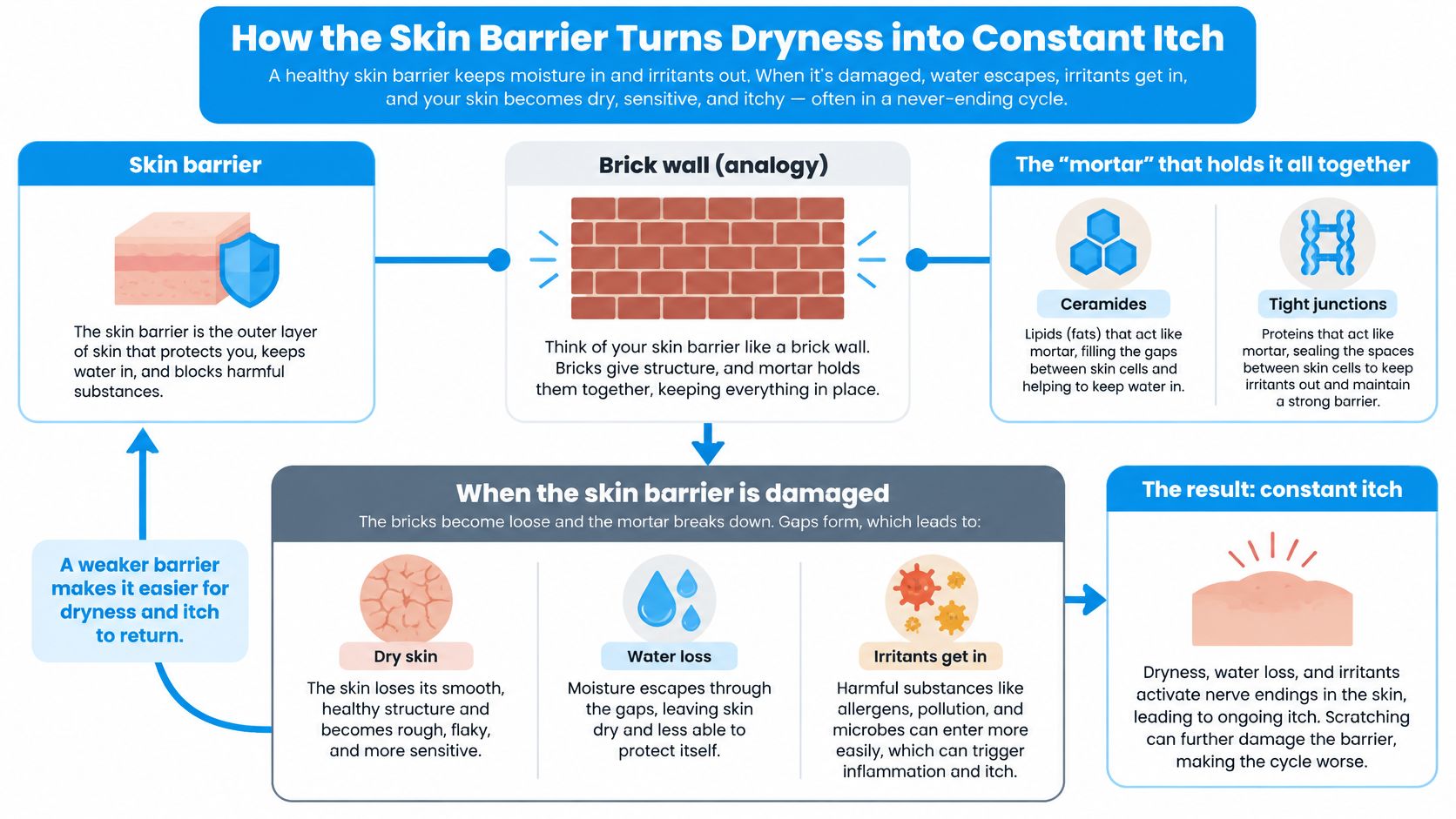
Think of the outer skin as a brick wall. Skin cells are the bricks, and lipids, including ceramides, form much of the mortar between them. Tight junctions provide additional seals between cells in the epidermis.
When those defenses weaken, water escapes more easily and outside substances enter more readily. The technical term for water escaping through the skin is transepidermal water loss. Skin can then feel tight and rough even when you haven't changed your skincare.
The diagram illustrates how those changes connect.
Why a little dryness can become persistent itch
Consider someone washing their hands repeatedly in dry weather. The skin becomes rough, their cuffs rub against it, and scratching follows. Each scratch adds mechanical damage to an already-leaky barrier.
The process also involves immune cells and nerves. A review of skin-barrier dysfunction and itch describes inflammatory signaling involving IL-4, IL-13, IL-31, TSLP, and IL-33, which can activate or sensitize itch pathways. Barrier disruption may also increase nerve density within the epidermis.
That helps explain why discomfort can exceed the visible rash. A mildly rough patch can itch intensely because the problem isn't limited to what you can see.
The cycle has connected parts:
- Barrier damage: Frequent washing, low humidity, and friction or prolonged sweat exposure weaken protection.
- Inflammation and nerve sensitivity: Ordinary contact becomes harder to tolerate.
- Scratching: Further injury increases water loss and allows more trigger entry.
Dryness and eczema therefore aren't interchangeable. Dryness describes a skin state; eczema involves inflammation and often needs more than moisturizer alone.
For complementary reading about everyday barrier care, ALODERMA's tips for calmer skin offer a practical perspective. The important distinction is that barrier support can reduce vulnerability without proving what originally caused the itch.
When Itchy Skin Needs a Doctor
Mild itch linked to an obvious exposure may settle when you remove that exposure. Severe, recurring, or unexplained itch calls for a different approach: finding the cause rather than repeatedly buying gentler products.
Persistent scratching can interfere with sleep, concentration, and mood. You don't need to wait until the skin looks dramatic before asking for help.
Book an appointment for persistent or disruptive symptoms
The NHS itchy-skin guidance recommends medical assessment when itching is severe, keeps returning, affects daily life, occurs across the body, or happens during pregnancy.
- Severe or recurrent itch: Especially when basic skin care hasn't helped.
- Sleep or daily-life disruption: Including scratching that repeatedly wakes you.
- A new rash or swelling: Mention any recent product or medication changes.
- Pregnancy-related itch: Contact your maternity clinician rather than assuming dryness.
Itch isn't always eczema. A clinician may consider hives, psoriasis, fungal infection, scabies, lice, medication effects, or an underlying condition outside the skin.
Recognize signs that need faster care
Inflamed skin can become infected, particularly where scratching has broken the surface.
- Prompt review: Oozing, crusting, painful cracks, increasing pain, or spreading warmth and redness.
- Urgent assessment: Blistering, fever, or a rapidly progressive rash.
- Emergency help: Breathing difficulty or facial swelling, particularly involving the lips, tongue, or throat.
Bring photographs and a dated list of products, garments, medicines, and symptom locations. Include nonprescription creams and supplements, and don't stop prescribed medication without advice.
For supports and recovery garments, use clean, completely dry skin, follow washing instructions, and avoid occlusive layering in hot conditions. Stop wearing a garment that produces a localized rash. Comfortable wear in one area cannot explain or rule out the cause of itch elsewhere.
Daily Routine for Calming Reactive Skin
A useful routine removes avoidable irritation while helping skin retain moisture. Keep it simple enough to repeat, rather than adding a different soothing product whenever you itch.
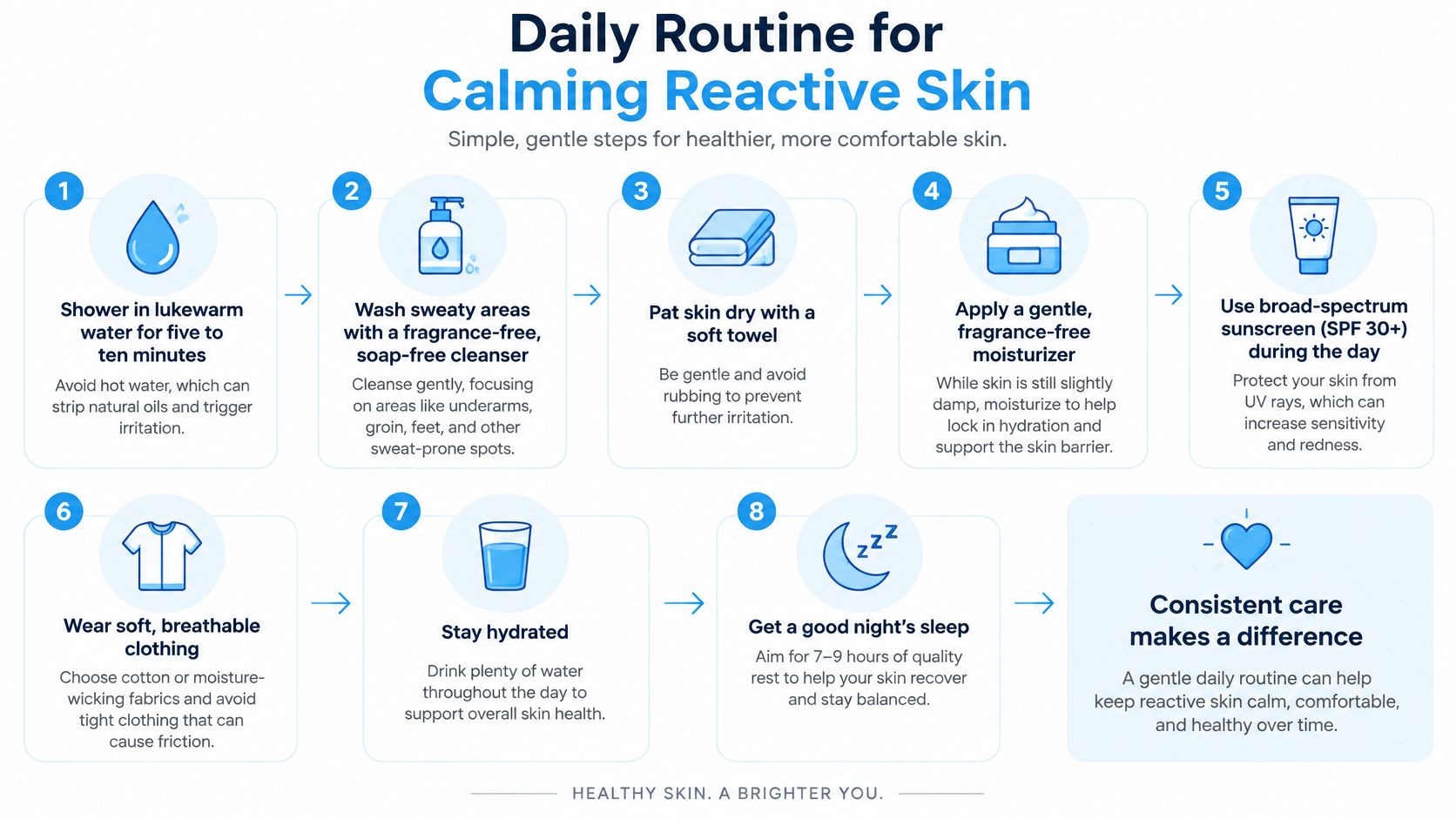
- Use lukewarm water and keep showers brief. Hot water can remove protective oils and worsen dryness. A shower that feels soothing while you're underneath it may leave your skin tighter afterward.
- Wash sweaty or dirty areas with a fragrance-free, soap-free cleanser, then rinse thoroughly. Don't scrub every surface until it feels squeaky clean; that sensation can mean you've removed too much surface oil.
- Pat rather than rub. Leave the skin slightly damp before moisturizing. Vigorous toweling adds friction precisely when the skin needs gentler handling.
- Apply a thick, bland cream or ointment promptly after bathing, including to your hands and other dry areas. Plain petrolatum is an option for very dry patches; skipping moisturizer after a quick rinse still leaves an opportunity for water loss.
- Simplify laundry. Choose detergent without added fragrance, avoid overfilling the dispenser, and use an extra rinse if residue is a concern. Skip fabric softener while investigating reactions because it leaves material on the fibers.
- Choose loose layers and change out of sweaty clothing promptly. Don't assume a soft-feeling garment will remain comfortable when damp or bunched beneath a brace.
- Reduce scratching damage. Keep nails short and smooth, and consider soft cotton nightwear if you scratch during sleep. Cooling the area with a clean, cool cloth is less damaging than rubbing through clothing.
This visual offers a quick reminder of gentle daily habits.
Keep the routine easy to evaluate
Set aside scented washes, essential-oil products, alcohol-based toners, and unnecessary exfoliants while skin is reactive. For help thinking through cleanser selection, consider the sensitive skin cleansing advice from Fillaree, while judging each formula by your own response.
Similarly, understanding what antimicrobial fabric is helps distinguish a hygiene feature from a skin treatment.
Look for fewer scratching episodes, less morning tightness, and more comfortable sleep. Don't treat a routine as a reason to postpone care when symptoms worsen.
Choosing Sensitive-Skin Friendly Clothing and Textiles
Start with the surface touching your skin: smooth, breathable, and low-friction usually matters more than a fashionable fiber name. A soft inner layer can shield you from rougher outer clothing, but adding layers isn't helpful if they leave you overheated or wet.
Compare texture, seams, and finishes alongside fiber content.
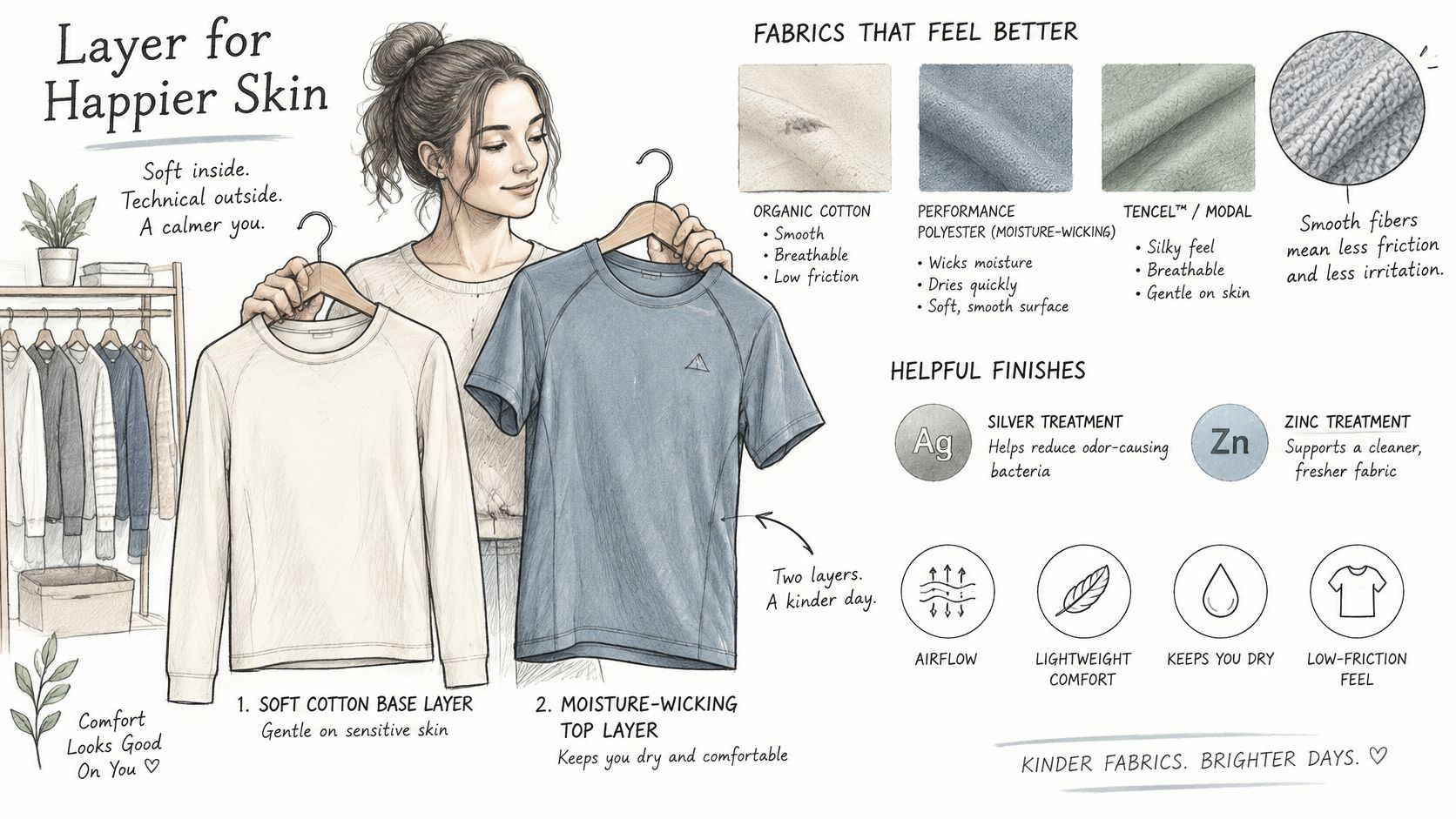
Sensitive-skin textiles compared
| Fabric or Finish | Moisture and Breathability | Irritation Risk | Best Use |
|---|---|---|---|
| Combed or organic cotton | Absorbs moisture; can stay wet | Often comfortable, but damp fabric can rub | Everyday wear in mild conditions |
| Bamboo viscose | Often soft; moisture handling follows construction | Processing, dyes, and finishes still matter | Smooth close-fitting layers after a wear trial |
| Bamboo charcoal blends | Blend and weave determine drying | Charcoal content doesn't establish tolerance | Test the finished garment |
| Fine merino wool | Handles moisture vapor and provides warmth | Fine fibers may be comfortable; rougher fibers can itch | Cool weather, with a liner if needed |
| Silk | Smooth surface with little friction | Dyes and care products can still cause reactions | Nightwear and friction-prone areas |
| Polyester and nylon | Can dry quickly in suitable constructions | Tight or poorly ventilated designs retain heat | Activity wear that doesn't leave skin damp |
| Silver, zinc, or copper antimicrobial finishes | Treatment targets microbes, not moisture handling | Finish-specific irritation or allergy is possible | Only when the feature serves a practical need |
Test the finished garment, not the claim
An organic label doesn't describe every dye or seam. Bamboo charcoal, germanium, and antimicrobial claims don't establish that a garment will prevent itch. The guide to choosing fabric for sensitive skin provides additional comparison points.
The most useful clothing test is whether the washed, finished garment stays comfortable during your actual activity.
Wash new clothing before use according to its care instructions. Begin with brief wear on intact skin, inspect the area afterward and later, and increase wear gradually only if there's no reaction. This is a tolerance trial, not medical patch testing, and it cannot guarantee future tolerance.
The accompanying video provides another format for exploring garment considerations.
For recovery sleeves worn through daily activities, pay particular attention to dampness, rolled edges, and fastening pressure. Remove an uncomfortable sleeve rather than trying to build tolerance through a developing rash.
Keep a Two-Week Trigger Log Before Changing Products
Use a short tracking period to organize observations, not as a mandatory waiting period before getting help. Changing detergent, moisturizer, and clothing together makes it difficult to identify which change mattered.
Record enough to spot a repeatable pattern
- Start with exposure and location. Note the date, skincare and laundry products, garments, medicines, and where the itch appeared. Include exercise, heat, and sweating.
- Change one nonessential variable at a time. For example, keep your established moisturizer while trying a different laundry routine rather than replacing both.
- Describe severity consistently. Use the same categories each evening, such as mild, distracting, or sleep-disrupting. Photographs can capture a rash that fades before an appointment.
- Remove a suspected item and record what happens. Don't deliberately retry something that caused swelling, blistering, a marked rash, or suspected allergy; ask a clinician about safe investigation.
- Escalate unresolved symptoms. Bring the log to an appointment if itch persists, spreads, or matches a warning sign. You don't need to complete the tracking period first.
When comparing moisture-wicking and antimicrobial fabric, record actual dampness and comfort rather than the label alone.
Improvement after removal supports an exposure-related explanation, but doesn't distinguish irritation from allergy by itself. Start your log tonight with what touched the itchy area and when symptoms began.
Thermo Recovery Wear offers compression-lite recovery sleeves and braces for joint support during rest and light activity. Visit Thermo Recovery Wear to review garment materials, sizing, and care instructions, keeping your skin's tolerance and any clinician advice central to your choice.


