


You're standing in the kitchen with a knee that's been nagging you all day. It feels stiff when you get up, but it also gets cranky if you walk too far. In that moment, the question isn't just “Should I use heat?” It's “Does this knee need warmth, or does it need cooling down?”
A lot of people reach for heat because it feels soothing. That can be the right move for a stiff, achy, non-swollen knee, especially with osteoarthritis or end-of-day soreness. It can also be the wrong move for a hot, puffy, recently irritated knee. The difference matters, because the best home choice depends on the symptom pattern, not on how long the pain has been around.
Table of Contents
- Two Knees, Two Different Choices
- How Heat Actually Changes a Sore Knee
- Heat or Cold How to Decide Tonight
- Ways to Apply Heat Safely at Home
- What the Research Actually Shows
- Safety Rules Everyone Should Follow
- A Realistic Routine You Can Start This Week
- Frequently Asked Questions About Heat and Knee Pain
Two Knees, Two Different Choices
One person comes home after a long walk with a knee that feels rusty. It's not visibly swollen, it just aches and resists bending. A warm pack feels good, and ten minutes later the joint usually moves a little more easily.
Another person spends the weekend gardening, then notices the knee is puffy, warm to the touch, and sore in a sharp way. Heat sounds comforting, but it can make the area feel worse because the joint is already reacting.
The first question is simple
Is the knee stiff and sore, or hot and swollen? That question should come before any guess about ice, heat, or rest. People with chronic osteoarthritis, post-activity soreness, or morning stiffness often fit the first pattern. People with a fresh twist, obvious swelling, redness, or an active flare usually fit the second.
Practical rule: If the knee feels stiff and achy, warmth may help. If it feels hot and swollen, skip heat and think cold plus evaluation.
That's why a one-size-fits-all answer falls apart in real life. The same household method can be calming in one knee and irritating in another. The right choice is symptom-led, not calendar-led.
If you want a deeper discussion of thermal approaches in general, see this overview of hot cold therapy. For readers looking at wearable support options, thermal compression wear is another useful reference.
This article is for adults with chronic stiffness, osteoarthritis, or after-activity soreness who want a sensible at-home routine. It won't try to talk you through red-flag symptoms as if they're minor. If your knee is very swollen, red, unstable, or the pain is unusual for you, get a clinician involved.
How Heat Actually Changes a Sore Knee
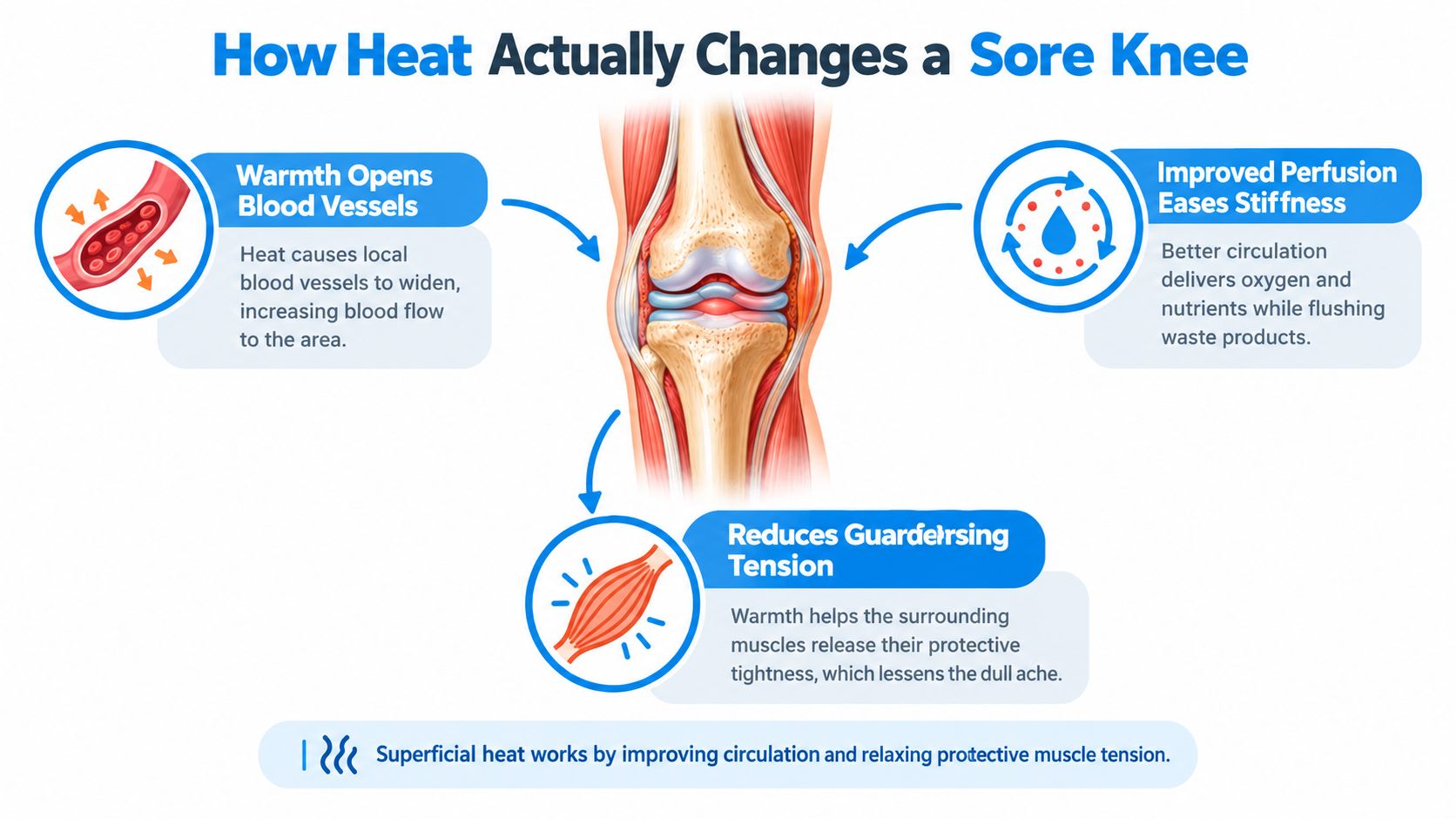
Heat helps a sore knee in a few simple ways. First, it widens local blood vessels, so more blood reaches the tissues around the joint. That extra flow can make a stiff knee feel less “stuck” and more willing to bend.
Warm tissue moves more easily
Think of cold taffy. It resists stretching until it softens. A knee with tight surrounding muscles can act a bit like that, especially first thing in the morning or after a long period of sitting.
Heat can also reduce protective muscle guarding around the quadriceps and hamstrings. Those muscles often tighten when a knee is irritated, and that tension can create a dull, dragging ache. When warmth helps those muscles let go, movement often feels smoother.
For chronic osteoarthritis pain, that can translate into better comfort before walking, stretching, or light daily tasks. It does not rebuild cartilage or reverse arthritis. Heat is a symptom-management tool, not a disease fix.
The effect is usually modest and depends on how it's used, how long it's used, and what kind of knee problem is present. A warm shower before a mobility routine can feel different from a brief heating pad session while you're resting. Both are forms of superficial heat, but they aren't identical.
Heat should feel comfortably warm, never intense. If it feels hot enough to make you pull away, it's too hot.
That last point matters because skin can be injured by excessive heat even when the sensation doesn't feel dramatic at first. A knee can feel pleasant on the surface while the tissue underneath is getting stressed. That's why safety rules matter just as much as the heating method itself.
Heat or Cold How to Decide Tonight
If your knee is stiff, achy, and not visibly swollen, heat is usually the better first try. If it feels hot, puffy, newly injured, or sharply tender, cold usually makes more sense. That simple split clears up a lot of home-treatment confusion.
For a fuller breakdown of both methods, see this overview of hot cold therapy.
A quick comparison you can use
| Symptom Pattern | Best Initial Choice | Why | See a Clinician If |
|---|---|---|---|
| Morning stiffness, end-of-day ache, osteoarthritis discomfort | Heat | May ease stiffness and help movement feel smoother | Pain keeps returning or limits walking |
| Knee feels warm, swollen, or visibly puffy | Cold | Better fit for an irritated, inflamed joint | Swelling doesn't settle or pain worsens |
| Soreness after activity without swelling | Heat or brief rest | Comfort and mobility support | Pain becomes sharp or unstable |
| Recent twist, fall, or sudden flare | Cold | Heat can aggravate reactive symptoms | Weight-bearing is difficult |
| Unclear pattern, mixed symptoms | Start conservatively | Don't force warmth on an angry knee | Symptoms are changing or unexplained |
A running-specific resource on cooling after hard effort is ice bath timing for runners. That is especially useful if the knee pain follows a workout and the joint feels more irritated than stiff.
Some people alternate heat and cold for subacute injuries, but only when swelling is settling and the joint is no longer actively hot. If the pattern is unclear, let the symptoms guide you instead of defaulting to habit.
If the knee is hot, red, swollen, or you have fever or a new inflammatory flare, stop experimenting at home and get medical advice. The simplest rule is still the one that helps most: stiff and achy points toward heat, hot and swollen points away from it.
Ways to Apply Heat Safely at Home
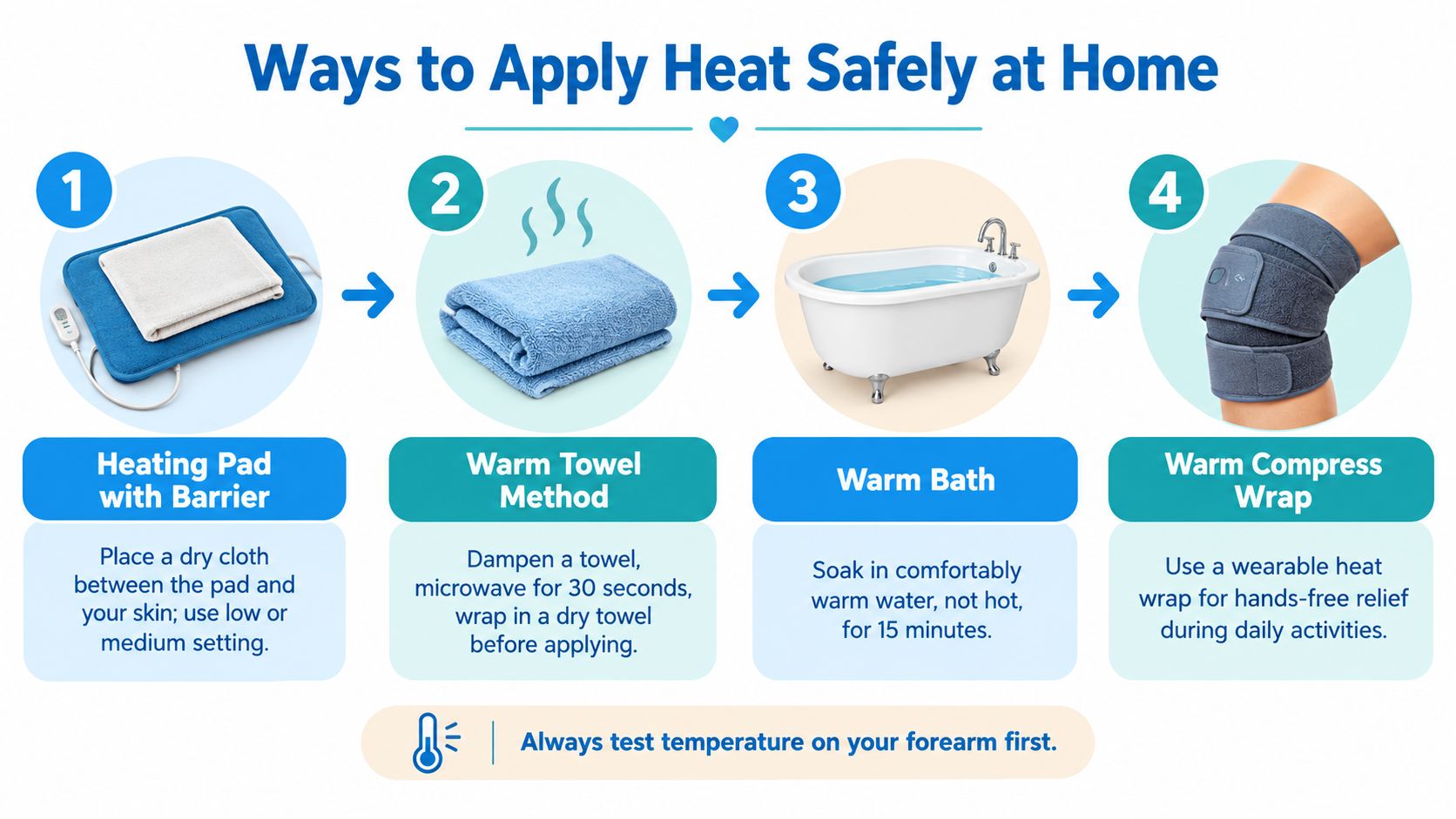
A heating pad is the most obvious option, but it's not the only one. The goal is simple warmth, applied long enough to relax the area, but not so much that the skin gets irritated. For many, 15 to 30 minutes is the practical range seen in clinical use.
Start with the easiest method
A heating pad with a cloth barrier is a solid starting point. Put a dry towel or thin cloth between the pad and your skin, keep the setting low or medium, and check the area often. That's useful before a walk, after sitting, or when the knee feels stiff in the evening.
A warm towel works too. A damp towel can be warmed briefly, then wrapped in a dry towel before being placed over the knee. It's simple, cheap, and easy to control.
Use warmth where it fits your day
A warm shower or bath can loosen up the joint before stretching or light movement. The water should feel comfortably warm, not hot enough to flush the skin or make the joint throb. If you notice more swelling afterward, that's a sign to back off.
A wearable heat wrap or infrared-responsive sleeve can be useful when you want gentle warmth while reading, doing chores, or heading out for a short walk. The point isn't to squeeze the joint hard, it's to support comfort without the bulk of a heating pad. If you're comparing options, guide to home care for seniors can be helpful context for older adults who need simple, low-effort routines.
Video guidance on practical heat use can also help if you're more of a visual learner.
If you're looking at a wearable specifically, heat wraps for legs is relevant because many readers want something they can use during normal movement rather than lying down.
Warm enough means you notice it, but you don't have to endure it.
As for timing, use heat before movement when stiffness is the main issue, or once or twice daily when the goal is comfort. If it's turning the skin bright red or making the knee feel more irritated, that's not the right dose.
What the Research Actually Shows
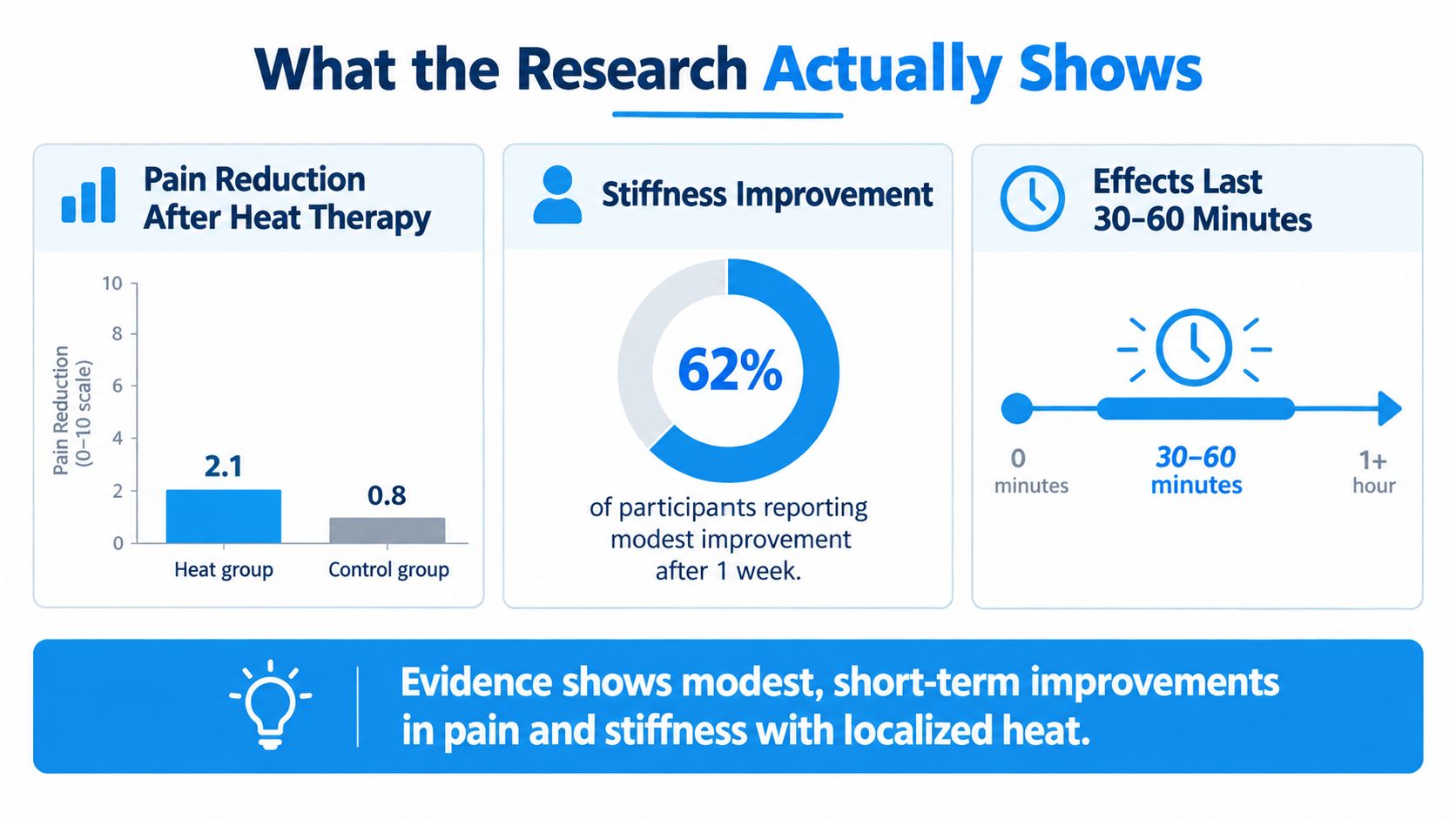
Research on heat for knee osteoarthritis points to modest, short-term relief. That wording matters. Heat can make a stiff knee feel more workable for a while, much like loosening a tight hinge before you open a door, but it does not act like a reset button for the joint itself.
In randomized studies, local heat has helped with stiffness, comfort, and sometimes function over short treatment periods. The changes are usually limited rather than dramatic. A review summarized pain improvement as less than 1 point on a 10-point scale, which is a useful reminder to expect a small nudge, not a major shift.
Head-to-head studies don't make heat look magical
Direct comparisons are mixed. Some trials found heat outperforming a comparison device on a single measure such as knee flexion. Other studies found heat and cold leading to similarly small improvements. That fits real life more than marketing does. If your knee is stiff and achy, heat may be the better pick. If it feels hot, puffy, or newly irritated, cold often makes more sense.
That symptom-based choice is the practical takeaway. Heat works best as a comfort and mobility aid. It can help you get started with gentle movement, make a walk feel easier to begin, or settle a tight knee later in the day. It should not be presented as something that changes the underlying disease process.
Marketing can run ahead of evidence
People get misled here. Claims about infrared fabrics, heated braces, or “clinical” effects often sound more precise than the evidence behind them. To support a specific claim, the exact product would need to be tested in the same kind of patients, at a similar temperature, for a similar wear time.
Guidelines have reflected that caution. The Australian guideline for knee and hip osteoarthritis describes the evidence for heat therapy as very low, while still treating local hot packs as a reasonable self-management option. That is a careful, balanced position.
If you are comparing infrared-specific products, this overview of infrared light therapy for knee pain explains where those claims fit, and where they can run ahead of the research.
Safety Rules Everyone Should Follow
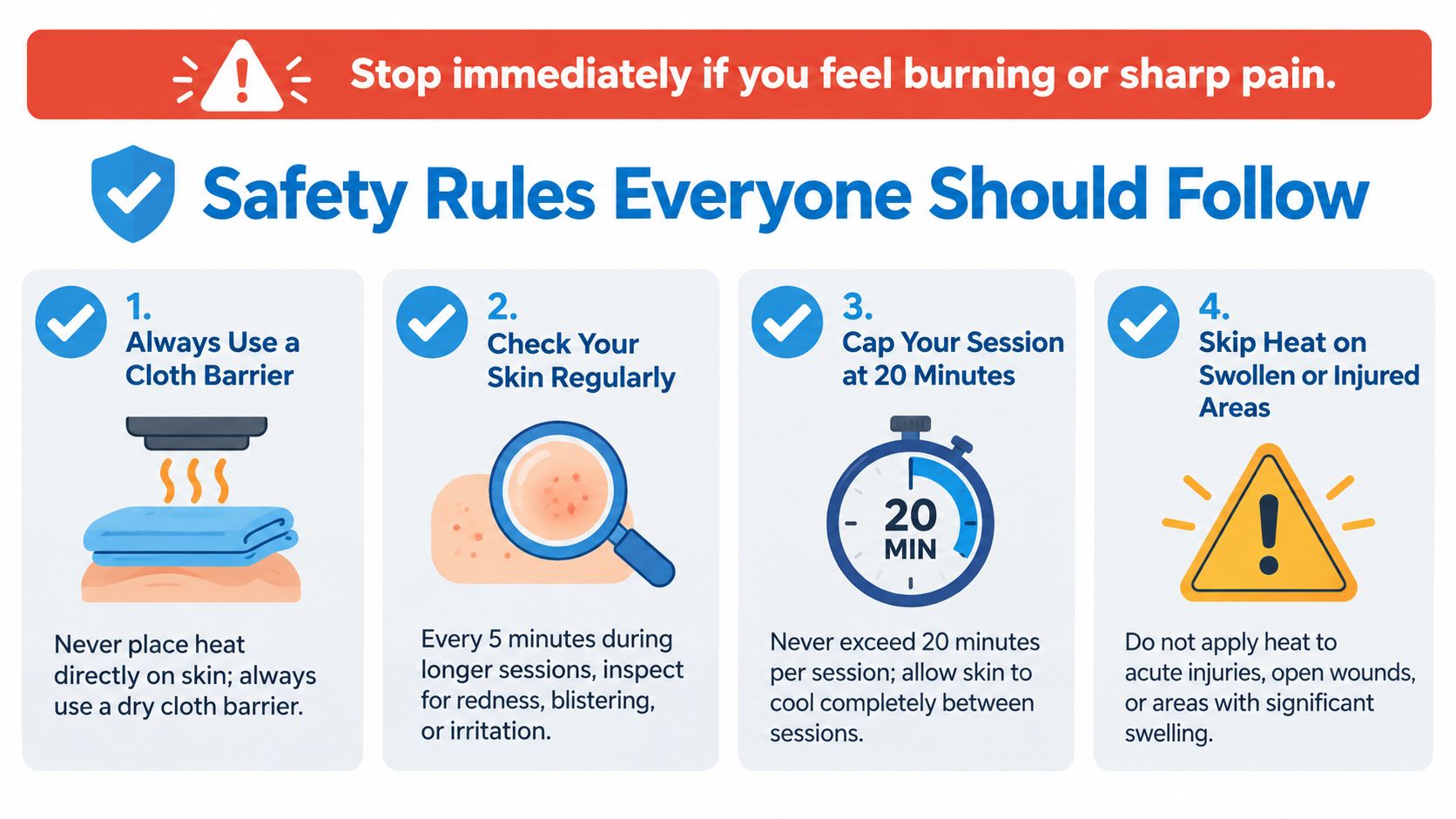
Heat feels gentle, but it can still burn skin. The safest setup is a cloth barrier, a limited session, and regular checks, especially if you're using a pad or wrap longer than a few minutes. Never assume that comfort equals safety.
Who needs extra caution
Older adults with thinner skin should be careful. So should people with diabetes, neuropathy, reduced sensation, or any condition that dulls thermal feedback. If you can't reliably feel when something is too hot, you can't safely judge a heat source by sensation alone.
Certain situations are a hard no for home heat. Don't use it on open wounds, active infection, a knee that's hot and red, or a freshly injured area that hasn't been assessed. If you've had recent surgery, follow the surgeon's guidance instead of improvising.
A few situations also deserve a clinician's input before you keep using heat, especially when symptoms keep changing or you're not sure what caused them. The same is true if the knee is becoming more swollen or more painful instead of less.
A simple home rule
- Use a barrier: Never place heat directly on skin.
- Check often: Look at the skin during the session, not just after it ends.
- Keep it brief: Don't keep adding time because it feels nice.
- Stop for irritation: Burning, sharp pain, or unusual redness means stop.
For people who want more detail on device-related irritation, infrared therapy side effects is worth a look.
If careful home treatment isn't helping within a week, that's a sign to get a professional evaluation. Pain that lingers usually deserves a better explanation than “maybe it just needs more heat.”
A Realistic Routine You Can Start This Week
If your knee feels stiff when you get out of bed, start with a short warm shower or warm compress. Follow it with gentle mobility movements while the joint still feels easier to move. Warmth can open the door to movement, while movement helps maintain that temporary looseness.
Keep the evening routine symptom-based. After a day of activity, a 15 to 20 minute heating-pad session can be reasonable if the knee feels achy and stiff rather than hot or swollen. Then take a short walk around the room or house. A smoother, easier walk suggests that warmth is supporting movement. If the knee feels hotter, more swollen, or more painful, choose cold instead and reassess what is driving the symptoms.
A sleeve with light compression and infrared-responsive material can provide gentle warmth during a walk, errands, or light gym work. It may suit people who want hands-free support without a bulky pad or tight compression. Thermo Recovery Wear offers this type of wearable knee support for daily use.
Two assumptions to drop
More heat does not automatically mean more relief. Once the skin feels comfortably warm, extra time or intensity can add irritation without adding benefit. Use the least heat that helps you move comfortably.
A costly infrared garment does not automatically outperform a basic warm compress. Careful use of warmth matters more than product claims. If a device helps movement and leaves the skin comfortable, it may be a practical fit.
Build the routine around the knee's response: warmth for stiffness, cold for heat and swelling, and movement for maintaining mobility. Heat works best alongside activity, weight management when relevant, and medical care when symptoms extend beyond simple stiffness. If stiffness persists, guided in-home recovery sessions Dubai can provide professional support beyond what home heat alone delivers.
Frequently Asked Questions About Heat and Knee Pain
How long should I use heat before a workout? Usually just long enough to loosen the joint, then move. If the knee feels better after a short session, don't keep reheating it.
Can I use heat before bed? Yes, if the knee is stiff and not swollen. Keep it comfortable, not intense, so you relax instead of waking up irritated.
Can I combine heat with topical pain creams? Sometimes, but be cautious. Heat can increase skin absorption, so don't layer products blindly, especially if the skin is sensitive.
What if my knee suddenly becomes hot and swollen? Stop heat, switch to cold, and get checked if it doesn't settle or if the change is dramatic.
If you're trying to sort out whether a warm sleeve, a simple compress, or a more wearable support fits your routine, visit Thermo Recovery Wear. Their knee sleeves are designed for gentle warmth and light daily wear, which makes them a practical option for people who want comfort without tight compression.


