


You pause at the stairs with a laundry basket, wondering whether your knee will complain again. A walk that used to clear your head now involves deciding how far you can comfortably go. Searching for a sleeve for knee discomfort seems like a practical next step, but the choices quickly become confusing: compression, infrared-responsive fabric, open kneecaps, and braces that look nothing alike.
Table of Contents
- Why a Knee Sleeve May Be on Your Radar
- Understanding What a Knee Sleeve Does
- Comparing Knee Sleeve Types and Design Choices
- What the Clinical Evidence Actually Shows
- Choosing When to Wear a Knee Sleeve
- Real-World Uses for Different Knee Sleeves
- Getting the Fit Right and Monitoring Wear
- A Smarter Buying and Care Checklist
Why a Knee Sleeve May Be on Your Radar
Knee discomfort can change ordinary decisions before it stops an activity altogether. You might choose a shorter shopping trip, avoid kneeling in the garden, or hesitate before standing from a low chair. Wanting something comfortable to wear during those moments is understandable.
Osteoarthritis helps explain why knee supports attract so much attention. The World Health Organization's osteoarthritis overview estimates that 528 million people worldwide have osteoarthritis, including 365 million with knee osteoarthritis, and describes symptoms such as pain, stiffness, swelling, and reduced mobility. Those figures establish the scale of the problem, not the effectiveness of any particular garment.
Start With the Problem You're Trying to Solve
Not every painful knee has osteoarthritis, and not every person with osteoarthritis needs a sleeve. A familiar ache during walking presents a different decision from pain that began after a fall. The useful starting question isn't which product looks most supportive, but what's happening when your knee bothers you.
- Name the activity. Is discomfort interrupting walking, household tasks, light exercise, or rest?
- Describe the experience. Aching, swelling, giving way, and restricted movement aren't interchangeable complaints.
- Set a modest goal. You might want a walk to feel more comfortable, rather than expect a garment to resolve the condition causing pain.
A sleeve belongs in a wider conversation about movement, rehabilitation, and appropriate medical care. Its value depends on the design, fit, intended activity, and your health circumstances, not whether it feels firm when you pull it on.
Practical rule: Choose a support tool for a defined job, not as a substitute for understanding persistent knee pain.
Understanding What a Knee Sleeve Does
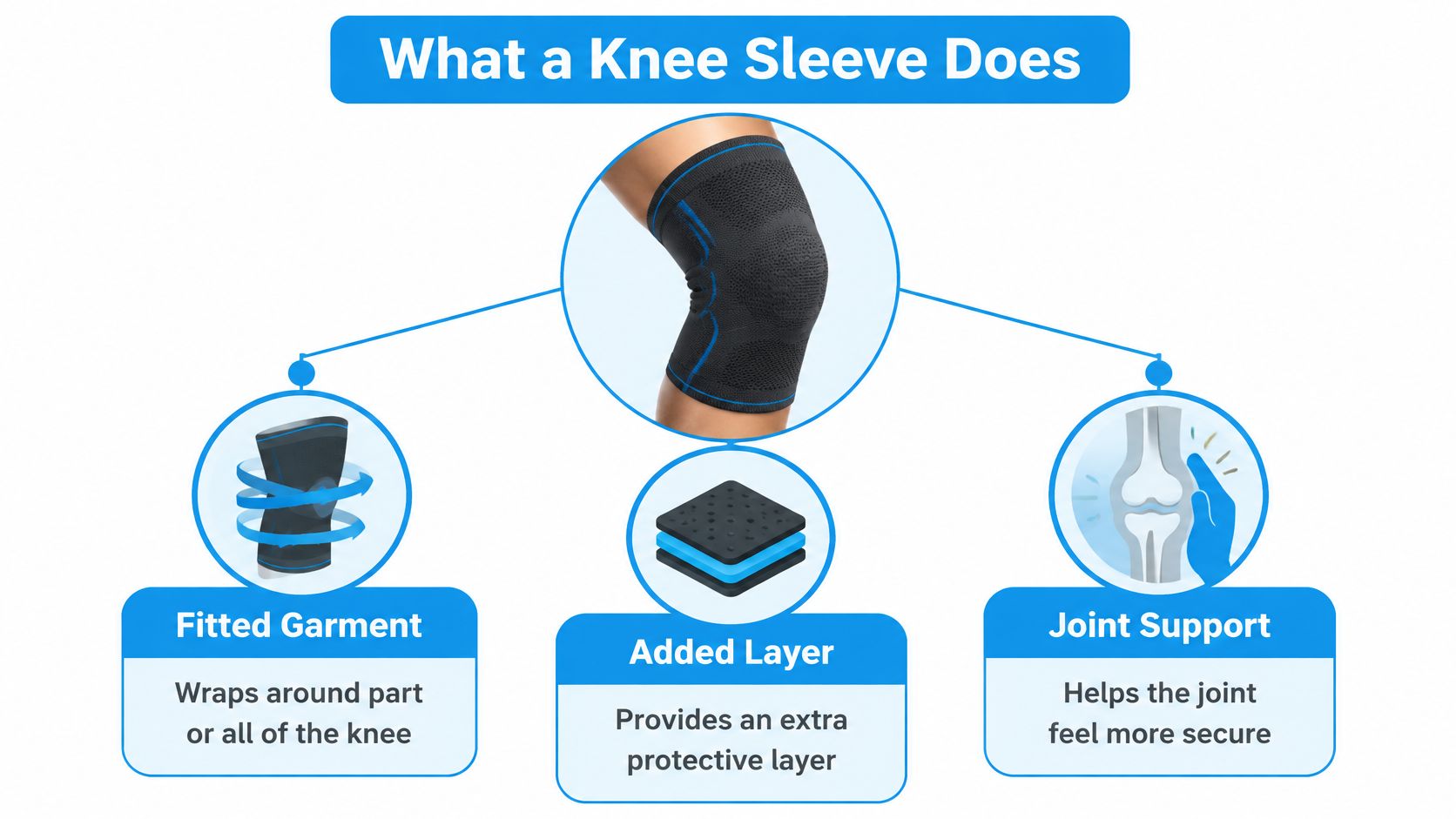
A knee sleeve is a fitted garment that surrounds part or all of the knee. Think of it as an added layer, somewhat like a light wrap. It can change how the knee feels during movement without replacing the muscles that move it or the clinical care needed to assess a problem.
The basic functions are easier to separate visually.
Separate Sensation From Structural Support
The word support can mean different things. Someone may say a sleeve feels supportive because the fabric makes the joint feel more secure. That isn't the same as a structured device designed to influence loading or control movement.
Likewise, warmth, comfort, and confidence aren't interchangeable with healing. A comfortable garment may make an activity feel more manageable, but that experience alone doesn't show that cartilage has changed or an injury has recovered.
- Comfort describes your experience. The garment feels pleasant or makes movement less distracting.
- Mechanical tension describes construction. Elastic material applies pressure around the knee.
- Treatment describes a clinical purpose. That requires evidence appropriate to the condition and the intervention.
Understand the Different Technology Pathways
Conventional elastic sleeves use stretch and mechanical tension. Their fit matters because the pressure comes from how the material sits around the leg.
Non-compressive sleeves aim to provide coverage without the same squeezing sensation. Some are simple garments without a special heat-related claim. Others use infrared-responsive textiles, with manufacturers describing a mechanism intended to support warmth or local blood flow.
These are different approaches, not stronger and weaker versions of the same product. A person who dislikes pressure may prefer a non-compressive design, while someone seeking an elastic wrap sensation may prefer compression.
The important distinction is between what a garment is designed to do and what clinical research has demonstrated. A technology description can help you understand construction. It can't, on its own, establish pain relief, improved function, or suitability for your particular knee.
Comparing Knee Sleeve Types and Design Choices
Start by comparing the job each design is intended to perform. A soft sleeve, a non-compressive recovery garment, and an unloader brace shouldn't be treated as interchangeable purchases because they all sit around the knee.
The difference between a knee brace and a knee sleeve is a useful starting point when product names blur those categories. Look beyond the label to the actual construction and intended use.
Knee Sleeve Options at a Glance
| Type | Design Approach | Typical Role | Fit Priority | Key Consideration |
|---|---|---|---|---|
| Soft compression sleeve | Elastic material applies mechanical tension | Perceived support during suitable activity | Even tension without painful edges | More pressure isn't automatically more helpful |
| Non-compressive infrared-responsive sleeve | Fabric incorporates an infrared-responsive mechanism without intended squeezing | Recovery-garment use during rest or light activity | Comfortable contact without restriction | Product claims need their own supporting evidence |
| Non-compressive sleeve without an added heat mechanism | Coverage without deliberate compression or a specialized heat claim | Routine garment comfort | Freedom of movement and stable placement | Don't assume it reproduces elastic-sleeve study results |
| Open-patella sleeve | An opening leaves the kneecap area uncovered | An alternative coverage preference | Opening alignment and comfortable edges | An opening alone doesn't establish a medical advantage |
| Structured brace or unloader-style support | More structured support intended for a specific mechanical purpose | Clinician-directed support for selected problems | Correct alignment and appropriate adjustment | It answers a different question from a comfort garment |
Pressure, Coverage, and Bulk Are Separate Choices
Consider how the garment will work during the activity you plan to do. Can you bend comfortably? Does it fit beneath your usual clothing? Does the fabric gather behind the knee when you sit?
Those questions are more useful than assuming a bulkier product must work better. Similarly, an open-patella design changes coverage around the kneecap, but that feature doesn't tell you how much pressure the rest of the garment applies.
Thermo Recovery Wear provides a commercial example of the non-compressive, infrared-responsive approach. The company describes its knee recovery garments as semiconductor-embedded products intended to increase local blood flow and warmth during rest or light activity. That's the manufacturer's description of its intended mechanism, not proof that every infrared-responsive sleeve provides the benefits observed in elastic-sleeve trials.
- If pressure is your main concern, compare compressive and non-compressive construction first.
- If movement feels unstable, seek advice about the appropriate support rather than choosing by fabric alone.
- If warmth is the attraction, check whether the seller is describing ordinary coverage, a specialized textile mechanism, or a demonstrated clinical outcome.
No category deserves automatic medical superiority. The right comparison depends on what you need the garment to do.
What the Clinical Evidence Actually Shows
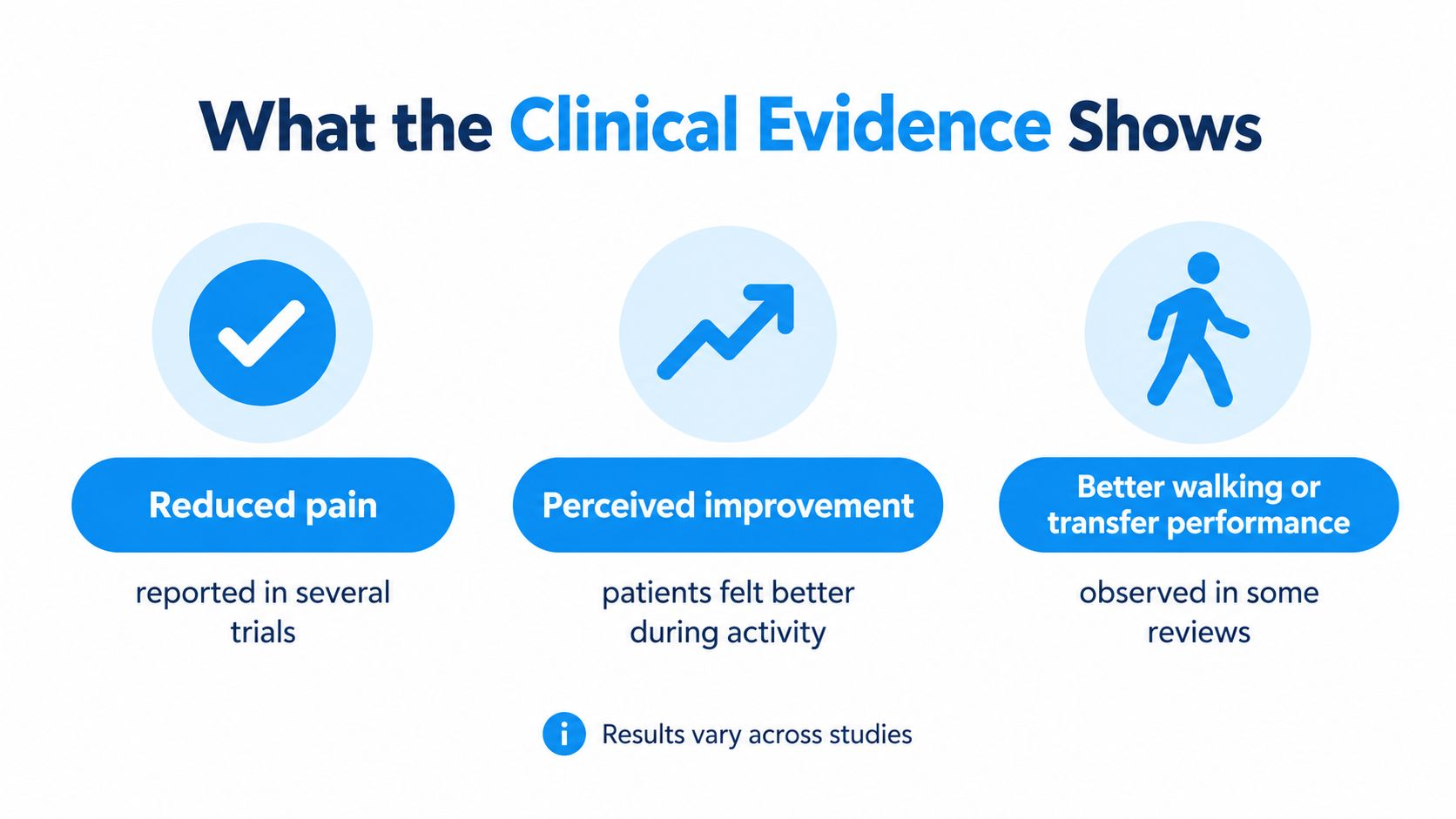
Research supports a cautious conclusion: some people with knee osteoarthritis experience symptom or mobility benefits while wearing a soft sleeve, but results vary across studies and tasks. That's more useful than either promising universal relief or dismissing sleeves entirely.
This visual summarizes the kinds of benefits reported, with an important qualification.
Pain Relief Doesn't Mean Every Outcome Improves
An American Academy of Family Physicians review of knee osteoarthritis supports summarizes a randomized trial involving 119 people with knee osteoarthritis and varus deformity: both neoprene sleeves and unloader braces improved pain and function compared with usual care, with greater benefit from the unloader brace.
Other evidence is less clear-cut. A placebo-sleeve comparison described in the clinical evidence found improvement from baseline with the active sleeve, but not a statistically significant difference between groups. Feeling better after starting a product doesn't necessarily establish that its special feature caused the improvement.
Task-specific results are particularly instructive. In a randomized crossover study involving 74 people and 132 affected knees, an elastic sleeve reduced immediate self-reported pain and improved walking and Timed Up and Go performance, but didn't significantly improve stair-climb power.
Laboratory Changes Have Limits
A biomechanical study of 18 adults with medial knee osteoarthritis found that an elastic sleeve reduced the first peak knee-adduction moment by 10.1% and positive knee-adduction impulse by 12.9% during walking. These measures help researchers examine loading associated with the knee's medial compartment.
That's evidence of an immediate mechanical effect under laboratory conditions. It isn't proof that a sleeve slows structural osteoarthritis progression or produces lasting clinical improvement.
An immediate change in pain or walking mechanics is a useful finding, but it isn't the same as evidence of long-term disease modification.
The mechanical findings also provide a sensible engineering reason to care about consistent positioning and elastic recovery. A sleeve that slips or develops uneven tension may not reproduce the fit used during testing.
Match the Evidence to the Product
The broader evidence includes subjective improvement alongside uncertainty about disability outcomes. It also doesn't establish that warmth explains the benefits of elastic sleeves.
For anyone exploring knee pain relief without surgery, the appropriate question is where a garment fits within a care plan. Evidence about an elastic sleeve can't automatically validate an infrared-responsive textile, a different construction, or a brand-specific relief claim.
Choosing When to Wear a Knee Sleeve
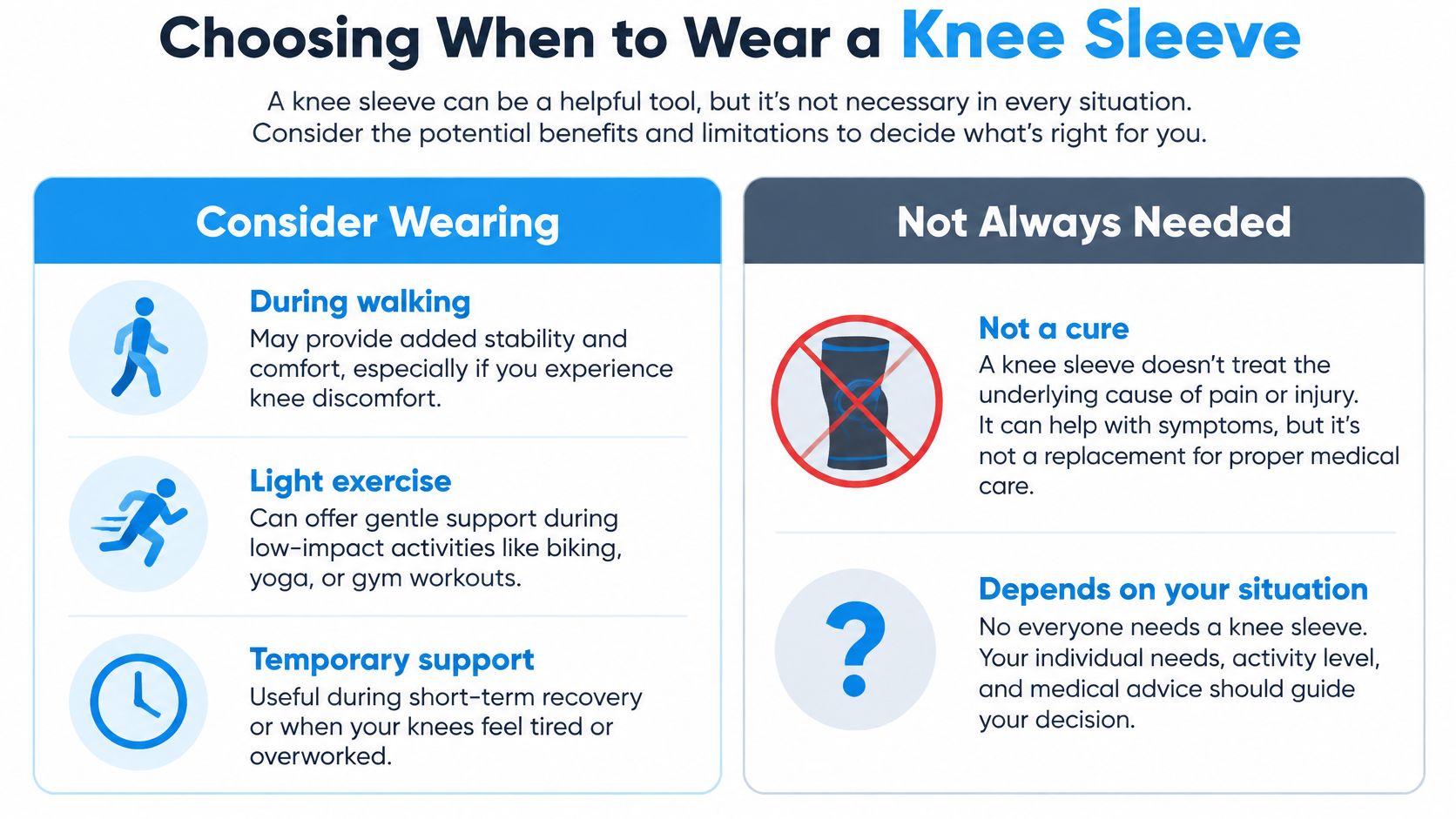
Choose a wearing occasion before choosing a wearing schedule. “During the walk that tends to bother my knee” is a clearer purpose than “all day because my knee hurts.” A defined occasion lets you judge whether the garment helps with the activity that matters.
The decision is conditional, not universal.
Use Support to Enable Appropriate Movement
A clinical evidence review and orthosis guidance describes qualified benefits from soft bracing and emphasizes exercise as a primary treatment. It also summarizes conditional brace recommendations when instability or abnormal loading is present, exercise is ineffective or unsuitable without an aid, and the device is likely to improve movement.
For someone managing an established diagnosis, a sleeve may be an adjunct during walking, light exercise, or a familiar flare. It doesn't build strength, correct the underlying cause, or replace progressive exercise. Exercise therapy, load management, weight management when appropriate, and prescribed treatment remain separate parts of care.
Different difficulties may call for different tools:
- Comfort during familiar activity. A suitable sleeve may be worth discussing or trying cautiously.
- Instability or abnormal loading. A clinician may consider a more structured brace rather than a generic soft garment.
- Difficulty moving safely. Ask whether a cane or another walking aid would address the actual problem more directly.
Know When a Sleeve Isn't the Next Step
New or unexplained symptoms deserve assessment rather than an experiment with tighter compression or longer wear. Don't assume an old osteoarthritis diagnosis explains every new change.
- After new trauma, have the injury assessed instead of using support to push through it.
- With marked swelling, locking, or giving way, seek medical advice about the cause and suitable activity.
- With calf swelling or neurological symptoms, such as new numbness or altered sensation, seek prompt assessment rather than relying on a garment.
A familiar ache that settles with your established plan is different from a knee that suddenly behaves differently. If symptoms persist, worsen, or remain unexplained, arrange clinical review.
The practical goal is to preserve appropriate movement, not to tolerate progressively more pain because a sleeve makes you feel protected. Confidence is useful only when it remains connected to what your knee can safely do.
Real-World Uses for Different Knee Sleeves
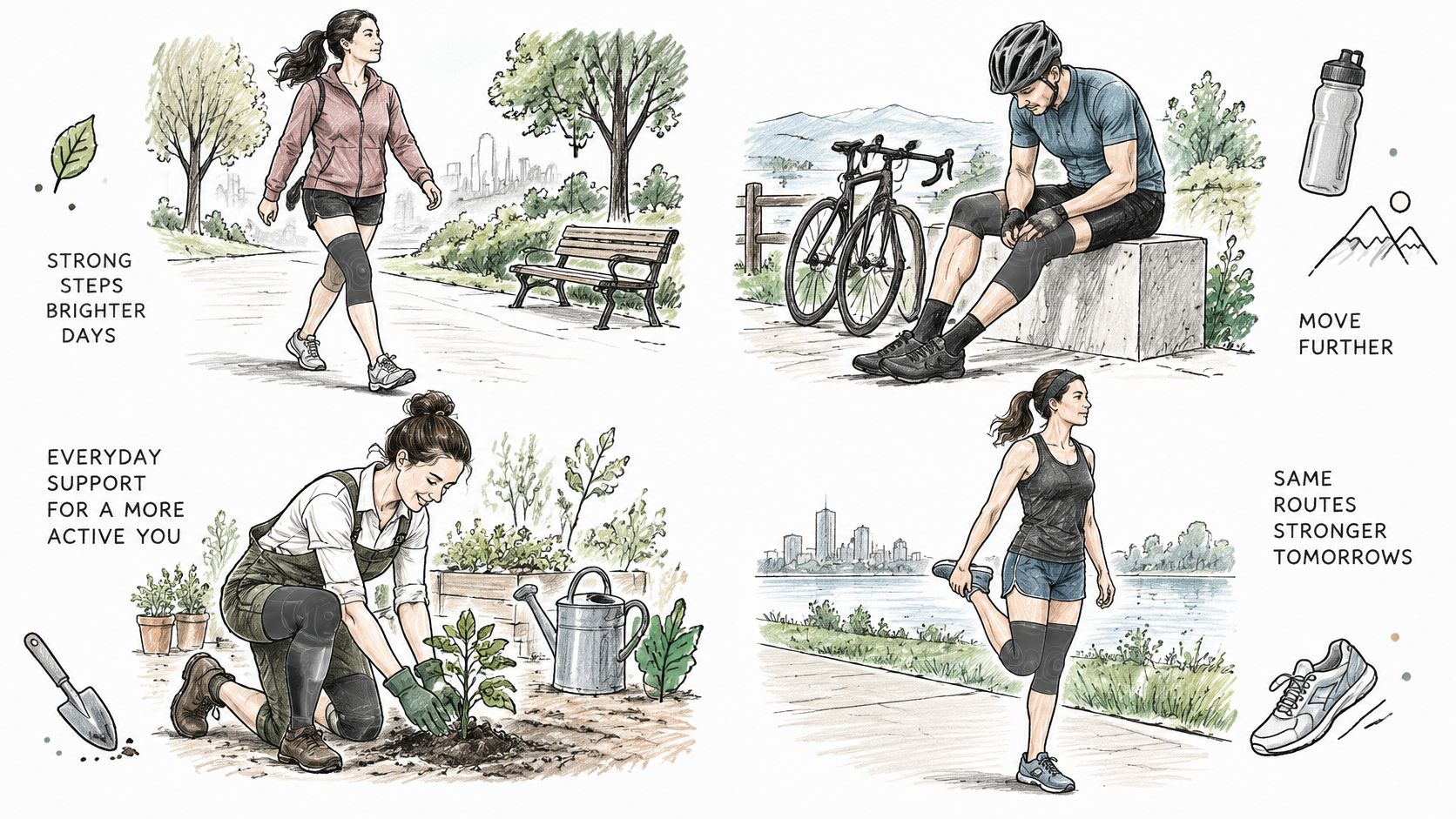
Everyday routines reveal differences that product photographs can hide. Sitting to read, walking outdoors, and bending over a garden bed each create a different test of comfort and placement.
These examples show varied activities, not a recommendation that every pictured activity suits every painful knee.
Different Routines, Different Priorities
During a familiar walk, someone might consider an elastic sleeve because they prefer a light wrap sensation. The meaningful comparison is how that usual route feels with a properly fitted garment, not whether wearing it makes them willing to suddenly walk much farther.
While resting at home, someone who dislikes tight pressure may prefer a non-compressive infrared-responsive option. Their reason for choosing it might be pressure tolerance and interest in the manufacturer's warmth-related design, rather than an expectation that it works like an elastic sleeve.
- For routine household wear, a non-compressive garment without a specialized heat claim may appeal to someone who wants comfortable coverage. Check sitting and bending, not just standing.
- For kneecap-area coverage preferences, an open-patella sleeve may appeal to someone who wants that area uncovered. Judge the opening's position and edge comfort rather than assuming therapeutic superiority.
Don't Copy Someone Else's Schedule
Work, exercise, household tasks, and sleep aren't equivalent wearing conditions. A garment that feels unobtrusive while reading may bunch during repeated bending, and comfortable daytime wear doesn't establish suitability for sleeping in it.
Cycling introduces its own repetitive movement demands. If that's your concern, consider the activity-specific questions raised in this guide to knee pain while cycling, rather than transferring a walking routine unchanged.
For another visual resource on the topic, the following video can complement the practical examples.
Your useful comparison is symptom, fit, and activity. Someone else's favorite recovery garment or brace may answer a different need altogether.
Getting the Fit Right and Monitoring Wear
Fit isn't finished when you select a size. You also need to know what happens when you sit, bend, walk, become warm, or develop swelling during the day.
Cleveland Clinic's knee-brace guidance says a sleeve should feel snug and secure without being painful or tight enough to interfere with circulation; a cautious wear trial includes checking skin and symptoms after 15–30 minutes, after activity, and after removal. That's a monitoring routine, not a universal prescription for how long everyone should wear a sleeve.
Measure for the Actual Garment
Use the seller's measurement locations and sizing instructions rather than guessing from your usual clothing size. A knee sleeve sizing chart provides the product-specific reference you need before ordering.
If translating body dimensions into garment shape feels abstract, Robosize offers a resource to help visualize garment fit from measurements. Use it as a general visualization aid, not as a substitute for knee-specific measurements or a clinical fitting.
- Before movement, smooth the garment and check that its edges aren't folded into a tight band.
- During your trial, sit, stand, and perform the intended activity gently. Notice slipping, bunching, and pressure behind the knee.
- After removal, examine the skin and compare how the knee and lower leg feel with your starting point.
Treat Symptoms as Stop Signals
Loosen or stop wearing the garment if you develop numbness, tingling, discoloration, increased swelling, or worsening pain. Don't dismiss these changes as a necessary adjustment period. If they persist or concern you, seek medical advice.
Heat and sweat also deserve attention, even when they aren't painful. A comfortable first impression doesn't account for everything that can happen during extended wear, especially if an edge rolls or fabric gathers.
Fit check: Secure placement is the goal. Enduring pressure, skin irritation, or altered sensation isn't evidence that a sleeve is working.
People with vascular disease, neuropathy, unexplained swelling, fragile skin, or significant skin sensitivity should seek clinician advice before prolonged use. A non-compressive label doesn't remove the need to check contact, seams, edges, and skin response.
Care for the Garment You Bought
Follow the manufacturer's laundering and drying instructions instead of borrowing instructions from another sleeve. After cleaning, inspect its shape, seams, and edges before wearing it again.
Mechanical fit and infrared responsiveness are separate questions. A textile's technology claim doesn't tell you whether its size, condition, or placement is right for your leg.
A Smarter Buying and Care Checklist
A useful purchase starts with a clear purpose and realistic expectations. Before ordering, make sure you can explain why you're choosing that design instead of picking the strongest-sounding claim.
Check the Details That Affect Daily Use
- Define the job. Identify the activity or comfort problem you want to address.
- Choose the pressure approach. Compare compression with non-compressive construction according to tolerance and purpose.
- Read the mechanism carefully. Distinguish ordinary coverage from an infrared-responsive claim and from demonstrated clinical benefit.
- Verify sizing and materials. Check measurement guidance, fabric information, and possible skin concerns.
- Plan garment care. Use the retailer's dedicated instructions for how to wash knee sleeves, alongside the product label.
- Review purchase support. Confirm shipping eligibility, return conditions, and how to ask fitting questions before placing an order.
The publisher provides sizing and care resources, along with inventory, shipping, returns, and text-support information. Those details can help you plan a purchase, but they don't establish whether a garment is medically appropriate.
The most useful sleeve is one you can wear safely for its intended activity, with a clear understanding of its limits. If the decision is being driven by unexplained symptoms rather than a defined comfort need, arrange an assessment first.
Thermo Recovery Wear offers non-compressive, infrared-responsive knee recovery garments intended for rest or light activity, an option to compare if you prefer to avoid squeezing pressure. Visit Thermo Recovery Wear to review sizing and care guidance, U.S.-based inventory, free shipping on orders of $49 or more, a 30-day return window, and text support at 855-640-8844 from 9 a.m. to 5 p.m. EST before deciding whether its approach suits your needs.


